
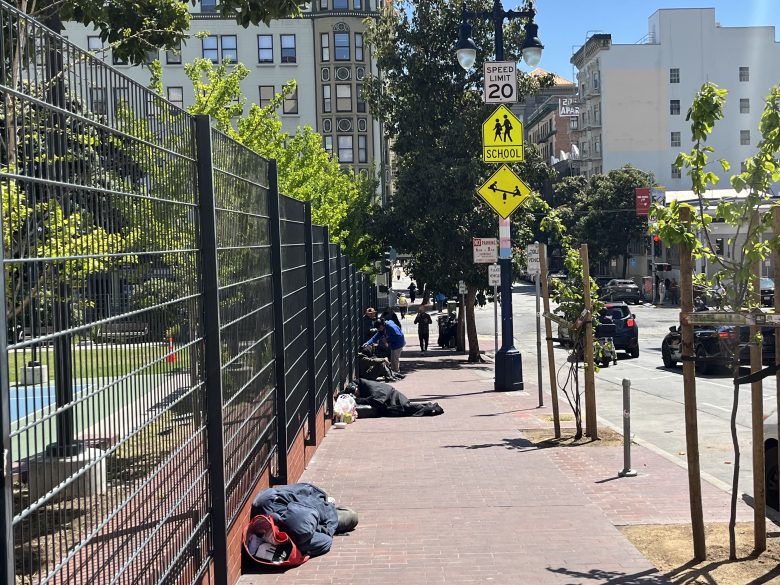

In what is known to many as San Francisco’s seediest neighborhood, there’s a new consensus: Quality of life has improved in the Tenderloin since the doldrums of 2021 to 2022, when street conditions were so horrible that the neighborhood became a national punching bag for conservative media.
Resident-driven organizing has helped prevent overdose deaths and brought out safety ambassadors to nearly every corner. A handful of new and exciting restaurants have also arrived, some drawing long lines of customers.
Crime is down, and residents say that the streets are more clear and less beset by open-air drug dealing than they were a few years ago.
Still, the Tenderloin is struggling to avoid empty storefronts. At the beginning of 2024, the neighborhood had more vacant storefronts (some 151 in all) than it had restaurants, cafes, or nonprofits. Vacancies were up 29 percent from 2021.
The types of new businesses are also limited: Four new bars and five new smoke shops opened up between 2021 and 2024, continuing a years-long trend of such spots dominating the neighborhood, according to data collected by the Tenderloin Community Benefit District.
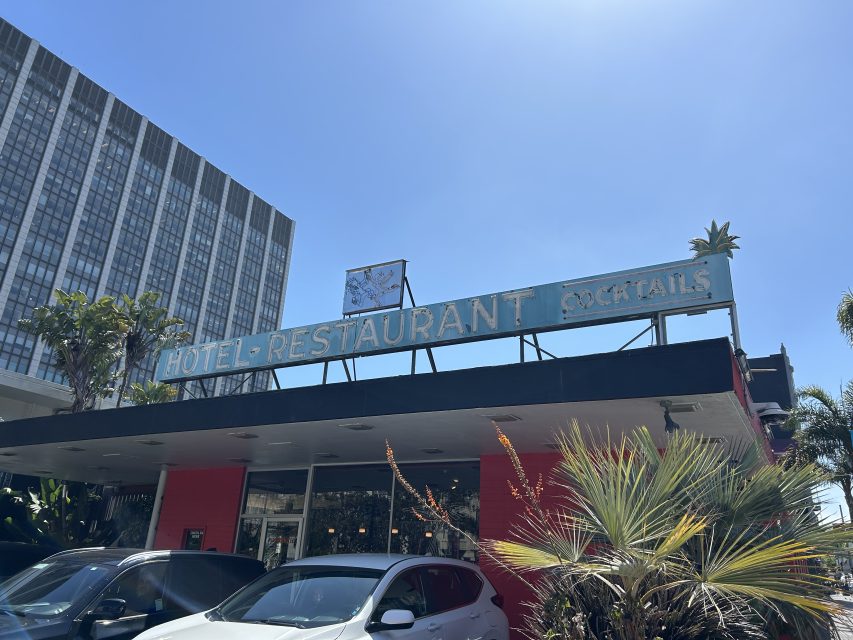
And businesses that rely on tourism, like hotels and theaters, say the turnaround has passed them by. They have it worse than ever.
“COVID shattered the reputation of our area,” Jamie Flanagan, a partial owner of the Phoenix Hotel and Chamber Bar, said.
While Tenderloin business owners and residents are starting to see the results of earlier demands to clean up the streets after the pandemic and exit of daytime workers from the Mid-Market area, the neighborhood’s reputation lingers.
Reputational crisis
There’s a story that Rob Ready, a former Tenderloin business owner, tells.
In 2022, then-Mayor London Breed opened up the Tenderloin Linkage Center at UN Plaza, which, for 12 hours a day, provided showers, laundry, social services and drug-use sites for people experiencing homelessness.
It was the same year that theaters along Market Street and in the Tenderloin were opening back up after the pandemic, begging out-of-town patrons to visit.
When the venues opened their doors each evening, the Tenderloin Center closed its own, and theatergoers from the suburbs encountered drug users with no place to go. They often didn’t come back.
It was poor city planning that Ready says hurt a lot of entertainment spots like his own, PianoFight, located on a street that includes the Warfield and Golden Gate Theater. They were a few blocks away from the Tenderloin Center.
The Warfield and Golden Gate survived. PianoFight did not, and closed in January 2023. There were lots of reasons why, Ready says, but the city’s approach did not help. “You had a bunch of policies that added up to an alchemy of shit.”
Bars and theaters are bedfellows: A thriving venue scene can produce a surge of out-of-town customers who will look for a place to grab a nightcap or a hotel room to crash in. Theaters on Market Street, and smaller venues up Taylor Street and Mason Street, support bars scattered across the east side of the Tenderloin. But when patrons forego shows or hesitate to venture out at night, business suffers.
“People just don’t want to come down here,” said Sophilya Leggz, a drag queen who performs at Aunt’s Charlie’s Lounge on Turk Street. The bar got a large portion of its customer base from theatergoers until the pandemic.
2022 was a turning point
In 2022, a crew of business owners and managers decided they had had enough. The group, which included PianoFight’s Ready and the Phoenix Hotel’s Flanagan, swore off paying their taxes until the city committed to fixing the neighborhood, particularly the open-air drug market.
The group formed the Tenderloin Business Coalition, which circulated a petition to demand that the city crack down on the drug market and protect businesses in the neighborhood. A group of residents and hoteliers later filed a lawsuit against the city in response to conditions in the Tenderloin.
The actions led to the creation of the Drug Market Agency Coordination Center, a city-wide task force that created a sense of urgency and enforcement in closing open air drug markets. Street conditions have improved significantly since 2022, business owners agree.
But the Tenderloin Business Coalition couldn’t work fast enough to save PianoFight. And in June, the Phoenix Hotel also announced that it would permanently close at the beginning of 2026, leaving its 38,000-square-foot building vacant.
“Water goes into cracks. Every time you lose a business,” Ready said, there’s a risk the area starts hosting drug dealing and loitering. The Civic Center Inn, for instance, has been abandoned since 2023, and it’s attracted rats, squatters, and piles of trash.

Also in 2022, Elon Musk purchased Twitter, pushed out half the employees by the end of the year, and moved out of the city entirely in 2024. Tech companies had been fleeing nearby Market Street since 2020, and city and federal workers were still remote. Projects meant to thrive with a strong customer base, like La Cocina’s Municipal Marketplace on Golden Gate Avenue, also closed.
‘All you have is your food’
Throughout, however, restaurants and cafes have been a steady presence. They make up the largest portion of storefronts and report dedicated customer bases and a strong sense of community among merchants, as well as a slight increase in patrons.
Tenderloin restaurants are often immigrant-owned and feature unique cuisines, like Yemeni food and Latin-Chinese fusion that can draw customers in from outside the area. Corner stores are also proliferating.
But owners and managers of storefront businesses say that streets stricken with graffiti and trash dissuade customers.
“In the Tenderloin, specifically, all you have is your food. You don’t have a pretty facade,” Rene Colorado, director of the Tenderloin Merchants Association and manager of @tenderloin_eats, said. “That’s produced just incredible food that you can’t get anywhere else.”
Eateries are scattered throughout the Tenderloin, with some concentration on Geary, Larkin and Hyde streets. Hotels, meanwhile, are grouped together at its fringes, towards the north and east.
A smattering of retail stores and other miscellaneous businesses are distributed across the blocks. The storefronts are unassuming and often tucked away. Corner stores and smoke shops have persistent problems with drug dealing and illegal gambling, which prompted three lawsuits from the city attorney earlier this year.
The number of smoke shops in the neighborhood more than doubled between 2021 and 2024, according to data collected by the Tenderloin Community Benefit District.
In contrast, though it has the highest density of children in San Francisco, the Tenderloin has no ice cream shops and no toy stores.
“The investors and people who are looking at this neighborhood only look at it in one way. We need to change that image,” said District 5 Supervisor Bilal Mahmood.
He emphasized the need for “carrot, not stick” legislation that encourages businesses to convert to better serve the community, like a corner liquor store becoming a grocery market.
Mahmood also said the concentration of services for the homeless takes “away space from other types of businesses, small businesses that could be serving the needs of the neighborhood.”
He’s sponsoring a law that would require other districts in San Francisco to open more homeless shelters and treatment facilities, potentially alleviating the stress on the Tenderloin.
For Mahmood, “activations” are a priority, like the recent Eid festival and “I Love Tenderloin Week.” He would like to see more police enforcement in the area, especially when it comes to open-air drug use, a persistent issue.
He also said that City Hall sometimes loses focus on how to support the businesses that already exist in the Tenderloin, instead focusing on opening new ones.
Since the beginning of this year, the Tenderloin has had its own dedicated employee in the Office of Economic and Workforce Development, Noa Kornbluh. One of the office’s priorities for the year is retaining the area’s small businesses.
Today, business owners give different specific answers when asked what immediately needs improving, or what success would look like in the Tenderloin. Some want the streets cleared of graffiti and drug users; others want their customers to feel safe walking around at night.
Seeing success might be as simple as a stroll down Market Street by that theater corridor.
“A metric success would be that we don’t need a police car every time there’s a show,” Mahmood said. “That naturally there’s enough foot traffic in the neighborhood, that there is that sense of safety already.”
When we stop enabling the users and dealers with smoke shops and liquor stores, the open air drug market will disappear. Unfortunately, SF is addicted to the revenue and so we will continue to perpetrate the fraud of hiding the drug dealers and users until 9pm. Every day Urban Alchemy cleans up the same mess from the same people. It’s great for people who don’t live in the area and terrible for clean and sober people who have to live in the Tenderloin.
Urban Alchemy does very little cleaning. Your conflation of Urban Alchemy with the other organizations suggests you read headlines and make comments based on that rather than the time you spend in the neighborhood.
Thanks for reporting
The Tenderloin remains a dumping ground where persons are allowed to act like animals and run around looking for and taking drugs
Persons use the public spaces like they own it
They are selfish
What kind of person would loiter on the sidewalk all day drinking or doing drugs
They are wasting their lives
This city needs to stop allowing and endorsing that
Clean up the mess
Zero drugs , no camping , no dogs running around without leashes , no garbage
And no adults running around like preschoolers
Not sure where or why they think they can act like brainless thugs and idiots 24/7
Where are the jobs in the tenderloin for these persons ?
Get rid of the drugs and the place would autocorrect
The persons are waste products and expect taxpayers to foot their bills
Done with that
Get off your butt and get a job like the rest of us
Welcome persons who want to get better want to help improve their life and contribute
Sad to see so many who have decided to continue to destroy their lives and others
Self accountability
So many wasted lives rotting away
Freeloaders need to move on
Game over
Reputation isn’t the problem; reality is the problem.
Reality requires action. Talk of reputation results in more talk.
Tenderloin is cleaner and the North Mission is now fentanyl central and Ms. Blough could not connect the dots for curious readers?
Could this change be because The Tenderloin is now represented by a conservative D5 supervisor and gets favorable treatment from the Mayor, fentanyl incidence reduced without any of the four pillars?
Meanwhile The North Mission is represented by a D9 dutiful servant of nonprofit oligarchs and public sector labor (who will be hard pressed to put together 6 not to mention 8 votes to move her agenda with this board) welcomes whatever crap Lurie throws over the transom, so long as the politically connected nonprofits city funding addicts get their city cash fixes.
Lurie is going to continue to treat the North Mission like dirt, as Supervisor Fielder has requested. Mahmoud is standing up for the TL and getting results. Walton is standing up for the Bayview to at least try to defend his constituents from the containment zone.
Fielder, in contrast, is keeping a low profile and appears to think that her constituents in the containment zone are privileged and should be celebrate being the doormats for the rest of the city.
The only way the Tenderloin will turn around is by shutting down most of the “services” that act as a magnet for junkies and the severely mentally ill. Of course the neighborhood will go to hell when you bring in hundreds (thousands?) of disturbed people who have been run out of every other town in America.