

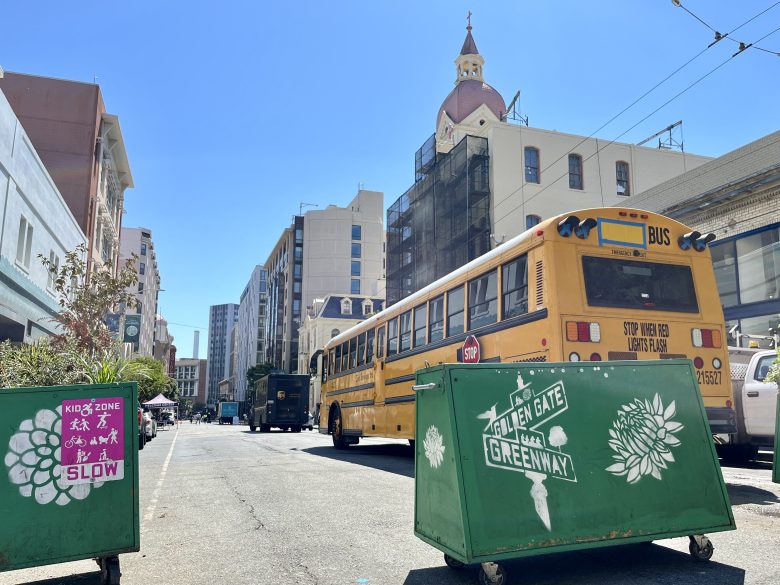
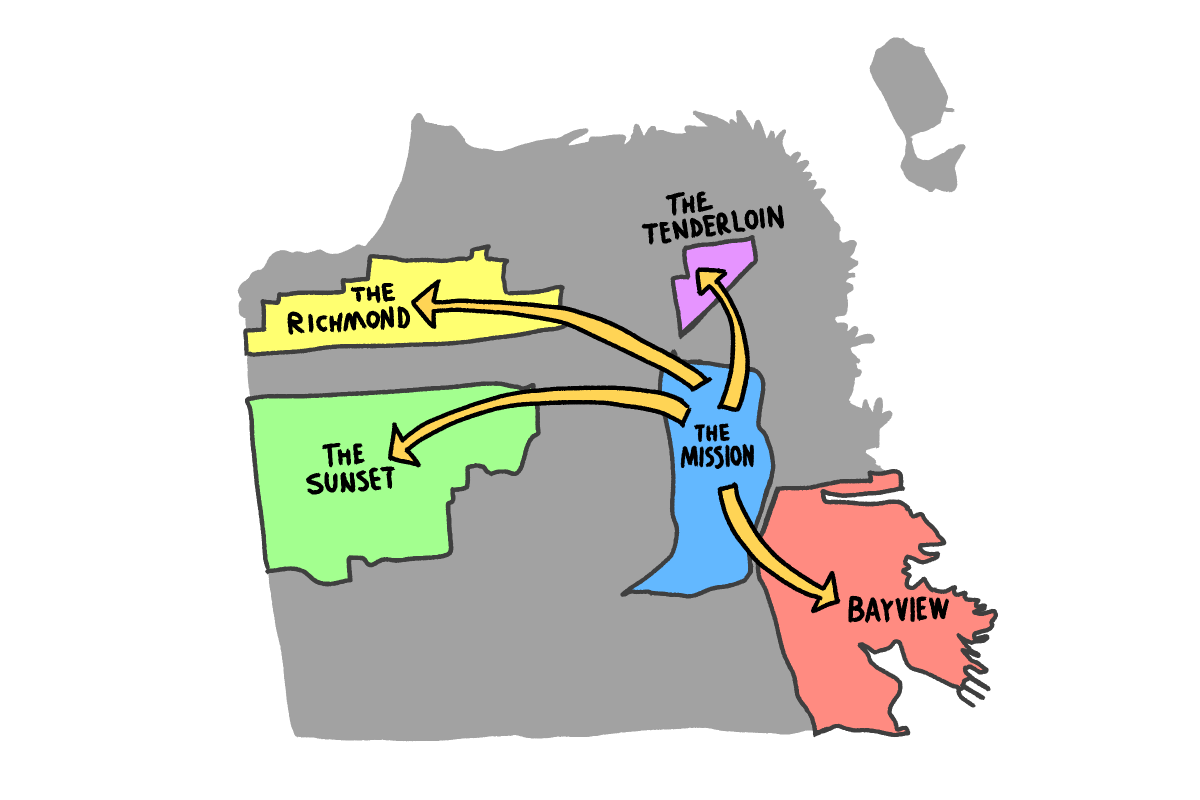
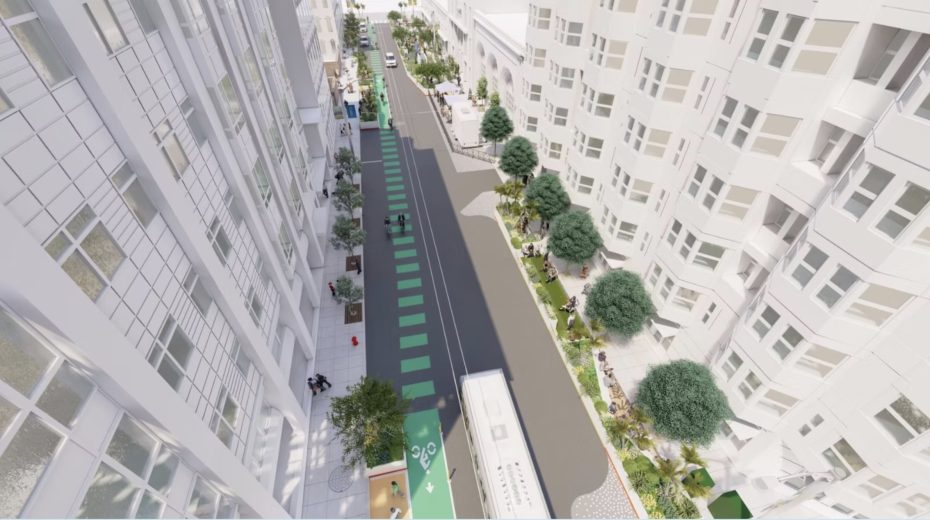
The Golden Gate Greenway, a one-block stretch of Golden Gate Avenue in San Francisco’s Tenderloin, was envisioned as a vibrant, car-lite community space in one of the most densely populated, treeless and park-poor neighborhoods in the city.
Renderings from 2022 show rows of tree-shaded benches for locals to sit and enjoy fresh air in a series of parklets.
The Greenway would be closed to most cars on the block between Leavenworth and Jones streets, and anyone could take a seat or a stroll: office workers, residents of the 111 Jones St. apartments, seniors from Vera Haile Senior Housing, and parents and children going to and from De Marillac Academy, Golden Gate Early Learning Center, Wu Yee Children’s Services and 826 Valencia’s Tenderloin location.
Three years later, the “green” in the Greenway’s name remains aspirational. It’s closed to traffic from 6 a.m to 6 p.m. daily, but more than $2 million allocated by the city and a pending federal grant has gone unspent. Today, with minimal shade and no place to sit, the Greenway is mostly an empty road and truck-loading zone.
The project leaders’ main priority, for now, has scaled back to street activations like pop-up events and, in the future, a mural.
“This work requires experimentation,” said Larry Kwan, the CEO of St. Anthony’s, the nonprofit leading the project. “People haven’t paid attention to the neighborhood … You need to be here and try, and see what works.”
In San Francisco, and in the Tenderloin in particular, those awaiting the Greenway say even small projects can become never-ending challenges.
Nils Behnke, the former St. Anthony’s CEO who saw the first few years of the project from its inception, called it “death by a thousand cuts;” permits and city funds are slow to come, community meetings take time, and the Tenderloin’s built environment offers some particular challenges.
Neighborhood conditions force pivot in plans
The first version of the Greenway began during the pandemic in 2020. Then, the block was closed off to serve as a temporary space for St. Anthony’s and other organizations to offer services like food distribution and COVID-19 testing.
In December 2021, then-Mayor London Breed declared a state of emergency in the Tenderloin, and soon after allocated $3.5 million toward neighborhood programs, including $200,000 to build three parklets for the Greenway.
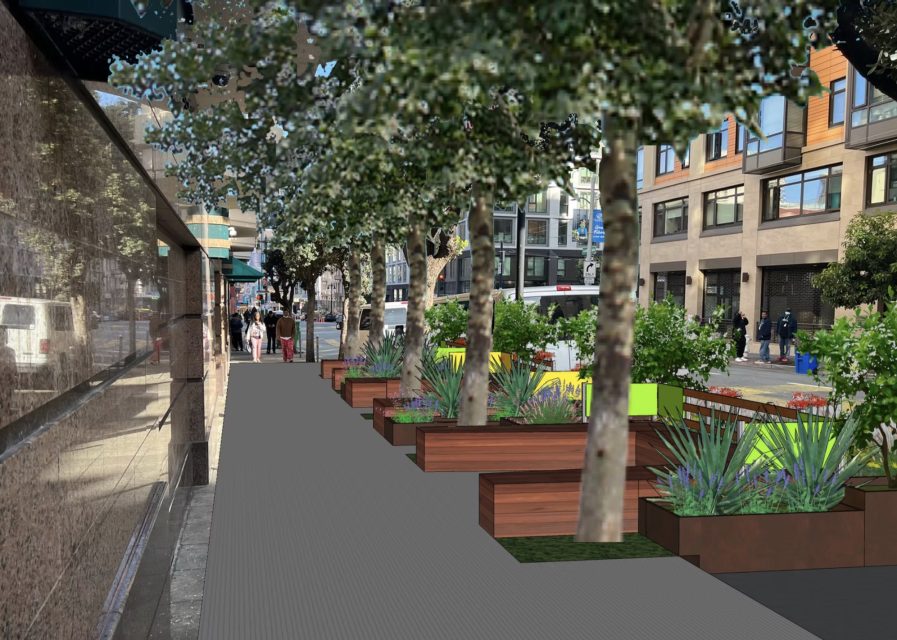
The new trees never materialized. Greenway representatives were told by the Bureau of Urban Forestry that most of the Tenderloin, despite having some of the lowest tree coverage in the city, has no capacity for digging new tree wells.
A major challenge, according to Chris Buck from the bureau, are basements extending under sidewalks, which are common in the city’s downtown and oldest neighborhoods.
The next best thing is to add trees in above-ground planters.
The fire department stalled the initial parklet plans in 2022, reportedly refusing to sign off on the widely supported project, at least in part because of street-clearance requirements for emergency vehicles.
Finally, the coalition of nonprofits operating on the Greenway in 2024 launched a pilot project with a single parklet, adding bench seating surrounded by plants at Golden Gate Avenue and Jones Street.
But the parklet often filled with people openly using drugs and blocking the sidewalk, according to workers on the Greenway.
“We couldn’t control for conditions at night,” said Geoffrey McFarland, the senior community engagement manager for St. Anthony’s, who leads the Greenway coalition, explaining why the community no longer wants parklets with permanent seating on the greenway.
“It was just unsafe, unhelpful, congregating at night, so it wasn’t serving the purpose of keeping the street green, clean and safe.”
Richard Rose, one of St. Anthony’s security and outreach workers, said people would lift the wooden planks off the benches to stash drugs and paraphernalia. Residents at the nearby apartment building complained.
Conditions got so bad that the city blocked access to the parklet in April by surrounding it with gates, McFarland said.
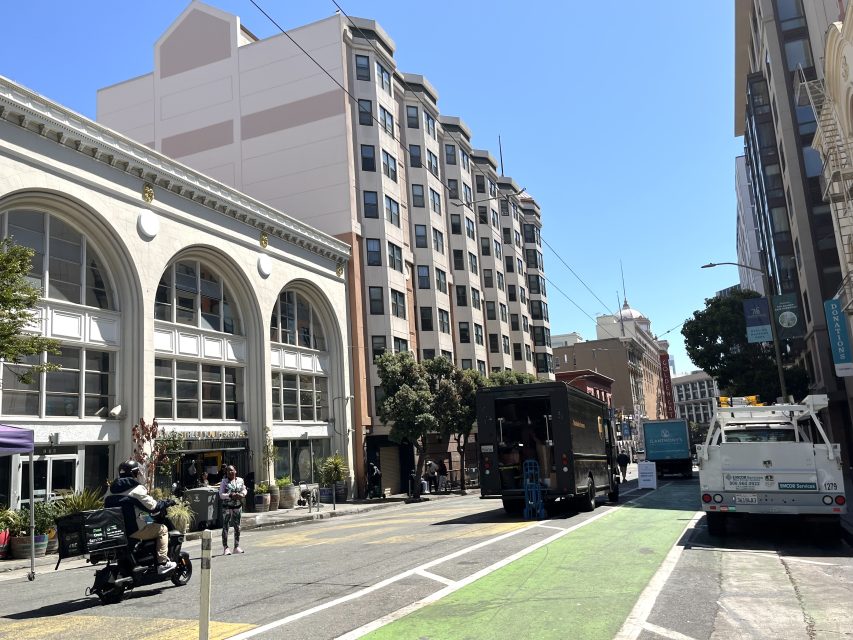
The parklet was deemed a failure and, earlier this month, it was taken down. Ironically, all that remains along the side of 111 Jones St. today is a gate the city uses to deter gathering and loitering.
As we spoke, Rose noticed someone paused on the sidewalk looking at their phone, and interrupted our conversation to tell them to move along. It might have looked innocuous, he said, but the person was known to openly consume drugs in the vicinity.
Forward progress?
The main objective to limit traffic on the Greenway has been put on the back burner as the necessary environmental review takes place. San Francisco Municipal Transportation Agency spokesperson Erica Kato said that won’t be complete until 2026.
In the meantime, promises of $1.35 million from the San Francisco County Transportation Authority and a street safety federal grant of $1 million in 2023 for the road work remain on hold.
This year, McFarland said, the plan is to test smaller-scale ideas — a mural, tree planters, lights and other “activations” of the area — before the real infrastructure work can begin. Those, too, will likely cost tens of thousands of dollars.
St. Anthony’s hopes to spend $90,000 in unused parklet funds to buy movable tables and chairs that can be put out during the day, but taken back and locked up during the evening.
That means residents and visitors can use the space, hosting events like the monthly Read, Ride, Explore event for children or the yearly Eid Street Fair, but the area will return to functioning as a regular street at night.
Supervisor Bilal Mahmood hopes to draw neighborhood businesses to hold pop-up markets on the Greenway, both to support them and create a better image for the neighborhood, similar to the way the skate park has helped to transform nearby UN plaza during the day.
Later this summer, Hometown Creamery will park an ice-cream truck on the block on Thursdays for a temporary pop-up, according to St. Anthony’s.
A stopgap to closing the road will be a mural painted on the asphalt road to more visibly mark the area as a safe gathering space. Perhaps unsurprisingly, it’s not as easy as it sounds.
Mahmood’s office is working to create a new permit for the mural in the middle of the street. It is, says Mahmood, not straightforward; what he describes as “no-man’s land” in the municipal code.
It would seem simple enough to paint a mural on a street that is already closed to traffic for most of the day, but so far, similar murals have only been permitted for streets that are officially designated as “slow streets.” The Greenway is still officially a mixed residential-commercial corridor.
“We’re going to focus on beautification of the street and continued activations of the street to hold the street closure,” said McFarland, who hopes the mural will be complete by October. “We truly believe it will make everything else roll out better.”
At least in the interim, he said, studies have found that asphalt art can slow traffic, too.
“The need is certainly there, and the idea is good,” said Behnke, formerly of St. Anthony’s, of creating community-focused open space in the Tenderloin. “Maybe the first iteration … didn’t quite get there. Should we therefore give up? I don’t think so.”
It’s always the same 2 reasons we can’t have nice things: bureaucracy and crackheads.
There’s nothing necessary about this BS non-priority, it’s pig makeup.
Lurie is following the Breed play of PR and giveaways without actually doing anything useful. “Projects” like this are just bread and circuses for the flag wavers, they accomplish nothing but wasting time and putting political feathers into PR managers’ hats. “Sunset Dunes” is another wasteful version of same, nobody needed it except for political control of the yuppie base they seek.
People will focus on the public drug use and other visible issues, but this sentence right here is what stood out to me. This city is eating itself.
“The main objective to limit traffic on the Greenway has been put on the back burner as the necessary environmental review takes place….that won’t be complete until 2026”
Why is it the city can’t figure out how to plant trees in the Tenderloin? Plenty of rooftops in world have trees on them (look no further than Salesforce Park). Even as they pretend to care about greening the neighborhood (but shrug because of basements), the city removes (and plans to remove) mature trees from nearby spots.
Recently Amsterdammers celebrated the 750th anniversary of the founding of their city. Part of the ring highway around the city was closed for a huge street party. The temperature in the sun was close to 110 degrees Fahrenheit, but in a temporary park area with the temperature was nearly 30 degrees cooler.
Hunh. On the campaign trail candidates Bilal Mahmood and Scotty part zone Jacobs seized every opportunity to blame crime, homelessness and drug use in the Tenderloin on then D5 Supervisor Dean Preston. Today, even with all of the extremely expensive declarations of emergency, SFPD raids and arrests nothing has changed. Who will Mahmood (and Denim Dan Lurie) blame next?
Instead of benches, which will be abused, use individual short, flat-top bollards, three per bus stop and wherever else necessary. No one could sleep on them so the people who need them could use them, day or night. They’d be easy to clean and not worth defacing. Win/Win…
I take computer classes, in both the Tenderloin, and in the SOMA area, both are in dire, need of trees. Yesterday when on 9th street I saw one sad Oak tree sapling, and attempt to plant another tree, only the hole was dug. The oxygen from the trees would clean up the pollution by cars, and brighten folks spirits as well.
There will always be places for people to hide drugs on any road. Like just storm drains for example. It’s no excuse to refuse to put benches.
As candidates, both Lurie and Mahmood doubled down on the blame of a supervisor challenging (and voting against) bad policies pushed by the mayor. They both insisted Preston’s challenging Breed’s corruption and power tripping was why government didn’t work. Now Lurie & Manmood tout they move”hand in glove” and in “lock step” (their terms) but nothing changes. Data shows overdose deaths increased +50 percent since January thanks to this collaboration.
For 25 years I have watched social experiments fail in the Tenderloin. Drug dealers disguised as non profit workers or as disabled. Budget cuts, a lack of funding, staff shortages and the inability to accurately count homeless people. Shut down the liquor stores and smoke shops and watch how fast everything improves.
In the meantime, the street is closed off and health care workers can’t access any short term parking to see the patients in the adjacent housing.
There is a lot of police in the area, but from what I see they just take up ALL the street parking and sit in the station.
On the surface, yes, a noble idea. But, unfortunately, this sounds like you’re just shoving and concentrating the street issues towards Geary. I live at Jones and Geary. And not a day goes by where my intersection has to deal with garbage left behind or dogs barking incessantly thru the night by the homeless. The homeless have ZERO respect for any neighborhood sidewalk they choose to plop themselves down on.
Rather then spend 2 million on a small area , use the money to pay for persons who are trained and able to walk the whole tenderloin 24/7 and get the sidewalks clear and free of drug addicts dealers , thugs and idiots who have demonstrated they cannot be out in public and ruin everyones well being for their own selfish self destructive behaviors
This city really needs to get this vagrants and waste products off the sidewalks .
This is getting really old .
Clean this mess up
Comments like yours are getting old. A magic wand that would make your undesirables disappear and reverse decades of social neglect would cost much more than $2 million.
Send ICE goons through once a day. No cost to San Francisco, problem will disappear in days. Next up, the Mission.
Take a time machine back to Nazi Germany or modern day Gaza, your paradise awaits.
And in the future a mural? “You need to be here in this neighborhood to see what works.” That sounds like something someone swimming in a sea of corruption would say. I say the federal and state government launches an investigation into where we the people’s money actually went on this one. Sorry but I’ve lived in this neighborhood for years. Why did you just follow the very clear plan Mr. Ceo of St. Anthony’s? Could it possibly be because you need to cut costs in order to spend some of the money on yourself while making it look like the project is working? You’re a slimeball and you know it.
A cab driver 12+ years ago pointed out me how Golden Gate was the quickest way to get to I-280 from the Haight and near-western neighborhoods. It still remains one of the few streets that clearly crosses Market into SoMa without shenanigans (compare Golden Gate to 6th against O’Farrell -> Stockton -> 4th). It’s a shame the streets which quickly move road traffic are closed, in favor of streets which promote gridlock and a lack of flow.
To respond to the other comment. The “ Green way “ is right in front of St. Francis dining hall and that church. So called crack heads already go there to eat. So don’t blame them blame the bureaucracy. Maybe if there more trees people would do less ugly things.
More nonprofits claiming to speak for the community, but only as long as they are on the clock and only if they get an infinite number of bites at the apple.
Why does anyone assume that a gaggle of MPPs and MPAs paid with city contracts and grants is going to have any special insight into what a diverse community wants?
Total waste of time and money and for what? Yuppie politics.
I assure you no yuppie is trying to visit the 100 block of Golden Gate Ave, before or after this change to discourage crackheads.