

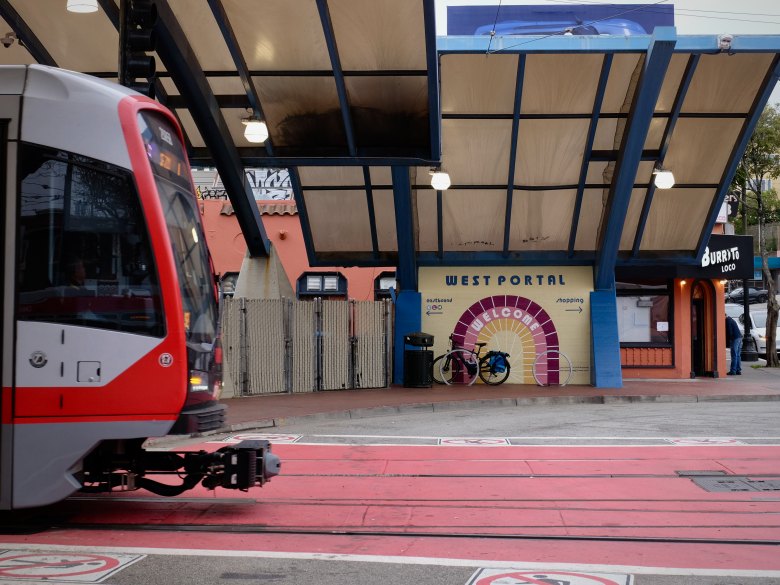

Hard caps on the size of storefronts in certain San Francisco neighborhoods were created to protect small businesses from being muscled out by deep-pocketed developers.
Now, Supervisor Myrna Melgar argues, in an ordinance approved by the Planning Commission on July 17, these limits are doing more harm than good.
Melgar’s bill seeks to remove hard caps on storefront sizes on five neighborhood commercial corridors: West Portal, Castro, North Beach, Pacific Avenue and Polk Street, the only neighborhood commercial districts in the city that have those caps.
Right now, businesses there that want more space than 4,000 square feet need to persuade their supervisor to make one-off, carve-out legislation to grant exemptions. Melgar’s ordinance would remove that hard cap, requiring a conditional use authorization from the Planning Commission instead, an easier step.
It would also allow larger retail spaces in those districts to be subdivided into smaller ones without an authorization from the commission.
Melgar touts the law as providing more flexibility for businesses, but merchant groups from three of the targeted business districts have come out in protest. A lot may have changed in San Francisco’s last quarter-century, they say, but the need to keep most storefronts on major commercial streets small is as relevant as ever.
Removing those caps, merchants from West Portal, Castro, and North Beach neighborhoods wrote in an opposition letter, would bring in large retail stores and “catalyze rent increases.”
“What it does is open the door for much bigger and wealthier tenants to come in and artificially increase the rent for our small neighborhoods and displace small businesses,” said Deidre Von Rock, the president of the West Portal Merchants Association.
Melgar, for her part, said it’s just a small change that will add “not a whole lot, but a little bit” of flexibility for new businesses to take on vacant spaces.
The merchants’ fear, Melgar acknowledged, is legitimate. But is it a “good strategy,” she asked, to make “everything so restrictive that only the people who are already here can stay?”
“I would argue that you need somewhere in between,” she said. “You want to preserve and protect, but at the same time, be flexible enough to change to new patterns.”
Create larger storefronts
Mosaddegh Eye Institute, an eye clinic at West Portal, knows the bureaucratic hurdles first-hand: The clinic last year sought to combine a vacant bank and nail salon into one space. Melgar’s office passed a carveout legislation for the clinic, increasing the lot’s size limit from 4,000 to 5,000 square feet.
Elena’s, a Mexican restaurant that found the perfect location on West Portal Avenue, had a similar issue. It could only get the space it needed by merging two storefronts, Melgar said — an action that put it dangerously close to the West Portal storefront size cap of 4,000 square feet.
If Elena’s went over, it would have had to ask Melgar to pass carveout legislation, too, adding about six months to its permitting process.
“They had to come just under the cap on purpose,” Melgar said. “It was a couple of square feet that they had to design around.”
The ordinance would still require businesses that exceed a certain square footage — 2,000 square feet for North Beach, and 2,500 for West Portal — to get a conditional use authorization from the Planning Department.
But that process usually takes less time, Melgar said, and would still give the public a say over larger spaces.
Split up large retail spaces
The second part of the legislation, to make subdividing larger spaces easier, is aimed at filing large, empty commercial spaces.
Take the former site of Lombardi Sports, at 1600 Jackson St., at Polk Street. The 40,000-square-foot space has been vacant for more than 10 years, and several potential tenants have reached out over the years. Those proposals “never came to fruition,” the planning report read, because the tenants couldn’t lease the entire space.
The space is almost impossible to subdivide: Unless it is split into at least 10 different spaces, it is out of compliance with the 4,000-square-foot limit set by the Polk Street Neighborhood Commercial District.
In general, small businesses prefer small storefronts. Many commercial spaces on Mission Street were originally built as department stores, furniture shops, or movie theaters, and have the large footprints to go with them. In recent years, they have proven harder to lease out, compared to storefronts on 24th and Valencia streets.
A recent rash of pharmacy and bank closures across the city have added even more large spaces to the rental market.
But, the merchant groups argued in their letter, the premise of the legislation is flawed. With the exception of Union Square and Van Ness Avenue, the merchants wrote, pointing to the planning report, vacancy rates on commercial corridors citywide are already on the low side, at 7.7 percent citywide.
Melgar’s ordinance, introduced in June and co-sponsored by Supervisor Danny Sauter and Stephen Sherrill, was approved at the Planning Commission in a 5-2 vote. It will go to the Board of Supervisors Land Use and Transportation Committee on Monday.
The merchants groups say they weren’t consulted before the commission vote. Melgar’s office said it’s committed to having discussions with businesses and supervisors who represent the affected districts, and already District 8 Supervisor Rafael Mandelman asked Melgar to take Castro Street off the legislation, opting to keep the size caps in his district.
The merchant groups also want the ordinance to only cover existing storefronts (like Lombardi Sports) to lower the risk that smaller storefronts are combined or demolished, and that landlords replace them with larger retail spaces.
Melgar’s office said it has considered the suggestion, but worries that if the subdivision only applies to existing storefronts, the city will have to pass similar legislation all over again.
“At some point later in time,” Melgar said, “We’re going to be in the same position.”
Cautionary note to westside Supervisors: it was helping Quickly Tapioca get around chain restrictions that put the $40K in Ed Jew’s safe, and him in prison.
Isn’t the headline burying the lede and misrepresenting the merchants? Small-footprint merchants aren’t upset about breaking up larger spaces into smaller footprints; they’re upset about removing the cap on space size, which will accommodate chains, pushing rents up and destroying fragile neighborhood character. You’re conflating the “second part of the legislation” with the main part of the proposal that concerns the merchants.
If neighborhood character is so fragile that it depends on constant intervention by the government to prop it up, it is fake and should just die.
Merchants aren’t asking for “constant intervention.” Melgar’s proposal is the intervention, and the purpose of this intervention is to fill the wallets of corporate landlords, big developers, and national chains. So, from your p.o.v., interventions are fine as long as they put money in the hands of corporations, but bad when they help small business. Got it.
Yet again, Melgar on the opposite side of the small businesses in her district, and again, they weren’t consulted before she rolled out legislation.