

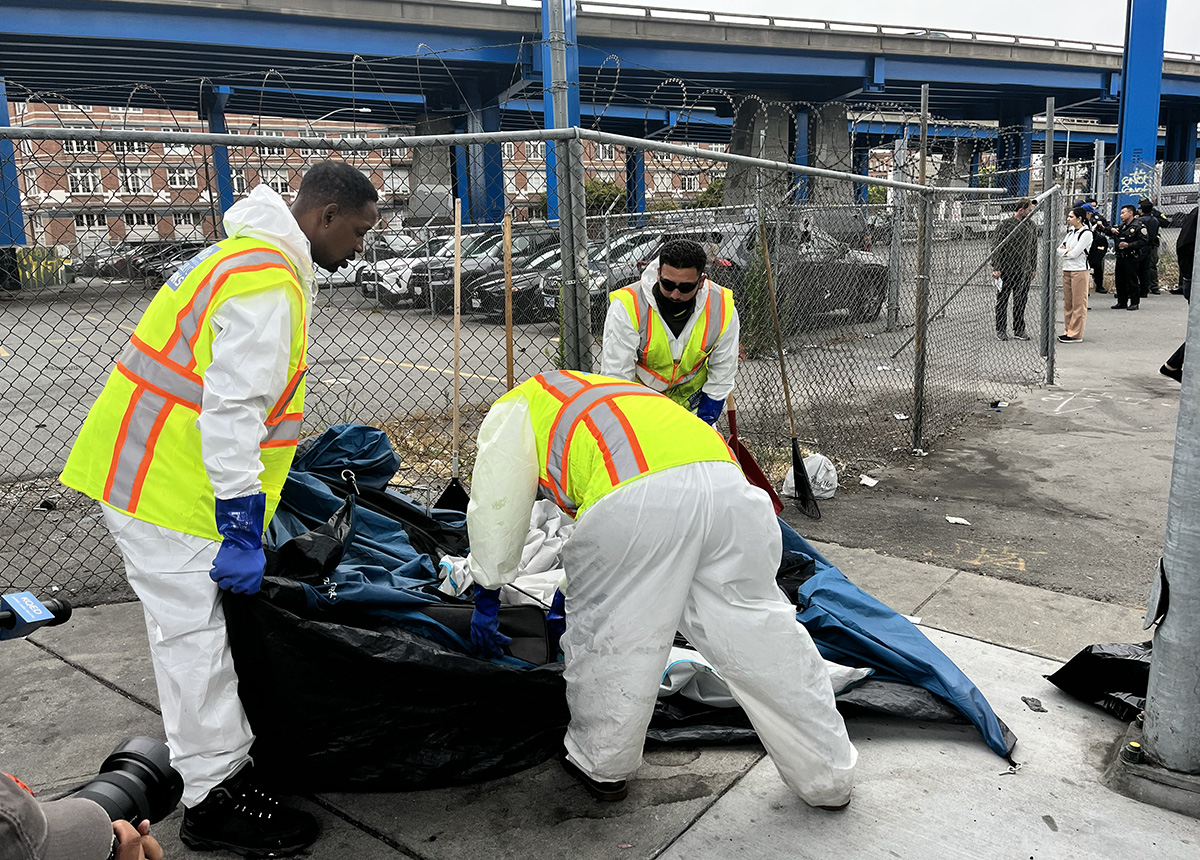

San Francisco has agreed to pay $2.8 million, and to change some of its homelessness policies to settle a 2022 lawsuit filed by the Coalition on Homelessness and several homeless plaintiffs.
The lawsuit alleged that San Francisco workers failed to follow the city’s own rules, including San Francisco’s bag-and-tag policy, which prohibits throwing away homeless people’s personal belongings. Instead, the city is supposed to collect and store these items so that people can later retrieve them.
“We are pleased that the parties have reached a settlement in this case that is so important to our unhoused neighbors,” Jennifer Friedenbach, executive director of the Coalition on Homelessness, wrote in a statement.
“The settlement has important mechanisms to ensure that the city complies with its policy for handling unhoused people’s property,” she wrote.
Of that $2.8 million, two individuals will receive $11,000 each. The rest will go to the attorneys from the American Civil Liberties Union who represented the plaintiffs in the case.
“The law must appropriately balance the rights of unhoused people with the rights of governments to keep order on the streets,” city attorney spokesperson Jen Kwart wrote in a statement. “We are happy to be putting this lawsuit behind us so that all sides can focus on providing services and addressing homelessness.”
The case originally alleged that the city had violated homeless people’s Eighth Amendment rights by threatening to arrest or cite them for sleeping on the streets, even though there was no available shelter.
This portion of the lawsuit became moot, though, after the U.S. Supreme Court’s June 2024 ruling in the Grants Pass v. Johnson case, which invalidated lower court rulings that rousting or incarcerating homeless people without a good-faith offer of shelter violated their Constitutional rights.
In addition to the monetary concessions, the city also agreed to several policy changes. This includes new training requirements for Public Works employees, who are typically tasked with clearing encampments, and increased documentation of homelessness operations, including photographing all tents, mattresses, and complete bicycles at the site of encampment sweeps.
The settlement also grants the Coalition on Homelessness access to documentation of city homelessness operations, and access to the yard where Public Works stores items that it has bagged and tagged.
If the Coalition finds 10 instances of the city taking people’s possessions or destroying them when it should not have within 90 days, then the Coalition will be able to raise a dispute and have the matter brought before a judge to be mediated. The access and ability to raise disputes will expire after five years, which is typical for settlements.
City sources were pleased with the settlement: $2.8 million is seen as an acceptable payout to end a years-long legal case and the city won’t be required to make any changes to its current policy.
That’s because the city’s current bag-and-tag policy is legal. The lawsuit’s focus, however, was on the city’s practices — its failure to comply with its own policy.
So, while the settlement does not require any policy changes, if the city does alter its bag-and-tag policy, it must incorporate a new series of minimum standards.
Those new standards include giving 48 hours’ notice before a planned encampment sweep, one hour of oral notice before an unplanned sweep, and four hours and written notice before clearing unattended belongings.
Last August, following the Grants Pass ruling, the city began doing “very aggressive” homelessness sweeps, sending DPW crews to clear tent encampments across the city. As of this June, the number of tents in San Francisco was only 165, the lowest count since the city started tracking that statistic in 2019.
“My administration is tackling our city’s homelessness and behavioral health crisis head-on,” reads a statement from Mayor Daniel Lurie. “We are doing the work to deliver progress for San Francisco, and as we put this litigation behind us, we will continue doing that work every day.”
I admire the work the ACLU does, but I wonder what could have been done had the entire $2.8 million gone to San Franciscans experiencing homelessness, instead of a mere $22,000 to two people. That’s less than 1% of the whole settlement.
$11K to two homeless people and $2.8m – $11K for the ACLU seems like an asymmetrical allocation.
This is an opinion, from someone who read into the plaintiff’s court documents and responses to later challenges.
1. It’s a federal level case, up to the Northern District Court’s appeal level. This means more experienced lawyers from ACLU and a high burden of evidence. ACLU had 16 major clashes in trials over three years with this case.
2. A absolute massive amount of ground research had to be done and literally from scratch, since homelessness isn’t exactly to audit or even start to survey, basically a lot of field work and interviews to meet the burden of evidence. In addition, auditing full activities from five different departments, DPW, SFPD, DEM, HSH, and SFFD.
3. The City, obviously, was dragging it out and every ruling basically had the judge telling them to knock it off, and the City was trying to save face. Here’s some examples. Back in 2022, Judge Donna said this in her ruling for injunction: “In their opposition brief, Defendants wholly fail to object to or even address the substance
or scope of the proposed preliminary injunction, thereby conceding these issues.” Then last month, with the City saying they’re “complying” and requesting summary judgement absolutely failing, and the judge shitting on them again, “Based on this evidence, a reasonable fact finder could conclude that the City’s failure to
adequately train its employees on the bag and tag policy amounts to deliberate indifference. None of the City’s arguments on this point lead to a different conclusion.” The city was literally losing on every point, and couldn’t defend. Yet kept it going because Breed didn’t want to look like a loser, and later Lurie.
4. After the ruling, the plaintiffs had to front the cost of overseeing the injunction as the judge did not agree on a special master. So the ACLU and CoH had to basically log and inspect DPW/other department trainings, watch the police and how they deal with clean ups, etc for three years.
Almost a million each year for all these tasks, over three years makes sense.
As per the plaintiffs, 11 thousand is basically for their short part in the proceedings and property loss that can be reasonably proven.
This doesn’t include work done by CoH, since they didn’t want money from the settlement, as it’s going to ACLU.
Hmmm. “Of that $2.8 million, two individuals will receive $11,000 each. The rest will go to the ACLU attorneys, who represented the plaintiffs in the case. “
Encampment sweeps are bad enough without also (illegally) destroying property… anybody else have a problem with literally 99% of the settlement money going to the legal team instead of the unhoused victims though??
That’s quite a payday for the ACLU attorneys and the homeless industrial complex nonprofits. $2.8 million for them and $22k for the people they are supposedly trying to help. Just part of the cost of living in San Francisco for the unlucky working taxpayers who fund this grift.
Wait, out of a $2.8M settlement, $22k went to the plaintiffs and $2.778M went to the lawyers? I support the ACLU but I am confused by this.
Ok. Since I am the first to comment. How come the judge allowed a $2.8m settlement and the 2 plaintiffs only got $11k each?
Huzzah for the lawyers! Will they get a piece of the $2.8M action? I guess they really showed those city workers whose stuff was whose. $2.8 million for that stuff, only $120,000 for a banana duct taped to a wall. The lawyers eat well tonight!
Wow, shameless. 2.8 Million and of course the rich get richer and the poor stay poor. Homeless HOMELESS. You can justify that the two Homeless people involved in the lawsuit are only walking away with 11,000 dollars each. That’s dispecable!!! (Sp) Use them for your lawsuit against the city to line your pockets even more. How do people look in the mirror everyday and not spit on themselves.
Thanks for reporting
The homeless coalition is a joke
Major grifters
They are surely not interested in helping just taking money from the taxpayer
Their whining and slick power points and games are self serving for the nonprofit
2.8 million to pay for lawyers minus a small chunk for a few homeless who had their junk not stored properly ?
Mad because they are told they dont own the public sidewalk and need to follow the laws nd show some decency and common sense towards others ?
Very tired of their enabling and taxpayer money going to support their bs .
Demanding to live in the Tenderloin where they can get drugs and we pay ?
Go get a job
Get off your butt
Mature
This city has a group
of persons who use these people as pawns.
Follow the laws and contribute or get out of town .
Ridiculous .
How many people might have had the opportunity to get substance abuse treatment with this 2.8 million dollars? Not to mention all of the revenue that the city will not see because of the lack of tourism, business, and property taxes due to the devaluation of our real estate. Hope Jenny Friedenbach is happy with herself! She literally RUINED San Francisco.
Braindead comment…
The city dragged it out, which is why it cost so much.
The plaintiffs only wanted the city to follow its own policy regarding property, and decided it best to drag it out in court for nearly 3 years.
And the city refused, on a prima facie case that could’ve been settled much earlier.
San Francisco screwed over itself.
True if the city had just given in to the extortion it would’ve been much cheaper! Just ignore all the incentives that would imply for future extortionists. We’d be finding homeless people losing their legally acquired and definitely not stolen Stradivarius every week.
So $22,000 goes to the homeless and $2,800,000 goes to the lawyers. Kinda sums up what’s wrong with our approach to homelessness
In all fairness, lawyers and the crackheads both turn it around and spend it on blow.
Great. Now in addition to the 2.8 million the tax payers can pay millions more to store and catalog their crap. Take a close look at these encampments. I’m pretty sure the contents aren’t family heirlooms or high school yearbooks. Mostly garbage, stolen bikes and stuff given to them by social services. What a joke
More like “San Francisco loses longstanding homelessness lawsuit”.
Nearly 3 years to fight against a lawsuit entirely of the city’s own making.
Only to beg and grovel to the Supreme Court for a win in a legal battle it was fully going to lose.
Then on the second point, the City failed to uphold its own goddamn policy on property.
Now the city has to pay 2.8 million, enforce its own policy, train staff and actually do their JOB, wasted an ungodly amount of time, and opens up the city to almost assured immediate litigation after 90 days knowing how the city will again, fuck it up.
And the tents hiding the misery?
Now on full display for all to see.
What a huge waste of taxpayer time and resources, jesus.
The Coalition on Homelessness in San Francisco presents itself as an advocacy nonprofit, but its business model raises serious concerns. While the city struggles with an ongoing homelessness crisis, the Coalition has actively opposed encampment cleanups and sued the city over enforcement, winning a $2.8 million settlement—paid by taxpayers. Their most recent financials show they brought in about $1.1 million in revenue, yet spent over 26% of that on executive compensation, with the CEO and top staff taking home over $314,000 combined. That’s a huge chunk of money going to salaries instead of direct services. This model does little to solve homelessness and arguably benefits from keeping the crisis alive. Taxpayer funds should be going toward housing and recovery, not legal battles and oversized nonprofit salaries.
For a benchmark: most charity rating firms would say anything below 80% of funding going to mission support would be a concerning rate for a “charity.” CoH and the like aren’t charities though, they’re just lobbying arms for the “nonprofits” whose business is to apply for and receive grant money.