

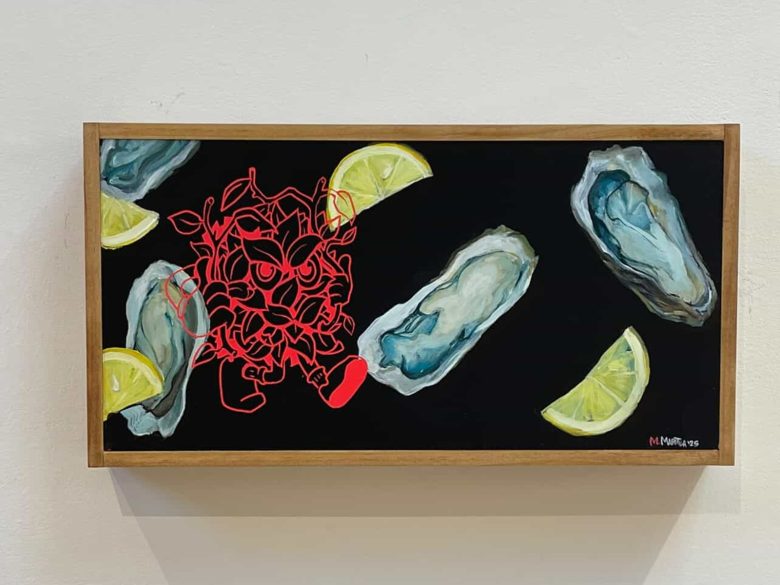

From the Mission to the Tenderloin to Daly City, Max Marttila portrays San Francisco’s urban rituals in street murals that engage actively with the community.
At his new Incline Gallery show, “Places to Rest,” running from July 11 to Aug. 10, he breaks apart that city spirit and blends it with his own.
The exhibit is a playful blend of city nostalgia and personal vulnerability. In one painting, a reinterpreted Lou Seal slings his Giants baseball bat back and beckons Pier 39 tourists in for a good beating. Marttila’s small-scale work differs vastly from his epic murals lining city streets, but the 36-year-old San Francisco native can do both.
If you’ve moved through the city, you’ve likely seen Martilla’s work. He began painting as a teenager, and he’s worked on dozens of murals since. A number have been with Precita Eyes, the longstanding Mission District-based collective, and the majority of his works are still collaborations with muralist friends.
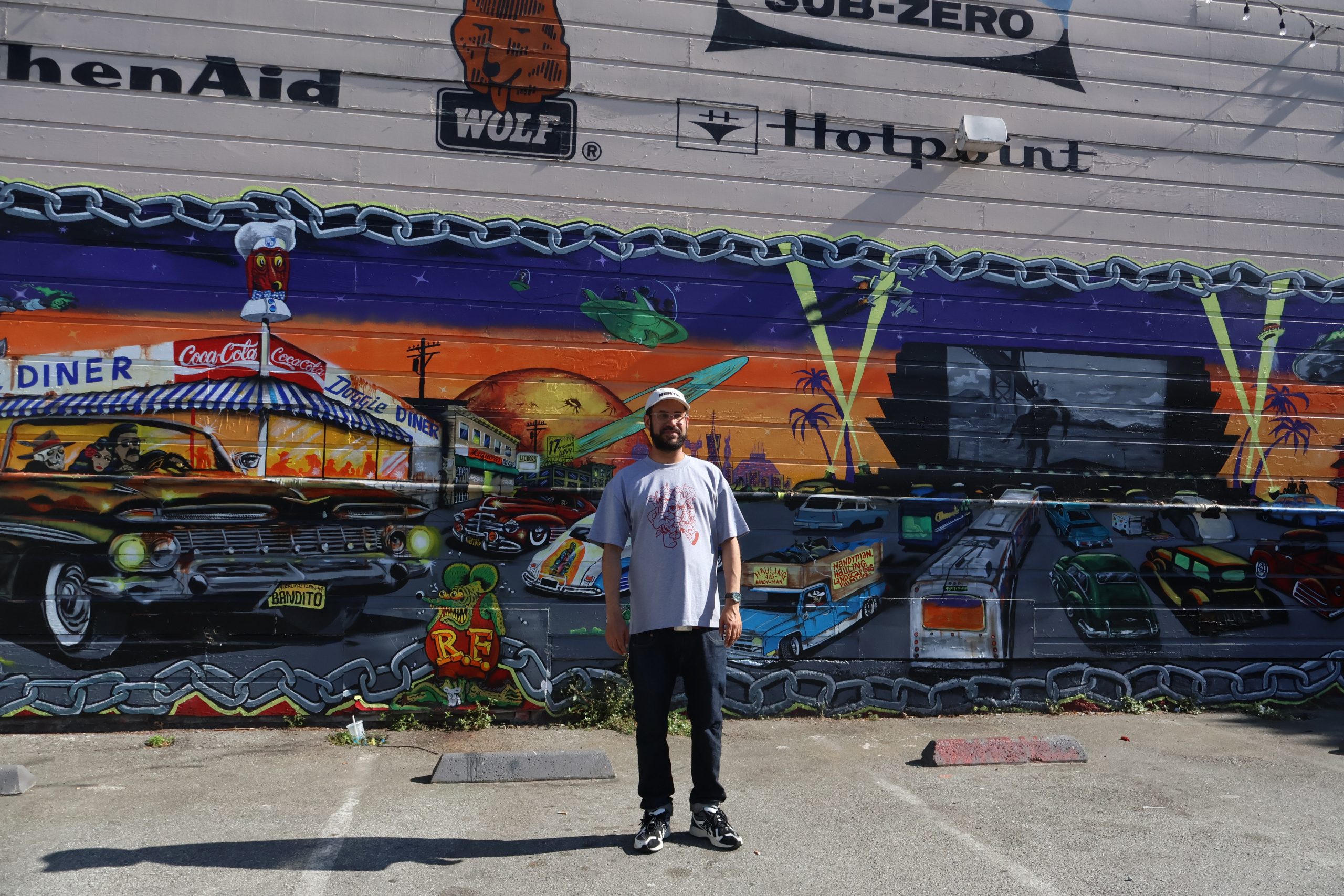
On a four-block walk to his solo show from 16th and Mission streets, Marttila and this reporter passed three murals of his: One on the corner of 17th and Mission streets, made with Eli Lippert; another recently completed work on 18th and Mission streets, made with Diego Irizarry and Drew Valencia that centers a sitting Ohlone woman; and Marttila’s favorite, a collaboration with his friend George Crampton Glassanos on the corner of 18th and Valencia streets, with Doggie Diner, Whiz Burger, an interpretation of Mickey Mouse’s antithesis “Rat Fink,” and a scene from “Vertigo.”
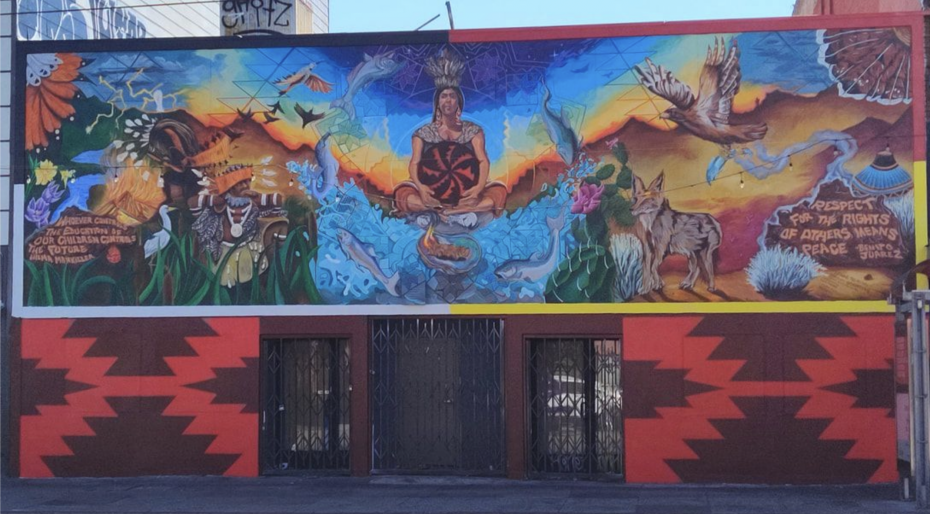
Marttila’s new show is housed just half a block away from that sprawling mural, at Incline Gallery, an independent gallery that’s hidden down a quiet alleyway at 766 Valencia St.
In many ways, Incline Gallery complements Marttila’s work. He said that he’s had many friends and family die in the last year. Incline, which was founded by Christo Oropeza and Brian Perrin in 2011, was formerly a mortuary. Drawing from familial loss and the space’s funereal history, Marttila found the show’s name: “Places to Rest.”
Oropeza, who now runs the gallery, said that Incline is “the Mission’s Guggenheim,” where everyone comes together to find an old San Francisco — one that’s not based in nostalgia but instead in a common visual vocabulary. The show and space pulse with city spirit.
Marttila revels in the ability to work publicly, incorporating the feedback of community members at all stages of the artistic process.
“There’s a lot of power in muralism,” he said. “We’re basically given the responsibility to control the visual landscape.”
During the wave of Mission gentrification in the 2000s, having that agency over the urban imagery of the neighborhood was particularly important. Most of his murals dealt with this explicitly, giving representation to the Mission’s historically diverse community. All murals should be political, he said.
Entering Incline, the first work that greets gallery-goers is what Marttila calls a “residual painting.” It began as a canvas used to test paint colors for larger projects, he said.
But, liking how it turned out, he began painting smaller, personally significant images onto it. The result is a background of rough modernist strokes covered in nerdish references.

The paintings that make up Marttila’s show continually evoke that juxtaposition of times and feelings. Many feel like new takes on pop art, with “Evangelion” robot meccas replacing Campbell’s Soup.
Others take recognizable images, like olive branches, a symbol of Palestinian resistance, and twist their sections into Rubik’s-cube-like reconfigurations. Some draw from street art, taking San Francisco symbols and making them deeply cartoonish.
The result is a show made from “Gundam,” infographics, and Muni transfer tickets. The canvas of one painting, set in the middle of the show, is hand-crafted from shredded winning lottery tickets.
Marttila’s murals often incorporate urban folklore into the changing landscape. His painting is more intimate, though at times more surface-level; the canvases are personal, yet sometimes he seems hesitant to say something serious without an audience.
He admits that he doesn’t know why washing machines figure so large throughout his paintings. They just do.
His brush strokes range from sharp and comicbook-like to soft and modernist. His work is the muralists’ collaborative practice collapsed into a personal, fandom-heavy and referential space.
The centerpiece, which Oropeza called “the blue note” of the show, is a skull made from segmented aerial scenes from different neighborhoods across the Bay. The melodramatic climax is both a reflection on the people that Marttila has lost and a testament to the old Bay that he loves.
Marttila says “fuck all that shit” to Herb Caen. For him, this city is still Frisco.
But if Marttila’s skull is the climax that Oropeza identifies, another major point comes immediately after with 22 sheets from Marttila’s sketchbook. The arrangement is a compilation of unfinished projects, symbols of personal value, and sketches straight from the subconscious.
As a muralist in the Mission, Marttila draws from a long line of painters and revolutionaries. But his solo show at Incline reads more like introspection than a necessarily outward-facing art.
Looking at his mural on 18th and Valencia streets, Marttila said that he feels more comfortable painting out in the open. Making things alone, he said, “is sometimes more pressure.”
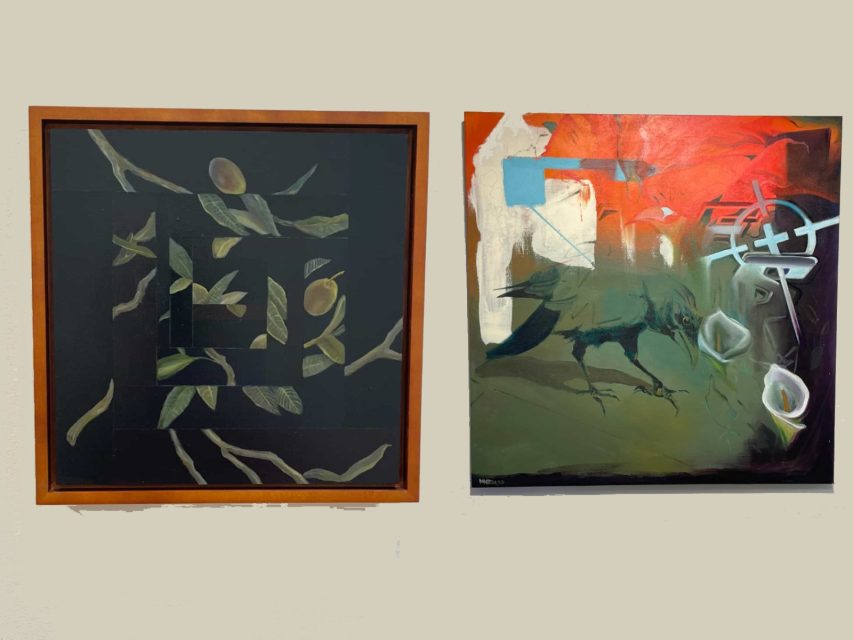
Two paintings from Incline Gallery’s new show, edited to appear closer together. Photos by Max Marttila. 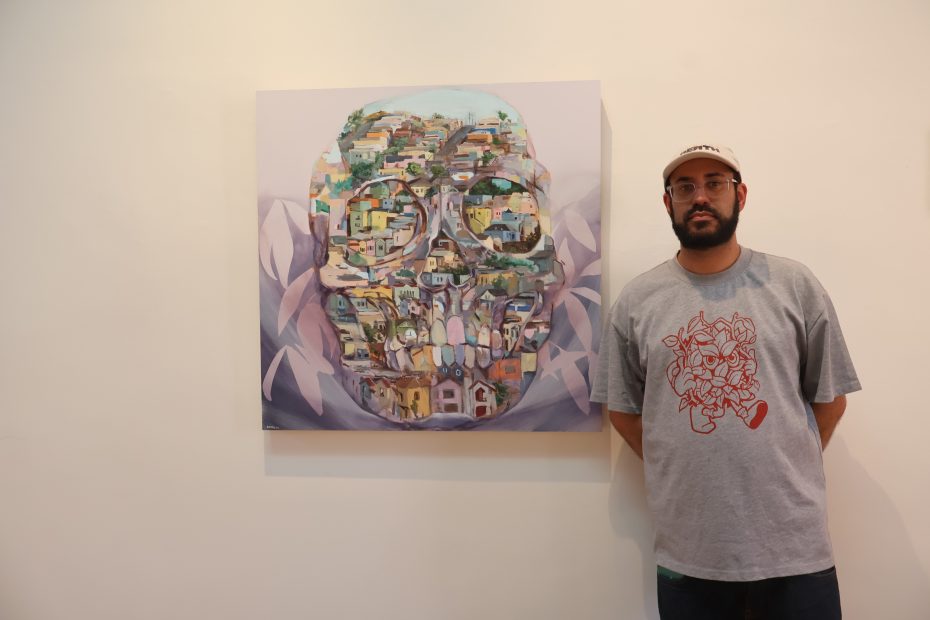
Max Marttila stands next to his painting at Incline Gallery, on July 10, 2025. Photo by Frankie Solinsky Duryea. 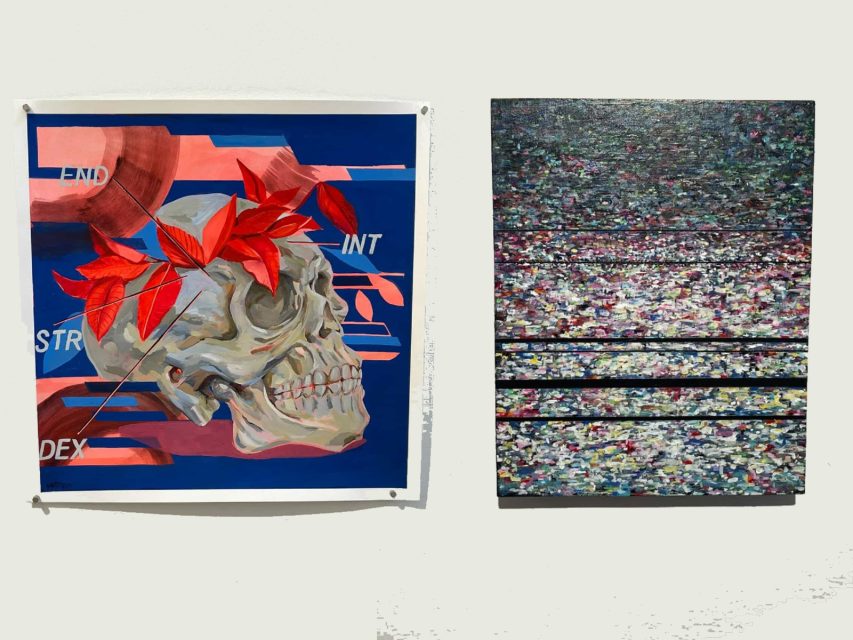
Two paintings from Incline Gallery’s new show, edited to appear closer together. Photos by Max Marttila.
Marttila acknowledged that if he were an outsider observer, he wouldn’t be able to find a through-line in the show. Standing in front of a painting, he described it deadpan as “Gundam stuff mixed with, uh, dietary restrictions. And a robot coffee cup.”
The last work on display is a painted cartoonish reinterpretation of Bush Man, the late city legend who used to jump out from behind a shrubbery and scare tourists at Fisherman’s Wharf.
Marttila says that the character is the patron saint of his show. The painting seems like a print, he admits. But if you look closer, those sharp lines betray the slight inconsistencies of a human hand. It’s cartoonish, but genuine.
Marttila’s show will run at Incline Gallery, 766 Valencia St., until Aug. 10.