


It’s usually for the best when your city’s governing process doesn’t remind anyone of a scene from “Casablanca.” You’ll be shocked, shocked to learn that, in San Francisco, it does.
“Please Monsieur, it is a little game we play,” Capt. Renault assures Victor Laszlo. “They put it on the bill, I tear up the bill. It is very convenient.”
So, San Francisco budgets this way. It is not very convenient.
The mayor last week pulled the rug out from under a handful of the city’s longstanding nonprofits, zeroing out a $4.8 million budget line item that funds decades-old code-enforcement programs in the city’s most put-upon residential hotels and apartment buildings.
This money also funds the San Francisco Apartment Association, which advocates for landlords in landlord-tenant disputes and works cooperatively with tenant groups to abate unsafe conditions and mitigate renter-landlord issues.
If you were working in a political laboratory to create a budget cut that would confuse and piss off everyone — progressives who take calls from the groups representing impoverished monolingual families crammed into cramped rooms, moderates who take calls from groups representing landlords and building owners — you couldn’t do much better.
San Francisco is in a budget hole, if you hadn’t heard. The response to our inquiries regarding why this cut was made was that there are many painful cuts to make. That’s true, and $4.8 million, despite being the sum San Francisco expends every 2.5 hours or so, is still a fair bit of money.
No outfit deserves to be paid just because it’d be politically inconvenient not to (though defunding residential hotel code enforcement programs would be a precarious move for anyone hoping to maintain good political relationships in Chinatown).
Every recipient of government largesse should expect to be asked to prove their efficacy and show what the city’s money pays for. But, in this case, that apparently didn’t happen.
The Department of Building Inspection submitted a budget to the mayor calling for a 15 percent haircut to the Code Enforcement Outreach Program budget. But the mayor gave it a 100 percent beheading.
These programs have been around since the 1990s. Your humble narrator spoke to several of the agencies receiving this money and doing the work, some of them since their inception. All of them were blindsided. None of them says they received a phone call from the mayor’s office offering a warning let alone a preemptive request to explain and quantify the program’s value before the cuts were made.
It’s not at all clear that the people deciding whether or not to fund these programs understand what these programs do.
In San Francisco, the mayor releases a preliminary budget by June 1, and the Board of Supervisors burns the midnight oil for a month to reallocate perhaps 1 percent of that budget, with perhaps 99 percent of the budget sailing through essentially unscrutinized.
Insofar as the budget process draws media attention and public input, it’s with regard to this fraught add-back process, in which millions of dollars are fought over out of the city’s 11-digit budget.
Mission Local has learned that the supes, starting with a Budget Committee meeting on Wednesday, have high hopes to restore perhaps $4.2 million of the $4.8 million Lurie proposed doing away with.
Once again, vast amounts of effort will be expended to restore budget crumbs after weeks of existential angst, while the overwhelming majority of the city’s budget remains unscrutinized. It fits no model of good government.
In other words: The mayor tore up the bill, the supes are trying to tape together the bill. It is very inconvenient.
At this point, you’re probably wondering what the Code Enforcement Outreach Program does. Folks in City Hall described it to us as an “outreach program,” which is understandable, considering the name and all. But that’d be kind of like describing “Animal Farm” as a treatise about animals and farming.
If the funding were cut, perhaps 40 people would lose their jobs. These people are paid to essentially keep an eye on the city’s 20,000-odd residential hotel rooms in Chinatown, the Mission, the Tenderloin and SoMa.
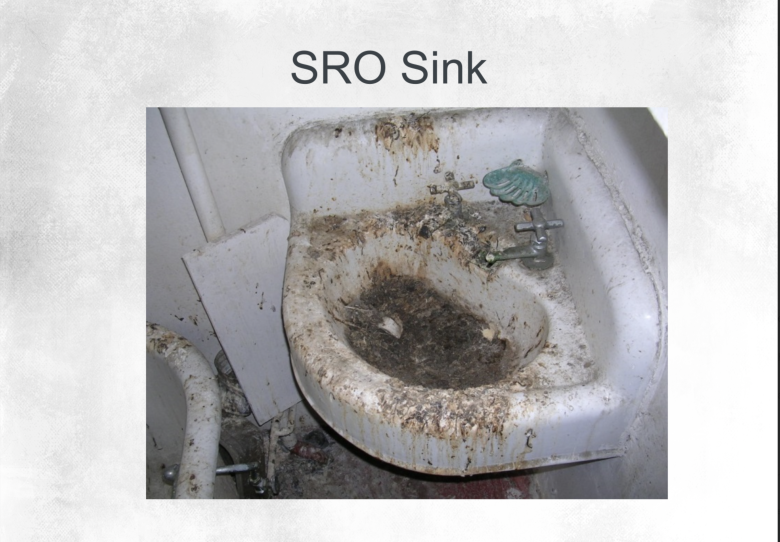
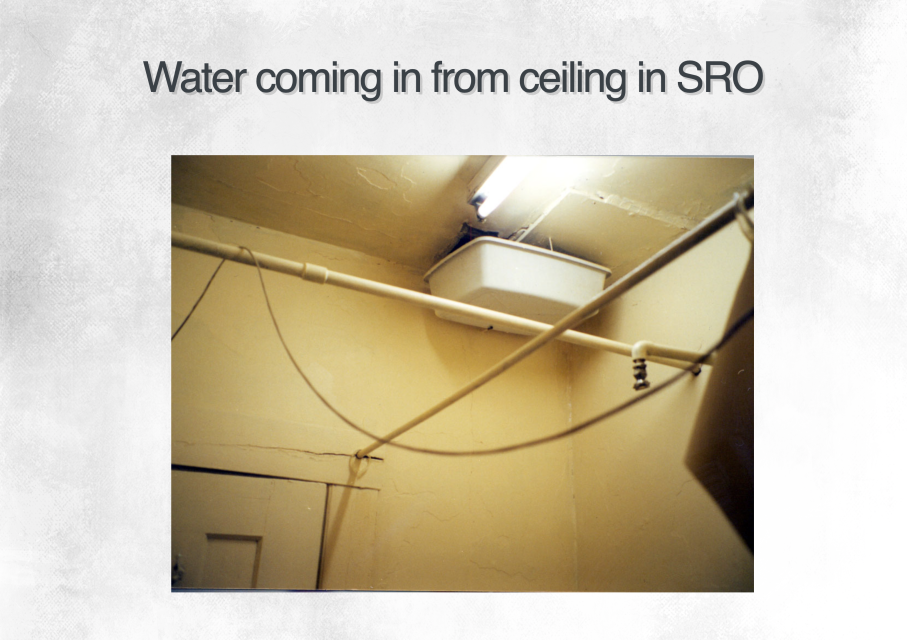
While there is, indeed, “outreach” going on, there’s more: Linguistically and culturally competent people are proactively looking for code violations of the sort that can lead to fire or chemical or structural dangers. Or like the revolting sink you see atop this story.
People living in dangerous, crumbling, putrid conditions can, ideally, have their situations ameliorated discreetly, without having buildings condemned and tenants put out on the street.
If need be, however, the baton is passed to housing inspectors, who do not do this work proactively and are not on speed-dial for put-upon, monolingual people, especially people who do not want to invite a government official into their home. And, if need still be, matters pass to the city attorney, who can take legal action.
In April, City Attorney David Chiu announced an $810,000 settlement against a Chinatown hotel owner.
“Let this be a lesson to all landlords who profit off of the suffering of their tenants,” Chiu said at the time. “In San Francisco, there are consequences for depriving tenants of a safe and healthy place to live. I’m proud our collective actions held the owners accountable and addressed the many issues at the properties.”
Those consequences, it turned out, were zeroing out the program that sparked this investigation and legal action. It would be like the Watergate Hotel marking Richard Nixon’s impeachment by laying off all the security guards.
In a total coincidence, in 2017 I visited one of the residential hotels where the city attorney in April extracted a high-six-figure sum from the owners due to “the many issues at the properties.”
Nine to 12 of the 27 rooms were vacant. I still remember the velcro-like sound of shoes sticking to the rancid carpeting and grandmotherly Mrs. Zeng explaining in Cantonese that “our janitor is very lazy” as she prepared razor clams in a dingy communal kitchen.
It’s not at all clear that all the officials who moved to nix this program without bothering to reach out and inquire what it did have ever set foot in a residential hotel.
They evidently didn’t talk to the people who administer these programs about what they do, let alone ask Mrs. Zeng about the experience she had pleading with her home’s former owner about the noxious conditions within. “He doesn’t care about the people in this building anymore,” she said while rinsing the bowl of clams. “He is rich.”
It is very convenient. For him.
“SRO”, “100% affordable” – we’ve designed a system of housing where the people we’re trying to help live in fear of asking for improvements and the property owners / operators never maintain livable conditions. From this article we learn there’s another $4 million dollars of cost to support a failed housing concept.
Fix the “concept” – make all housing mixed income.
In light of these stark “funding priorities”, it’d be edifying to see where newbie Mayor Lurie’s campaign donors and Trump’s “advisory board” of Tech billionaires intersect. Chris Larson and Joe Gebbia $upport both.
Right? Where are the Billionaires when it comes to helping the poorest?
Crickets. They’ll donate millions for techie drone law-and-order toys…
I do think this article could have been more convincing. We learn what the Code Enforcement Outreach Program is supposed to do but are not presented with any evidence that it is actually doing it effectively. Being culturally competent is not much help if no results come from tenants’ complaints. The Mrs. Zeng quoted wasn’t ‘t saying that this program was helping. And the disgusting sink: How did it get that way? Mr. Eskenazi seems to assume that the program was cut because people in the Mayor’s office do not know how bad the SRO’s are. I expect they do know. But perhaps they think that if this program is good the hotels should not be so bad. Other than tipping off the City Attorney’s office to a good court case, which is not the Code Enforcement Outreach Program’s primary job, we do not hear of any successful enforcements coming from the program. Do tenants know about it? Do they call? How many cases is the program working on? How do they enforce? Do landlords react when they get a call? Why should the program be saved?
Mayor Lurie is also set to take back soda tax money to spend on what matters to him. (2016’s Proposition V, implemented in 2018.) Prop V generates about $15 million per year. SF’s penny-per-ounce tax on sugary drinks is helping San Franciscans live their best lives by making it easier to drink more water, eat fresh fruits and vegetables, get exercise, improve oral health, and drink less soda. https://www.sodatax-sf.org/
The Tenderloin Food Policy Council is set to lose $170,000 (just a bit more than 1/1000 of one percent of the city’s budget). The group focuses on food insecurity in one of the poorest neighborhoods in the city.
Of course, Lurie’s ever-growing list of public drinking zones might help. If enough people buy enough of rum and cokes or 7 and 7s, Prop V might generate enough extra funds that the city can return the funds to where they were intended to go. For that to work, however, a few things will have to happen: there will need to be a substantial net increase in the consumption of mixed drinks in San Francisco; the mayor won’t steal that increase in taxes; and, the negative consequences of increased alcoholic mixed drink consumption won’t cost the city more than the “profit” to be made from that endeavor.
“ SF’s penny-per-ounce tax on sugary drinks is helping San Franciscans live their best lives by making it easier to drink more water, eat fresh fruits and vegetables, get exercise, improve oral health, and drink less soda”
You cannot believe that.
I don’t consider an SRO resident as housed. However the city does. I lived in several SRO’s back in the day and it’s very depressing to say the least. Once you get into the hotel system it’s hard to get out and it’s like living with savages!
I lived in SRO’s for years. They do not care about the residents. They’re only nice to you when it’s time to pay rent. I hope I never find myself in that predicament again.
Your Property Manager was nice at rent time? You must have been at one of the (comparatively) better SROs… ¯\_(ツ)_/¯