


The four-month pilot of a triage center on Sixth Street, a law enforcement and treatment hub that offered referrals to people struggling with homelessness and drug addiction, ended on Friday, according to sources from the San Francisco mayor’s office.
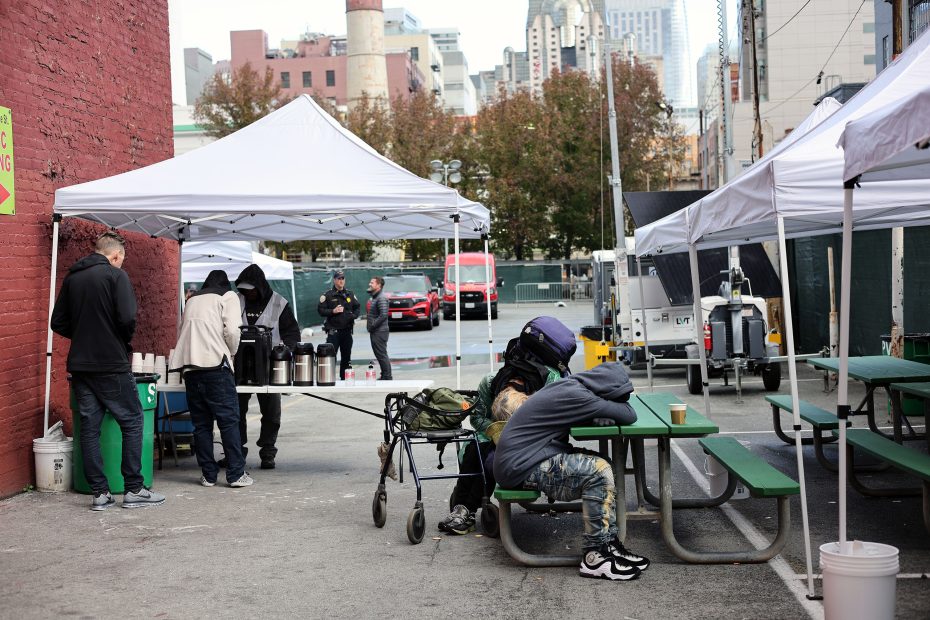
In the coming weeks, the site is expected to transition into an “oasis,” like the one run by Urban Alchemy at Turk and Hyde streets: A safe outdoor space, chaperoned by ambassadors, where people can gather, sit down, and relax.
In other words: A park in a parking lot.
Services will no longer be offered at the Sixth Street location. Instead, the city’s neighborhood-based street teams, which involve multi-agency coordination and patrol different areas of the city, will handle outreach and offer services like connections to shelter or treatment on the ground.
The Tenderloin-area street team, four other neighborhood teams, as well as a citywide team were announced in late March.
“When I took office, it was clear that Sixth Street desperately needed help,” Mayor Daniel Lurie said in a statement to Mission Local. “We piloted the Mobile Triage Center to surge resources, and we have made real progress connecting people to services.”
Lurie said the Sixth Street triage center helped to inform the development of the neighborhood street teams, which are a collaboration of seven city departments. Now that the teams are fully operational, he said the site could be transitioned to the new model.
A source from the mayor’s office said that more recent encounters for services have largely been handled by the roving street teams and have decreased at the stationary hub at 469 Stevenson St.
Newer data from the mayor’s office shows that more than 3,200 health connections were made at the triage center by the end of April. Shelter placements, meanwhile, were relatively low at the center, with 377 connections to shelter in its first three months.
Street teams had more success reaching people directly: Data from the mayor’s office shows 653 people were connected to shelter within the first 49 days of the teams operating.
It is unclear what type of shelter this may refer to; anything from long-term housing to a 24-hour stay at the city’s new crisis stabilization center counts as a shelter placement.
Envisioned as an arrest-processing facility
The triage site, located in a parking lot, was initially sold to the community as a place to offer services or easily process arrests. It also became a hub for better coordination among police and other city departments, like the Department of Public Health and the Department of Emergency Management.
While police were often present or stationed nearby, however, the triage center was not ultimately used as an arrest processing facility. For many, it became a place to get a cup of coffee or respite from the street.
For the acting captain of the San Francisco Police Department’s Tenderloin station, Kevin Knoble, that was often enough. “It is so comforting to have a humane thing to offer somebody; that immediately is a success,” he said in an April interview. His hope at the time was to establish enough contact and trust with people that eventually, they would accept help.
Sources from the mayor’s office said one of the site’s goals was to improve street conditions on Sixth Street, and that it has succeeded in that effort. They could not, however, provide any data to support that claim. And walking around the Sixth Street corridor, signs of success are often hard to spot.
Some days, the alleys along Jessie and Stevenson streets are clean. But Sixth Street itself can be impossible to walk through, as crowds of people block the sidewalk, slumped over and actively consuming drugs in the middle of the day.
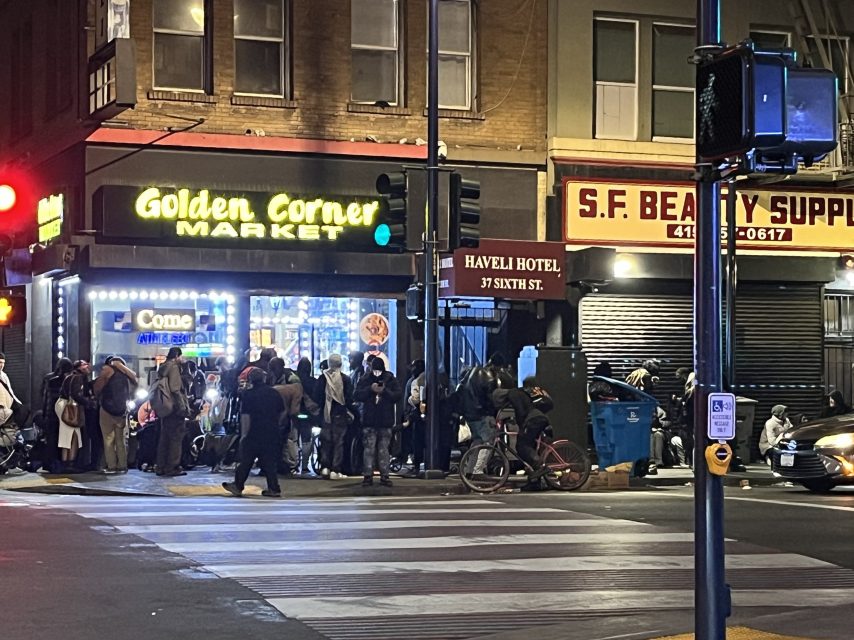
At night, the crowds swell, and more than 100 people gather along Market and Sixth streets, many clustering around the Golden Corner Market, which stays open late. One Thursday after midnight, people drank, openly took drugs, and played music, while an Urban Alchemy ambassador stood nearby.
At one point in the evening, some in the crowd began throwing glass bottles at this reporter’s car.
On Thursday morning around 11:30 a.m., this reporter observed three people using pipes and foil to consume drugs at the corner of Sixth Street and Mission, with one swaying semi-conscious in the middle of the sidewalk and another passed out on the ground.
Walking toward Market Street, others sat among suitcases and miscellaneous items strewn about on the sidewalk as pedestrians stepped gingerly to get through.
The triage center is just around the corner, and a police car is parked just up the block.
Nearby, Azmi Murait stood behind the counter of his shawarma shop.
Though he can see some of the efforts being made, Murait said it isn’t enough. Often, when he points out blatant drug dealing or other illegal activity to police, officers tell him they can’t take any action.
When he has stepped in himself, asking groups of people to stop blocking the entrance to his restaurant or filming drug dealers, he has gotten blowback: Once, people broke his glass windows and attempted to enter the store, brandishing tools as weapons, said Murait, who opened the shop in 2022.
He wasn’t afraid, he said. He went to grab his knife.
“We have to feel safe. It’s my right to have my business here,” he said. “I’m fighting for my rights. I can die for it.”
Kate Robinson, the head of the Tenderloin Community Benefit District, said she is hopeful for the oasis idea.
“The Turk and Hyde oasis was part of a game-changing effort of transforming that intersection,” Robinson said, noting that she used to observe constant “negative activity” there when she worked with Safe Passage, which focuses on getting children and seniors safely through the neighborhood. “The oasis is exactly what it sounds like; it really transformed the block.”
Robinson said the oasis, which was built on a parking lot after the Turk and Hyde mini park for children was renovated across the street, has had sustained success since it came about in 2022.
“It really stabilized and sustained that as a positively vibrant intersection,” Robinson said. Now, people go there to socialize, and she has even taken work meetings there. “We have limited spaces in the neighborhood, so it’s really nice to have a place to sit down, a picnic table to sit down at, that’s really a safe space.”
Good story. Thanks for covering this.
what does “connected to shelter” mean? is the city getting people safely off the street or just getting them on another waiting list? if all that’s happened is the cops chased people to another block elsewhere in the city then this was a failure.
anecdotally, i can walk down 6th to get to my flat after work when i couldn’t 5 months ago. but it’s still covered in feces, trash and people who aren’t getting help.
Thanks for reporting.
People should be offered services and temp shelter; however , as this article shows most don’t come or refuse.
Until the drug supply is stopped , most want to remain on the streets .
I dont understand why people dont comprehend this.
Addicts , dealers , thughs , vagrants have made a lifestyle choice .
Most who offer services and understand homelessness and drug addiction, including the addicts know this .
The drug supply must be stopped .
The party needs to stop.
Yeah, a mini park for children, until the junkies and the gang-bangers show up.
Hopefully they will staff it with Steward’s To keep it clean, safe and inviting like we do at Bodekker Park.