
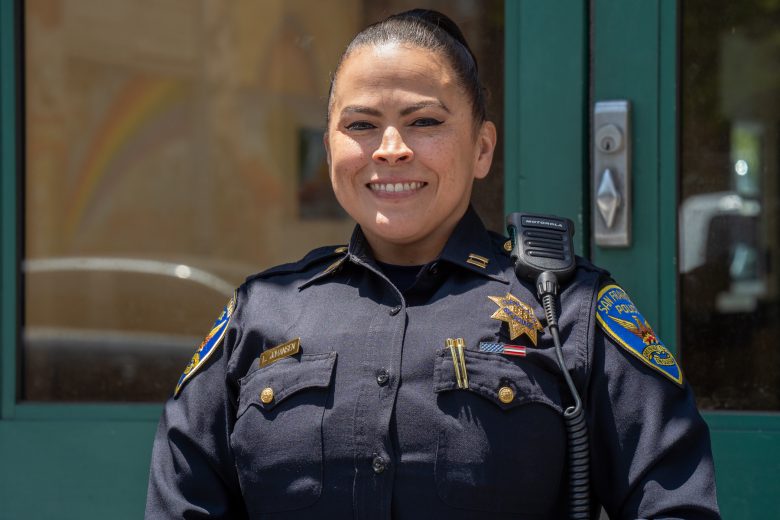

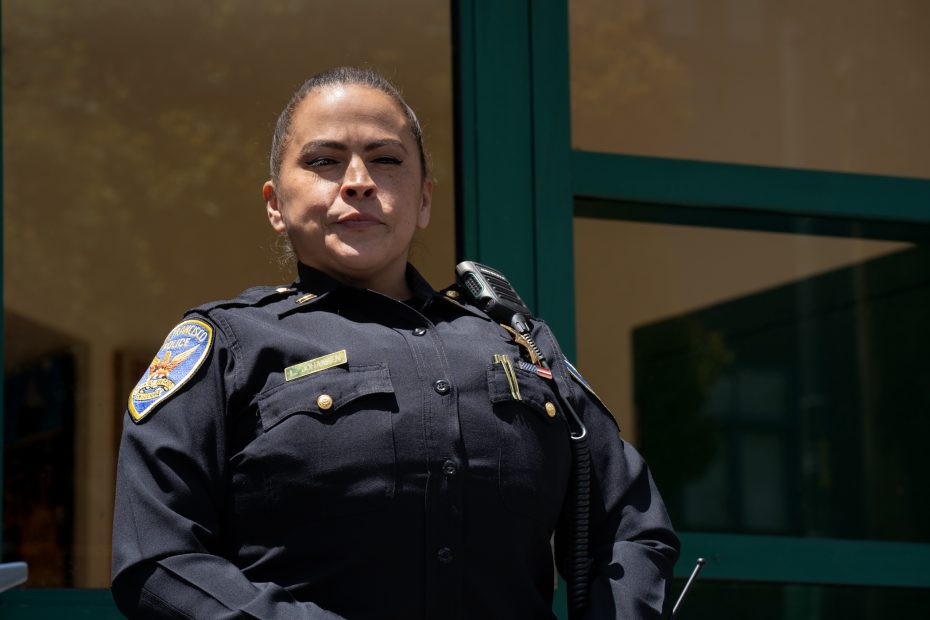
For nearly a year, Liza Johansen has served as the captain at the San Francisco Police Department’s Mission Station; she’s the second woman to hold that position.
In some ways, the situation in the Mission is good. Violent crime is a fraction of what it when Johansen was growing up in the neighborhood, or starting out as a police officer. But that doesn’t mean that public spaces necessarily feel safe.
Johansen spoke to Mission Local about SFPD’s months-long collaboration with other city departments to eliminate public drug use and fencing of stolen goods at the 16th Street BART station and surrounding areas.
District 9 supervisor Jackie Fielder awarded Johansen a certificate of honor at the Board of Supervisors meeting June 3. Fielder thanked the captain for doing something that few captains in the Mission could: “bringing people together.”

The interview took place on Friday, June 6 at Johansen’s office at the Mission station at 17th and Valencia streets. It has been edited for clarity and length.
ML: What does this neighborhood mean to you?
LJ: Well, I grew up in lower 24th Street. I went to elementary school here on 24th Street. I went to Saint Peter’s. When I became a police officer, it felt very much like I made it out of the neighborhood, for lack of a better way of saying it.
When I was on probation, I came back here. It was bittersweet. I would drive by the flat I grew up in every single day, and it felt like my life came full circle.
I didn’t understand the need for having Spanish-speaking officers until I was working here. It used to get to my heart when people were asking for help and then the officers didn’t speak the language. I really learned the value of being able to connect with the community in that way, in a professional capacity.
Then, I came back here as a lieutenant for three years, and it was a very hard time. It was after George Floyd, during Covid. It’s very hard to watch the community that you grew up in, that you love, suffer. I was responsible for the officers as well and I was trying to keep their morale; they were also dealing with Covid within their families.
ML: What does it mean to you to hold the position of police captain?
LJ: I think for many of us, women and people of color, our mere existence is change. I have to remind myself of what I stand for, and that people pay attention closely to how I conduct myself. I do value that responsibility and I take it very seriously.
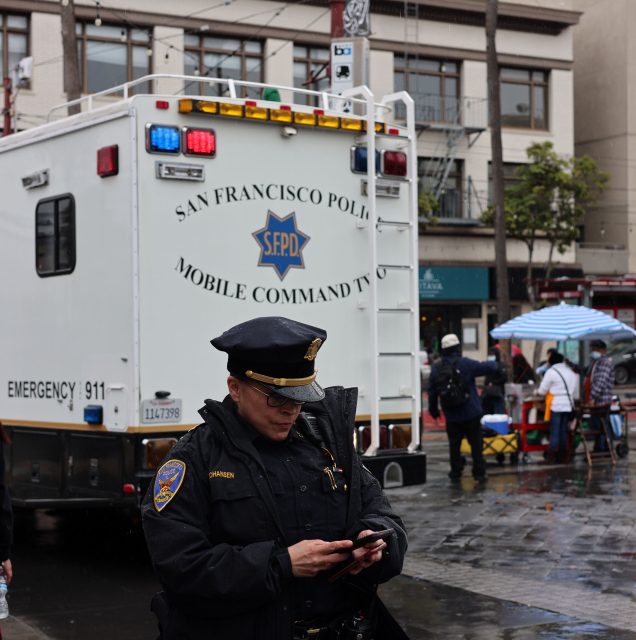
ML: It’s been nearly three months since the arrival of the Mobile Command Unit on 16th Street Plaza. Has it been effective?
LJ: I think it would be effective when the community has a clean, safe place to thrive. When we brought in the command van, my main concern was the plaza and the alleys, and then to see if what we were doing was going to be effective.
With that short-term goal, I’ve seen it be very effective. I mean — I can pick your brain about it as well. I value Mission Local’s coverage of it on a daily basis. You guys are eyes when I’m not there and when we’re out there.
So to answer your question, for the short-term goal, I do think it has been effective.
ML: How do you measure success beyond the short term?
LJ: Well, as a law enforcement officer, I think that’s a layered question. I think success can’t be measured by just one agency. Personally, success would be for me to be able to pull back all the police presence and have the community repurpose those plazas and take over and do something positive with it on a daily basis. That’s what it would mean for me, personally.
Professionally, I ask that question all the time: How do we measure success? Because even if the numbers go down, if the community doesn’t see or feel a difference, I would question that.
ML: For the police department, for your station, what is your long-term goal? Right now you have the command center, you have the Drug Market Agency Coordination Center [DMACC is a multi-agency task force that combines law enforcement with other city departments to address drug use and dealing in the Tenderloin and SoMa. It was created in 2023 by then-mayor London Breed]. What is the long-term goal for the 16th street plaza? How do you achieve it?
LJ: Well, I would love to not have cops have to just stand there for hours. That’s a heavy lift on our part.
I would love for law enforcement to be given the authority to enforce illegal vending. [In 2018, state legislation decriminalized street vending.] I just want the community to be able to walk to work and go to school and not have to see what they see right now on 16th and Mission. It takes a lot of work to get there, and it’s a constant not letting up. It’s tiring, but it’s worth it.
ML: You just mentioned the vending ban. You’re behind that piece of legislation? You’d like to see those powers come back to the police department?
LJ: I try not to take any political views on it, but I do think that when the Department of Public Works is the agency that can enforce it, DPW needs SFPD there so that they’re not harassed or assaulted. So the enforcement looks overwhelming. What takes DPW workers and 10-15 cops can be done with two police officers if we had the enforcement ability.
ML: Have you considered moving the command center to other parts of the neighborhood? Have there been conversations about a second command center?
LJ: There will not be a second command center coming. If and when the command center is needed in another part of the neighborhood, it will be moved. When I was a beat cop, it was at 24th and Mission because there was a lot of gang violence there.
ML: When was that?
LJ: I want to say 2008, 2009.
ML: Was it effective then?
LJ: Yes.
ML: How long have you been asking for resources? How long have you been sounding the alarm for?
LJ: When I got here at the end of August, early September, I gave myself a couple months to assess everything and come up with some kind of plan. So I would say I was probably sounding the alarm at the end of October, beginning of November.
ML: Asking for the command center?
LJ: Those discussions did come up. I was told somebody had thought about it before. So it was a lot about, ”Where are we going to get the power to do it? Where are we going to put it? Is it available?” (There were) a lot of logistics.
ML: Neighbors have been complaining about drug users simply being displaced from one part of town to the other. How do you plan to approach that?
LJ: I think the displacement that we’re seeing is something that’s expected. I think it was something that was predictable. I think DMACC saw that when they did enforcement in downtown. So we knew that that was going to happen.
When the criminal element moves and we are able to accomplish what we want to on the plaza, and the community is able to take back that plaza and repurpose it, we will follow that displacement. San Francisco is not going to be a place where the criminal element can thrive the way that it was. It’s not going to happen. We just follow.
ML: Let’s talk about the two blocks of Mission between 14th and 16th streets. We’ve seen some criminal activity has moved there. We’ve seen a lot of unpermitting vending on the weekends. What do you make of that?
LJ: The approach that has been really successful with the alleys has been the offering of shelter before the police go out and do enforcement, so that the people who need help do get the help that they need, if they want it. Police then will go through and enforce in the alleys and then Public Works ideally would go through and pick up garbage and clean the streets.
Now, what I’m seeing on Mission between 14th and 16th — a lot of the displacement is there, as well as Potrero. The issue, which has just recently been brought to my attention, is if the resources [The Mission Street Team, a collaboration between several city agencies which does outreach in the area] go out first there, they are not safe because there’s a larger criminal element and it’s more condensed, so the enforcement will have to go out first, but then that’s challenging because of the vending. The city of San Francisco has to be orchestrated in their approach.
ML: Can you talk a little more about a new approach?
LJ: Santiago Lerma [Director of the Mission Street Team] would be best. He comes up with the approach that he thinks is effective and then I support him in that. When we first got to know each other, he was like “Let me know when you’re available.” I was like, “Santi, you come up with a plan. You let me know when you need cops and we’ll be there.” …. We work well together.
ML: Based on our observations, there seems to be less police presence at the northeastern BART plaza and a lot more vending. The conditions there seem rougher compared to just across the street.
LJ: I’ve gotten a lot of that feedback. I’m very wary about where I’m moving the resources, because I don’t want what we’ve already done to be undone by trying to address too big of an area.
As far as extending those resources, I’m working closely with DMACC, BART and other agencies to help address that. I don’t want to move and then have it just go back to the way that it was. But I’m seeing the same thing.
ML: Some residents have said they don’t see enough police officers doing foot patrol.
LJ: Well, it depends what residents you’re talking about. You have some who feel better when there’s more of us, and you have some who might not want to see more cops out there. If I have two officers on foot somewhere, and then a call comes out of a violent crime in another part of the district, they need to run or walk to their car to get out there.
When I was a beat cop, there was foot patrol all over the place. Some people do work overtime for the foot patrols, but it’s hard to do that with this number of cops. I think I have three working today. It’s very challenging. Sometimes you see them and sometimes you don’t, and that really depends on staffing on a daily basis.
ML: There’s a sense of distrust from some members of the community when it comes to the police department. How do you gain the trust from the community?
LJ: Because of how the area was when I grew up, I would say my views of police have changed through the years. I wasn’t born a police officer. I would say that I respect that.
I took the community meeting out of the station, and I put it mostly in the neighborhood. I try to move it around and keep it where I’m accessible if people from the community want to come and talk.
I think I’m very humble. I do my best to let that emanate from my person. Because I’ve worked here, I’m used to getting yelled at and talked to in a certain way, and I have to listen through people’s anger and hurt to hear what they’re saying, but that’s just who I am as a person.
The police around the country, and around the world, are different. Many have had good times and bad times. I don’t expect to heal decades and decades of issues in my lifetime, but I do my best on a daily basis. I try really hard to let people see me as a person.
ML: There is a lot of drug use moving to Mission Street. How is SFPD shifting that focus?
LJ: Well, 16th and Mission has always been an area where there is drugs. I used to buy drugs undercover there. Has it gotten extremely worse? Yes. I think we are doing everything that we can from a public safety approach. So there’s the cops that you see, there’s undercover work being done. There’s a lot of different layers of police work getting done to address that issue.
ML: On the weekends, the area is pretty abandoned by officials. (Mission between 14th and 16th streets)
LJ: I know, it’s infuriating. We do sporadic operations when we can get the personnel. You have to verify this, but for Public Works, it’s overtime on the weekends for them. If they don’t have people that sign up for overtime, then there’s no enforcement.
The police officers are not going to go in a crowd of like 100 people — if they even have the opportunity to make observations, to have probable cause — to make an arrest. There’s not enough personnel.
Sometimes Public Works will have somebody, and then citywide will try to pull officers and we don’t have them. It’s very hard to navigate it on the weekends.
ML: How did you take Chief Scott leaving?
LJ: It’s hard to see him go. [On May 7, SFPD Chief Bill Scott announced his resignation in order to take a job in Los Angeles] He’s done a lot of good work here. As a woman, as a woman of color, as a leader, I have learned so much from him, professionally and personally. So, it’s hard to see him go. I can’t imagine who can fill his shoes.
ML: Have you been getting eight hours of sleep since the command center arrived?
LJ: I don’t think I’ve gotten eight hours of sleep in 20 years. I really don’t know how to not work at 120 percent. I’m so blessed to have a staff that works as much, if not more than I do.
But to answer your question, no. When my kids were small and I was an investigator, I’d be on call and I’d have to leave in the middle of the night and they’d cry for me not to leave. I would always say, ”The bad guys don’t sleep, so mommy doesn’t sleep.”
ML: How is it being the police captain? Do you have people coming up to you when you’re not working, bringing issues to you? How do you separate your personal life from your job?
LJ: I very rarely come out in San Francisco. I stay close to home. I have a partner, so the phone going off constantly can be challenging. The other day I went home, I put my things down. I was like, “two phone calls. I’ll just make two phone calls,” and he was like, “Okay, Liza, two phone calls.” I counted my 35 calls that day at home, so I learned my lesson.
I’ve been divorced twice. I’m either here or I’m with my partner, there’s no other in between. My partner knows that he shares me with this job, and he knew that coming into it.
The job takes a physical toll on me. He says I talk police work in my sleep, like I woke up in the middle of the night, like, “Did he tell the lieutenant?,” and he’s like, “Liza, you’re sleeping.”
ML: Anything else that you would like to add for people to know?
LJ: That I lead with my heart, and that everything matters to me all the time. Whether they see it or not, our officers are working constantly. That’s all we do. It’s so hard for me to keep the morale here at the station because they’re wearing so thin and they have lives and they have children.
I would love for this community to try, when they see an officer, to put all negativity aside and just go up and say, “Hi,” and say, “Thank you,” and engage them in conversation. I think it would mean a lot to the community to know them as people, and it would mean a lot to the officers to be treated like people.
When I first glanced at this article I winced. My initial gut reaction was, this looks like another woke DEI episode of a POC woman put into an authority position, for the sake of the leftist sociopolitical agenda.
Reading the interview, I found myself liking this Captain. She seems authentic, smart, dedicated . I came away thinking of her as competent cop, doing her job.
Compare to that LAFD chief making comments during the Palisades fire. It’s that kind of woke DEI that brings a bit of a curse to genuine public officials like this one.
What are we to make of the fact that SFPD staffing is allegedly down 25% from full staffing, yet the department’s budget is significantly larger than it ever has been, skyrocketing on a per-sworn officer basis?
Overtime pay? Trying to attract good professionals in the wake of defund the police?