

The new BART fare gates, first installed in December 2023 at West Oakland station and ubiquitous today across the Bay Area, were put in place with a promise to reduce fare evasion.
The agency said that the new 72-inch “Next Generation” fare gates, which came with an eyebrow-raising $90-million price tag, would “deter fare evasion with a design people can’t push through, jump over or maneuver under.”
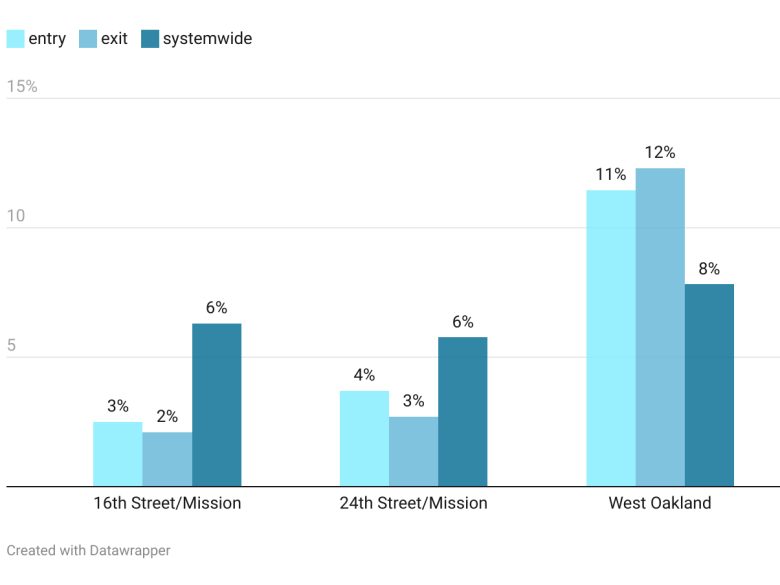
The agency pointed to data from West Oakland that showed an 11 percent increase in entries and exits between January and June 2024 when compared to the same period in 2023, almost double the systemwide increase in that timeframe.
The equation is simple: With less-permeable gates, there should be a corresponding increase in paid ridership.
But a closer look at data from Mission District stations — 16th Street/Mission and 24th Street/Mission — does not paint a clear picture of success.
Six months after the installation, entries and exits at both the 16th Street and 24th Street BART stations increased, but at lower rates than either increased across the entire system. That’s compared to the same six-month period in the previous year.
The 24th Street station saw 1.7 million entries and exits from October 2024 to March 2025. That’s a 3.2 percent increase from the same period in the previous year, but less than the ridership increase of 5.8 percent across the entire BART system.
At 16th Street station, the new gates were installed on Oct. 12, 2024. That station saw a modest 2.3 percent increase in entries and exits in the next six months, lower than the 6.3 percent systemwide increase in that same period the previous year.
James Allison, a BART spokesperson, said he would caution against drawing the conclusion that the gates in the Mission stations did not fulfill the goal of deterring fare evasion until the agency has a chance to examine the data more closely.
He referred to a quarterly performance report released in March that showed about 17 percent of riders saw fare evasion firsthand, which was down from 25 percent in the same period the previous year, before the fare gates were installed.
Some stations have reported increased fare revenue following the installations, Allison added, like the Pittsburg Center station, which saw a 6 percent increase in paid exits within the first week of installation.
“I encourage riders at the Mission stations to see for themselves the difference between the old gates and the Next Generation Fare Gates,” he said.
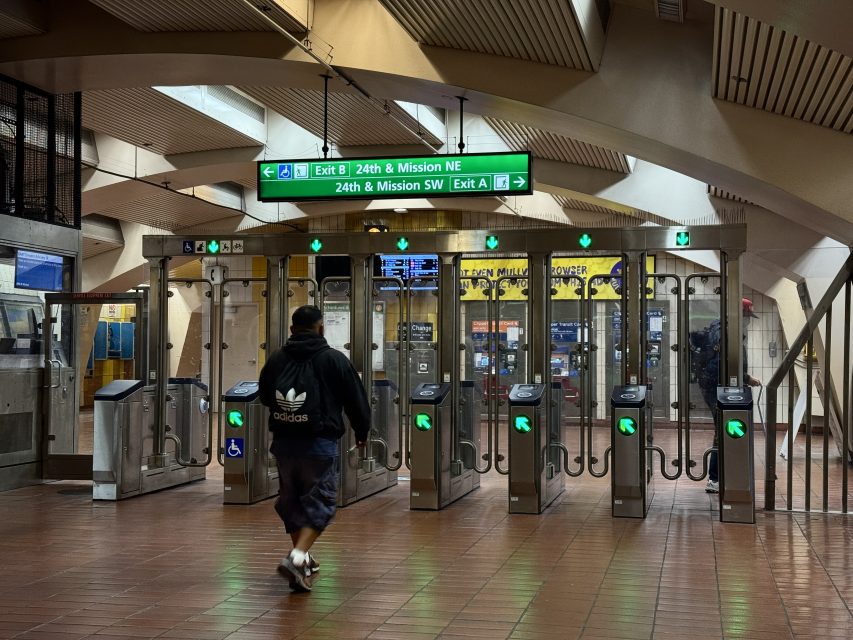
Gloria Lopez, who was waiting for a train to Antioch at 24th Street station around 3:30 p.m. on a recent Tuesday, said she had been followed closely by someone else to get through the gates at least three times.
“It’s more dangerous now, because you don’t know who’s behind you,” Lopez said. “I don’t like people getting close to me, especially men.”
“People don’t hop it. What they do is they go right behind you really close,” added Jeff, another passenger. “It feels kind of weird. They almost push you so that they can get through faster.”
A BART agent, who wishes to remain anonymous, said that the new fare gates meant “fewer homeless people with shopping carts coming through” — what she called “less flow of transients.”
“They do serve a purpose,” she said, but that seems to be more about keeping up an appearance of cleanliness than fare evasion, per se.
Another possible side effect of the new gates? Those who continue evading the fare are now more aggressive, the agent said.
In March, the agent witnessed a woman in her 60s punched by a group of teenagers after she refused to let them exit the gates after her. “She was punched so hard, when she fell to the ground, she slid a couple of inches.”
“Fare evasion is still there,” the agent added. “It has just changed.”

I really hate these new gates. They react too slowly to tagging your clipper card so you have to pause as you walk through: It disrupts the flow and makes it easier for someone to follow you. Plus if you are too slow you get a face smash from the gates. It also visually makes the whole experience of Bart less pleasant.
I was just in London recently and they did a so much better job with the fare gates (plus the escalators, plus the wheel noise…) Plus who names train lines after colors when almost 5%of the population is colorblind? Why can’t Bart learn from other countries? Everything they do seems so nonstandard and clunky.
At $90 million how many additional fares do they need to pay them off plus interest? I doubt they did the math.
The tailgating is a huge problem. I basically check around me every time I go through the gates to ensure nobody is lurking.
This is anecdata,but I commute in/out of the 16th St stop almost every day, and the amount of evasion I’ve seen has dropped a lot– from what felt like multiple people every day to maybe 1-2 per week.
As the article mentions you do get folks tailgating which is annoying. There are also folks who hop the plexiglass near the NE entrance.
I also wonder if some fare evaders have switched from BART to Muni.
That doesn’t make geographic sense.
I used to see both men and women jump over the turnstiles but I haven’t seen anything like that in a long time.
The new fare gates are awful. They no longer tell me how much is left on my card. They often don’t work (tap again, see agent) and I have to try a different gate. I saw someone climb over one of them.
I have been followed through several times, mostly at 24th St. One time I stopped so the woman could not follow me through. She pushed me and then started yelling about how I should keep my hands off of little girls. As a rider, I do not know the best way to deal with someone following me through?
What I’ve witnessed since the new gates have been installed is an increase in fare evasion.
The gates stay open longer than the old orange gates. Fare hoppers / tailgaters have more time to plan, more time to maneuver, and more time to follow riders through the gates. My personal experience …I have been tailgated more in the last 6 months than I had been in 20+ years prior. I also observe gate activity at my stations. I deal with data, logistics, and process mapping & improvement for a living, so it’s the type of thing that I casually observe when I’m out and about. In my daily observations I see much more tailgating (entry and exit) as well as more sliding under the gates than I did with the old gates. With my personal experience coupled with my observations over time and at multiple stations, I say that fare evasion seems more prevalent than before.
The article linked is based on rider observations reported. Not much additional detail was provided. That kind of survey is going to come with a big margin of error along with a lot of assumptions (which may or may not be correct).
I am curious how exactly the surveying and analysis were done. Was there a benchmark study of lost revenue due to fare evasion? How was $90MM determined to be fair and reasonable? How was the pathway to recoup that investment documented? You would have to capture 22 million $4 fares to make $90MM. That seems to be an enormous hurdle. There are several other factors to look at to have a proper modeling of fare evasion impact on the BART system.
The main study pointed to is a policing study (enforcement) versus a business study (rev-gen). And BART has previously mentioned fare evasion impacts them to about $25MM (over time?, per year??). On the surface that’s way off…spending $90MM to address a $25MM impact. I don’t have all the details. I’ll try to find out. But for now, that just doesn’t seem right.
From a long time daily user standpoint the new gates have a slight delay after tapping which throws off the pace of entry/exit compared to before, and makes gate clumping more prevalent during rush hour. Even off commute hours has more clumping due to the slow opening. They have changed the flow of the commute. As a rider, I don’t like the new gates. Add that feeling to the observations that fare evasion seems to have increased (vs. decreased) and I would say the roll out of the new gates is not successful, or at least not as successful as BART is claiming.
One thing keep in mind is that they were not asking the gates primarily to capture lost revenue from the fare evaders themselves. They were primarily banking on what is started in the article concerning “transients”. They have had a huge decrease in ridership sure to a decreased feeling of safety. The primary goal was to increase the feeling of safety and the survey of people’s feelings of fare evasion show exactly that. Hopefully that translates into increased ridership and maybe even a couple extra fares from some of the folks that were evaders before.
It doesn’t stop them on the ends where there is a stairwell or an escalator. They just hop around it.
Bart station agents need to do more or quit making so much money and benefits. They are totally useless. Might as well just throw your money away paying them.
– “saw fare evasion firsthand” . . . I have had persons push me through the fare gates
I have seen persons jumping the fence / the gate I have watched countless persons tailgating
– Since BART will not share their propriety data with Cubic, that is why we don’t know our balances. Just more of BART not being transparent
I used the new gates for the first time on Saturday the 14th at Civic Center. They don’t show Clipper card balance, unlike the displays on the old gates. WTF?
Keeping up appearances is *so* San Francisco in 2025. Whether it’s BART or Lurie, they’re just trying to appease voters and elected representatives at state and federal levels.
> Another possible side effect of the new gates? Those who continue evading the fare are now more aggressive, the agent said.
Next step would be for increased BART PD patrols to arrest violent transit riders.
> “They do serve a purpose,” she said, but that seems to be more about keeping up an appearance of cleanliness than fare evasion, per se.
The appearance of cleanliness is important. Public transit riders deserve a clear, comfortable experience. Let the hobos carpool with people who drive around in cars.
The headline says fare evasion didn’t decrease in the Mission, but the story itself says fare evasion decreased in the Mission. Seems like tailgating is the real problem with the new gates, not whether they cut fare evasion. Why would ML use a headline that’s contradicted by the story?
This is one of the most biased articles (and poorly written) I have ever read. I live at 16th and mission. One of the problems with the tall gates… is that it is surrounded by short walls. I see people hopping the wall all the time. Overall, the gates DO help reduce the number of people that hop that wall, which is reflected in the data.