
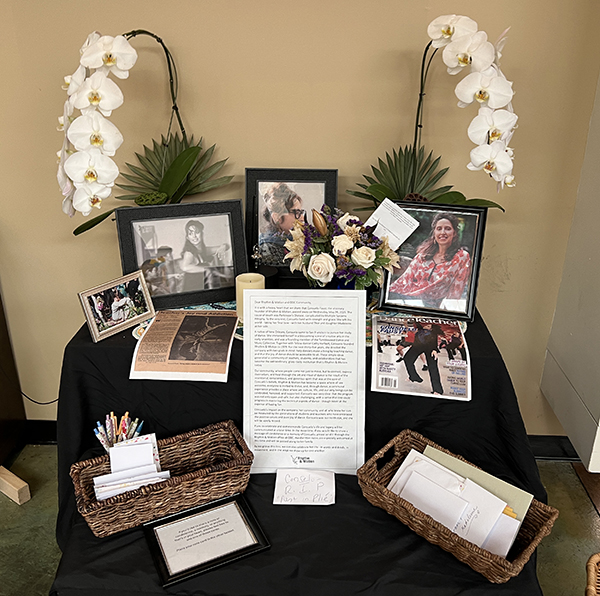
RIP — ”Rest in Plié” — reads one of the many messages on the altar for Consuelo Faust at ODC’s Dance Commons on Shotwell Street in the Mission.
The beloved dancer and teacher died in May after a long battle with Parkinson’s Disease. In 1979, Faust founded Rhythm & Motion, a dance program combining a high-energy workout with music to choreographed routines, after being chided for teaching an aerobics class too much like a dancer.
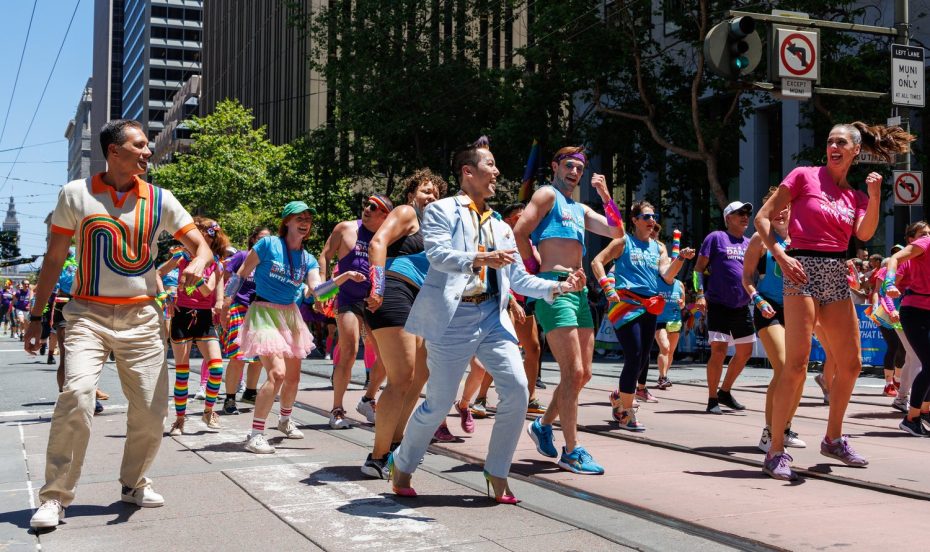
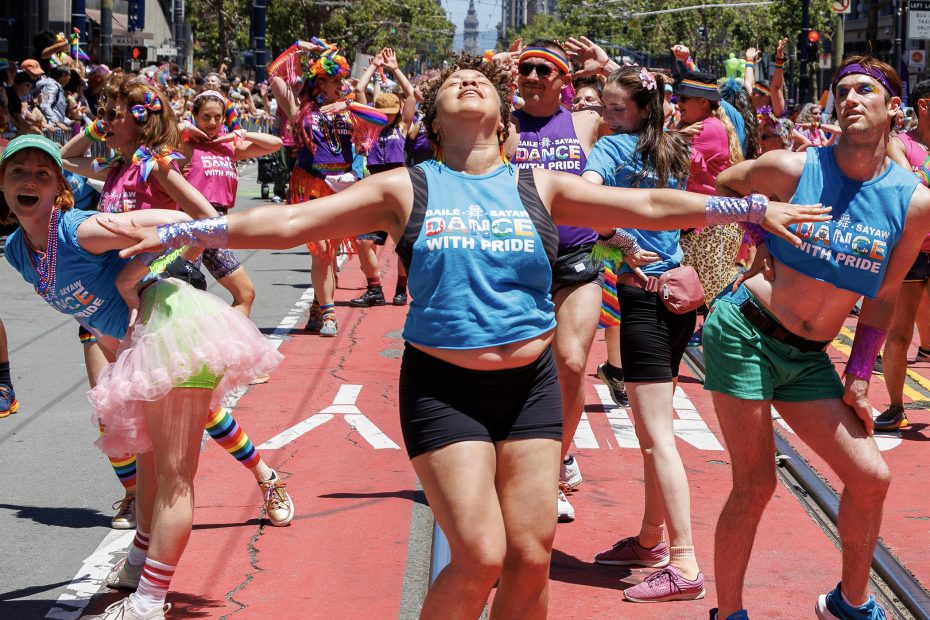
Faust died the month before Rhythm & Motion brings its nearly 200-strong contingent of dancers to the Pride parade Sunday. Her death has infused this year’s appearance, which marks a decade of Rhythm & Motion dancing in the parade, with big feelings and deeper meaning.
“Consuelo’s experience was that students were liking it, and she had a lot of people in class,” said Dudley Flores, Rhythm & Motion’s artistic director. “She was very popular, and there’s value in being a dancer, because the body and mind knows.”
After moving to San Francisco in 1972, Faust became part of the experimental all-women’s dance troupe Tumbleweed — there was an all-men’s group called Mangrove at the time — and went on to create two of her own dance companies.
Yet the San Francisco-born Rhythm & Motion, which she created with fellow dancer Cathy Herbert, is her enduring legacy. For 35 years, Faust directed the program, creating trainings and a pipeline of teachers that gave work to dancers.
Today, Rhythm & Motion employs 24 teachers in San Francisco and has opened satellite programs in Berkeley, Santa Cruz, and Portland, Oregon. Flores hopes to continue to expand, both within the city and beyond.
By turning dance into a workout, Faust made it more accessible to the general public. She likened it to a house, Flores said, in which you snuck would-be dancers in through the back window instead of bringing them in through the front door. “She was an amazing mentor in helping me, and us, shape how we teach people and how we lead,” Flores said.
Thanks to Faust, numerous luminaries within the dance world got their start from Rhythm & Motion: The executive director of Dancers’ Group, Wayne Hazzard; noted choreographer and performer Amara Tabor-Smith; and dancer and teacher Kathleen Hermesdorf, to name a few.
The charismatic New Orleans native also helped long-time dancers find a path back to loving the art after negative encounters with body-shaming, something Flores himself experienced after he switched career paths from doctor to dancer.
“There were teachers who said, ‘if you’re going to be a professional dancer, then your leg needs to be higher,’” Flores said. “That’s not encouraging.”
Flores, like Consuelo before him, wants adult dancers to feel good in their bodies, and feel good about dance. His message is getting through: He has a cult-like following similar to Faust’s and, on Saturday mornings, an average of nearly 100 dancers sign up both in person and online for his class.
Writer Laura Fraser, who has danced with Rhythm & Motion since 1984, struggled with body image and a past negative ballet experience before she found the dance program.
“Consuelo and Rhythm & Motion helped me discover my physicality and realize a dream that I could dance, no matter what size my body,” she said. The 64-year-old is presently in Cuba studying salsa and Afro-Cuban dance thanks to her experience with Faust, she said.
“It allowed me to develop and pursue one of my greatest passions,” she said.
This year is marked by Faust’s death, reduced corporate funding for the parade and a White House that, to put it mildly, feels unfriendly to celebrants. “This year feels different because of the struggles going on in the world,” said Teri Cahill, a retired Zuckerberg San Francisco General Hospital nurse. “It’s like a wall.”
Cahill has been dancing with Rhythm & Motion for more than 30 years. As a nurse, she watched many young people die during the height of the AIDS epidemic.
Despite the heaviness, the mood in the studio is one of pure exhilaration. “The rehearsals have been so loving and joyous and full of intention,” Flores said. Lucy Junus has been dancing with Rhythm and Motion since 1984. “It’s my happy place,” she said.
At 66 years old, she considered giving herself a break this year from dancing in the parade but changed her mind. “It’s so joyful to be together. The energy is incredible,” she said.
Lynn O’Kelley is dancing for the first time in the parade Sunday, though she’s danced with Rhythm & Motion on and off for 15 years. The death in May of her gay friend Garbo Chang, who jumped into the water at Ocean Beach to save his dog Benji and drowned, spurred her decision to participate this year. “I’m doing it for him,” she said.
The contingent of dancers in the Pride parade represent the LGBTQ+ community as well as allies, including many parents of queer children. The songs chosen for three choreographed routines include Chappell Roan’s “Pink Pony Club,” Keala Settle and The Greatest Showman’s Ensemble’s “This is Me” and David Guetta and Szia’s “Let’s Love,” all of which promote active self-acceptance and love.
“We need to be present, and we need to keep showing up,” Flores said.