
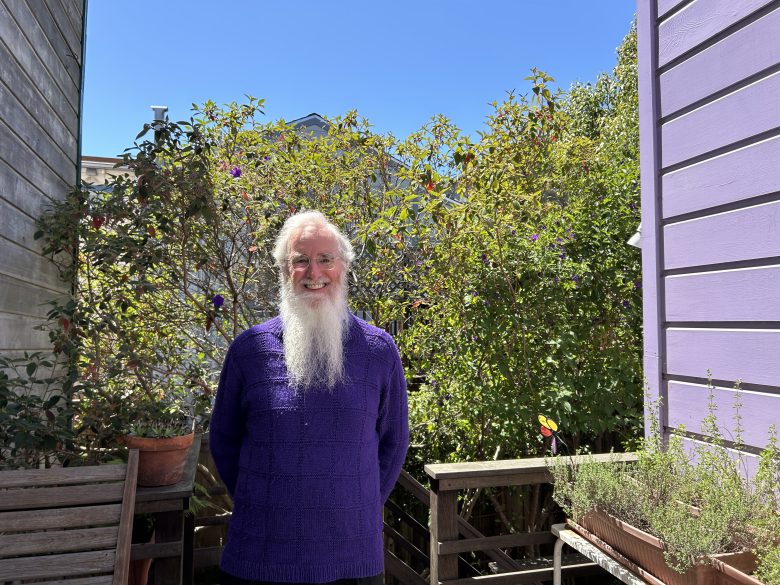

When he was 29 years old, Edward Hasbrouck and his partner took a trip around the world at a particularly opportune time.
It was 1989, and they arrived in China just months after the Tiananmen Square massacre. While they were in Kashmir, an armed nationalist movement erupted. And by the time they made their way to Germany, it was November, and the Berlin Wall was falling.
When he returned home, Hasbrouck, a lifelong activist in anti-war and environmental movements, made a pivot. He had never held down a consistent job, but he trained to become a travel agent.
“I saw my role not as selling people on travel, but to engage in travel — not as a commodity, but as an experience,” he said. “A lot of what I find most valuable about travel is not what you were seeking but what you find that you were not looking for.”
Fast forward eight years and Hasbrouck wrote the “The Practical Nomad,” a 1997 guidebook that covers details like crossing borders, picking travel partners, and haggling. In it, he advocates for longer journeys to mitigate the environmental impact of air travel and, he said, he’s never owned a motorized vehicle, preferring transit and bicycle journeys.
But, five years after the COVID-19 pandemic, Hasbrouck said his relationship to travel has been irreversibly altered. He’s hesitant to travel by air for recreation, and is unsure if he will do so again, wary of the potential health risks of Long COVID and the environmental effects.
Born and raised in Massachusetts, Hasbrouck said he was formed by the New England town meetings he attended in the Boston suburbs, where every neighbor had a say in what was happening in their community.
Now living in the Mission, his life is less nomadic. His activism work is based in the fight against climate change and empowering youth activism.
“I don’t pretend to live a perfectly moral life. I try to be aware of the costs I impose on the world and make some positive contributions,” he said. “A sustainable world is one that is going to be more local.”
He’s particularly interested in activism against the selective service. In 1982, he was convicted for failing to register for the draft, and spent four and a half months in prison.
When talking about this time, he lights up with passion, leaping through decades of activist history and government contradiction. Working at the National Journal of Resistance to the Draft was what first brought him to San Francisco, in 1985. Today, he protests outside the Tesla dealership most Saturdays, and writes extensively about the fight for digital privacy and free movement.
“I’ve spent my life struggling in struggles that have not been successful,” he said. “But at the same time, that’s all sunk cost. It’s not a reason to stop being active now.”
“He’s hesitant to travel by air for recreation”
“His activism work is based in the fight against climate change”
Given that every single flight emits hundreds/thousands of TONS of C02, yeah.
People driving around in “EV”s oblivious of where their power comes from, yeah.
Even just staying home buying groceries creates plastic waste none can deal with.
Just washing your clothes puts microplastics into the ocean, soon onto our plates.
If we were SERIOUS about the environmental costs we’re inflicting on the future…
what would it look like? Because we’re about to see what it looks like to ignore them.
So people can visualize the facts, just making cement for construction causes 400% more Co2 release, than air travel… so even building homes is heating up the planet ! It seems there is nothing humans do that does not heat up the planet. I fly a lot to enjoy the whole planet. I did my part by not having children, who will also not have children. I ‘feel good’ about my choices too !
I know that Ed Hasbrouck will likely not read these comments, but in the early 2000s, we followed his book religiously when we traveled.
This article has warmed my heart and lighted an otherwise pretty dark time.
We have also stopped flying for leisure travel, even though most people we know travel further and further by air, almost like collecting trophies. We are very eco conscious in our day to day lives, which mostly feels like spitting into the wind, but at least we can live with our choices and feel good about them.
So, hey, Ed! Thank you so much 🙂
Well, as long as you “feel good” about your choices… That’s all that matters.
Keep fighting the good fight Edward. It does make a difference, for all of us (whether others appreciate it or not) (& for, I suspect, you’re karma 😉). Knowing you are out there passionately & courageously doing what you do & writing the amazing & well researched articles you write (not highlighted enough in this article), is heartwarming, inspiring, & quite educational. Thank you Edward!