

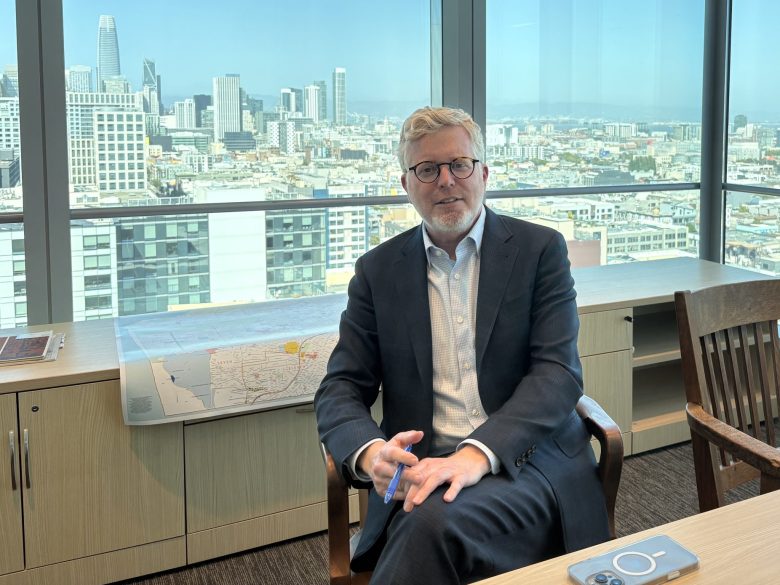

Richard Hillis was appointed as director of the San Francisco Planning Department by former Mayor London Breed in February 2020, just before the one-two punch of the COVID-19 pandemic and rising interest rates slowed development across the city to a crawl.
Prior to replacing John Rahaim, Hillis worked as the executive director for the Fort Mason Center for Arts and Culture, served as a planning commissioner from 2012 to 2019, and worked on the redevelopment of Octavia Boulevard and Treasure Island at the city’s Office of Economic Workforce Development.
During his time in city government, Hillis has been a vocal supporter of new development. In one discussion of whether a proposed six-story condo complex had enough affordable housing, Hillis took the position that neighborhoods were becoming more expensive whether new buildings were being added or not, so blocking new construction on the grounds that it wouldn’t be affordable was a dead end.
As planning head, Hillis was involved in rezoning the city’s western neighborhoods, passing the “housing element” — a state-mandated plan to streamline new development by reducing planning commission oversight — and developing a “family zoning ordinance” that further upzones the westside.
On June 9, shortly after announcing his retirement, Hillis met with Mission Local to look back over his time as planning director, and discuss whether San Francisco really can build 82,000 new units of housing by 2031.
The interview has been edited for clarity.
Mission Local: So, five years as director. What achievement are you most proud of?
Rich Hillis: The work we’ve done around housing. We’ve got a housing crisis. We have an affordable housing crisis. I’m not a big fan of distinguishing between the two.
We have to produce more housing in all areas of the city, not just high-rise buildings in South of Market, but smaller multifamily, triplexes, fourplexes, 25-unit buildings.
I’m proud of the work we did: Passing the housing element unanimously at the Board of Supervisors, responding to the state’s audit of our processes.
We’ve heard a lot about how it takes us too long to approve housing projects. We’ve dramatically reduced that with the help of the state and changes to local law.
I’m proud of the work we’ve done around permitting reform and PermitSF. That work’s just started. But Prop. H and the Small Business Recovery Act significantly reduce the amount of time and the amount of process to get a small business approved on a commercial corridor.
We created a community equity division to focus more on neighborhood community planning. The Tenderloin has been a big one. We’ve continued work in the Mission, SoMa and Japantown.
We put forward the family rezoning plan, which would allow for more multifamily housing to be built in the western and northern side of the city where we’ve seen very little housing built in the last couple of decades.
ML: San Francisco is required to build 82,000 units by 2031. But the progress has been slow. Do you think this particular goal reflects any semblance of reality? Or do you think the goal should be altered?
RH: It’ll be extremely difficult to hit those numbers. That’s 10,000 units per year, right? It’s triple the amount that we’ve actually produced in the past couple of decades.
But what we’re proposing — reducing the timeline to build new housing, expanding areas of the city where you can actually build new housing — they all make sense. We’ve got 70,000 units of approved projects in our pipeline, primarily on the eastern side of the city.
We should be aggressive about getting those projects built. But also, we should be equitable and look at areas where we haven’t seen a lot of housing being built or proposed.
They’re extremely difficult targets. But there’s no downside to trying to strive to hit those.
ML: But realistically, do you think the goal can or should be altered?
RH: We are trying to aggressively meet the housing needs of this city and of the region. Whether the number was 60,000 or 80,000, we would be proposing the same rezoning package.
I like that there isn’t just pressure on San Francisco. The fact that the state has given every jurisdiction in the region aggressive goals to hit, this is good for the region. Obviously it’s a tough number to hit for us. But it’s equally tough for cities in the Peninsula or East Bay.
ML: You talked about building all types of housing. Do you think there should be more mixed-income housing or more 100-percent-affordable housing?
RH: We should be building all types of housing. There’s benefits to all types of housing. We need the 100-percent affordable project in the Sunset and the two-unit market rate project in the Sunset.
ML: We’re seeing a lot of shelter and treatment beds in eastern neighborhoods, and a lot fewer on the west side. Why do you think this is happening? Is this good city planning?
RH: We’ve changed the zoning so that those uses would be allowed throughout the city. The state has also mandated that as part of our housing element.
If we look at how much housing has been produced in the city, it shows that 90 percent of the housing over the last couple of decades have been built in 50 percent of this city. It is not right.
ML: But why do you think, right now, a lot of the shelters and treatment beds are in the eastern neighborhoods?
RH: I think it was because the underlying zoning did not allow for those uses to happen in parts of the city.
The processes have changed to allow for those projects to be approved ministerially. So it’s allowed for them to move quicker too.
[In short: ministerial approval means that because the state declared that San Francisco hasn’t been permitting enough housing, until 2031, most developers with plans to build multi-unit housing in San Francisco can get permits without needing to assess environmental impacts (CEQA) or follow neighborhood notification requirements, as long as they follow certain state guidelines].
ML: Is it also true of affordable housing? Should it also be spread out across the city?
RH: Exactly. Affordable housing projects need the same underlying zoning changes that market-rate housing needs. Take 2550 Irving St., a 100-percent affordable project. That needed changes to the underlying zoning to allow it to happen.
Those changes came through state law. But the city’s zoning on the west side, which we’re in the midst of changing, was controlled by density.
That’s part of the change we are making: Removing these artificial density controls, and in some instances, increasing height. That applies to affordable and market-rate housing.
ML: Do you think once these changes are made we will see more equitable distribution across town in terms of shelters and affordable housing?
RH: Yeah: Shelter, affordable, and market-rate. Ninety percent of the housing that’s been built in the city recently has been built in the areas that we rezoned over the last couple of decades: eastern neighborhoods, Market, Octavia, Downtown, Transbay and Mission Bay. We haven’t done that on Geary or 19th Avenue. That’s what we’re undertaking now.
ML: What do you think is the legacy of the Eastern Neighborhoods Plan?
RH: I think one issue that’s come up is that it allowed for more housing to be built in one half of the city, somewhat leaving the other half untouched.
Part of what the state has pushed us to do is to look at areas of the city that have infrastructure, services, parks, but haven’t seen a ton of housing growth. We’re rezoning to allow for some of the same types of projects you see in eastern neighborhoods to be able to happen in the Richmond District, on Geary, on Lombard, on California Street.
ML: What do you think of the Small Sites Program program? [The program helps local nonprofits buy properties and lease units to existing low-income tenants and others threatened by displacement]. Do you think doing more of that would be a good idea?
RH: Small Sites is good because it protects existing tenants. But we also need to build more affordable and market-rate units.
ML: A lot of the current mayor’s priority heavily relies on downtown. How bad do you think things are right now with downtown? What do you think downtown might look like in five or 10 years?
RH: If you read the downtown plan which the city adopted in the ’80s, it envisions much more residential. What we got, as a result of more economics than anything, was more offices.
Because of COVID and office vacancies, we do have the opportunity to now promote more residential downtown. There’s been a series of ordinances that have been passed to make it easier to convert office buildings to residential. We haven’t seen a ton of projects.
In most cities that have been successful in promoting office to residential conversion, there have also been financial incentives. So we’re working with the Office of Economic and Workforce Development to allow for some of those to be put in place, like tax increment financing.
I think it will take time, but especially the older buildings downtown are prime candidates for conversion to residential.
ML: Do you think conversion is the only way out for downtown?
RH: No. We’re already starting to see interest in businesses relocating downtown or coming from other jurisdictions to locate in San Francisco. We’re starting to see developers interested in building office space.
Since I’ve been here, there have been three or four cycles where we’ve seen significant increases in vacancies downtown. COVID’s been the biggest and probably the longest lasting. But I’m confident in San Francisco.
I think we’ll see an upswing in the office market. We already are seeing it. It’ll take longer than it’s taken in prior cycles. But I think it’ll also help to see conversions. Union Square would be a great place to live.
As downtown shifted farther to the south like Transbay, Rincon Hill, Mission Bay, we’ve generally planned and zoned those neighborhoods to require a certain amount of residential as well as office.
ML: What do you think of the current mayor’s plan with downtown? Do you think he’s on the right track?
RH: Yeah. The mayor has been extremely effective at promoting a downtown, addressing issues around street conditions, removing permitting barriers. The legislation that was passed and signed by the mayor in central SoMa to allow for more flexibility. Before, we had a certain percentage of commercial and residential uses that you needed to have on large parcels. We removed that.
ML: What do you think are the indicators for success or failure for downtown in a few years? Is it more residential units?
RH: More residential units. More conversions of commercial to residential. Less vacancy on the office front. Filling ground-floor spaces in Union Square and elsewhere with retail and food and beverage.
ML: I wanted to talk a little bit about the Mission. Mission Local‘s office was actually in that burnt-down site at 22nd and Mission. What do you make of this decade-long saga of that site, especially that it was ultimately approved as market-rate housing with a few affordable housing units? Couldn’t the state law have been written in such a way as not to benefit a transparently bad actor?
RH: I think the work we’ve done as a department with the Mission that started with MAP 2020 [MAP is short for Mission Anti-Displacement Plan]. I think we’ve drastically improved our relationship with the Mission community and have worked to prioritize the needs of the Mission community that were reflected in MAP 2030. And one of those was to increase the amount of affordable housing.
Every site can’t be affordable housing, right? We’ve got to figure out where the resources are, and how we can purchase sites to bring about affordable housing. Those that the city is not going to purchase for affordable housing, I don’t think they should remain vacant.
The city should look at potentially purchasing that site for affordable housing. It would be a great site for affordable housing. Just because it was entitled, doesn’t mean there still isn’t an option for the city to acquire that.
ML: You still see the possibility for the city to buy it?
RH: Yeah, sure. But I think it should be housing. It’s unfortunate that the building was burned down and subsequently demolished. But the best outcome for that site is housing. And certainly it would be great for it to be affordable housing.
But it’s not owned by the city. It would have to be acquired by the city or by a nonprofit developer. We also have to be realistic as to how many sites the city can acquire for affordable housing. If it’s not affordable housing, it’s still a great site for housing.
ML: Do you think 1979 Mission at 16th and Mission is going to get the tax credit this year? Is there going to be any extra pressure from the city to make sure that they get it? Because the mayor is really focusing on cleaning up the area.
RH: That one is less in our ability. Certainly, funding is a constraint with a lot of affordable housing projects, but that will eventually be an affordable housing project, which is great.
We didn’t necessarily approve the project, and state law wasn’t as strong as it is today; that would allow for that project to be approved ministerially. But it led to the ultimate acquisition of it.
It was the 10 South Van Ness project’s affordable obligation to buy and donate in lieu of their affordable housing at 10 South Van Ness. It was a successful outcome, but it only could happen because we approved a market-rate project at Market and Van Ness.
ML: Can you talk a little bit more on how and why that happened?
RH: Why it happened was because that community very much pushed for that site to be 100-percent affordable. So either the city had to acquire it or a project sponsor needed to acquire it to meet their affordable obligations.
So when we were doing the hub planning, which is basically the buildings around Van Ness and South Venice and Market and Mission, we were in the midst of approving 10 South Van Ness. One of the outcomes of approving that project was we adjusted the code so they could acquire the 16th and Mission site to satisfy their affordable obligation.
But that needed a change to the code. It was pushed by Supervisor Ronen at the time, the community, the Mayor’s Office, the Planning Department.
ML: I want to just go back a little bit and talk about you and your job at the department. What was your biggest regret?
RH: I would like to see the projects at this corner of Market and Van Ness — One Oak, 30 Van Ness, 10 South Van Ness — to really strengthen this corners. Not great that we haven’t seen those projects move. Like 10 South Van Ness, they started and stopped construction.
It’d be great to strengthen this intersection, which is a key intersection that’s well served by transit. To have more people living and working here. We just haven’t seen that planning vision come to reality yet. I’m optimistic it will happen, but it may take some time to get there.
ML: Why did it stop?
RH: Primarily the underlying economic conditions. It’s hard to build high-rise housing. Construction costs are still high. Rents just don’t support it.
ML: Are you worried that the 22nd and Mission site is going to also just sit there?
RH: I don’t think it’s going to start construction anytime soon. But there’s still an opportunity to potentially acquire that site for affordable housing.
ML:Was the job of the planning director how you imagined when you took it on?
RH: I’d say it’s what I expected. When I started, it was March 9, 2020. Two weeks into my job, we were conducting most business remotely. Every commission hearing I had for the first year was remote.
At the time the office vacancy was extremely low. We were hitting up against the Prop M office cap [Prop M, with some exceptions, limits the amount of office development the city can approve to 950,000 square feet a year]. Those issues dramatically changed as a result of the pandemic.
I don’t think the job was terribly difficult or different from what I expected. But some of the issues were dramatically different from the time I interviewed till the time I started and the pandemic hit.
We weren’t talking about the revitalization of downtown. However, housing and housing affordability have continued to be an issue. So while the pandemic changed some of the issues we were faced with, it didn’t change that we need to build more housing and more affordable housing.
ML: What did you gain appreciation for over these past five years?
RH: I got to know more of the planning staff. It’s not easy to go out and talk to neighborhood groups about changes that may be coming to neighborhoods and getting feedback. Our department I think did that extremely well.
I had a great appreciation for the passion that community groups bring to issues from my time on the Commission. As the department head. It’s good to see people are passionate about the city and where it’s going, from those that want to see a ton more housing built so there’s a future for them and their families, to those that want to preserve what’s great about our city.
ML: What do you think should be the next director’s focus and priority?
RH: Housing is still going to be a huge issue.We’ll get through the rezoning by the end of the year. We have to, by state law.
It will be critical finding resources to build the amount of affordable housing that we’re obligated to build. We’ve relied on fees from new housing and new office buildings to build and finance affordable projects. We need to find more tools and resources.
Downtown will continue to be there; getting vacancies filled. That’s less of a planning issue, more of an economic development issue.
ML: When did you decide to leave the job, and why? Would it have mattered if someone else won the mayoral race?
RH: I always expected to be here for four or five years. I wanted to see the work we’re doing around that family rezoning plan near completion, which I think it is.
I’ve been here 25-plus years working in the city. I’ve loved my job. I’ve loved the people I’ve worked with both inside the city, and the community advocates, and people who are passionate about San Francisco and about what it’s going to look and feel like, not just today, but in 20 or 30 years.
It’s a tough decision to leave a job you like. But I also think it’s time to try something different.
ML: Do you see yourself in the public services or private sector?
RH: More public.
ML: Any plans?
RH: No, not yet.It’s hard to think about what you’re going to do next, when you work 60 to 80 hours a week. My plan is to take three or four months off, maybe drive across the country. Figure it out from there.
“We’ve got a housing crisis. We have an affordable housing crisis. I’m not a big fan of distinguishing between the two.”
How will we know when the crisis is over. How measured. How close or how far away are we from that point?
With nearly 80,000 approved and permitted homes in the housing pipeline, when will electeds and Planning require developers to build their approved projects? San Francisco needs strong, impactful and enforceable legislation to compel permit hoarders to build. Until that happens, the convo is moot.
“We’ve got a housing crisis. We have an affordable housing crisis. I’m not a big fan of distinguishing between the two. ”
That right there lets you know this thoughtless Breed goon doesn’t give one thought about poor people or the blue collars who made SF great.
He can’t be gone fast enough – to be replaced by Lurie’s hand-picked same, another out of touch developer’s pet yes-woman, a canned vote. Disgusting.
I wish these people luck when they inevitably end up back in NYC. Soon I hope.
Which developer is Hillis going to a lucrative post-employment deal with once he swings through that revolving door?
My first thought, too. Well, second thought. First thought was, yeah, it’s too bad about the stalled construction at Market and Van Ness. I mean, there’s only several thousand unaffordable “market rate” studio and 1BR vacancies in the Hub and down Market, surely we need more see-through units along the Market St corridor for those twenty-somethings who are still leaving the city in droves…
Are you saying that all new market-rate homes fail to sell or rent? I happen to know a few cases where they do in fact rent or sell. So there is demand for market-rate housing.
And if not all of them sell or rent, which is also likely, then those sales prices and rents will have to come down, proving the YIMBY point that building more homes lowers housing costs.
Prices are not falling and developers are sitting on empty units and tens of thousands of fully entitled projects.
What will it take to convince you that lenders and developers are in nothing resembling YIMBY’s hurry and will take their sweet time to maximize profits for the long game?
If you want new homes then there has to be a decent ROI for those who risk their capital to build homes for SF residents.
“Mission Local: So, five years as director — what achievement are you most proud of?”
Qualifying for medical coverage for me and my family would be an answer.
Executive Director my ass. People like this guy are nothing but grifters.
Bingo.