

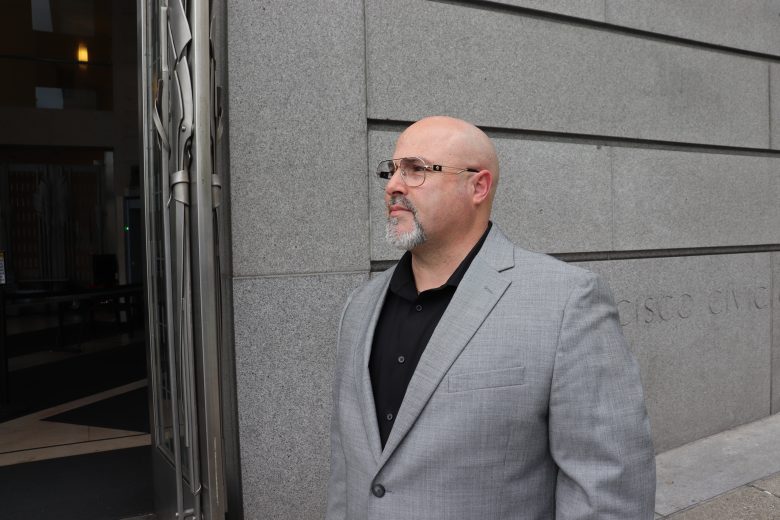

On the seventh day of Elias Georgopoulos’s trial against the city and county of San Francisco for the alleged harassment and discrimination he endured while a senior parking control officer at the SFMTA, Georgopoulos’ former psychologist took the stand.
In 2012, Dr. Elliot Henderson diagnosed Georgopoulos with a paranoid personality disorder. That didn’t mean that his paranoia wasn’t justified, said Henderson, appearing via Zoom before the jury at the San Francisco Superior Court. But it did mean that Henderson thought that SFMTA was a toxic environment for Georgopoulos.
“For him, [the transportation agency] is a toxic environment,” said Henderson. Continuing to work as a parking enforcement officer would only worsen Georgopoulos’ mental health, Henderson concluded.
Instead, Henderson said he was “surprised” the city instructed Georgopoulos to return to work after his first assessment. Henderson was surprised to find out he was still working there in 2020, when they met for another assessment.
That time, he diagnosed Georgopoulos with an “adjustment disorder with agitation and personality functioning,” a mental health disorder that leads to an intensified reaction to stress — with anger. “I was surprised that he was able to return to work, and work for that extended time.”
Georgopoulos is filing suit against the transportation agency for the harassment he allegedly endured on the job. He additionally alleges that the director of parking enforcement, Shawn McCormick, referred to Georgopoulos, who is Latino, as a ‘spic,’ and targeted the Mission, Bayview, and Excelsior for tickets because “those people don’t know how to fight City Hall.” McCormick denies the accusations.
“It appeared to be a highly volatile situation,” said Henderson. “I feared for his safety, as well as Mr. McCormick’s safety. … He was enraged, and morally justified for being so.”
City attorneys argued that Georgopoulos was quick to anger, shifting blame away from the city, which Georgopoulos accuses of fostering a culture of harassment and discrimination at the SFMTA.
But Henderson stated that despite Georgopoulos’ apparent paranoia, and emotional reactivity, he believed him.
“It is my opinion that his information was credible,” said Henderson. “He wasn’t exaggerating the extent of his suffering.”
In the aftermath of a heated argument with McCormick over Georgopoulos wearing a body camera at the SFMTA office, which Georogopoulos thought would deter other parking enforcement officers from harassing him at work, Georgopoulos says McCormick called him a “spic.” In his testimony on Thursday, Georgopoulos says he then left the building for good, and immediately headed to the workers compensation office in search of a doctor for his “mental state.”
“I was trembling,” recounted Georgopoulos.
McCormick denies ever calling Georgopoulos a “spic,” and on Thursday, the city questioned why, if Georgopoulos was wearing a body camera, he didn’t record their interaction.
Henderson says he evaluated Georgopoulos immediately following the alleged incident. On Thursday, Henderson said that being called a “spic” was a “predominant and identifying issue” for Georgopoulos ever since.
Georgopoulos, returning to the stand on Thursday, said that he had nightmares and would wake up in cold sweats ever since he left his former workplace in 2020.
“He should not return to work in his capacity as a [senior parking control officer],” said Henderson, adding that he feared what would happen if he did.
“McCormick […] targeted the Mission, Bayview, and Excelsior for tickets because “those people don’t know how to fight City Hall”
Unfortunately, the City waging class war on behalf of the wealthy against the working class is an old story…
when the city ignores those areas then residents complain that the city doesn’t care about them so the city is in a “damned if you do damned if you don’t” situation. What do you propose the city do then? enforce or not?
This may sound crazy, but there IS a third option. Instead of “targeting” or “ignoring” certain areas, maybe try impartial, unbiased enforcement. I know, crazy right?
” What do you propose the city do then? enforce or not?”
Fact #1: The US has the highest rate of imprisonment in the world by absolute numbers (higher than China and India with much larger populations), and the highest rate of imprisonment of any industrialized nation (#5 overall).
Fact #2: The US has the highest Gini coefficient measurement of wealth inequality of any industrialized democracy or of any country outside the global south.
Fact #3: The US pays more for military and espionage than most of the rest of the world combined. The US has 800-1000+ foreign military bases, far more than the rest of the world combined.
Fact #4: No other country has the drug and housing unaffordability problems the US has (among many, many, many other uniquely American problems). What are we doing differently? What does the rest of the world know that we don’t?
SF can’t solve social problems caused by national political and economic policy. At best, all SF can do is the to manage the problem as best it can. At worst, it exacerbates the problem by using city powers to perpetuate the class war (as Lurie has chosen to do).
The area around 16th St BART has always been sketchy, but the recent zombie apocalypse is the direct result of Lurie displacing the fetty contingent from the Market St corridor. Lurie did this at the behest of downtown landlords who blame their empty offices, storefronts, and exorbitantly-priced 1BRs and studios for coders on street riffraff instead of on decades of poor policy that inflated their property values to absurd values that are currently slowly reverting to the mean.* **
* real estate prices rocket up in a boom, but are “sticky” in a bust (IOW, supply & demand theory doesn’t explain real estate bubbles)
** the mean might never be reattained and a new median might obtain, but absent monetary policy to boost asset prices (that inevitably results in a bubble and spreads inflation to other sectors), RE has to become more affordable or the market will stay frozen.
Relying on the prison-industrial complex to solve deeply-rooted social problems arising from national economic and local planning policies will never work, but if you enjoy living in a police state, have at it.
OTOH, I’d revert to the status quo ante for now, letting the zombies congregate along mid-Market; providing shelter, job training, social services, and treatment as needed (paid for with corporate, property, and financial transaction taxes); and using the police to “walk the beat” on commercial corridors and handle violent crimes, but not to act as neighborhood hall monitors or boots on the ground for the military-prison-surveillance-industrial complex.
Two 4,
I gossip with lots of what I’ll call City ‘Line’ Workers cause they’re on the Front Lines and I’m nosey and they told me that one of their supes told em they could get their ‘quotas’ by preying on the Mission cause the Poor People there had big families and couldn’t afford garages to they parked on sidewalks and other illegal stuff.
I’ve been here 45 years and not had a vehicle for 30 cause SFMTA ‘stole’ my last 3 pickup trucks and held them for a ransom beyond their value to anyone other than a wealthy antique collector.
lol
go Niners !!
h.
I am familiar with Elias Georgopoulos and his background, and I believe it’s important to recognize that many of the challenges he describes may stem more from long-standing personal patterns than from the workplace alone. While every job has its difficulties, the SFMTA employs a large and diverse workforce and operates in a high-stress environment where public conflict is common. Parking enforcement officers are expected to manage those situations with professionalism, and I would be surprised if the SFMTA did not offer training in anger management and de-escalation. If Elias did not take full advantage of those resources, that is ultimately his responsibility. It’s also a matter of public record that he has been involved in litigation in multiple jurisdictions across California, including Los Angeles. In my opinion, this suggests a broader tendency to approach conflict through legal channels. Based on my personal experience, I do not see Elias as a victim in this situation. I am aware of past behavior (including attempts to form personal sexual relationships in legally sensitive settings) that raises additional concerns. Given the timing and tone of this article, it’s fair to question the motivations behind the narrative, particularly as it relates to ongoing legal proceedings.