


Anatolian Table has replaced beloved Yellow Moto, and calls itself a Turkish and Aegean kitchen. With Tuba gone (formerly at Guerrero and 22nd streets), the Mission has been left without a Turkish restaurant, if not without many of the Medi flavors represented here.
I went early recently, on the first night of the Valencia Street night market (the newest neighborhood street fair in the Mission.) The streets were packed with revelers enjoying one of the first warm and sunny days we’d had in a while.
But Anatolian Table was empty. When I’d enquired about reservations (they don’t take them), I was told the wait would never be more than 15-20 minutes. There is the same ample outside seating as with Yellow Moto.
The décor is a little homier (little cloth-shaded lamps at each table) but still elegant, but the bar is, sadly, no longer a full bar, and there are no plans to make it one. Instead, there is a selection of wines from Turkey, Greece, Italy, France and California, and beers as well. We can get our cocktail fix elsewhere.
Our first order was the ezme, a dish totally unknown to me: A walnut, bread crumb, tomato paste, and red pepper, chunky spread that came with sliced flatbread.
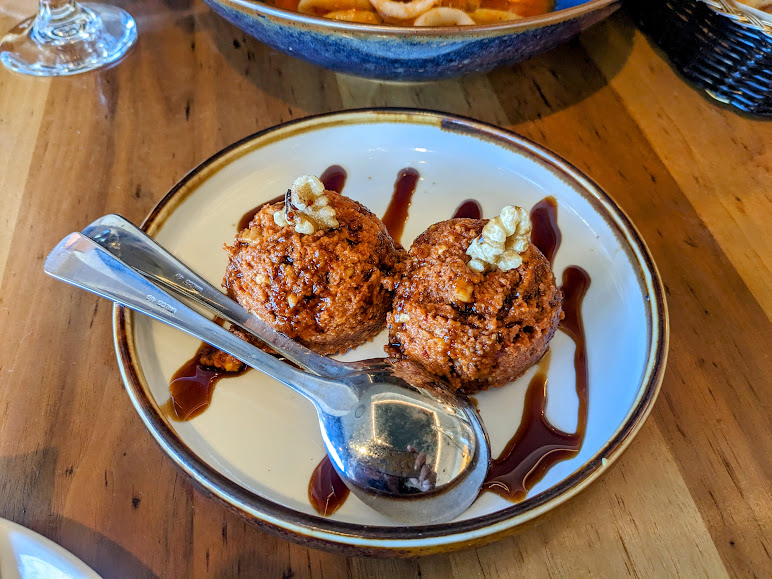
I loved the pepperiness of the spread, the nutty crunch, the tartness of the pomegranate syrup. Unfortunately, the bread itself was a little tough and dry. My dining companion said “That’s not the bread you get in Turkey.” Still, I loved the spread enough to make do.
We’d requested the octapodaki (grilled octopus with butter beans), but they were unfortunately out of it. So instead, we got the kalamar.
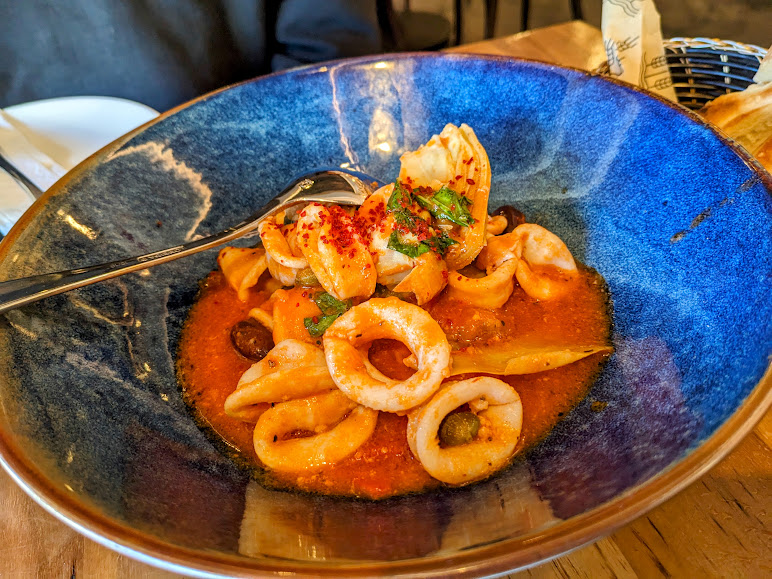
Reminiscent of a bouillabaisse, with piquant notes from the kalamata olives and capers, this was a rich tomato-and-white-wine broth. The rings of calamari were cooked perfectly al dente, with a few shrimp thrown in for good measure. I also loved the artichoke hearts, which added an herbal nuttiness. And yes, I dipped some of that bread into the broth to sop it all up.
Next, lahmacun.
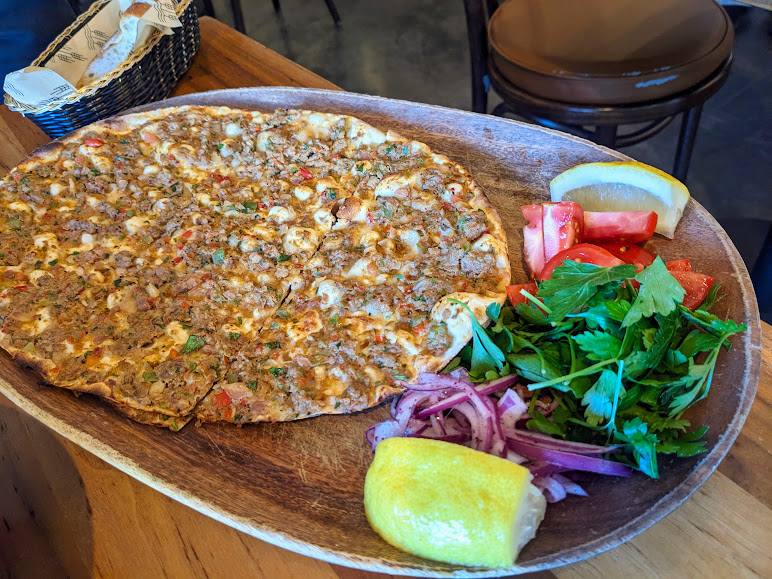
A very generous portion that had me rethinking the rest of our order. Lahmacun is the traditional flatbread dish topped with finely minced meat — lamb or beef, usually — that you’ll see on many Turkish menus. Here, there were two layers of a supremely thin, cracker-like bread, covered in lusciously spiced ground meat, sided by cilantro, sumac-seasoned onion, tomatoes, and lemon to make your own wraps.
I loved this dish, and if we hadn’t ordered so much, I would have finished the entire thing. As it was, there was plenty left to take home.
For entrees, we shared two, the manti and the kofte.
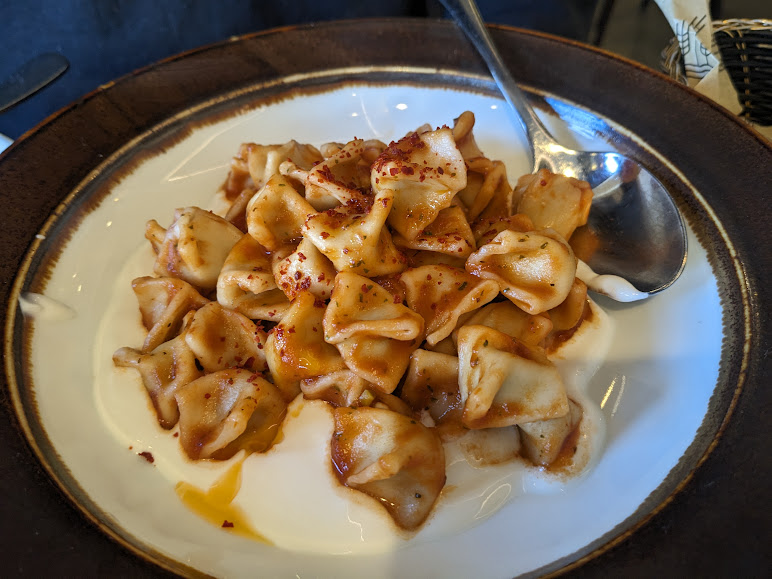
Manti are impossibly small dumplings filled with ground meat and served over a spiced yogurt sauce. For me, these were a cut above. Even though I thought they could have used another 30 seconds in the water, (the dough on a few was a little underdone), the fragrant ground beef (I believe) had a beautiful, perfumey taste that I couldn’t quite put my finger on.
I asked, and the server came back with, “mint and marash pepper.” Hmmmm. both discernible flavors, but they did not account for that intriguing floral sensation. They came bathed lightly in a “burnt” butter tomato sauce, and a quite good tart/sweet yogurt beneath.
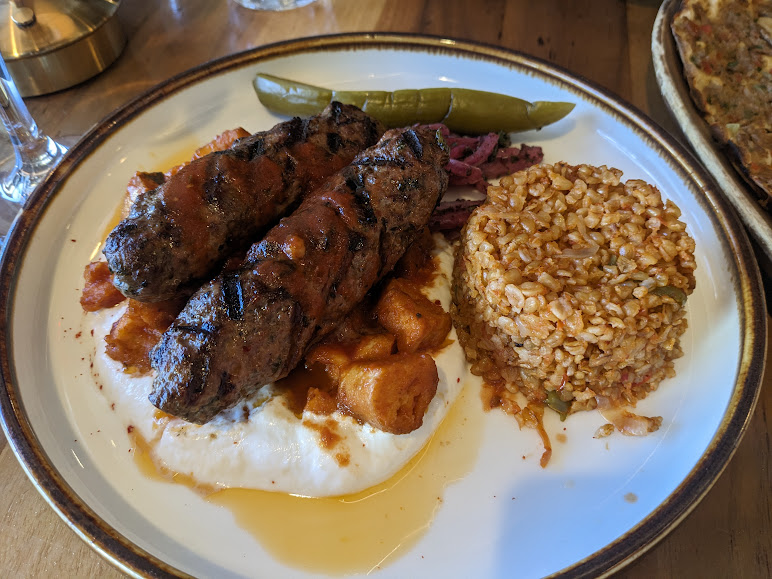
The kofte was sided by red onions, a pickle, bulgur wheat, and something else. Carrots? Sweet potato? They actually turned out to be “bread cubes,” or croutons that had soaked in the juices of the meat, more burnt butter, the house tomato sauce, and the yogurt. They were hearty and delicious, and it was quite a genius touch.
As to the kofte itself, the BF makes it for us quite often at home, and I’ve had it in other restaurants. I’ve never had kofte this good. Bursting with juiciness, flavorful, perfectly spiced, a lovely outer crust with a tender interior, this was simply a wow. The yogurt was delicious too, more garlicky than the sweeter one with the manti. (I could have done without the bulgur, however, as it was rather bland.)
We both had a glass of the Sevilen kalecik karasi, a red wine made with a dark-skinned, Turkish grape. The wine was smooth, fruity, with notes of berries, cherry and spices. I also tried the Mavroudi Kanarkaris, a Greek red; more red fruits, spices, and vanilla. I appreciate having these new-to-me wines nearby.
About halfway through our meal, the place was completely jam-packed, with people waiting outside.
Second visit: Again, no octopus! A friend who had visited a few weeks prior and, granted, had arrived late in the evening, found that the kitchen was out of most of the items he requested. Growing pains, I’m sure.
We ordered the meze combo for three of us, which included tzatziki, tabouli, hummus, borek, falafel, ezme, sarma (stuffed grape leaves), badimcan (roasted eggplant), a feta cheese spread, and olives, all served with their homemade bread.
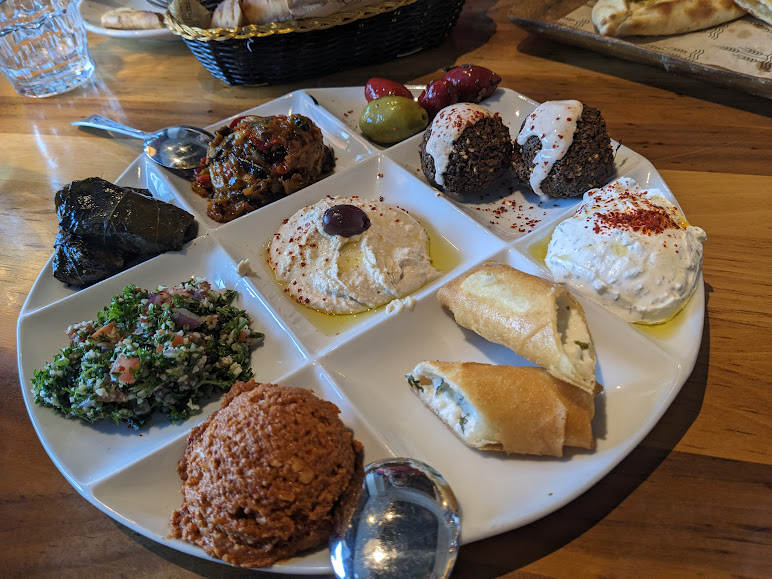
The standouts for me were the feta cheese spread (we found it addictive) and the roasted eggplant (as well as the ezme I’d had the first time); the rest was rather standard mezze fare. (The bread was much better on this visit.)
Next, we had the yumurtali pide. Pides are typically boat-shaped, thin flatbreads topped with a variety of ground meat. cheese, and/or vegetables. The yumurtali pide was covered in tender fried eggs, kesseri and feta cheeses, za`atar, olive oil, and herbs.
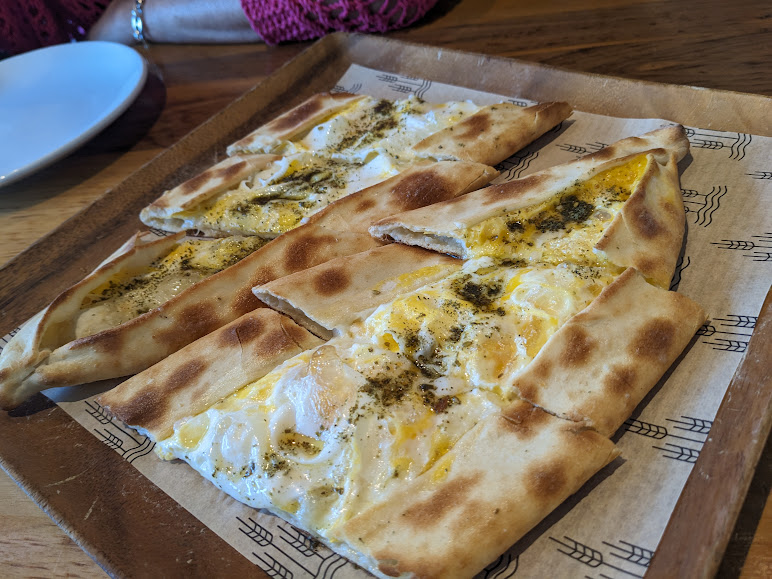
This was our favorite dish of the night: Luscious, silky, creamy and just cheesy enough.
We also got the mantarli pide, topped with mushrooms, za`atar, olive oil, kesseri cheese, and arugula.
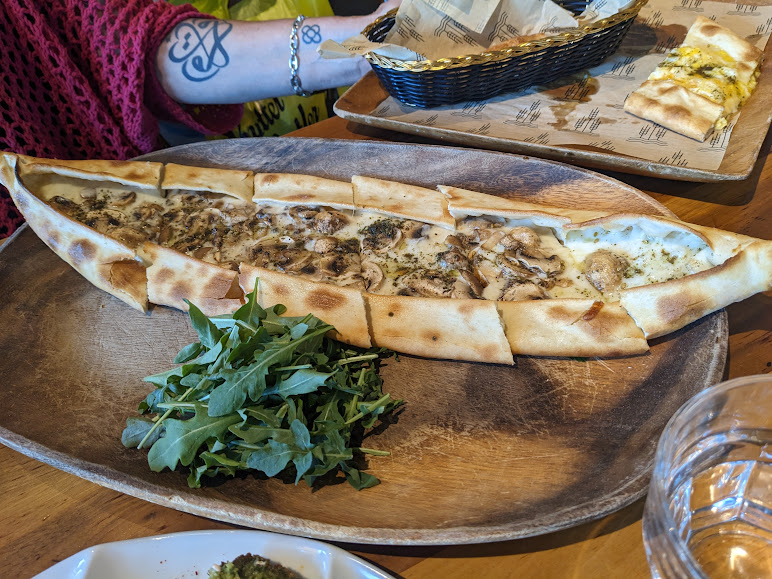
Also good; from the looks of it, I’d expected it to be a bit dry, but it was not. Plenty of mushrooms and cheese, and I only wished there had been some olive oil on the arugula, as I’m sure we were supposed to top the pide with it. I’m very eager to try the kusbasi pide sometime, featuring minced lamb and kasseri cheese.
Since they were again out of the octopus, we ordered the halikarnas tava.
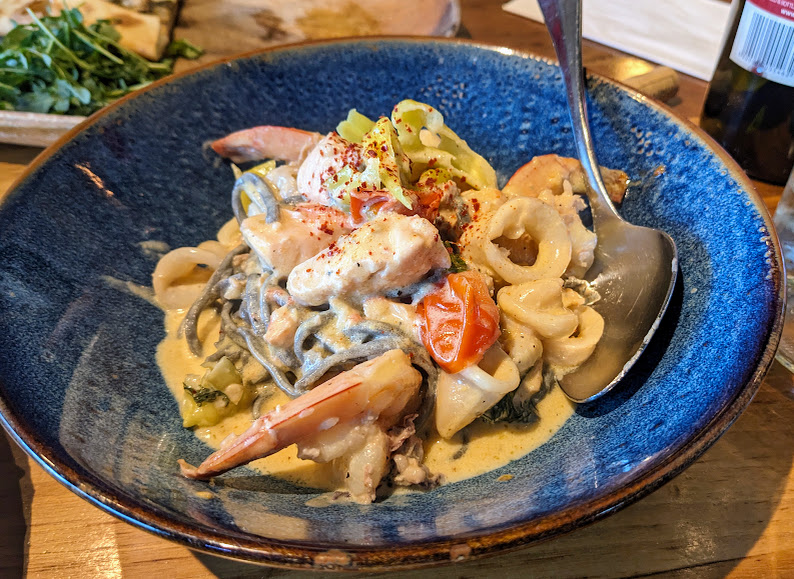
It’s a soupy concoction of octopus, kalamari, salmon, prawns, campari, mustard, dill, and ouzo in a peperoncini cream sauce over squid-ink pasta. I’d have preferred the sauce to have been a light wine one rather than a creamy one, as I felt the brininess of the pasta was somewhat drowned out. Still, the seafood was cooked perfectly, and the sauce was light.
All in all, my first visit was the better one, as some of the dishes on the second felt a bit basic. But Anatolian Table is already incredibly popular, an instant neighborhood favorite, and there is much more on the menu to explore (grilled fish, chicken, plenty of lamb, salads, and typical main dishes, like moussaka.)
With people lining up at the doors, service can be a little hectic and haphazard, but everyone was warm, friendly and eager to please. And, in this age when a bowl of pho can cost you $19, a meal here is actually quite reasonably priced.
Anatolian Table (Instagram)
702 Valencia St.
San Francisco, CA 94110
I have to try this place now. But stop eating octopus, they’re smarter than we are.
All these great dishes but you can’t get an ouzo.
Yea, if they had raki and ouzo, I would strongly consider visiting but wine and beer doesn’t set them apart from any of the other Turkish restaurants.
You say that without trying the food even once…