

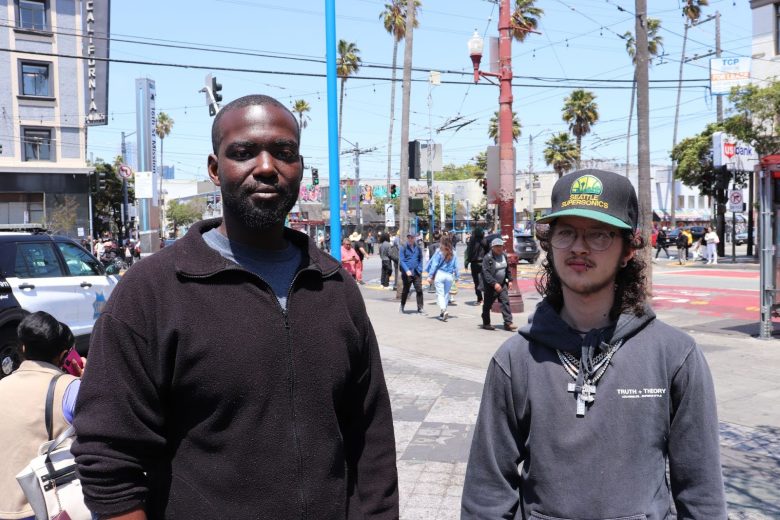

On a blustery Saturday afternoon at the southwest 16th Street BART plaza, Brayden Haas and Quinn Wafer were “just hanging out,” soaking up the sun, smoking a cigarette, and taking in the scene.
They are new friends. Just last week, they both graduated from the same treatment program. Both Haas and Wafer came to San Francisco to seek out treatment. Wafer is from Antioch, and Haas is from Oregon. Haas’ mother is a drug treatment counselor in San Francisco.
Wafer stood with his hands in his pockets, surveying the 16th Street Plaza. A woman was preaching in Spanish in front of a small crowd across the street at the northeast plaza, but here, it was quiet enough that a few people were sleeping.
San Francisco is a tough town to stay sober in, they say. “Temptation is everywhere,” said Wafer.
But Wafer says places like the 16th Street plaza motivate him to stay sober. “The homeless people, seeing people struggling, that motivates me. I don’t want to be on the street.”
Much of the drug use that used to be in the plaza has gone since the mobile command unit arrived in March, they say.
“It’s all in the Tenderloin now,” says Wafer. The policing just moves people around, he adds.
“We need a program,” said Wafer. “Not more police.”
Before he got sober, said Wafer, he almost died. He had to be revived with Narcan four times. He credits his success to support from his newfound friend, his family, his spirituality, and what he learned in treatment.
Haas and Wafer have spent a few of the days since they’ve graduated approaching people on the street about getting into treatment, as well as handing out food, water, and coffee. But today, they’re just keeping each other company.
As the two young men talked, a man approached them asking for cash, and then drugs. Haas shook his head. He didn’t have anything to give him, he said.
“It’s so easy to slip back,” said Haas, as the man left. Wafer nodded.




We need to cut our treatment programs, we can’t be the country’s magnet for every addict. How much are taxpayers funding these guys? And to have the gall to demand a new program? Don’t let the door hit you on the way back to Antioch and Oregon.
While we’re at it, we should also cut the programs, policies, and platforms that suck in transient get-rich-quick software startup and financial/crypto/AI fraudsters from around the country and the world who drive up the cost of living for the people who work providing goods and services that people actually need and want and that make the city a good place to live.
The problem is that progressives have been enjoined from moving much of any agenda above and beyond poverty mitigation services in order to get their crappy poverty mitigation nonprofits funded.
You go to 16th St to get sober is like asking an alcoholic to go to the bar to keep sobering.
Guy’s mom gets paid to do substance treatment counseling, her son from Antioch gets addicted and needs treatment, meets friend from Oregon, so we need to throw more money blindly into treatment so that San Francisco taxpayers can treat the world on demand because people from elsewhere tell us to?
Are there any other global constituencies for which we’re expected to bear the burden?
The treatment grift is washing over San Francisco politics like a tsunami. This is the opportunity for San Francisco’s conservatives to craft their own nonprofit patronage network.
Addiction is addiction
The person took the illegal poisons and needs to be held accountable and responsible to get help.
Why does the taxpayer here need to pay for all the drug treatment and resources ?
It is unfair if the taxpayer is forced to pay for others addiction issues .
I would expect that all of us should get our healthcosts covered for our health concerns . Heart attacks , hiv , diabetes etc .
Why addicts jump to the front of the line while we dont get any help with our medical issues and bills is not equality .
Persons who havent ingested poisons should not be getting treatment before hardworking taxpayers who have medica/mental health issues .
I feel that first we need for the issue of mental health need to be addressed very much so.