

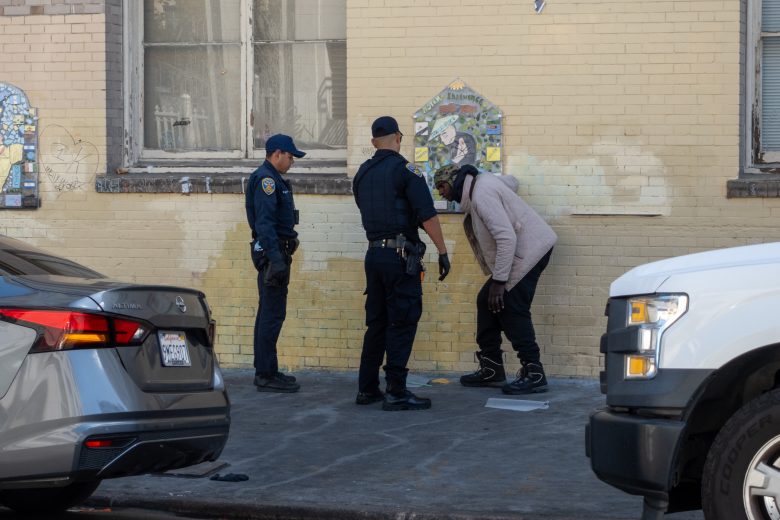

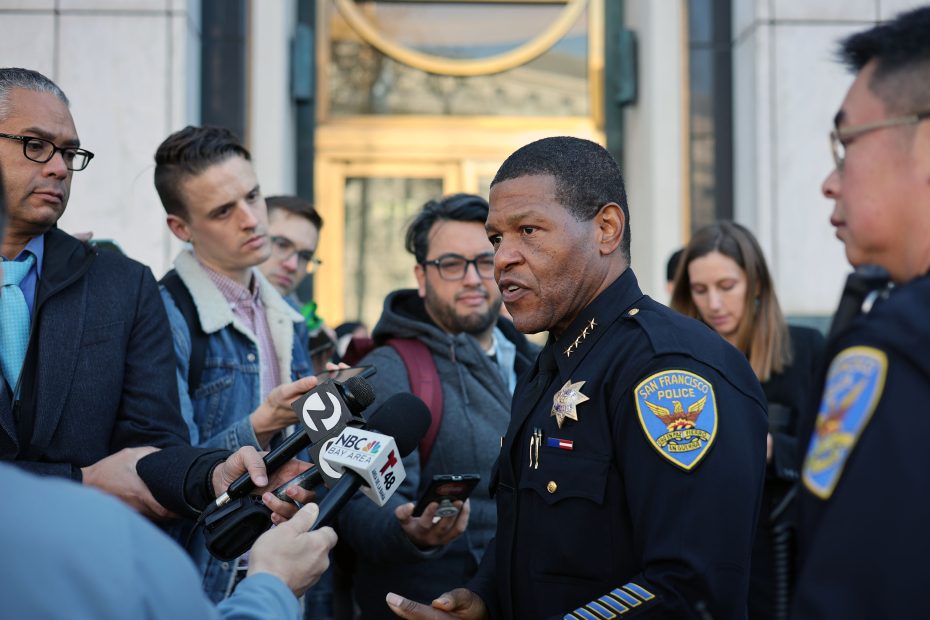
In response to the public’s “countless” complaints about drug activity, San Francisco police have increased their enforcement of low-level crimes, chief Bill Scott said at a police commission meeting Wednesday evening.
Open-air drug use in parts of the city has been a “constant and ongoing issue” for the department, Scott said. In the last couple of months, police have made arresting large groups in publicized raids part of their strategy.
“We’re seeing a cultural shift with the lower-level drug offenses,” Scott said. “Those are the types of offenses that the public is, quite frankly, just fed up with.”
As part of this shift, he continued, the courts have been detaining more fentanyl dealers, and more first-time offenders have been arrested than in years prior.
Police, the chief said, continue to focus their attention on these crimes at hotspots like 16th and Mission streets, and Market Street and Van Ness Avenue.
16th and Mission
It’s been a month since police parked a mobile command unit at the 16th Street BART plaza. Scott today acknowledged concerns about the “militarization” of the area, but said there are no immediate plans to remove it.
“And until further notice, until that area gets stable, we’re going to continue to work on the alleys,” he added. “Even though there is displacement … the groups are getting smaller, and the locations are fewer.”
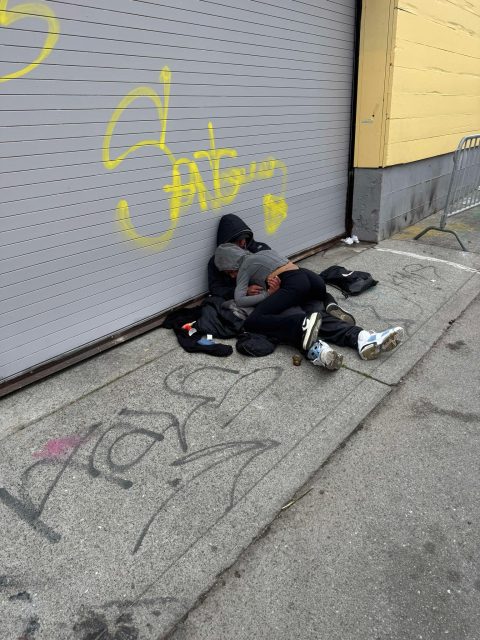
Residents who live near the 16th Street BART Plazas regularly send Mission Local photos of what they describe as rampant drug use along the side streets of Caledonia Street, Wiese Street and Julian Avenue. This morning alone, two residents sent in photos of individuals slumped over on Wiese.
Past efforts to stabilize 16th Street, including fencing and vending zones, were unsuccessful, Scott said. But, he noted, the year-long effort to replace drug activity at U.N. Plaza with sanctioned activity, including dance classes and ping pong, was a model of success.
Market and Van Ness
Scott said police have made a “number of arrests” since their March 25 raid at Market and Van Ness that yielded 41 arrests, but no charges.
“But one of the issues that we face,” he said, “is it is quite overwhelming when our officers approach the location and there are sometimes 100 plus people that are there for the purposes of drug activity.”
SFPD’s mass arrests at Jefferson Square Park on Feb. 27 made a visible difference, Scott said. “We haven’t been as fortunate with [Market and Van Ness].”
Individual arrests, the chief awknowledged, don’t “even touch the surface of making a difference at that location.”
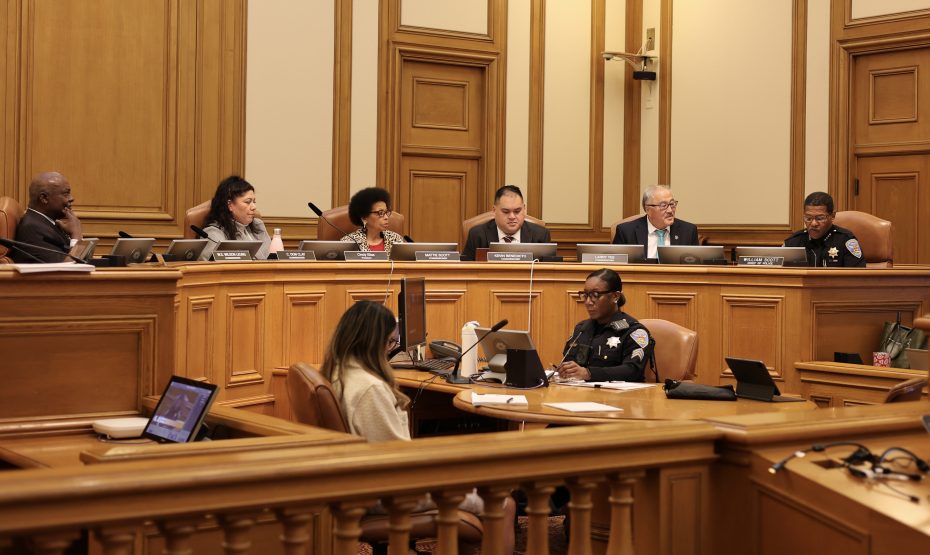
Although no charges were filed in the March 25 raid, Scott said 37 items of drug paraphernalia were taken. He was unsure how many officers or health professionals took part in the raid, but noted that some of the people arrested were connected to medical treatment in jail.
“Charges alone are not necessarily the best metric of the efficacy of arrest and public safety,” said commissioner Wilson Leung, a former assistant U.S. Attorney.
Still, police commission president Cindy Elias said, the raid was a “Catch-22:” Officers appropriately followed orders to arrest. But it became a waste of resources when those arrested were released.
Past “Whac-a-Mole” approaches, Elias added, have “caused a lot of fatigue amongst officers.”
“There should have been a judge that said there was probable cause to arrest,” said commissioner Don Clay, a former Alameda County Superior Court judge.
The chief responded that there is an “ongoing effort” to coordinate the police’s response with the narcotics unit of the district attorney’s office, but said he did not foresee any policy changes.
According to Scott, the department is working on using surveillance technology to better identify criminal behavior, which can help establish probable cause.
While drones and body-worn cameras were used in recent raids, neither the Market and Van Ness nor Jefferson Square Park raids used public safety cameras or private surveillance to identify individuals.
“There’s still things that we can do better,” Scott said. “That’s an ongoing objective of ours.”
Hurray! Let’s make crime illegal again.
“Although no charges were filed in the March 25 raid”
“Past Whac-a-Mole approaches, Elias added, have caused a lot of fatigue amongst officers.”
“There should have been a judge that said there was probable cause to arrest,”
You read that part too right?
Oh, noes, the SFPD that we pay good money to are getting *fatigued* when they are made to work. Are there nonprofits around that intervene to provide services to help the Blue cope with this inexcusable injustice?
“As part of this shift, Scott continued, the courts have been detaining more fentanyl dealers, and arrested more first time offenders than in years prior.”
The COURTS are now detaining and arresting people?!? This really has gotten out of control.
While we’re quoting the cops here, should we feel bad that they find it “quite overwhelming when (their) officers approach the location and there are sometimes 100 plus people that are there for the purposes of drug activity?” Poor cops, maybe they should try strolling around public spaces as I generally do, unarmed, unempowered and solo. Further, the “whack a mole” approach has “caused a lot of fatigue amongst officers.” You know, I experience fatigue too, when the well-paid officers I’m funding make excuses and whine instead of just doing their damn job. (Which should also include massively ticketing the common, wildly illegal, motorized vehicle behavior we see every day in the Mission.) Overwhelm and fatigue are real all across this city.
Thanks for reporting
Please come and report on the large longstanding drug dens on Larkin and on Polk.
Every alleyway is full of dealers and addicts .
Police will find lots of success with criminals here .
Their efforts ane time would be appreciated .
And the number of overdoses and deaths will decrease.
Snooze.
Arresting street level dealers is small potatoes.
Why are they not capable of going further upstream in the value chain?
Here’s a suggestion:
Follow the street dealers, don’t arrest them.
See where they get their stash.
See where the stash giver gets their supply.
And so on and so on. And placeTHAT part of the distribution network under pressure.
The current playbook won’t work long term. It has never worked in this country’s history.
We suffer from a lack of imagination.
I bet 2 levels up is out of SFPDs jurisdiction. Do you really think they can go to Richmond……Stockton……Mexico…….China?
Trying to shut down distribution networks has been the main approach to the drug war for decades and it doesn’t work either. The magic of capitalism is that where there is demand, there will be supply. If you actually want to end drug use, you’ve got to address demand. They don’t have drugs in Singapore because nobody is willing to risk the death penalty just to have some fun. People will risk death to get rich, though.
To be clear, I support legalization. But criminalizing dealing while letting use slide is immoral in my opinion.
“The chief responded that there is an “ongoing effort” to coordinate the police’s response with the narcotics unit of the district attorney’s office, but said he did not foresee any policy changes.”
So you’ve been in the job for how long, you’ve had all that time to “effort” some coordination so officers aren’t arresting 100+ people just to let them go, but you still can’t come up with a SINGLE policy change that would make sense or help?
What did you say you do here?
The war on crime under a billionaire mayor turns on to get the poor people. What a shocker.
Have a stable of Judges, on-call 24/7, who can link up with the cops on the street of a situation. Let the Judge see what the cop’s body-cam sees, like an illegal tent, so the Judge can render the decision on-the-spot.
Also, for ANY infraction punish them with 48 hours of no drugs. This will MATTER to the junkies and they will eventually go elsewhere and the dealers will follow them.
Let SF’s new motto be, “Come To San Francisco To Do Illegal Drugs? We Will Harsh Your Mellow…” and mean it.
Addicts answer to a higher power. There is no reliable form of deterrence.