

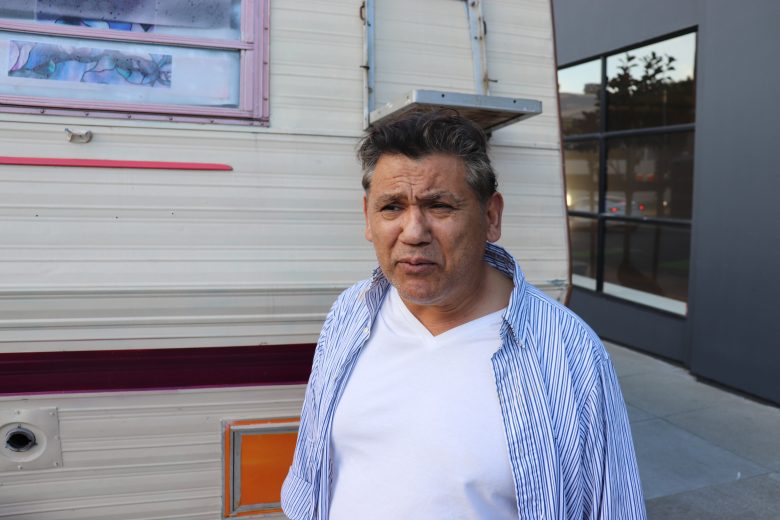
A little after three in the morning, Armando Bravo Martínez was abruptly woken up by the screech of wheels skidding on the road: It sounded like a car was headed straight towards his RV.
Seconds later, he heard a deafening crash. A car had smashed into the vehicle parked in front of him, flipping it onto the sidewalk. The tire marks still skid the ground.
“I thought it was going to hit me,” said Martinez, his voice shaking.
For many RV residents, fears of being struck by another vehicle are just one of the many daily anxieties that come with living on the street. Some have been robbed, others threatened.
But mostly, the constant fear of their vehicle being towed — and potentially losing their home — follows them wherever they go.
S.F. has no safe-parking site for RVs, and no plans to open one
The last safe-parking site in San Francisco, located near Candlestick Park, closed last month, so there is currently no city-provided spot for RV dwellers to park.
Those who cannot afford to rent a spot in an RV park — rates go from $1,600 to $2,000 a month — will be on the move for the foreseeable future, avoiding unfriendly neighbors and the city’s parking enforcement officers.
Before March 3, approximately 35 people lived in RVs parked at the Bayview Triage Center, which offered free protected parking spaces, as well as access to case management and sanitary services. Then, it abruptly closed nine months before the city’s lease was set to expire.
The homelessness department cited costly infrastructure issues and difficulty renewing the lease. Those who lived at the site reported electricity outages, pest infestations, diesel fuel leaks, and strict limitations on visitation and even shower use.
Now, the department says it has a new “multi-pronged strategy” to address vehicle-based homelessness. But opening a safe sleeping site will not be part of that strategy, according to department spokesperson Emily Cohen.
District 10 Supervisor Shamann Walton says his office was “promised” 20 safe-parking spots for RVs at Jerrold Commons, a new Bayview homeless shelter at 2177 Jerrold Ave. But on Monday, Emily Cohen, the spokesperson for the Department of Homelessness and Supportive Housing, confirmed that the site “does not have the space for personal vehicles” anymore.
Instead, eight of the 68 beds available, spread across 60 tiny cabins, which are rooms in “homeless villages” like that at 16th and Mission, will be reserved for those who currently live in an RV. But only if they leave their vehicles behind.
Walton says the lack of parking spots for RV residents will create an even greater risk for the community.
“We need to have space for vehicles to live safely,” said Walton, who has clashed with Mayor Daniel Lurie on the lack of RV sites and called Lurie an “oligarch” earlier this month for opening the new shelter without space for RV dwellers. “We need a real plan. There has been no indication of what that plan is.”
The number of people observed living in vehicles on San Francisco streets has risen in recent years from 1,049 people in 2022 to 1,442 in 2024, according to the 2024 homeless Point in Time Count, an increase of 37 percent. That’s a reversal from an earlier downward trend: In 2019, those counted living in vehicles numbered 1,794.
RVs often beat a shelter, say San Francisco’s homeless
For many, RVs are preferable to shelters, where many homeless residents live in close quarters, sometimes near drug use and, for women in particular, sexual harassment. An RV is a de facto private abode, often complete with running water and a bathroom.
Melodie, who declined to share her last name, has lived in her RV in San Francisco since 2008. She has a chronic brain injury, which she received as a child, that impairs her ability to carry out daily tasks and remember what she needs to do.
She’s had a hard time maintaining steady employment, and has lived off of disability and social security since becoming homeless after she was fired from her job. For a brief period in 2011, Melodie lived in a shelter, but quickly returned to her RV; the shelter was “uncomfortable,” and she wanted privacy.
The RV is worth the risk of parking on the street, but Melodie has already made sacrifices: She’s been towed three time in the past year; her RV is old, and could be considered “dilapidated” by parking authorities. And, in January, she lost much of what she owned after someone broke in.
“My belongings were spread out what looked like 35 feet around my vehicle,” said Melodie, who was parked in Bayview-Hunters Point at the time. “I don’t know what I lost and what was taken.” She says she later found her late partner’s art and clothing, which she had saved since his death 12 years ago. It lay crumpled in the mud, and strewn in bushes near her vehicle.
On April 10, Melodie’s RV was towed again. She has not yet reclaimed her vehicle. She says it’s too stressful to go through the whole process of getting it and her belongings back, and has since been living in a friend’s car.
First tow’s free, next one’s $104
Homeless people can retrieve their vehicle free of charge in San Francisco the first time it is towed if they have visited what’s called a coordinated entry point in the last six months, a kind of access point for people to be assessed for housing services.
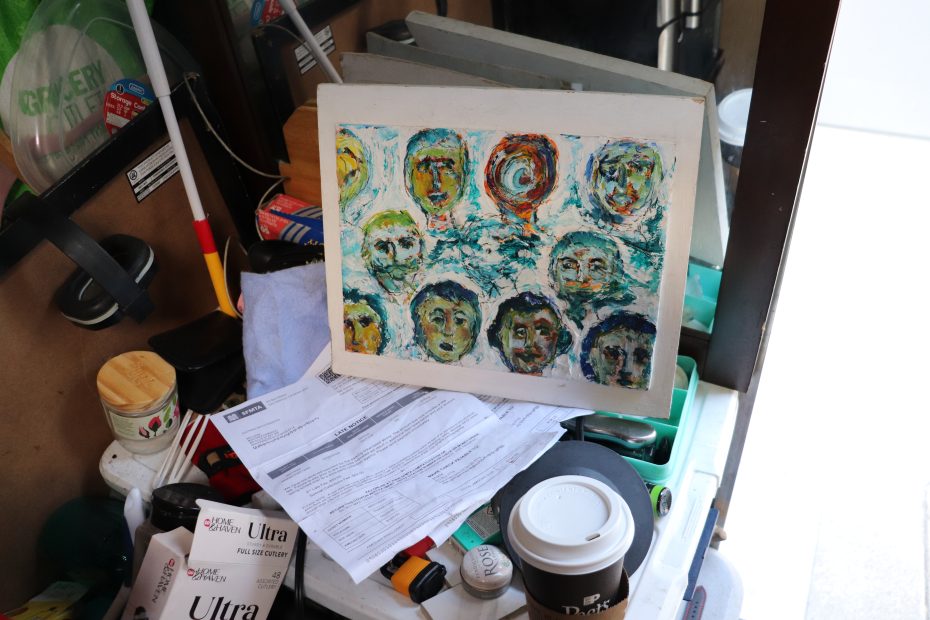
If their car is towed again, it costs $104 to retrieve it from the impound. There is currently no official policy that requires items left in an RV to be returned to their owner.
If a vehicle is dilapidated, has expired registration, is parked in a no-parking zone, or if it is not moved within 72 hours of receiving notice that a neighbor has made a 311 complaint, it is subject to being towed. Even if spared, it could still be ticketed, which has become a costly burden for many RV residents.
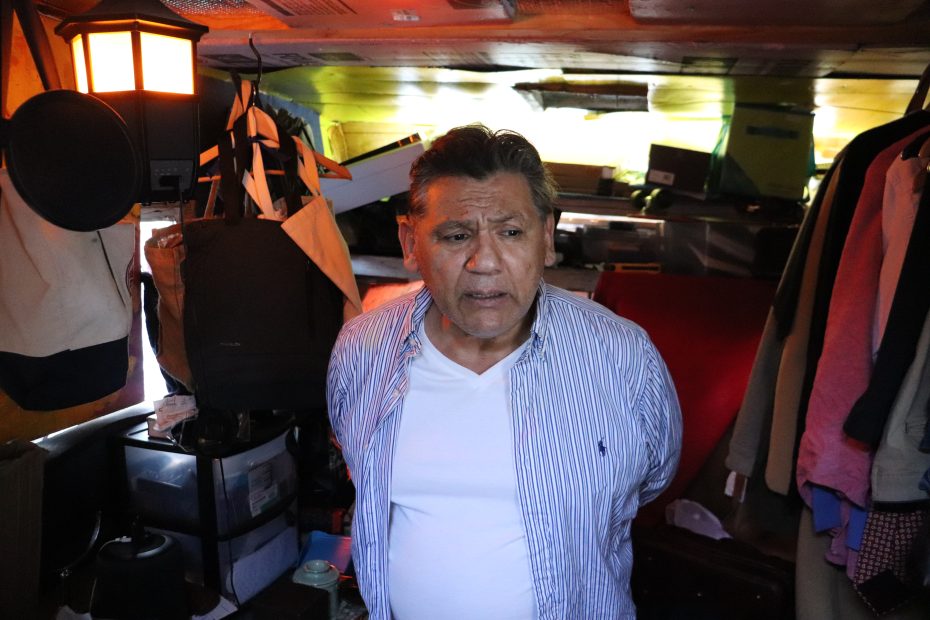
Martinez, the man who witnessed a crash in front of his RV and has been living in his vehicle for two years, works at Martin’s, a soup kitchen in Potrero, to pay off some of his parking tickets; he also has a job as a caretaker for elderly patients with dementia. Martinez says he owes more than $2,000 in tickets to the SFMTA.
He has crammed three years of belongings into his RV, which he painted pink and orange; he also decorated its windows with a stained-glass film. “I’m a big fan of clothes,” he joked, pointing to a pile he sleeps on each night, surrounded by hanging shirts, bags and sweaters. A single Vanity Fair magazine hangs from the wall. He donated most of his magazines to the soup kitchen, but he kept this one for himself for the cover: A pop-art image of a young Queen Elizabeth.
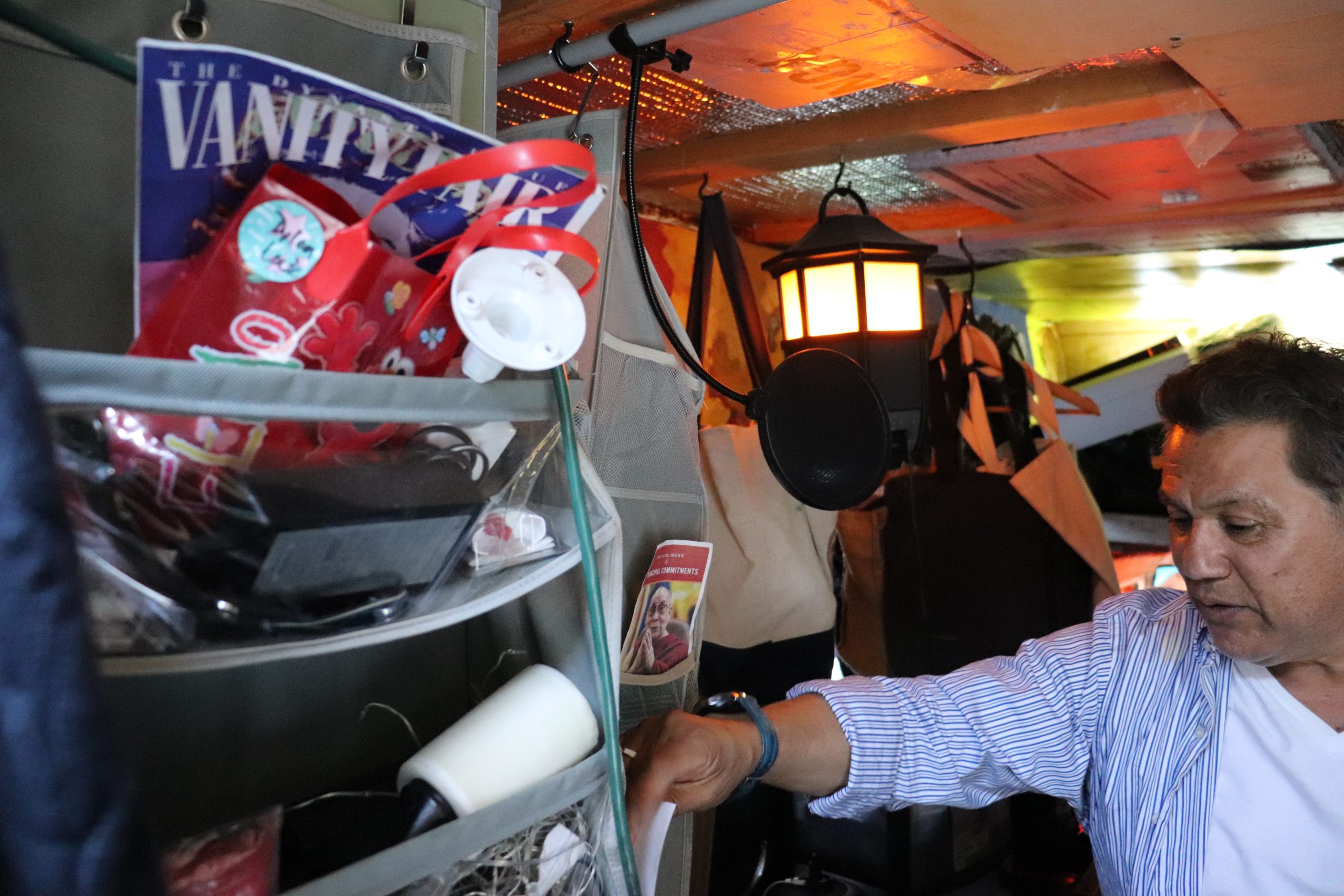
Martinez started living in his RV after losing his job as a live-in caretaker. He’s since found another job, but he’s not sure when he’ll be able to afford an apartment. Still, he’s ready for a change.
“I’m getting tired of living in an RV,” said Martinez. “I want to travel … maybe I’ll go to Paris,” he mused, chuckling. “But I don’t know, I can’t do that right now.”
Martinez moved to the Mission from New York in 2002. In New York, before alcohol got the better of him, Martinez lived a distinctly different life. He was a senior fellow at the World Policy Institute and a member of the Council on Foreign Relations. At the age of 38, depression and PTSD from childhood trauma, combined with an increasingly severe dependence on alcohol, ended that life. Doctors at Zuckerberg San Francisco General Hospital, he said, saved his life after he almost died of cirrhosis of the liver in 2008.
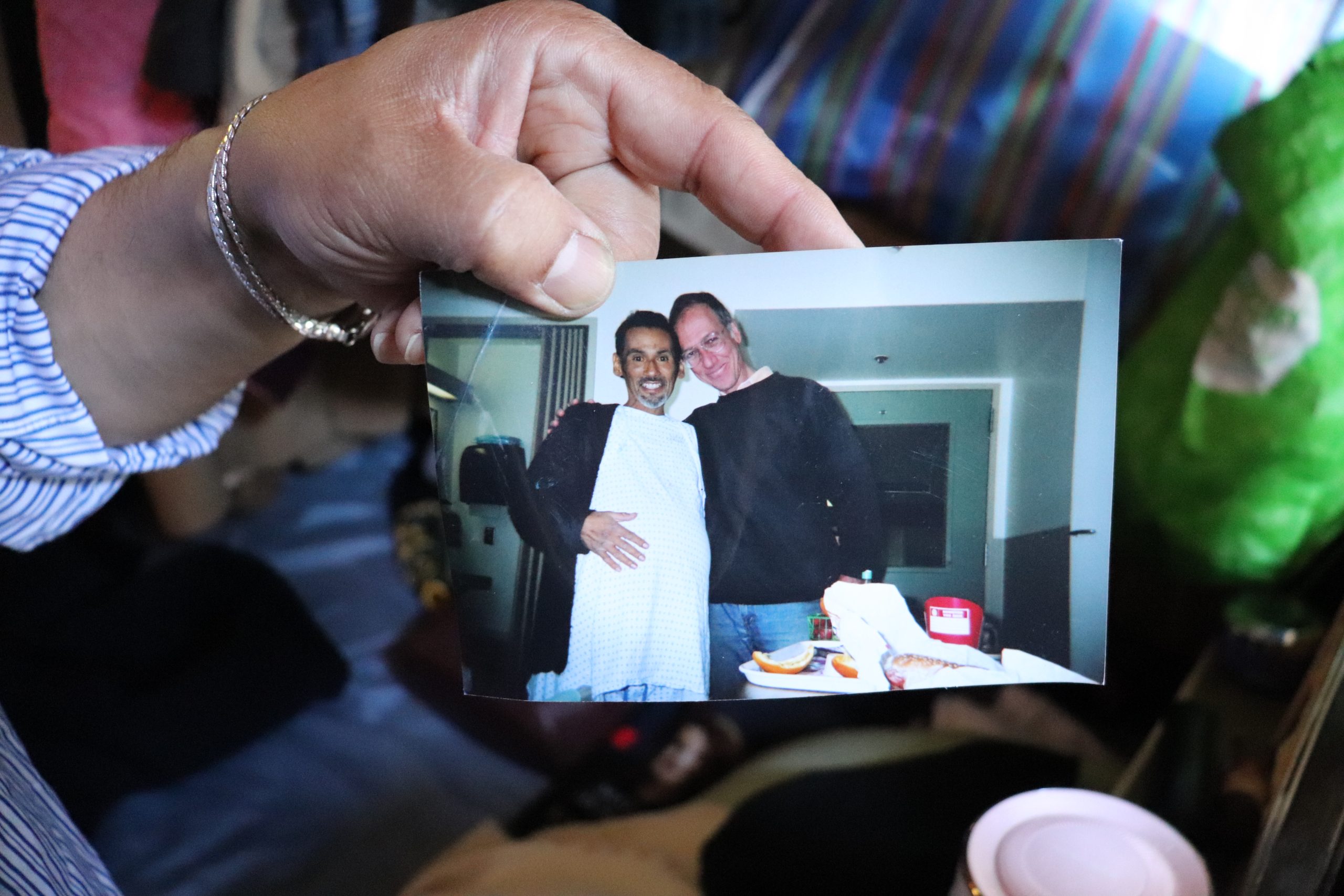
Since then, it has been a long, and sometimes unsteady, road to recovery. Martinez says that living on the street in his RV has not made maintaining his sobriety easy.
“I wouldn’t have been able to survive this whole mess if I was drinking,” said Martinez. “I wouldn’t be able to be here talking to you today.”
Last year, Martinez and his fellow RV dwellers, who he thought of as a second family, were forced to vacate where they had been living for the past year atop Bernal Heights.
After that, Martinez, his chihuahua Audrey, and a caravan of other RV residents went on the move, and a lot has changed: Six months ago, Martinez’s dog was hit by a car, the community split up, and now, Martinez parks alone to avoid negative attention from police or neighbors.
Being on the move means sleep’s never easy
Between midnight and 6 a.m. at least twice a week, RV dwellers often have to vacate their spot to avoid street cleaning, driving for long periods of time to find a new place to park that will fit their vehicle. That means sleep is hard to come by.
“It’s not tranquil,” said Martinez. “You don’t get a lot of sleep.”
Still, there can be community in living in an RV.
Carlos Perez, another RV owner who parks in Bayview, says RV residents on Jerrold Avenue take care of each other. Some look after his brother, who is disabled. They let each other know when there is suspicious activity nearby, and everyone knows that a section of the street is Carlos’ spot.
Perez and his brother have been living there in an RV for about 12 years. He says he is lucky to have a job just a couple blocks away, and a boss who lets him check on his brother twice a day between shifts, and move his RV to avoid street cleaning.
But it’s never easy.
“People try to make it even harder for us,” said Perez. “They take things from us, even though we work hard … We are living like that because housing in San Francisco is really, really bad … I’m not a horrible person, I’m just trying to survive.”
Perez says that if he were offered a spot at Jerrold Commons, he would take it. He has already filled out an application.
“They said there would be an open space for RVs,” said Perez. “But I heard that wasn’t going to happen. I would be happy to not have to move my RV every week; it would give me a little bit of peace.”
And, at this point, he would trade it in for a shelter, as long as it was private. Asked if he would give up his RV for a spot in a tiny cabin, Perez replied: “Of course.”
Sorry folks, you can’t live for free in a giant derelict vehicle in the most expensive city in the country.
Normal people with jobs can’t afford the rent in San Francisco. I don’t see why the city should support these folks, many if not most of whom are illegal immigrants.
If they have RVs, they can go live somewhere where the real estate is cheaper, which means literally everywhere else in the country.
There is always the rest of California and 49 other states to find cheaper housing somewhere other than the single most expensive major city in America.
Yes, it is ridiculous for RV dwellers to claim that they have “nowhere to go”.
They even have the means to travel to those other places.
And yet you still demand your trash get picked up, your bus be driven, your pizza delivered, your streets swept, dry cleaning done, lawn mowed, dog walked, tire replaced, shingles painted, drinks mixed, your retail secured, etc. You still want all of those blue collar jobs done, right?
You just expect them to commute here from Nevada or something to do it for you.
“They’ll just take High Speed Rail, right?” – Clueless agents of gentrification, SMH
Stop infantilizing these folks. They have agency. No one is forcing them to live like this.
Ah yes, the classic ‘if you can’t afford it, leave’ argument. Because nothing says ‘solution’ like exiling the poor from their own hometowns like modern-day lepers. I was born and raised here—why should I be priced out of my roots so some tech bro can have a second condo he doesn’t live in?
The tech bros will say because you were not smart enough to earn enough money to afford the prices we have here since they invaded our city like locusts.
Did you even read the article? These people are not from San Francisco.
New York is actually easily #1 again. SF is cheaper than it was a decade ago.
I have so much to say about this story but little space to say it all. I’ll start by saying, people living in RV’s are NOT homeless. They have a home on wheels. Next, it is illegal to bribe RV owners with SRO housing or, taking their vehicles if they don’t accept. This is a parking issue not a homeless issue. By saying there are RV Parks that rent spaces is the same as saying, those RV owners can keep their vehicles but those on the streets can’t. If you own an RV, you own your home. Next, the city created this problem by failing to enforce rent control laws which has forced single people and families to find alternative housing. I’d rather see these folks living in RV’s than on our streets. Frankly, Emily Cohen is nothing more than a political mouthpiece who takes her salary from taxpayers and, it’s in the best interests of these bureaucrats to maintain the status quo to protect their meaningless jobs. We have the highest paid transit workers in the country and spend 500 million dollars annually for the Department of Homelessness. We still have the same homeless numbers we had 20 years ago but spend more today to NOT fix the problem. Lastly, the main issue I have with RV’s that no one ever brings up is the health risks of dumping waste water in the streets which pollute our landscape and waterways. That’s why they must go to an appropriate facility for long term use and not be parked on the streets.
“Housing is expensive”, THEN MOVE. Why are you here complaining and expecting everyone to tolerate your presence on their streets!? You are not owed anything, move to a cheaper state.
I don’t think you grasp the underlying issue. There is no reason for a one bedroom apartment to rent for $3,500.00 a month. To qualify, you must earn $10,500 a month salary or three times the amount of the rent. Furthermore, many people have made the decision to move to a “cheaper state” and found out, you get what you pay for. Many have moved back. Lastly, the effects of global warming on our weather has created year long disasters with floods, tornadoes and hurricanes. These people spend their lives rebuilding and hoping for the best. Your comment is shortsighted and cruel.
Perez is an accidental climate survivor. Living in vehicles is a movement to reduce greenhouse gasses. Perez is not a part of the movement but through necessity he is practicing the mechanics. The water, fuel Perez uses and the space he occupies is less than what most household pets consume. The Real Estate Industrial Complex is guiding the debate and forcing the conversation to turn against the homeless rather than the unsustainable and unaffordable product they sell.
Blessings.
Bye bye. Go somewhere less expensive and stop littering up our city. We are all tired of this sh@: and want you GONE
Mr. Mayor,
People who work for you ae touting over 200 acres of land planned for Recreational use on Treasure Island.
It takes around 62 acres to build a First Class RV/Tent Campground for 1,000 paying guests to the Best City in the World.
AI and UBI will have millions of Americans on Permanent Vacation and a Life Expectancy of 200 soon.
They will all want to visit San Francisco which will have 4,000 high quality old fashioned Camping Slots within our City Limits.
Build them, Daniel and they will come.
Treasure Island could have adjoining playing fields for a variety of sports.
Instead of working to alleviate the suffering of our lower class workers you have continued Mayor Breed’s actions to make their lives more miserable.
Please help these people because they deserve it.
You wouldn’t be helping the Fentanyl gang cause they don’t have the bandwidth to maintain an RV.
2 SF RV/Tent Campgrounds on Treasure Island and one each on half of Harding and Lincoln golf courses.
go Warriors !!
h.
“I’m not a horrible person, I’m just trying to survive.”
politico.com/newsletters/california-playbook/2025/04/22/the-state-senator-who-could-foil-the-yimby-agenda-00302346
Stop electing gentrifying liars with big-P political agendas who get all their funding from Billionaires’ corporate SuperPAC donations. They literally could care less.
It seems like what we need is more high income people whose taxes pay for the endless social services required to support the low functioning people with literal brain damage on the streets. There is no universe where Ms. SSI is going to be able to afford a union built, $1300/sqft apartment which is the going rate for new builds.
I am so sick to see so many seem truly proud to hate the poor.