

How rough is the state of San Francisco’s bereft downtown? Rough enough that the city’s longtime chief economist deploys a metaphor not from the academic canon but, rather, the chaotic realm of Warner Bros. cartoons.
“Right now we are still doing the Wile E. Coyote thing where we’re walking on air and holding up a ‘help me’ sign,” says Ted Egan. “The laws of physics haven’t yet kicked in. Or, in this case, the laws of economics. But they are called ‘laws’ for a reason.”
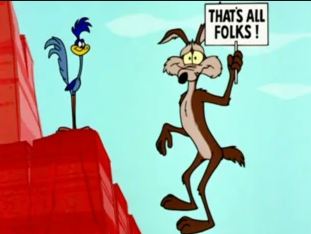
So, that’s pretty rough: For those of you who haven’t watched a Roadrunner vs. Coyote cartoon in a while, once the laws of physics invariably kick in, the coyote plummets from a cliff, soaring earthward with a high-pitched whistle and emitting a cloud of dust and bomb-like report when he strikes solid ground.
This is not the municipal metaphor any city aspires to. But it’s the one we have. Downtown vacancies remain stubbornly high, as do downtown rents. “I can’t think of a significant lease signed by someone who said, ‘I want to be in San Francisco because rents are low,’” Egan says. “But we will get there. Because there is no alternative.”

Desperate and/or intransigent building owners or operators unable or unwilling to offer market-realistic rents are going to eventually bite the bullet, go into foreclosure or otherwise come to real-estate Jesus. Reasonable rents of the sort that could attract back nonprofits long ago economically banished to the East Bay will be proffered. Bigger companies that never fully left downtown may also muscle in, jumping at the chance to switch offices and save money.
It’ll be a bloodletting and a free-for-all, and some major players will absolutely lose their shirts. And, even after all that, Egan is not hopeful San Francisco will ever replicate its pre-pandemic boom times of virtually nonexistent office vacancy and “bars bursting at the seams.”
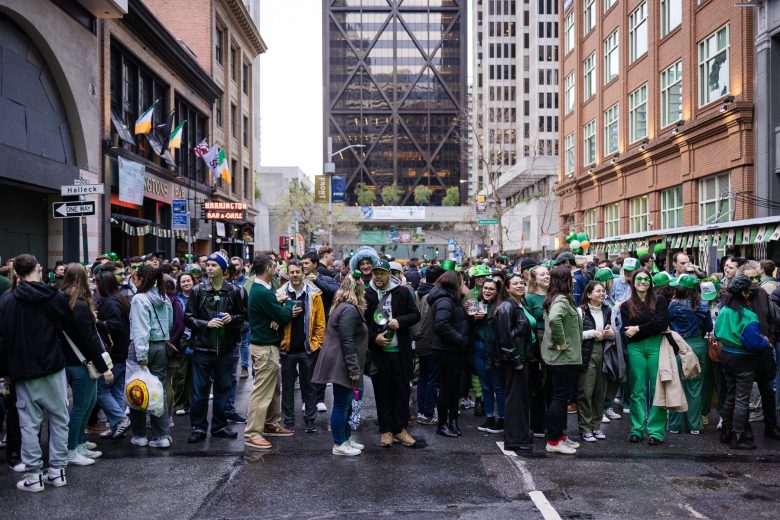
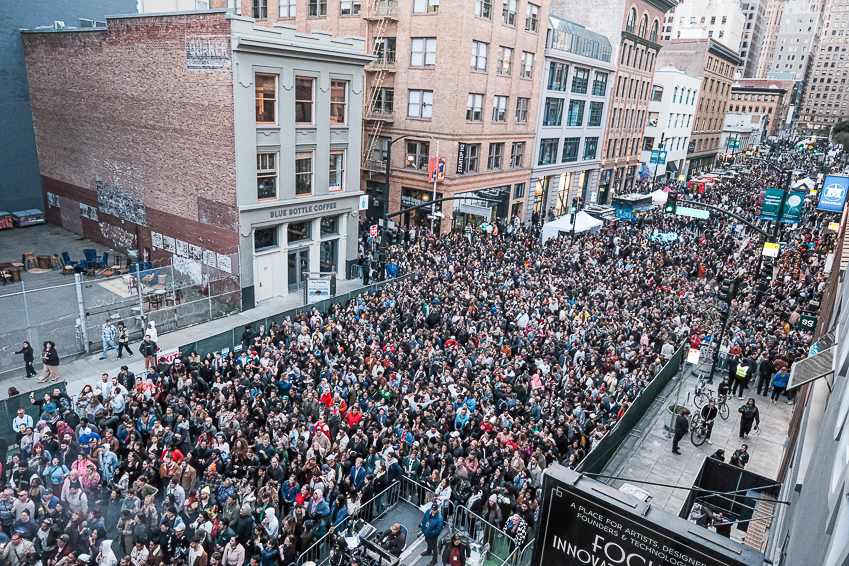
This is a sobering prognostication. But the city’s steps thus far to revive downtown are a far cry from sobriety. Rather: San Francisco wants you to walk around downtown, and a burgeoning number of other neighborhoods, with a drink in one hand and your wallet in the other.
That’s hardly a bad thing: There is only so much a city can do to counter global market forces, even before the “stable genius” federal move to tank the world economy via maniacal tariffs. It is not possible for a single city to quickly revitalize a downtown dependent on a now-archaic business model, and San Francisco was especially vulnerable, as it featured a corporate monoculture so uniform that everyone wore the same vest. Converting office spaces to housing is neither architecturally possible nor economically feasible for the vast majority of buildings, and it’s increasingly clear that a number of hollowed-out office towers will likely have to be razed.
The city can’t do much to hold back the global tide. The big-picture things it can do can’t be done quickly. Christ, it makes you feel like getting a drink. Well,the city can help with that. And quickly.
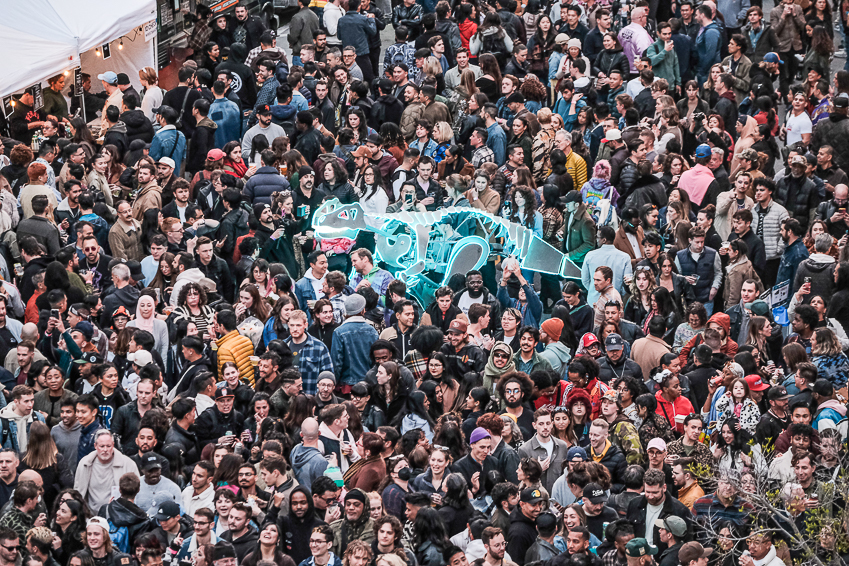
In short, it’s alarming how many of the city’s solutions to economic deterioration downtown and elsewhere essentially boil down to creating party zones where young people can drink and socialize.
This, again, is hardly a bad thing; reducing the reflexive intransigence and labyrinthine bureaucracy associated with doing business in San Francisco is good. Getting thousands of people into city retail corridors and giving them the ability to amble across the street from one establishment to another while holding an adult beverage, a move that required state action from Sen. Scott Wiener, is good.
Activating moribund ground-floor retail and entertainment with roving drinkers is good, though House of Shields proprietor Dennis Leary notes that massive, festival-like events, while “very cool,” do not stave off a return of “tumbleweeds” the next day. And it remains a stretch to claim that any of this city-sponsored revelry will translate into businesses renting out the millions of square feet of moribund office space looming above the roving drinking and merriment.
“Ground-floor retail and entertainment zones aren’t going to drive anybody to rent out the fourth floor for office,” Egan sums up concisely.
So, the problem here isn’t that the city’s eager, if not monomaniacal, advocacy for drinking and socialization opportunities for young people is bad. It’s just that it’s overpromising. This is not the Warriors signing Jimmy Butler. It’s more akin to the Warriors signing Kevin Knox II.
Still, every downtown bar/restaurant owner I spoke with was grateful for the city being proactive. Everyone appreciates the intentions here. It’s the unintended consequences that are more worrisome.
To wit, Wiener and Mayor Daniel Lurie this year introduced a state bill that would allow for 20 new discounted liquor licenses to be created for the SoMa-downtown-Union Square “Hospitality Zone.”
Extant businesses, hanging on by their fingernails, appreciate city efforts to support street fairs and other excuses to bring potential customers downtown. They’d love for the city to facilitate programs where businesses, hungry for employees to return to the office, incentivize this by giving workers tabs at local bars and restaurants.
Instead, the city’s response in this case came off like a sucker punch: Hey, let’s get you guys some more competition. And let’s subsidize it.
The city’s strategy is familiar to anyone who’s watched the movie “Field of Dreams:” if you build it, they will come. That worked out well enough for Ray Kinsella. But we can’t all have disembodied voices in the cornfield offering us supernatural economic guidance.
In the real world, as of Friday, there were no fewer than 114 liquor licenses presently “surrendered” by belly-up San Francisco establishments. Of those, more than 50 were the sorts of licenses a bar/restaurant would apply for.
“There is not a demand for more bars and restaurants in the Hospitality Zone. We know that from 30 licenses surrendered in the last 12 months alone,” said Brian Sheehy, the CEO of Future Bars. He operates more than a dozen establishments, including several in or near the Hospitality Zone: The Lark, Local Edition and The Dawn Club.
“We do not have the supply of customers to support even the existing businesses. If you give away 20 licenses, you threaten the existence of the establishments hanging on right now.”
Adds Eric Passetti, who runs a number of downtown bars, “Why aren’t we doing something to get those surrendered licenses activated? There’s a reason they’re sitting dormant now; people don’t see a way to make them work. Why are we adding more?”
Last month, the Golden Gate Restaurant Association wrote to Wiener. A major worry: Disseminating 20 heavily discounted liquor licenses into the market could devalue what, for many restaurateurs, is their lifeboat in the event of foundering. Liquor licenses are a bit like New York City rent-controlled apartments or taxi medallions in a pre-Lyft and Uber age. In boom times, a San Francisco liquor license could fetch a quarter of a million dollars.
The pandemic burst that bubble: In February, they were going for about $150,000. As of March 6, per the GGRA letter to Wiener, “a type 47 license was being offered by a broker for $114,550, already reflecting a 24% loss of value…” For bar or restaurant proprietors who’ve gone out of business, a liquor license is an asset that can be used to stave off personal bankruptcy. Or, at least, it was.
Is it perverse for a government license to cost so much, and even create secondary markets, due to enforced scarcity? Yes. Will offering new liquor licenses at a deep discount have the intended effect downtown? That’s harder to say.
Wiener, for his part, said he’s open to feedback from restaurant trade groups, which have proposed a number of amendments to his legislation. “But,” he says, “respectfully, a rising tide lifts all boats. Getting new restaurants into Union Square and Yerba Buena is going to be good for everyone, including existing restaurants. This is a good bill.”
Another white whale of Wiener’s — and, before him, Sen. Mark Leno — is extending bar hours to as late as 4 a.m. This has failed, repeatedly, with Gov. Jerry Brown memorably vetoing the bill in 2018 and “two more hours of mayhem.”
Assemblyman Matt Haney has, this year, resurrected this legislation. And, this time, it just applies to the hours of establishments in “hospitality zones.” Will this help it advance out of the legislature and onto the governor’s desk — where, perhaps, Gavin Newsom will sign it (if Charlie Kirk and Steve Bannon tell him it’ll own the libs)? It just may.
San Francisco can’t counter global economic trends. But it can throw a party. And even though young people do not party nor socialize nor, most of all, drink with the fervency of their aging (ahem) counterparts, setting up regular downtown festivals and making it easier for people to buy drinks, perambulate and spend money is definitely something the city can do.
Everyone loves a party. Parties are fun. But, when advanced as a solution to the city’s Life, the Universe and Everything problems, we’re back in the realm of Wile E. Coyote, who would open a small parasol when large boulders were falling upon him.
San Francisco is actively hostile to people looking for a place to pee. Sure, let’s add lots of drunk young people into a place with no real access to bathrooms. What could go wrong?
Put up police vans on every corner. As learned at 16th, they keep the progressive-homeless-mentally-ill-drug addicts away, while providing a convenient place to pee. It’s a win-win.
“I’m sorry, Sally. The libraries are all closed, the parks are all closed, and there are huge potholes in front of your school. We had to pay for 40 police vans to arrest people for peeing.”
Are you saying people should pee on police vans? I don’t understand this comment.
she’s saying we’re wasting precious tax payer dollars on sfpd overtime at the expensive of public services and facilities, it’s pretty straightforward.
I’m saying that the problem is people who urgently need to pee, and no bathrooms for them to pee in. Mark’s solution was police vans. Which… don’t provide public bathrooms. So the only thing the police vans could do would be to arrest people for public urination. Oh, and cost a fuckton of money.
It’s a win win though!
Maybe downtowns exist because people had to be there, not because they wanted to be there.
Take a trip to NYC or any city in Europe. They’re ripping.
That’s because their ‘downtowns’ (all of the top-tier cities have multiple ‘central business districts’ have DENSE HOUSING and good transit that runs 24/7….and you would have to be crazy to want to drive a car there.
Not even true at all, almost an AI-generated claim.
Is Wall Street in NYC or Canary Wharf and The City in London ripping?
Joe, I wonder how difficult to get, and expensive, liquor licenses are in SF, and how that compares to other cities.
Is there an economic benefit from making liquor licenses difficult to get? I believe you have some experience in France, where most cafes also sell wine and liqueurs. Would the entire city perhaps benefit from a relaxed stance on liquor licenses?
One thing we don’t talk about enough is the difficult tourism market for SF. If the city became known for cafes with small but interesting selections of California wine, for example, maybe that would be a draw.
It’s a State agency, ABC, FWIW. City laws wouldn’t change that. There are other things that city can put in the way, planning dept etc, but not licenses itself.
Lurie is asking fellow oligarchs like Laurene Powell Jobs and Sam Altman-Fried for “ideas” to reinflate the local commercial real estate bubble (because who better to ask than the same sociopaths who got us into and have gained the most from this mess?). $30 street cocktails for young, transient, imminently self-obsolescing, eighty-hours-per-week bit wranglers who are too busy looking at their phones to flirt with in-person humans is a “smart” way to make San Francisco billionaires great again!
Daniel wants to make “it easier to start a restaurant, a bar, or a startup.” So, that’s it: AI and booze for the kiddos who work at it. And robot cars, so the drunk kids can get back to their pods for their two hours of sleep the techlords will abide. More ribbon-cutting oppos for the mayor, to be sure, but no decent jobs for people without degrees in symbol manipulation, and no meaningful way to fill the currently nearly twenty-two Salesforce Towers’ worth of vacant office space.*
All the mayor has is the same old class war: tax breaks for the latest “tech” scam, more gentrifying condopod towers for coders, and more places for them to slurp artisanal vodka-infused boba (yay, more minimum-wage service jobs!).
*Socketsite, where are you?!
Nailed it. Thank you.
I am glad you are writing about this..I noticed that all plans for recovery the city is promoting always involved alcohol, music and parties. So judging by this, recovery is a long way from us..One’s need to bring businesses back, workers back , downtown traffic back with shoppers like a regular city. but no, every corner now is turning into a fan zone. That is showing us that our elected local nobel prize winners don’t have a clue; we can go back a few administrations..they did as well with weed; feels like every street has a nail salon and a weed place next to it.But keep going, you are on the right track.
San Francisco trying to get rid of the drug problem, trading it in for an alcohol problem. California trying to push bar closing times to 4 AM.
Renaming districts, closing the Great Highway . WHO are you people.
Don’t bring your ideas here. If you didn’t like it THERE, don’t bring your there HERE
Yet another clueless fool who has no idea why SF is….SF.
Maybe read up on this city’s history. Since this city was a city, it’s been all about incubation of what’s new. It mercilessly cycles out the old and tired. Eventually the outer neighbors accept and incorporate what’s going on downtown (that is, in the denser neighborhoods). It takes a while because it’s hard to shake off redlining even decades past it being ruled illegal.
‘Upper Great Highway’ itself was a 100-year experiment—it existed on park land as a ‘parkway’ to mimic other coastal CA beach promenades, but was never given a name or number and was a headache since the very beginning. Being never an official road, it served a purpose when Playland at the Beach was there, but in recent years has been irrelevant as a vital artery (the oft-quoted ‘20,000 cars per day’ figure is a lie) because there just isn’t much Richmond-to-Parkside or Northern San Mateo Co commuting traffic anymore.
West-side residents have been given a lot of chances to roll with the times and support real public transit and they have failed. But there’s some glimmers of hope here and there with the younger folks who live out there.
So pass this on to your neighbors—Upper Great Highway no longer exists. Use your ‘shout at cloud’ energy to demand better crosstown Muni service—at the very least get a bus-only lane painted but BRT is really what’s needed.
“Since this city was a city, it’s been all about incubation of what’s new.”
Pffft, NYC transplant doesn’t even know the word Ohlone.
The Great Highway actually does still exist even as they pave the beach further for a stage in Snowy Plover habitat using Billionaire “donations” to skirt CEQA and other policy reviews, as the rest of the city unburies itself from 3/4 of a Billion dollar deficit across the board.
Who are you people is the right question. You aren’t from here.
Absolutely ridiculous. You might want to read up a little more on the the “city’s history,” Glen, which has always been about tolerance, sharing and diversity…. which the Great Highway provided to everyone. San Francisco is now becoming a city run by a few rich little little tech oligarchs who ride bicycles and are doing the same thing to San Francisco that Elon Musk is doing to the country… trying to change how all of us live in order to suit their own selfish lifestyles. There are a lot of people in our city finally “shouting at the cloud” these days, or have you been to far up there yourself to notice?
San Francisco is nothing but an opportunity site for the get-rich-quick schemes of fly-by-night boosters. Residents are an annoyance to be marginalized, neighborhoods fodder for redevelopment.
go yell at the clouds
Go get run over in the outer sunset like a local child probably will as a result of Prop K’s slapdash supporters backing Billionaire developer lies.
Incumbent businesses do not want the government to allow competition – what a surprise.
When will voters realize that Scott Wiener is a pawn for developers, real estate lenders and the Carpenteros Union, masquerading as an immoralist?
Apparently George Lee is a pawn for preserving the present situation of empty buildings and blight, with 45-50 people dead from car crashes a year and 200+ dead a year from drug overdoses because nothing should change and no one should get a chance to make a fresh start with a job that might be available were new businesses/shops/restaurants to open. Cool cool cool
“45-50 people dead from car crashes a year” – actually this is the maximum number of fatalities since the “Project Zero” BS to spend millions and millions appeasing bicycle lobbyist Google lawyers got started – more every year. Spend spend spend, NYC transplants, then you can just move back when nothing good comes of it.
Not alcohol, bars, and street level festivals, but Electric Kool Acid Test 2.0 — psychedelics and immersive theater experiences; populate the grand old empty buildings with live performance and film, raves, and meditations etc. All power to the imagination.
Call me old, but I remember when drinking in the streets was the problem, not the solution.
Can’t believe Mr. Abstinence, Sup. Dorsey, is in favor of open drug use in the streets. At this rate, he’ll be handing out straws and tinfoil in 20 years.
Alcohol kills orders of magnitude more people each year than fentanyl. Such codependent enabling of destructive behavior is only acceptable when licensed operators (campaign contributors) are peddling poison.
The number of people alcohol kills compared to the number of uses of it very favorably vs fentanyl. Orders of magnitude.
Fentanyl is far more dangerous than alcohol in all forms.
Meanwhile 90% of the produce you eat was farmed using sewage sludge, human faeces and other waste products. Bon apetit, teetotalers.
One thing I’d like to point out that I don’t believe the author touches upon is that throwing these parties is about trying to revitalize our cities reputation. That reputation is the main reason the tourism industry has cratered and yet roared back in other cities. Between fentanyl and the mass homelessness that resulted from the pandemic SF got a pretty bad rap that has stuck even if it’s no longer quite as accurate. Throwing these parties pulls in people from outside the city and shows them that it’s actually still a happening place and safe and clean (in most parts). These people then leave and spread the word that it was a good time and hopefully that helps us fix this image problem. Tourism is just as important to get back as the office workers.
Lower rents are a no-brainer! Thank you for bringing this up. It seems so logical, yet no one treats it as a serious issue. The government often resorts to band-aid solutions and appears afraid to take the necessary action. At this point, building owners in downtown areas are delusional, thinking they can attract businesses with their high prices. This obsessive focus on tech industry has contributed to our current situation. Why are all parties involved being so stubborn? What incentives do they have to keep vacant offices instead of renting them out at lower prices? Who is making money out of this mess that refuses change? I know many people and businesses that would rent in a heartbeat if the prices were more affordable.
“It seems so logical, yet no one treats it as a serious issue”
Well it is logical and the problem, but there’s no easy way to force property owners to wise up and be realistic about taking anything less than the absolute top dollar. How exactly would that work? What would that law even look like? And you can imagine the political response to such a suggestion too. So you’re right, it’s both perfectly logical and yet no one is serious about doing anything about it, really.
More drug tourism?
Bars and restaurants can’t get enough staff to stay open past 9 or 10:00 o’clock, even in jumping neighborhoods like Hayes Valley – so how on earth will they find the people to stay open til 4:00 a.m.? It always seems that Scott Weiner lives in a different city than the rest of us….
coming out of the pandemic we definitely had a shortage of FOH and BOH staff who had found other workin the mean time, but nowadays I can tell you it’s a hard job market. There are way more underemployed servers and cooks than there are positions available.
I mean I get it. We have some of the best universities in the nation sprinkled around the bay area. We need to draw in the recent grads with flashy gems to try to snag them for the long haul. That’s what keeps our biggest industries in town: health care, research/tech, finance. It’s also what draws the best minds to those schools in the first place. But we also need to help define what it is that young people want too. Most young people don’t want to pickle their organs to have a good time, a lot of them, especially the smart ones, have figured out that it’s pretty unsustainable to do so. But yeah, it’s also gotta be cheap, because we don’t make enough money for anything these days, so I get flooding the market. It’s a hard needle to thread to be sure.
I hear the complaints that this won’t do enough and even could cause some issues (tho overall seems good to me). What other alternative actions would you rather they do to fix downtown?
If a liquor license is surrendered does that mean someone still owns it but there’s not an active bar actively using it?
This seems like a no brainer. Value loss on liquor licenses does not rank high on the list of the city’s issues.
I’m not interested in the events, but the fact that they are well attended and apparently safe has positively changed my impression of downtown
If surrendered it goes into the ether, gone. New application.
This is crazy. To get young people drunk ! Please ! Hahahahha
“leans heavily”. It’s just one thing, and like the other one things – if a resurrection of the 2010’s is the idea – not nearly enough. Union Square used to have retail with regional draw. Now, the little that’s coming back creates something more of a version of your random backwater suburban strip mall, garnished with a couple BART stations.
Nearly every recent study of Gen Z shows that they drink less alcohol than all previous generations before them. Alcohol sales in the US have been cratering for years, and they certainly won’t be helped by the convicted felon’s taxes (aka tariffs). So, this seems to be maybe not be a good sustainable plan for luring people out into various neighborhoods or bringing people downtown on a consistent basis.
Instead why not invest in more music clubs where local bands can build an audience and generate the kind of local music scene we used to have? For example, 11th Street used to be a great corridor for music with DNA Lounge, Slim’s, Paradise Lounge, and others nearby, where every night of the week people would go hear bands cheaply. This was before gentrification killed the nightlife there.
It just feels like partying in the streets is going to get old quickly, and there’s the potential for a lot of serious downsides.
“This was before gentrification killed the nightlife there. ” – Bingo. Ironically the gentrifiers don’t spend their money on local businesses like the locals they replaced, are instead all about the “trending” instagram pop-up Soliel Ho hype BS. Those places open and close every few years and the rents never, ever go down. Ever. The fun spots that existed before have literally no place to be anymore in SF. Lease is up = we’re gone, we can’t afford 4x rent, so enjoy your bespoke $55 Belgian truffle martinis until the next douchey pop-up viral experience comes along.
We don’t need more places for young people to fry their brains till 4 a.m. only to get rolled on the way home. We need to offer quiet, serene environments to cleanse the spirit. We convert unused ground floor spaces to public washrooms connected to meditation rooms (yes, with supervision). Cleanse your guts, cleanse your face and cleanse your mind. Next idiotic question: And how the hell we gonna pay for that brilliant idea? Uhh … mañana a little bird gonna come to our window and whisper the answer.
Campers,
Legalize the Sex Trade
Decimalize Drugs
Make Top Cop an Elected Office
Build SF City RV/Tent thousand space campgrouns on half of our golf courses and on Treasure Island
Put Ohlone Casinos in Armory and Twitter building and Cow Palace.
That fills the restaurants and hotels and guarantees Foot Patrols.
go Niners !
h.
Public intofication illegal
If persons are impaired and in public they should be arrested
No exceptions
Alcohol or fentanyl.
Grow up
If you cannot handle your alcohol or use drugs , game over .
Lawlessness is lawlessness
Not supporting this or paying for it with my taxpayer money