

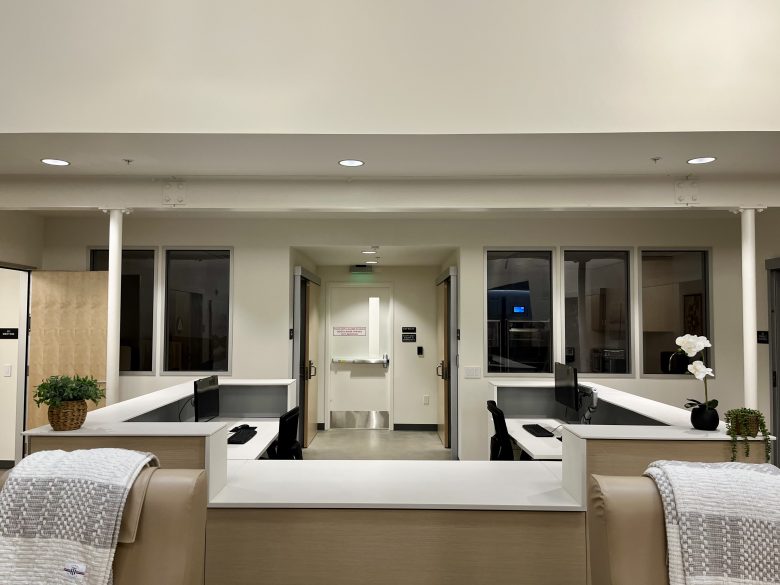

The San Francisco Department of Public Health opened a 16-bed facility at 822 Geary St. to to provide medical care for homeless people in crisis on city streets, as an alternative to taking them to jail or filling hospital emergency rooms.
Visitors will be primarily people who don’t need to be urgently hospitalized, but need lower-level medical care, officials said today. Street teams, police and EMS vehicles will be able to drop people off at the center 24 hours a day, seven days a week.
“Treatment for people in crisis. More capacity in our emergency rooms. More officers back on the street more quickly, and it will be open around the clock,” Mayor Daniel Lurie said this morning, emphasizing that the city must “move with urgency” to get people off the streets and address consistent overdose deaths.
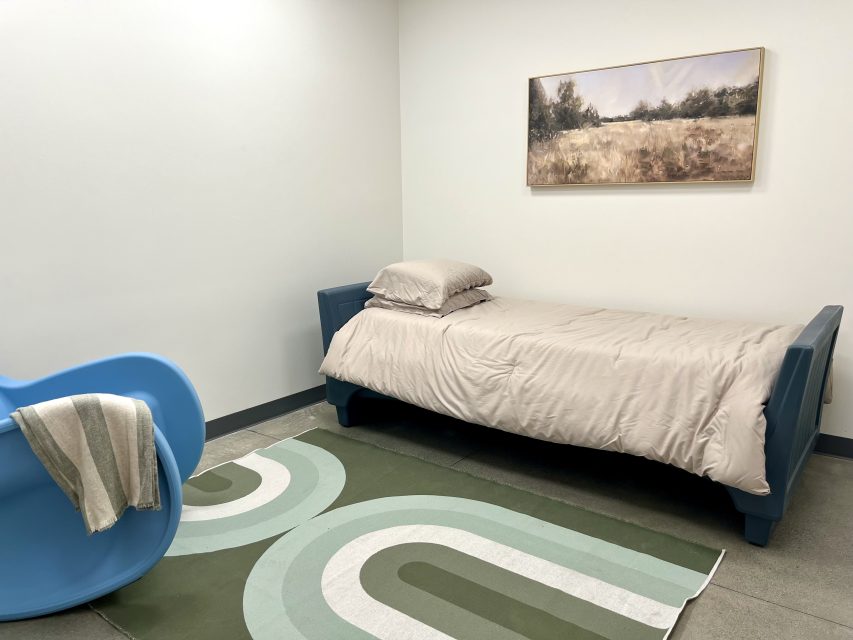
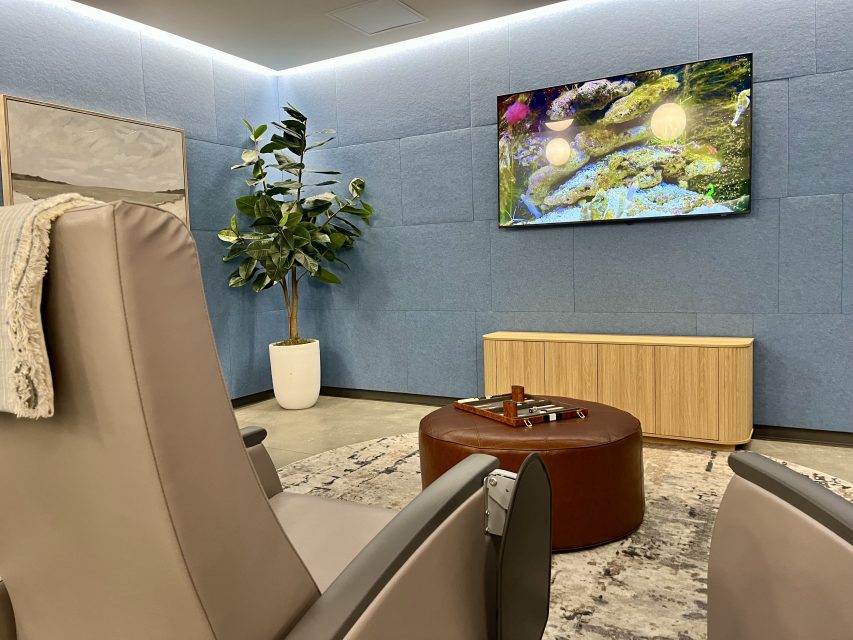
The brand-new center, located at what was once a Goodwill store, and which was originally slated to become a supervised-consumption site, appeared fully set up this morning. The center, which was originally funded and created by Mayor London Breed’s administration, had multiple living-room areas with armchairs, a consultation and an exam room, and two bedrooms set up with a bed and a chair. The city purchased the site in 2021 using funding from Prop. C.
Department of Public Health Director Daniel Tsai said it was important to get homeless people off the streets and into “effective treatment and sustained recovery.”
For now, though, the center may provide just temporary relief; the stabilization center will only be able to host patients at the center for 23 hours at a time.
Tsai said people will be assigned case managers, and be taken to the next step of care after their stay, but where that will be is still unclear.
The city has a major shortage of shelter beds overall, and Lurie campaigned for mayor on a promise to expand the number of shelter beds in the city by 1,500 within six months of his taking office in January.
Today, 525 people are on a waiting list for shelter.
“My administration will build adequate shelter beds,” Lurie’s campaign website reads. “By building the beds necessary to house the homeless, we will no longer push the problem from one streetcorner to another.”
Kunal Modi, Lurie’s Chief of Health, Homelessness, and Family Services, told Mission Local today that the 16 beds at the stabilization center would contribute to that count, despite only hosting patients for one day.
Asked how the beds would be sustainable in such a short-term model, Modi said there would be other efforts to supplement the crisis center.
“This is one part of our strategy. There’s no single opening that is, itself, a silver bullet,” he said, and said there would be “a range of steps or other beds that we’re going to continue to open because we need to have an entire continuum of care for folks.”
The costs of operating the center, which is required to have a physician on call at all times, and at least one licensed clinical professional for every four clients, are still unclear.
Patty Blum, vice president of Crestwood Behavioral Health, which will operate the center, said this morning, as she gave a tour of the facility, that staffing levels at the center are “extraordinarily high,” and that patients will be constantly observed while there.
Blum said the facility will also be staffed with registered nurses, case managers, recovery coaches, and dual-recovery certified coaches. The site will also host overnight security, and police and GLIDE ambassadors will oversee the surrounding blocks.
“The most expensive thing is letting people who are in distress continue to be outside,” Modi said in an interview, “and cycling unnecessarily through our hospitals or other places that are not the right care settings for them.”
Police Chief Bill Scott told Mission Local that the center was a needed option for officers interacting with homeless people in crisis on the streets, and jailing people is not always the best option.
“A lot of folks end up in the emergency room or, depending on what the dynamics are, they end up being taken to jail,” Scott said. “The law allows us as police officers to be able to detain, even arrest, bring people to a facility like this under state law, and then we can release them here.”
At that point, people will “voluntarily” receive treatment.
Folks really seem to be missing the point here. When police encounter someone having a mental/drug crisis on the street, currently they can:
1. Leave them on the street to suffer
2. Take them to the ER which is crazy expensive
3. Take them to jail where services the person needs are likely not available and it’s also expensive.
Now they have option 4 — take them to this center where they can hopefully rebound. It’s a triage center. If they can’t recover in 23 hours, then they need to go to a hospital or other care facility. Think of it like going to urgent care rather than the ER because it’s less expensive, less of a wait, and more appropriate to the actual need.
“… and it will be open around the clock,” Mayor Daniel Lurie said this morning, emphasizing that the city must “move with urgency” to get people off the streets and address consistent overdose deaths.
“the stabilization center will only be able to host patients at the center for 23 hours at a time.”
Round the clock – for 23 hours, moving with urgency to… get people off the streets? Until tomorrow anyhow? Now this may relieve ER’s somewhat but that PR push doesn’t quite line up with itself.
Thank you .
What is the cost?
Addiction is treatable chronic disease .
It is a disease of choice .
Having a person stop using drugs is not enough.
Abstinence , treatment and helping them maintain a drug free lifestyle is important.
There is no cure .
It is illegal . If a person refuses or fails treatment and continues to use then they should go directly to jail.
Playing games and bargaining with an addict is foolish and harmful .
In the area where this center is it makes no sense why there is even one drug dealer still present? They must be removed asap.
No sympathy for a dealer . They are killing people .
“Treatment for people in crisis. More capacity in our emergency rooms. More officers back on the street more quickly — and it will be open around the clock,”
This is absolute bs. Say a cop in the mission district contacts someone in crisis. One option is to take them to SFGH, maybe by police car, maybe by ambulance with an officer escort. Once they’ve done that, at some point in that shift they need to return to the station and write a report about it.
Now, i stead of doing that, they can do a much further drive across the city to the new stabilization center. At some point in their shift, they still need to go back to the station and write a report about it.
How is a longer drive that takes officers out of their districts for a longer period of time getting that officer back on the street sooner?
And how many people actively in crisis will elect to voluntarily stay there once they’ve been dropped off?
I guarantee you SF General costs more than 10x what this will cost to give someone a place to come down from their drug/mental crisis.
Great, hiring pigs to oversee security at homeless shelters. Real nurturing environment…