

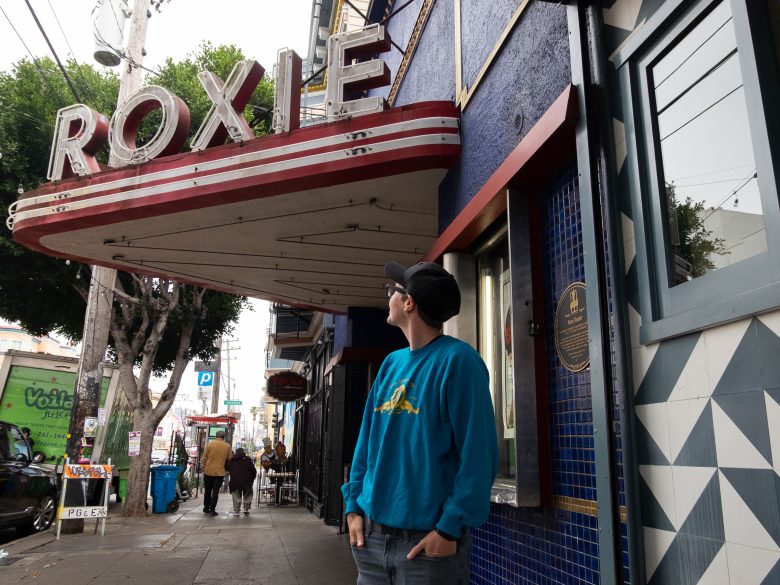

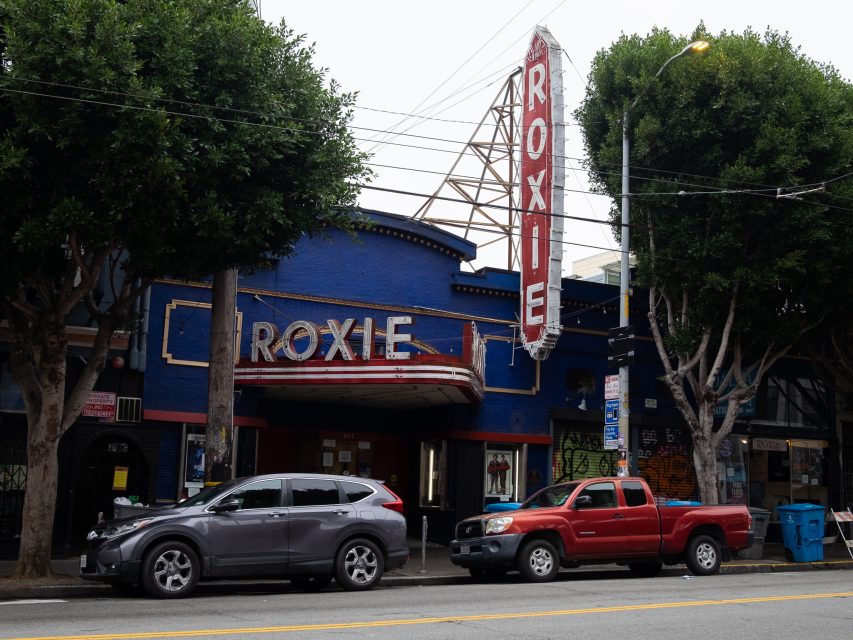
The Roxie has been a movie theater since it first opened in 1913. But for decades now, the question of whether it would be able to remain that way has been a source of great anxiety for the cinephiles and film festivals that depend on its wide-ranging, eclectic programming.
Last week, the nonprofit that runs the Roxie announced that it had an agreement to purchase its historic building from its owners, and is looking to fundraise $7 million. It’s already most of the way there, with $1.4 million left to go.
It was great news, and it left Mission Local full of questions. Lex Sloan, executive director of the Roxie, kindly obliged with a show-and-tell of what the Roxie’s been up to and what’s to come in the future.
The Archive Room
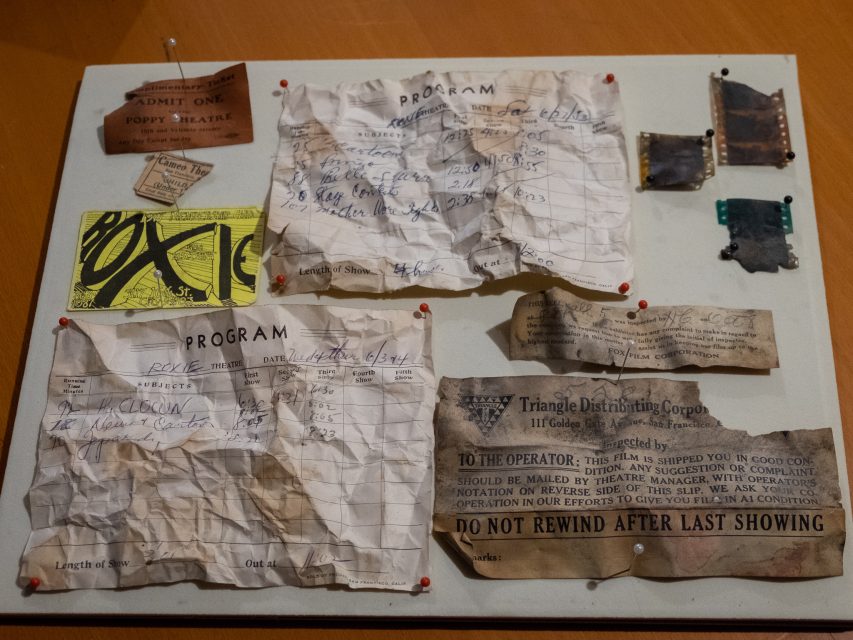
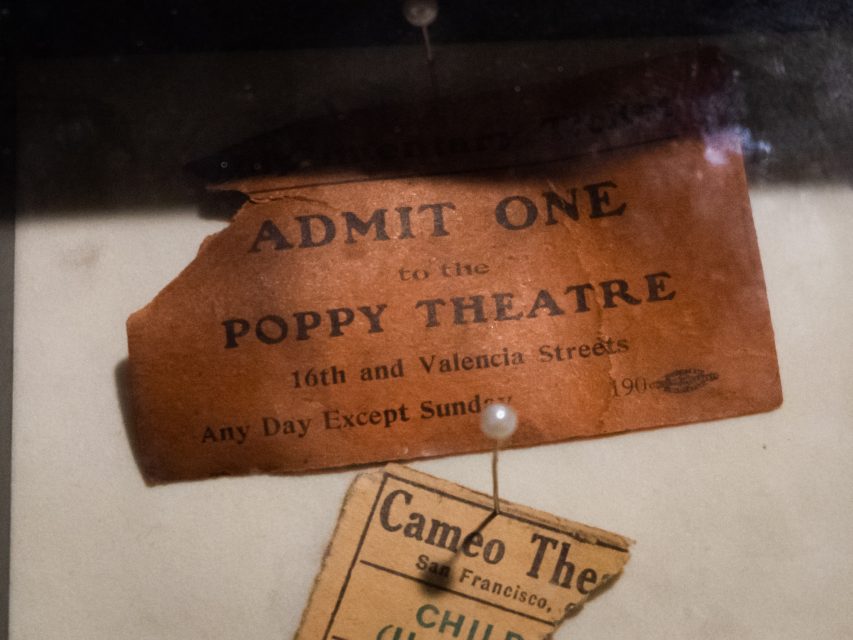
Lex Sloan: This is a movie theater ticket from 1913, when we were called the Poppy Theatre. It was discovered in the walls when we were doing some renovations in the Big Roxie to make the theater wheelchair-accessible. It just fell out of the walls, which was unbelievable. We always knew that the Poppy was the first name of the Roxie, but it wasn’t until we got this physical ticket that we were like, “Oh my gosh, that’s from 1913.”
Then another time period, which was the ’50s, fell out of the wall. [Sloan pointed to a program schedule dated June 27, 1953.] These are so cool, because there are bingo and “Jeopardy” and news and cartoons and stage contests and then the movie. [Those were the different programs for one day on the schedule.]
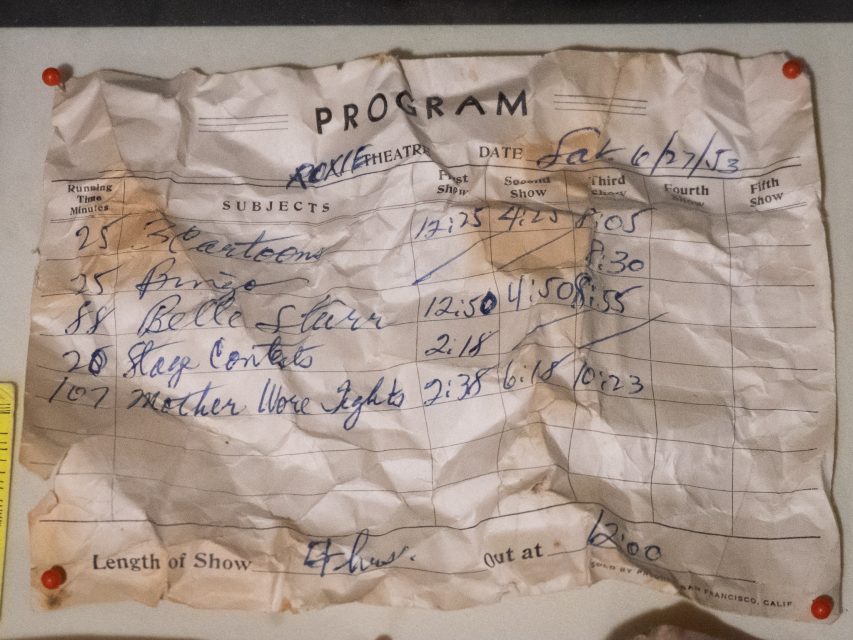
We’ve always been a neighborhood cinema. We were never like the Castro with a big, flashy movie-palace marquee [The Roxie does have a flashy sign, but it’s so small that there’s no room to display the names of the films it’s showing.] We were always serving this neighborhood and playing news and cartoons and having games. It was really important to know that we’re first and foremost here to serve our neighborhood and our immediate community.
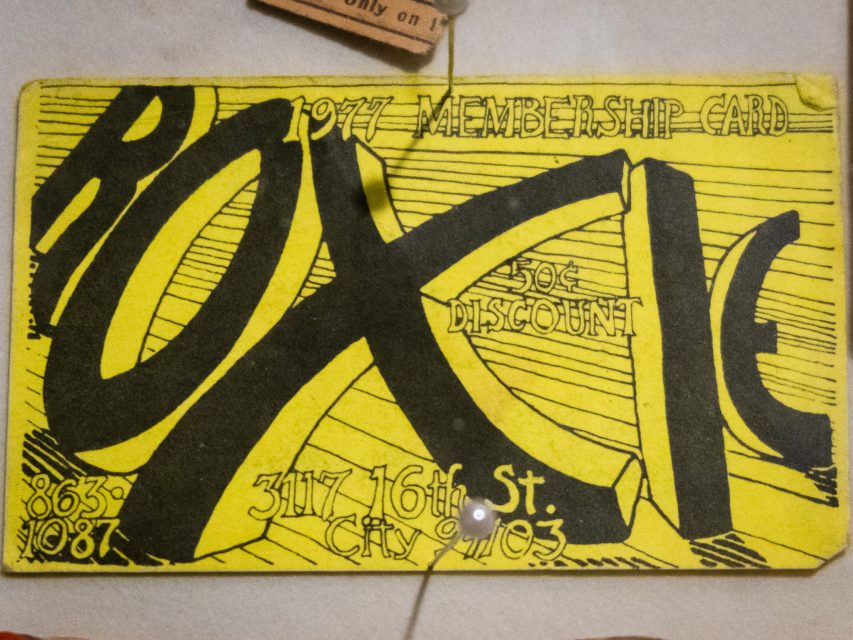
And this I bought off eBay. [Sloan pointed to a yellow 1977 Roxie membership card.]
Mission Local: Wait, do you just go on eBay and search “Roxie”?
LS: I do, I try to reclaim our history. That was the first membership card.
The Roxie has lived a ton of lifetimes. It was a German-language cinema. It was a porn cinema. In the late ‘70s, we became the cinema that we really know and love today. The founders of the Roxie, for better or worse, put people and cinema before profit. And that has gotten us to the point we are right now.
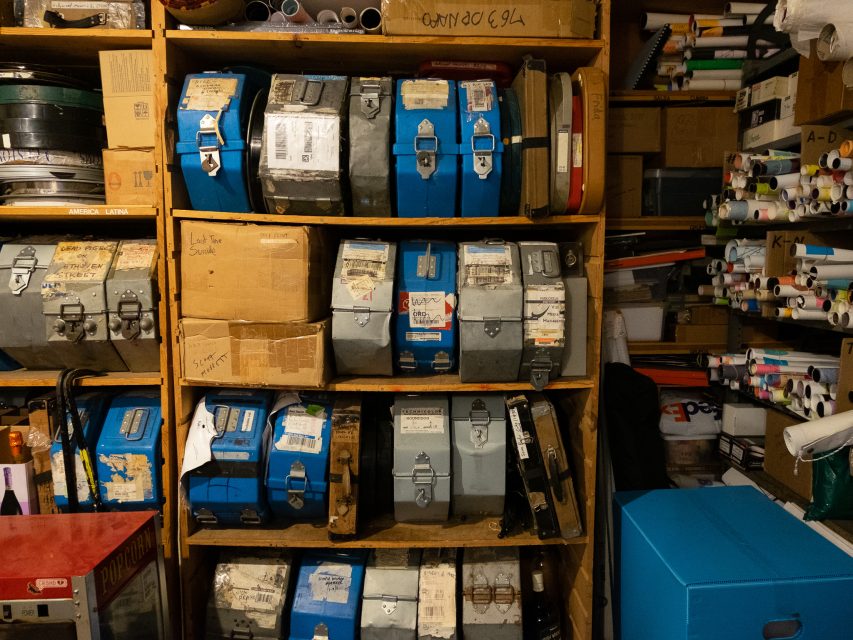
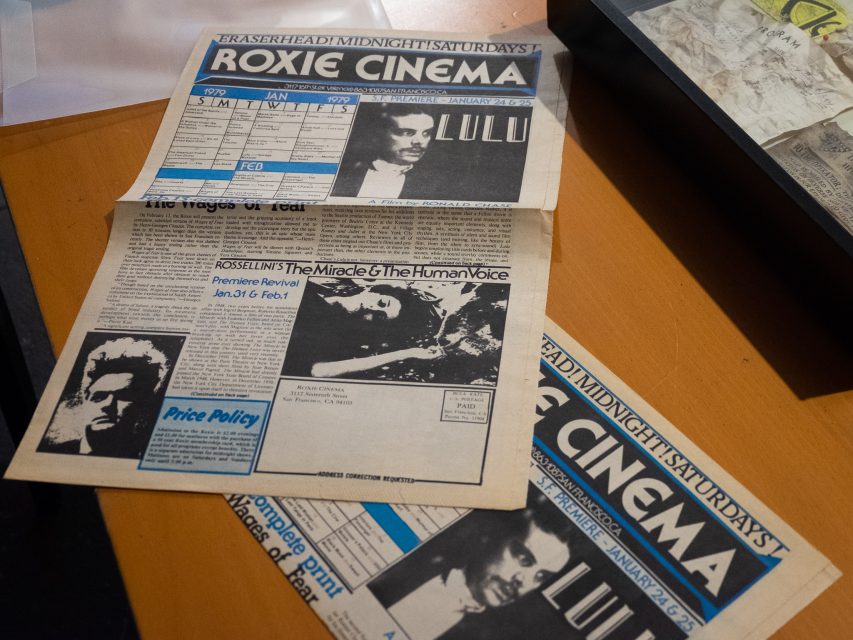
I looked at current programming and then I looked at these [Sloan gestured to shelves loaded with file boxes containing programming calendars dating back to the 1970s] and I’m like, “Oh, we’re still showing these same films, and a whole lot of new ones.” Staying true to our roots as a neighborhood cinema and as this funky art house cinema.
Projection Booth
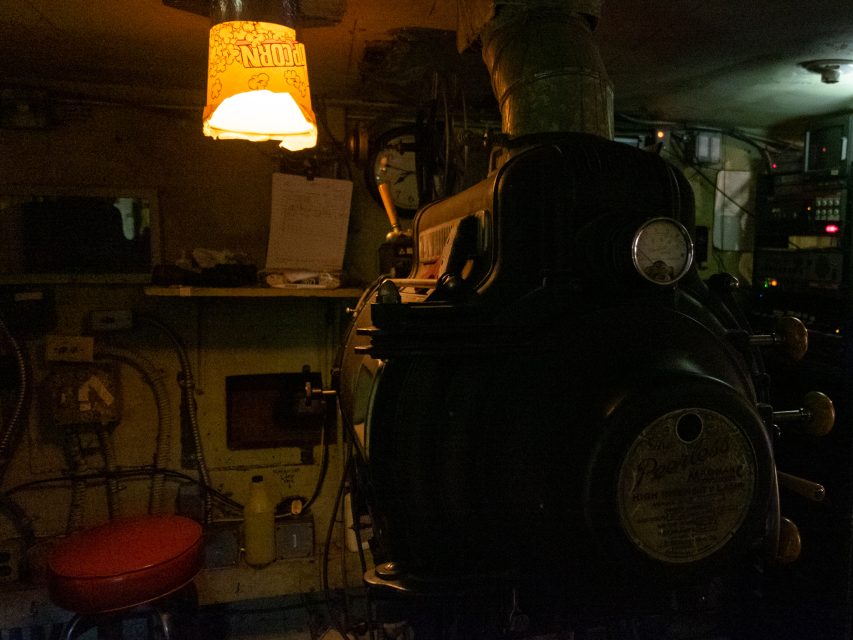
LS: These projectors are 35mm projectors, and they’re from the early ’40s. They’re kind of like old Mustangs: We service them. They have motors. They have oil. This is light going across the film strip at 24 frames a second, and shooting 90 feet across the theater.
This is how a cinema was built to be watched. We’re still really committed to showing 35mm and 16mm film. Most movie theaters have taken this out.
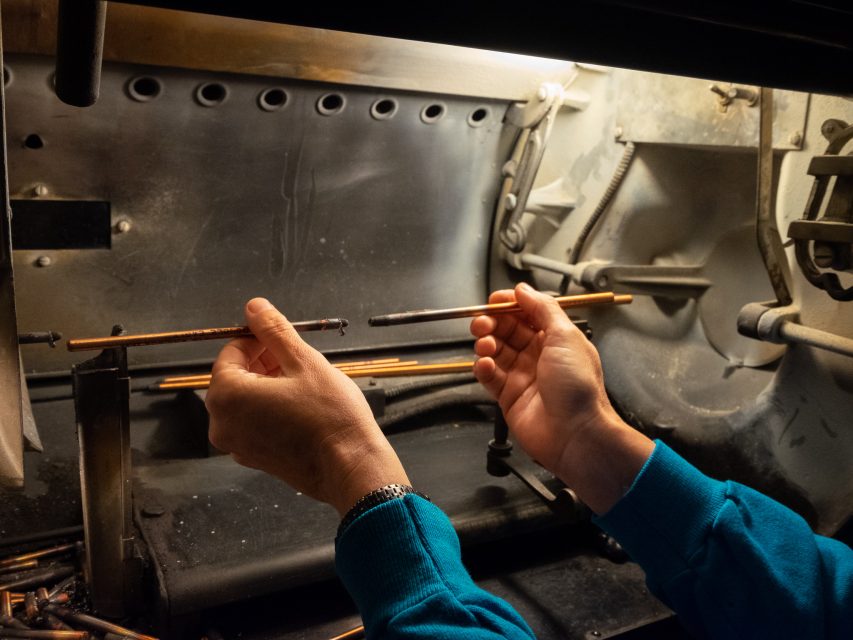
These [long, skinny sticks] are carbons. There’s a negative and a positive carbon. They’re super light, and the projectionist lights them together, and it creates this really bright white arc of light. It bounces off the reflector back there. And that’s what creates the source of light.
Some cinema purists would say that carbon arc is the best way to watch a film. Because of the quality of this light, as opposed to a bulb. With black and white film, the darks are darker, the whites are more white.
At this projection booth, you can really feel the lifetime of the Roxie. We’ve had lots of famous people up here. Quentin Tarantino was up here. Patton Oswalt and David Cronenberg will be here Monday.
It’s really challenging as digital has taken over because there are fewer and fewer places we can get parts. The last batch I ordered of these carbons was from Indonesia. They don’t make them in the United States anymore. I don’t want to say it’s a dying art form, because we’re keeping it alive and other cinemas are keeping it alive. But it is not easy.
ML: Are there any other cinemas in the city that still use this kind of projector?
LS: There are other cinemas that show 35mm and 70mm, but no one else in San Francisco uses this projector. The Stanford Theater down in Palo Alto does.
It adds a layer of challenge, because the projectionist has to change from reel one to reel two when the film is running out, but also keep the carbons burning. That just means you’re constantly focusing on it. It’s a lot.
I bring tours up here sometimes — mostly college, some high school. When I try to describe film on 35mm versus digitally, I say, “Do you listen to records?” and then they’re like, “Oh yeah, records are cool.” I’m like, “That’s kind of like watching a film.” You know [digital] is zeros and ones. But these are the light waves and sound waves and the imperfections and the scratches and the dirt on the screen. It’s just really so magical to see something so unique.
[We stopped to look at a wall covered in photos at the top of the stairs leading to the projection booth.]
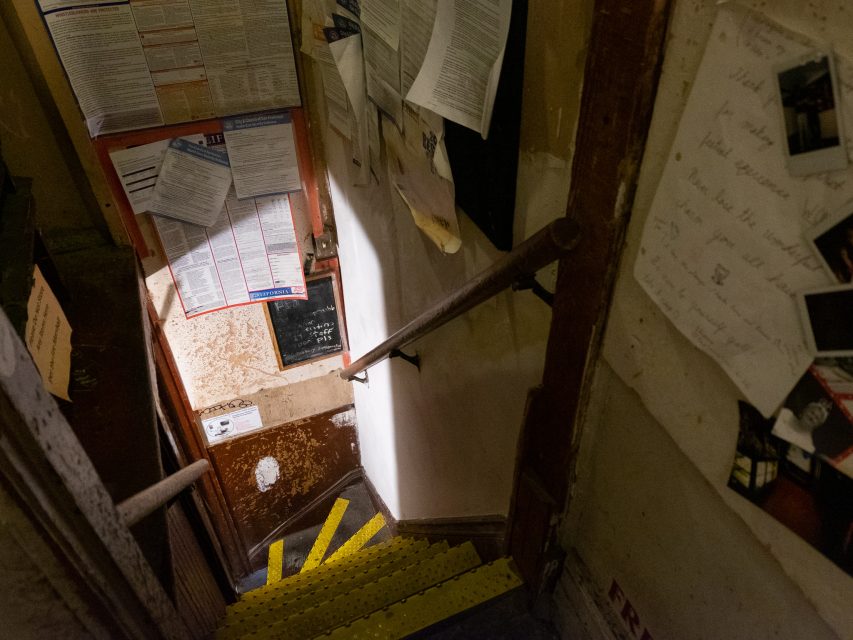
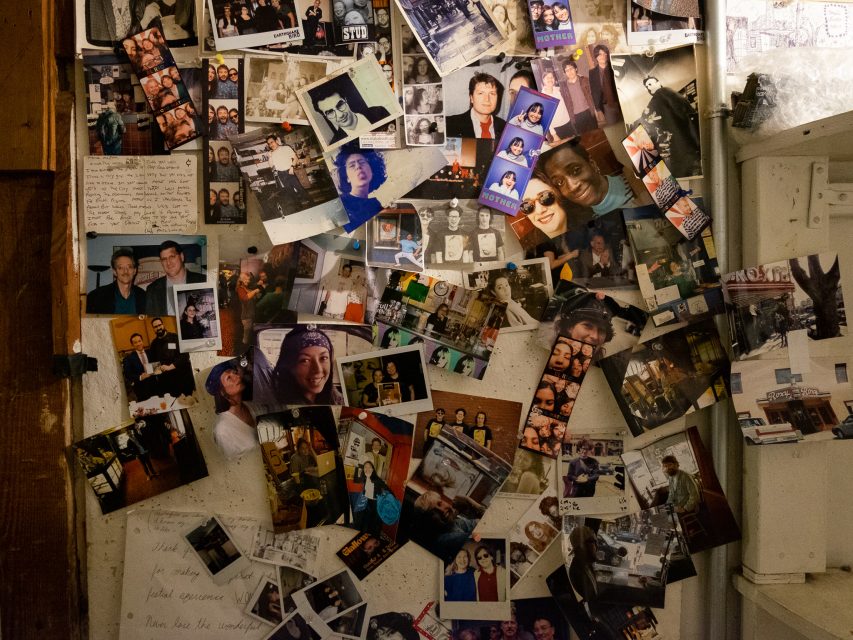
LS: The Roxie has so many lifetimes. It’s also just so many lives. This was someone’s first job. People have been a part of the Roxie and passed away. This has been a stepping stone to people’s careers.
We’re just stewards of the Roxie. We don’t own the Roxie. It’s all these people and these stories that made the Roxie the movie theater it is. Our faces are up there. But more faces will go on top of this, and so that evolution of the movie theater — you can really just feel it when you look up here.
Watch your steps coming down. It’s scarier than going up, and more people hurt themselves coming down.
Main Auditorium (aka the Big Roxie)
ML: What’s your favorite seat?
LS: I usually sit in the back corner, just in case something happens. I can jump up and get out easily.
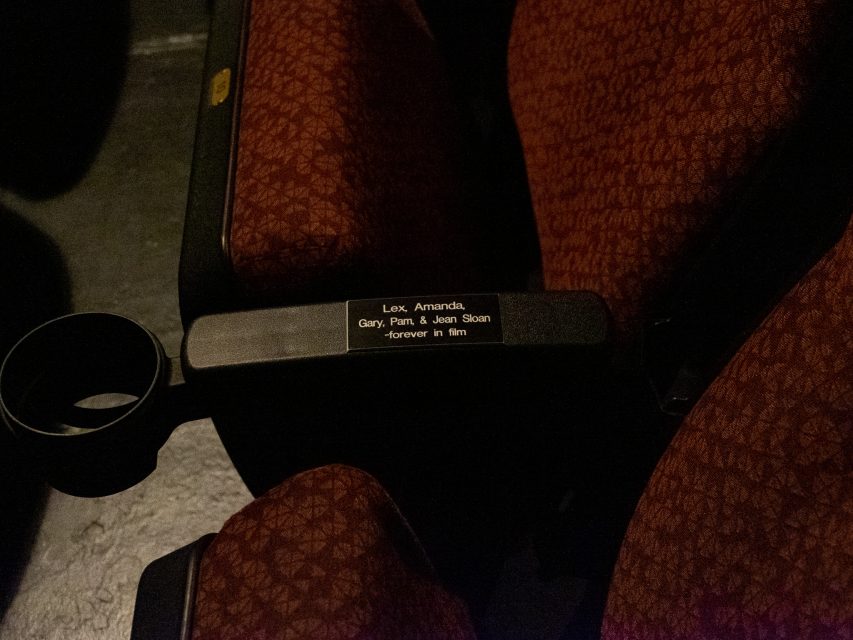
[We pass by a seat with a placard reading “Lex, Amanda, Gary, Pam & Jean Sloan – forever in film.” On every seat, there’s a similar placard.]
LS: So this is my seat. I mean, not really.
ML: I never noticed these.
LS: Oh I love these so much. Whenever I’m having a stressful day, I will sometimes come over here and pace up and down the seats because it’s such a reminder of the community that is part of the Roxie.
One of them here is in memory of people. There’s one up there that’s the Red Vic Movie House that used to exist. Some of them are about the Roxie’s history and people that played a part in it. Some are just silly and goofy. But because of their collective randomness, this is our people.
ML: How long have you been with the Roxie? How has the Roxie changed during the time you’re here?
LS: I started at the Roxie in 2015. You know how certain things change and certain things stay the same? The Roxie has definitely evolved over the last 10 years. I think the spirit of the Roxie is very similar to how I’ve always known it to be. There’s just a lot of love in this room, and a lot of love for cinema, and care for people.
When I came on the Roxie, it was still a fairly new nonprofit, even though the theater’s over 100 years old. Becoming a nonprofit in 2009 was and still is key to the fact that the Roxie is here today, and still standing and still strong and thriving. Being a nonprofit allows us to have this incredible membership program and get grants from the city and collect donations for our Forever Roxie campaign.
But being a nonprofit didn’t solve all the problems. Those first years were challenging. A lot of people sacrificed a lot. Every day, I’m reminded of the shoulders that I get to stand on to continue. It’s just kind of incredible to think about how many people truly sacrificed and had very sleepless nights to keep the Roxie going. There were some really tough times, and quite a few “Save the Roxie” campaigns. Without those, we wouldn’t be here with the opportunity to potentially buy our building.
ML: Tell me more about some of the tough times.
LS: Covid, definitely. It’s hard to believe that was five years ago. We were closed for over 400 days. We didn’t know when we’d be able to reopen, and we didn’t know who would come back to the movies.
So many cinemas have closed in San Francisco, especially in the last five years. They couldn’t reopen after Covid, or they did and it was a real financial struggle. The fact that the Roxie is still here today is just truly incredible.
ML: You said at the time when Roxie reopened after Covid, you didn’t know who’s going to come back. So who came back for the movies?
LS: Oh, man. I’ll never forget the day we reopened. Our members came back first. People, including myself, were in tears just to be able to be back in this space. We had super limited capacity. We reopened with 25 percent capacity. It was a long time before we had sold-out shows again. It was almost a year before there was a packed house. Now, we have sold-out shows every week.
One of the really exciting things since we reopened is seeing a younger audience come. Being here on 16th and Valencia, it’s just such a really special neighborhood. To have young people coming back and making the Roxie the place to be has given me a lot of hope for the future of cinema.

ML: What was the point when the team at Roxie was like, “Okay, we should buy this building”?
LS: It’s always been something that’s been discussed: Every leadership team for the last 40 years has wanted to find a way to buy the building.
We have amazing landlords. Not every nonprofit or renter has such great landlords. Without them being willing to sell, we wouldn’t be in this opportunity. Their family has owned this building for 40 years. They’re a San Francisco family, so they care about the success of the Roxie.
About two years ago, a conversation started really happening between our leadership and the owners to negotiate back and forth to find a purchase price that we all could feel comfortable with.
ML: How did it go from “We should buy this building” to “We actually can”?
LS: It has to be said — although I sometimes worry I can’t find the right words to say it, because it was personally emotional for me — everything that happened with the Castro. The Castro was just a really big, important part of San Francisco’s cinema-going story. [The Castro Theater, which was a mainstay of local film festivals, closed during the pandemic and never fully re-opened. It is currently leased to Another Planet Entertainment, which plans to operate it as a music venue that occasionally shows movies, instead of a full-time movie house].
That was really a catalyst to get together the key leadership and supporters and say, “We’ve got to find a way to secure our future, not just for the Roxie, but for the film festivals that use us as a venue, and for our community partners. It just was obvious that the ripple effects of losing so many movie theaters in San Francisco was affecting everyone.
So we set out with this really incredibly ambitious goal to raise $7 million. When we set that goal, it really felt like, “how are we ever going to get to the top of this mountain?” I still think about that. We’re climbing the mountain, and I can see the summit, finally. It’s become more and more real.
So we decided that we really wanted to try to make this happen and buy the building. We had a lot of great consultants helping us even get to that point where we could make that decision.
We started talking to the landlords and we signed a purchase and sale agreement [in May 2024]. That was the first step, because it laid out the timeline and the price.
Getting that commitment allowed us to go out to this amazing Bay Area film-supporting, film-loving community and start asking for gifts in support of the campaign. The community showed up.
We received a grant from the Rainin Foundation. It’s such a vote of confidence. The money was really a game changer for us. [The Kenneth Rainin foundation donated $1.2 million for the Roxie Forever campaign and $100,000 for general operation support.] We spent a year in the silent phase because we wanted to get to 75 percent of the goal before we went public.
One of the things I love most about this moment in the Roxie story is that we get to be a story of hope for the rejuvenation, the revitalization of San Francisco. We get to say, “Hey, arts and culture is important, and part of the Bay Area at its core.” Institutions like the Roxie make San Francisco “San Francisco.” We wanted to be far enough along in the campaign that it got to be that story of hope and that we’re doing this together.
ML: How much is the price? [The Roxie has a total fundraising goal of $7 million, but the asking price of the theater itself is unknown.]
LS: I can’t say.
What I can say is that the campaign is about more than just buying the building. The campaign is about the possibilities for the future. Not owning the building — even with the most amazing landlords, we’re always at the risk of displacement. It’s hard to dream big when your future is a little uncertain.
Now, we get to dream about some really fun things. I don’t know if you can see it, but our screen has this stain on it and it’s been driving me crazy for the last decade. You can see it right there. Our screen and our digital projector; upgrading those. Some motorized masking; right now we have to pull a rope to change the masking, which is pretty funny. The campaign beyond just the building allows us to invest in our viewing experience and do some programming that hopefully makes folks happy.
ML: What would you like to do with the building once you purchase it? Is there anything that you want to try, but can’t necessarily do as a renter?
LS: Because the building is so old, one of the first things we’re going to do is just some structural retrofitting and some not-so-exciting stuff to make sure that the building is taken care of.
But also we were just kicking this idea around — what about solar on the roof? And how can we make the Roxie more environmentally friendly? I think we’re pretty good right now. We compost all of our popcorn, which is most of our garbage. What other things could we do as owners to make the Roxie more sustainable?
Then thinking about what it would look like to expand programming so that we have more show times. We just started a matinee screening every Thursday, and people are loving it. They want to see the Roxie and the street happening during the day, too, because [on weekdays] we bring crowds just at night. We’re going to try a midnight show; it’s going to be at 11 p.m., but we’re calling it Almost Midnight. There used to be a lot of midnight movies at the Roxie.
ML: Is there anything that you are worried about owning your own building?
LS: There’s nothing I’m worried about with owning the building. It is going to require us to build some new muscles and do things we haven’t done before. I’m sure there’ll be some surprises along the way. I know whatever challenges pop up, we’ll be able to solve them and probably be stronger because of it.
ML: Maybe more things would come out of the wall.
LS: I know! I forgot to show you, but on the floor of the projection booth, there’s these slats between the floors. I think if we took off just a little bit of the floor, we would find so many things. Maybe a gum wrapper? That’s a treasure trove. When we replaced the seats, there were old tickets and candy-bar wrappers.
ML: What’s gonna happen to Dalva, in between Big and Small Roxie?
LS: Dalva is in the parcel that we’ll take ownership of, and I’m so excited. We’re so lucky to have a bar right next door, so that when people finish the movie, they can go have a conversation about it. It’s open after our films, and we’ve been experimenting with some drink collaborations.
I’m excited about the different kinds of partnerships that you’ll see emerge between Dalva and the Roxie in the next year.
I think one of the great things about being a movie theater is we get to drive business to the Mission. People come see the movie, but they also make a night of it. Whether it’s tacos and pupusas or window shopping on Valencia Street or picking up a book at Dog Eared.
The neighborhood drives business to the Roxie. And I know that the Roxie drives business back to the neighborhood.
ML: We were just saying that there should be a little connection between the bar and the theaters.
LS: That would probably require some changes to our liquor laws. But we’re hoping we can get a wine license. That’s on the horizon.
ML: Do you remember a screening that’s really special to you?
The mixtapes are always so Roxie. They’re documentaries and experimental and music videos and narratives; that’s why we call them Mixtape, because there’s no specific genre. Some are made by first-time filmmakers, and some are made by people who’ve been making movies in the Bay for decades. They all come up here at the stage and they span the whole auditorium. They get their moment to see their movie on the big screen with an audience. There’s something so special about that.
ML: Especially when you’re a filmmaker yourself.
LS: Yeah, I’ve never had my film in Mixtape. I’ve submitted and not been selected, which is fine. But Mixtape is something I look forward to, for sure.
ML: Why should people still watch films, in this day and age? Why should they watch them in a theater?
LS: I have a million answers for why people should still watch films in movie theaters. One of the things that makes watching movies so special is because it generates empathy. For two hours, you get to go into someone else’s world. You get to experience different cultures, or people with different lived experiences.
I think cinema generates compassion, and it can also be a place of resistance. Cinema, I believe, has great power to make social change. We’ve been screening “No Other Land” and “The Encampments;” the Roxie specifically programs thinking about the impact that the movies are going to make and the conversations that people are going to have after they have seen a film.
In a movie theater, where phones are off and the screen is big and the sound is all around you, you’re immersed in this other world for a specific amount of time, with an audience full of strangers. You’re having this shared emotional journey and cinematic experience. You hopefully walk out of our front doors feeling renewed or excited or sad, but you’re feeling.
One of the things I love about this place is how many memories have been created here. First dates happened in these seats. We’ve had some engagements right here, or filmmakers watching their film on the big screen for the first time with an audience.
It really is something about bringing people together. It’s the creation of a shared space of belonging. Especially now with all of our political challenges, what’s happening in our world and the heartbreak that is happening every day, the cinema is both a place of refuge and a catalyst for change.
Long live The Roxie!!
I remember when Thomm Gunn used to read his poetry outside on the sidewalk
Thanks so much for your article. I’ve been going to the Roxie for years so I feel familiar with it but now I know much more about it. It’s a treasure
Yes, Long Live The Roxie! I am sad, however, that Dalva was allowed to cover up the old inlaid entry way that bore the name of the former establishment: ” (Sumko’s) Fireside (Lounge) ” That place was super cool and so was Sumiko (sp?).
Thank you for this tour of the Roxie, and to Lex for your thoughtful and devoted leadership.