


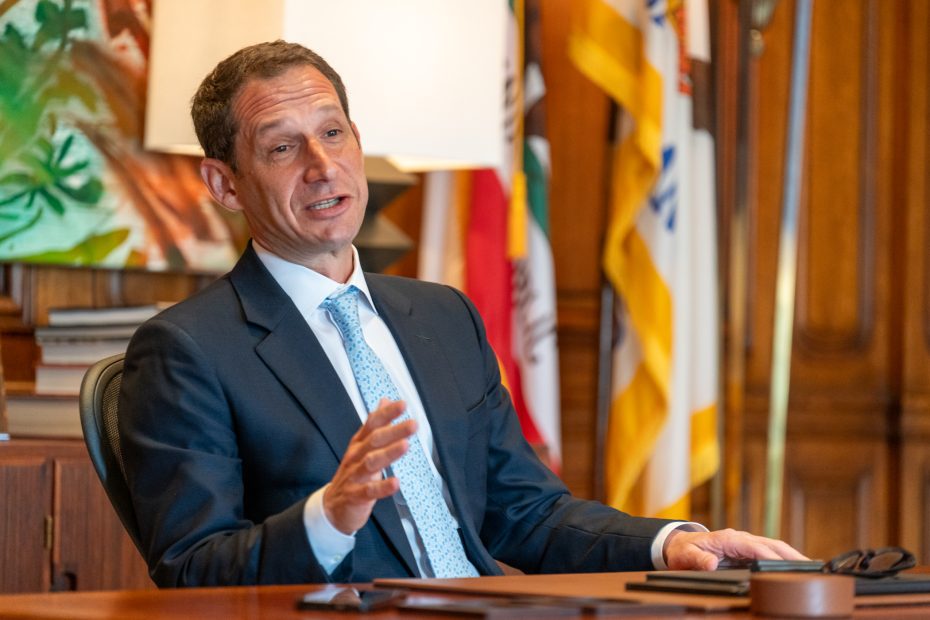
When mayoral candidate Daniel Lurie announced an aggressive plan to stand up 1,500 shelter beds within six months of assuming office, every member of the political establishment said this was an impossible goal.
You know what? They were right.
Lurie is not going to make the 1,500-shelter-beds-in-six-months benchmark. Instead, the marching orders to all the city departments tasked with bringing these beds online have morphed: The goal is now to have 1,500 beds established or in the pipeline by July.
To give you an idea of the difference between “established” and “in the pipeline” consider the Borscht Belt comedy standby: Did you hear about the [insert ethnicity] accountant? He absconded with all accounts payable.
In the same way that there’s a difference between a pile of cash and a pile of invoices, there’s a difference between a real bed and an aspirational one. While we’re at it, what’s a bed? You’d think a bed is a bed is a bed, but, in San Francisco, it’s not: Lurie has redefined a broader scope of beds to fall under the aegis of “shelter bed,” and decided to count 361 beds that were “in the pipeline” during the administration of Mayor London Breed toward that 1,500. On top of that, he added a couple of months to the six-month deadline.
These are political games politicians play. But the appeal of Lurie was that he’s not a politician. Semantic exercises of this sort are all the more awkward coming from someone whose earnestness and genuineness were, and still are, major selling points.
Because here’s the thing: Missing this arbitrary deadline is not necessarily bad news. And there are certainly worse things than missing the deadline: If Team Lurie had decided to go damn the torpedoes, full-speed ahead on adding homeless beds and crammed shelters so full with bunks that people’s feet were dangling out the windows, that would be worse.

And that is not happening, to the huge and palpable relief of the city officials focused on the housing and sheltering of the homeless. “We were really worried it’d be 1,500 beds in a warehouse,” one says.
Instead, the word from those same city officials is that Lurie and his policy chief, Kunal Modi, are being smart and thoughtful about where and how to add new beds to the shelter system. They’re “following the data.” They’re seeing what types of behavioral health services are needed and trying to address those on the front end.
Making a big box and hounding everyone off the street into it would solve the “out of sight, out of mind” problem for the housed. Creating a more service-rich environment instead of repeatedly shuttling people between the streets and shelter, however, might actually solve some homeless people’s problems.
“Hey,” says one veteran homeless professional, “it might actually work.”
Homeless people today are, by and large, sicker and more troubled, and often more likely to be disabled than those of even a decade ago. The oldest baby boomers are now 79, and seniors are the fastest-growing segment of the homeless population. Bunk beds don’t work for the aged or people in wheelchairs. On-site healthcare services are increasingly advisable at most homeless shelters, to reduce even-more-expensive trips to the emergency room.
The decision to include a wider array of beds in the definition of “shelter bed” — including, among others, “interim housing and stabilization/treatment beds” — came off as an accounting trick.
City officials, however, pushed back on that: It would’ve been easier just to go the bunk beds and warehouse route, consequences be damned. To wit, there are only 16 or so beds in the 822 Geary St. “crisis stabilization center,” a newly opened site meant for people who’d otherwise be sent to the Emergency Room or jail.
The price tag here is $7.3 million a year, not including another $600,000 or so yearly for security. Doing the math, that’s $1,353 per bed, per day.
So, counting beds like these toward the 1,500 goal isn’t really an accounting trick any more than absconding with all accounts payable. This is a costlier and more involved investment meant to address the dire situation on the ground. And, while 822 Geary was funded and planned by Breed’s administration, future service-rich beds are going to be Lurie’s charge.
“We’re very focused on the right types of beds, not just any beds, so that we have the right places for folks to go,” Modi told Mission Local’s Eleni Balakrishnan at the opening of 822 Geary last week. “We have places right now for folks to go. We want more.”
So, that takes time. More than six months. Also, while the 1,500 shelter bed moonshot has garnered most of the media attention, Lurie’s larger aim, “Project Home Run,” was to add “2,500 units of interim bridge housing” in his first two years. That’s housing. Not shelter.
This is the overarching goal. And the more consequential one.
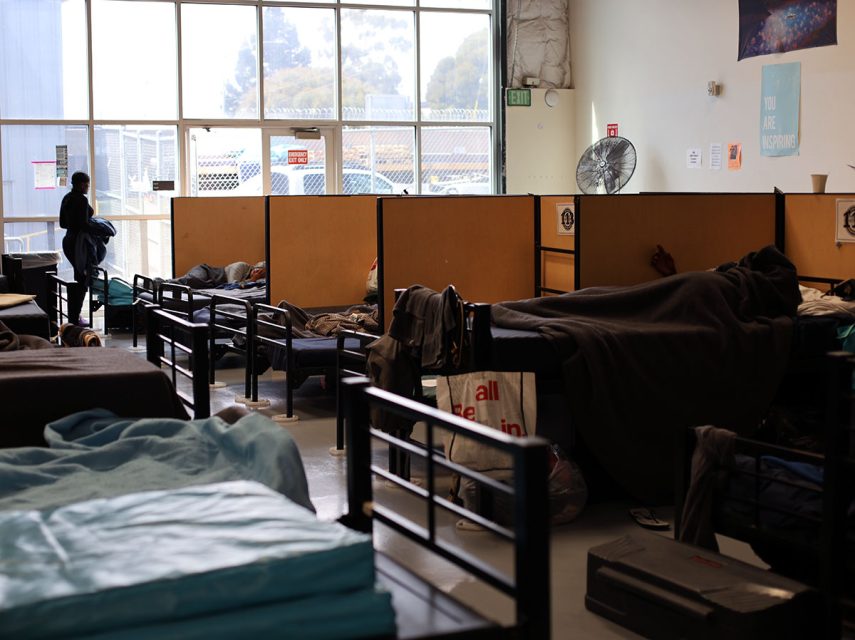
Even with the longer timeline and the new “in the pipeline” nomenclature, Team Lurie is still trying to create more shelter beds.
It’s doing this by attempting to put more beds onto the properties it already has — where homeless people are already sheltered. In some cases, such as the “Jerrold Commons” site in Bayview, this could be scores of new beds in a new structure. But there are many such sites, and even a few beds here or there would add up.
Is the city doing this because it’s difficult to find new sites to shelter homeless people? Yes, it is. And it may become harder, for good or ill, if the Board of Supervisors passes District 5 Supervisor Bilal Mahmood’s pending legislation regarding “geo-equity.”
Mahmood’s argument, which has been advanced by prior Tenderloin supervisors, is rational: It’s not equitable to site a disproportionate number of shelters and services in the TL if you want to say, with a straight face, that this isn’t the city’s containment zone.
This legislation, which already has five co-sponsors, would require every supervisor to identify a shelter or behavioral health center site in their district by 2026. It would also, critically, not allow new sites within 1,000 feet of existing sites without a board hearing and waiver process.
Mission Local has learned that the mayor’s office is sorely displeased. It warrants mentioning that, along with nine other supervisors, Mahmood in February ceded the board’s oversight powers and gifted Lurie significant new unilateral abilities to enter into contracts to address homelessness and/or drug use. Mahmood’s legislation, by adding new restrictions and processes, would considerably temper Lurie’s newly expedited powers to add new shelters (or behavioral health centers).
Disgorging these responsibilities in the name of expediency, and then enacting legislation to claw them back, feels a lot like buyer’s remorse.
Mahmood doesn’t see it that way. “This isn’t about not trusting the mayor. I campaigned on geographic equity all of last year, and I’m representing the Tenderloin,” he says. “I’m not going to be a supervisor forever, and the mayor won’t be the mayor forever. This is just about ensuring we have some things codified into law.”
The ordinance’s six sponsors virtually guarantee its passage. With eight votes, the supes can override a mayoral veto. Mahmood’s stated goals aren’t unreasonable. But, as it stands, his legislation would definitely make it more cumbersome for the mayor to locate suitable shelter sites, let alone usher them into reality.
More than one thing can be true. That’s often why government moves at the speed of government.
In “Star Trek,” Captain Picard says, “Make it so,” and it is made so. Perhaps a more germane “Star Trek” analogy is Q snapping his fingers and reversing the polarity of the universe. When asked how this could be accomplished, the omnipotent being replied, “You just do it!”
Government doesn’t work like that. If Daniel Lurie didn’t know it before, he knows it now. But voters did not select Lurie because of his deep experience in government or his policy chops. By and large, the electorate would likely understand the realities of a mayor learning on the job, especially if he can point to progress.
Lurie is doing a dozen events a day and putting them on Instagram; he’s going to so many cafes that friends have expressed concern to me about his caffeine intake. His social media feed projects omnipresence and positivity and, gosh darn it, people like him.
Rarely has a mayor been in a better position to say, “I said what I said before, but I’m now clear on what we can realistically do, and here’s what we’re doing.” You’d think most voters would be okay with that.
“I’m never going to apologize for setting ambitious goals; San Franciscans deserve nothing less,” Lurie said on his 100th day in office. “We may not always hit them, but we will never stop trying. We won’t make excuses, and we will apply what we learn.”
You know what? If the city can get 1,500 beds “into the pipeline” by July, that’s commendable. If the city can make progress — tangible progress — people will be pleased.
It was Benjamin Franklin who wrote that “honesty is the best policy” (He apparently did not frequently ask his fellow founding fathers “Is bald with long hair a good look for me?”). In the early 21st century, honesty, ideally, remains one of the better policies. It would be good if our mayor could simply be up front about what’s realistic, what’s not and what we’re doing.
Hey, it might actually work.
Even if the mayor creates and assigns beds, it will not help the street scene. The city needs to enforce our quality of life laws and crack down on the selling and use of drugs, especially fentanyl and meth.
Two distinct problems that overlap, but are entirely different issues.
I can see the point of geographical equity in siting unpleasant city services. Mahmoud bounding his ordinance by supervisorial district instead of by neighborhood only reinforces containment because it means that the Tenderloin larded up with services entails that the Haight and Inner Sunset and Japantown are off the hook just because of district lines.
You put the homeless where they most want to be, which just happens to align with where most voters and taxpayers want them to be, in D6 and the eastern parts of D5 and D9.
Against their will, “you” put homeless people where they want to be. If the point is to make them not homeless anymore, then we’re gonna want to shelter and treat them far away from the addiction stimulus.
The “nice” neighborhoods are going to be like those pricey rehab centers, only upzoned, lol.
I think mandatory enforcement is going to be needed to get people into these beds. Even when we do have them available, they are under utilized.
Wrong. There has never been more beds than homeless in SF.
So, in other words, go sleep in an overcrowded, unsafe place that feels like jail, or… go to jail?
Surrounding cities hope we add beds galore.
Weird how the Peninsula cities don’t have these issues…but not really, they just tell them to keep moving north.
Why is it always SF that needs to add homeless services? When will the rest of the Bay Area and the state pick up the slack? We are already doing more than our fair share.
“We are already doing more than our fair share.”
Says who? SF has homeless and Billion dollar budgets being mismanaged, certainly there’s plenty more we can do with what we’re already spending.
Given that there are 8,000 more unhoused people in SF than even the most basic shelter beds could accommodate, I’d say that no, SF is not doing its fair share.
Shelter beds are not enough, we need low income housing so people do not end up homeless in the first place. And we need more Residential beds for those with addition and mental health issues. I agree, a warehouse with dozens of bunk beds will not reduce the un-housed we see on the street.
Time to look around the world
6 million in refugee camps by un at a fraction of the cost
Either people are uneducated here who are to be helping , including nonprofits on the grift or those in charge in SF government are limited .
Very arrogant of SF not to also do this .
Camps away from neighborhoods and drug dealers .
All services centralized in a camp
I was really worried about Lurie, especially his previous comments regarding safe injection sites. He’s surprised me so far.
” When asked how this could be accomplished, the omnipotent being replied, ‘You just do it!’
Government doesn’t work like that.”
Neither does reality.
“Just doing it” in this case does not mean snapping your fingers and making it happen. It means understanding the problem, the range of possible solutions, and putting the pieces that you can afford together to make outcomes happen in some reasonable span of time.
The difficulty in this picture is that the sheer number of beaks that need wetting view the outcomes in terms of them getting paid rather than in making politically meaningful progress in solving problems.
Combining advocacy, service provision and policymaking in one self serving bundle all but demolishes any sense of ethics.
“It means understanding the problem, the range of possible solutions, and putting the pieces that you can afford together to make outcomes happen in some reasonable span of time.”
Indeed. But the possible solutions will never, ever happen, because they’re not profitable. So instead, for decades and decades, politicians try to sell us that their latest shortcut will work. This is nothing new.
First let’s blame the non-profits who’s “solutions” will never happen….later we can look at the politicians who give the non-profits our tax money.
Solutions are not profitable, monetizing human misery is quite profitable. This means severing the connection between contracting and policy making so that those who get paid by the city are not in a position to set policy as to “who gets paid how much to do what” as is the case now.