


“I’m just going to read this,” says Bobby Barber, a solid, bearded man standing in front of the glittery backdrop of the stage at The Stud, before the drag show protesting London’s Metropolitan Police Service begins. It’s 6:30 p.m. on Monday in San Francisco, and London is a long ways off.
“So many people have so many questions,” Barber continues.
At around 2 a.m. Pacific Standard Time, San Francisco drag luminary Peaches Christ (Joshua Grannell in civilian life), wearing a silver sequined dress that looked part glamazon, part Joan of Arc, hosted a similar protest on the London Metropolitan Police Department’s home turf, aka Scotland Yard.
As former stage manager to San Francisco drag legend Heklina, and co-founder of Peaches Christ Productions, Barber is expertly stage-managing the North American part of this protest.
The timeline Barber reads out loud begins like this: On April 2, 2023 Peaches finds Heklina (aka Stefan Grygelko) dead in the rental they shared in London. Things look suspicious. The front door is unlocked. Grannell is fairly sure Heklina was not alone.
Grannell, Heklina’s best friend, gives London’s Metropolitan police samples of his DNA, to compare against any other strands of hair or anything else they might find in the apartment. He passes along advice on how to hack into Grygelko’s phone. Any text messages in there, Grannell tells them, will be the best way to know what happened in the last few hours of Grygelko’s life.
The police say there are no signs of foul play, and that they’ll be in touch with updates every week.
The London coroner on April 27, 2023, released a “Certificate of the Fact of Death” which lists the cause of death as “undetermined.” An official death certificate with more information will come soon, the police say. Months go by. The police stop responding to messages.
January 2024: A man contacts Grannell and says that he has inside knowledge of the case, and that the police know more than they’re letting on. A detective with the Metropolitan Police’s Violent Crime Unit denies this, but says that there may have been some “bias” in how they handled the Heklina case.
At this, the audience, which is packed in front of the tiny stage, wall-to-wall, erupts into angry sighs. “You think?” a voice says sarcastically.
The police then tell Grannell they never unlocked Grygelko’s phone — they just mailed it to the executor of his estate, Nancy French. “They sent the phone back to America without ever having looked inside.”
“Negligence!” a voice from the crowd says, loudly.
“December 2024” Barber continues: Grannell, fed up, contacts The Guardian, which does a story about the case. “THEN, “says Barber, “NOT so coincidentally, the police release CCTV footage of three people of interest to the public.” In the footage, three dark, people-shaped smudges who may or may not have been involved in Heklina’s death walk down a street in Soho.
“Now, this is just last week,” Barber continues. “Five Met Police came to San Francisco to take more statements from Peaches, and then go to Palm Springs to work with Nancy on getting the phone finally unlocked.” Met police tell them both that Grygelko had a lethal combination of drugs in his system, but won’t specifically say which drugs, or why there’s still no death certificate. “This just happened a few days ago,” says Barber. Also, he adds, Grannell was asked to submit more DNA samples because the originals ”expired.” A forensics expert contacted by Grannell tells him that’s not a thing. The samples, they postulate, were either lost or thrown away.
A wave of something big goes through the audience: Part wow, part sigh.
“Fuck that,” a quiet, crisp voice says, from the back of the room.
“This isn’t just about Heklina,” says Barber. “This is about victims of homophobia and transphobia.”
“AMEN,” someone yells.
This isn’t the first or the worst time the Met police have been accused of selective detective work. A decade ago, Met police failed to catch Stephen Port, a London man who was drugging young men and sexually assaulting them, even after a young man was found dead of a GHB overdose directly outside of Port’s apartment in June 2014, and three more were found dead in a cemetery a few blocks away over the next several months.
A report commissioned after Port’s eventual arrest and conviction quoted one Met police officer as repeatedly seeing officers avoid responding to crimes involving LGBT people. By the time Port was charged in October 2015, four men had been killed and an unknown number had been assaulted. Much of the early work of connecting the murders to Port was done by the friends and families of his victims.
Very angry, talented people
Heklina, as a drag queen, came into existence in 1996, a few years before the famous “No Obits” headline in the Bay Area Reporter signaled the waning of the AIDS epidemic — in San Francisco, anyway. “In the ’90s, with AIDS, you just were born into activism,” Barber said in an interview before the Stud event. “It was all around. It was a part of who you were. Your friends were dying, and it just made you angry, and the government was ignoring you.” That said, he adds. “I don’t really think of myself as an activist or a protester. I’m just trying to get justice for my friend.”
The shows Heklina curated and emceed were not drag in the sense that many people thought of it. The goal was not to look attractive, female, or even plausibly human. Grygelko, who had spent part of his childhood in Iceland, named his drag alter ego after the Icelandic volcano Hekla. Performances were dark, earnest, campy, punk, extremely committed to the bit, and often a cathartic riff on current events. Barber recalled a show following the 2003 invasion of Iraq when a group of drag queens dressed as Mount Rushmore grabbed boulders and attacked a drag queen dressed as George W. Bush.
To be gay and of a certain age in San Francisco is to have participated in, or at least been adjacent to, the process of organizing your way into political power. To have lived all that, and see one of your own die an untimely death and be ignored by another government — people show up.
“Just because we’re 5,000 miles away doesn’t mean we can scream and yell and protest what they’re doing,” says Barber. “So, in honor of that, I got a lot of angry, very talented people.”
Cue the angry, talented people. Kochina Rude vamped sinisterly to Gang of Four’s “I Love a Man in Uniform,” dressed in a combination military uniform and ballgown.
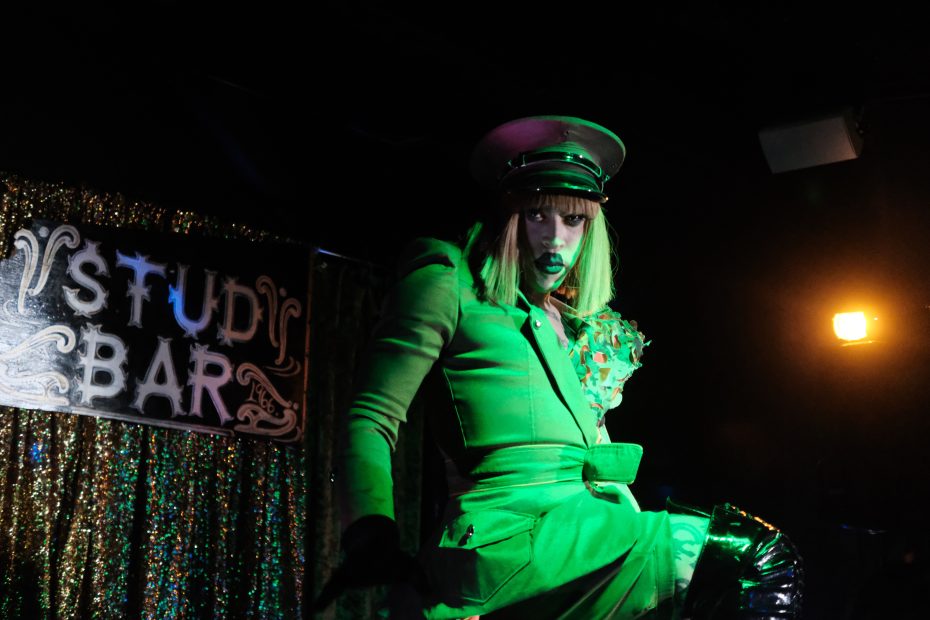
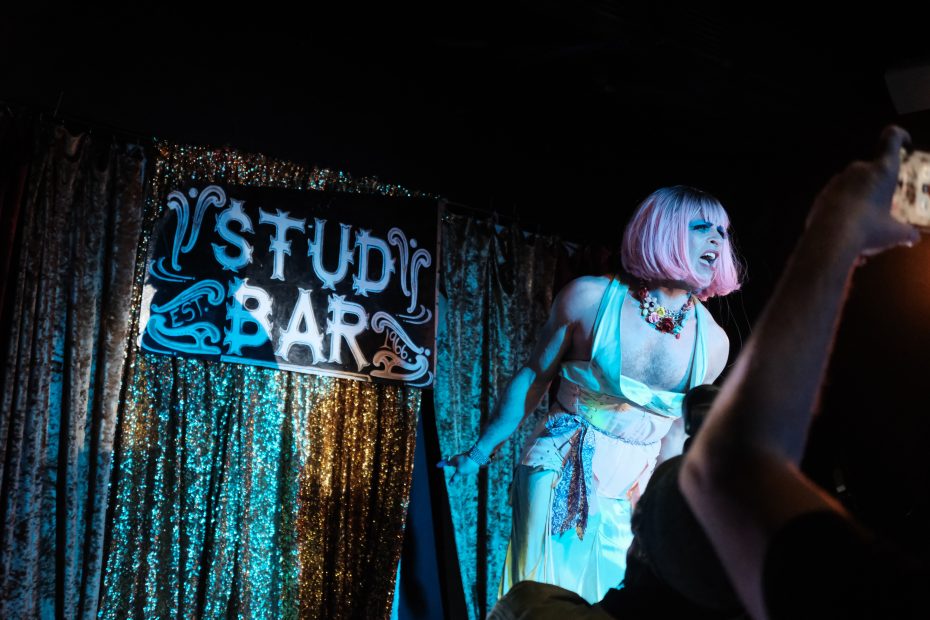
Stanley Frank Sensation gave an anguished performance to “Five Years” by David Bowie.
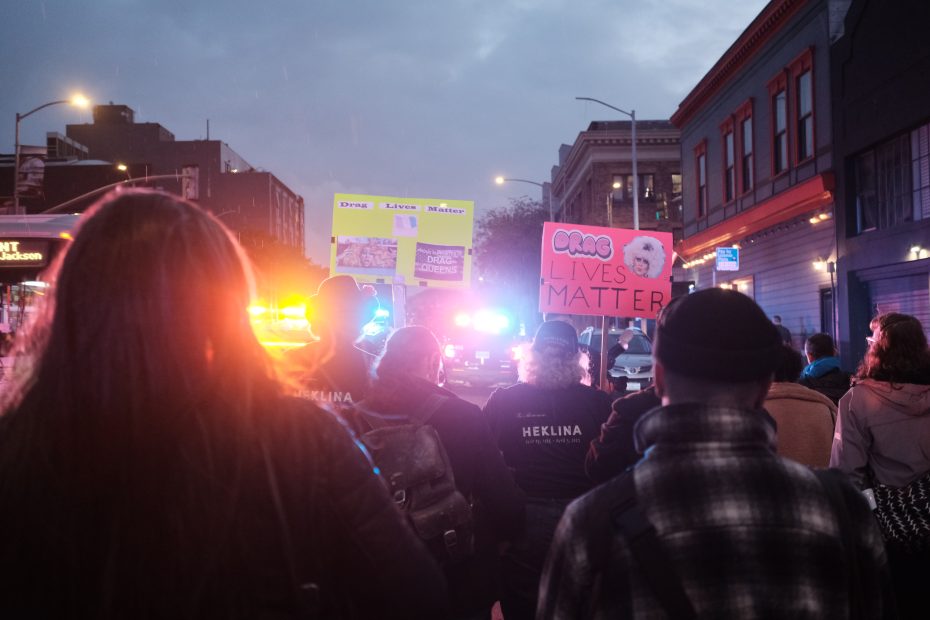
After the curtain call, the crowd begin to file out of the Stud for the three-block march to Oasis at 11th and Folsom and a second show. There’s a theme here; Heklina began her drag career at the Stud, then went on to open Oasis with D’Arcy Drollinger. Those who can make it until 11 p.m. are encouraged to go to Pillows at Powerhouse, co-hosted by David Glamamore, another San Francisco drag luminary. On their way out, marchers collect plastic cups with lit tea lights in them. Outside, the wind is gusting, and blows most of the candles out immediately. “Does anyone have a lighter?” someone asks plaintively. “Damn this clean living.”
At the London protest, a crowd of about 100 had met in front of Scotland Yard, made speeches, and chanted “London Met, you’re not done yet.”
At the San Francisco march, the crowd is about twice that size, and can’t figure out what to say, or if anything should be said at all. “I can’t tell you how to protest or how to feel,” said Barber, before the march. “If it’s a primal scream cathartic thing for you, and you want to scream the whole way, get those demons out. Those of you who are choosing to make it a quiet vigil, let them do that quietly. We’re not going to judge on how anybody marches, whether it’s quiet or as a demon.”
“Hey hey, ho ho” someone chants experimentally. “Met police have go to go!”
“Met police are the London police,” someone is explaining to a new arrival. San Francisco Police Department squad cars have come out to escort the marchers; their red and blue lights flash silently, illuminating the marchers like they’re at a nightclub.

“I know what we have by living here,” Barber said, earlier, about the courtliness of having a police escort when you’re protesting another police force 5,000 miles away. ”We have the least homophobic, least transphobic police force probably in the world.” It’s funny, he added. When he thanked Captain Luke Martin from Southern Station on a flyer for the protest, people immediately commented, saying things like, “How dare you thank the police?”
“I was just like, ‘How dare you?” said Barber. “It’s true camaraderie that the left should be looking at — like, the way Harvey Milk treated the unions and the cops or the firefighters.”
“Justice for Heklina!” someone yells. Perfectly serviceable. Maybe the kind of thing Heklina would have made fun of, the way she made fun of almost everything.
“Trans rights!” someone else yells. Both circulate for a while.
The rain is falling a little harder, but it’s not too bad. More like fast-moving mist.
“Eat ass!” someone yells, speculatively, near the head of the march. “For Heklina!”
Yes, that is the chant. The crowd keeps it up all the way to Oasis.
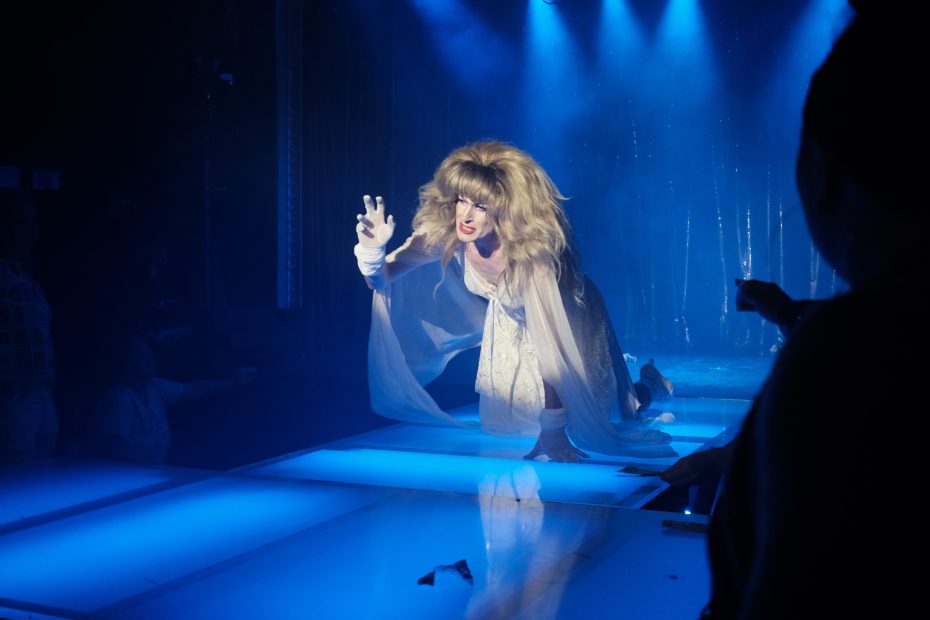
Laundra Tyme performs Edge of Seventeen at Oasis at the Justice 4 Heklina show. Photo by Audrey Nieh. 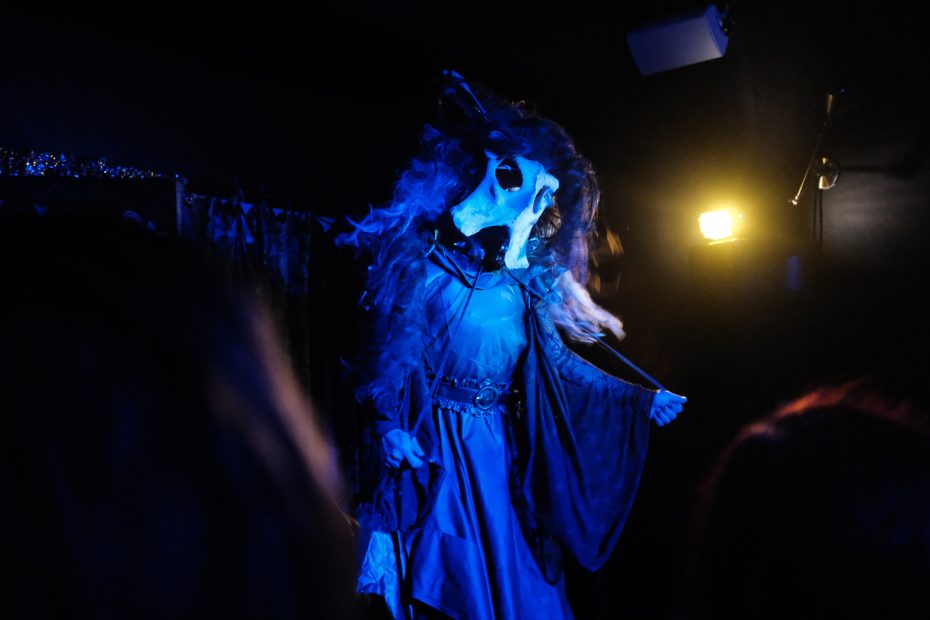
Suppositori Spelling performing at the Stud in a headdress made of a cow pelvis and multiple wigs on March 31, 2025. Photo by Audrey Nieh. 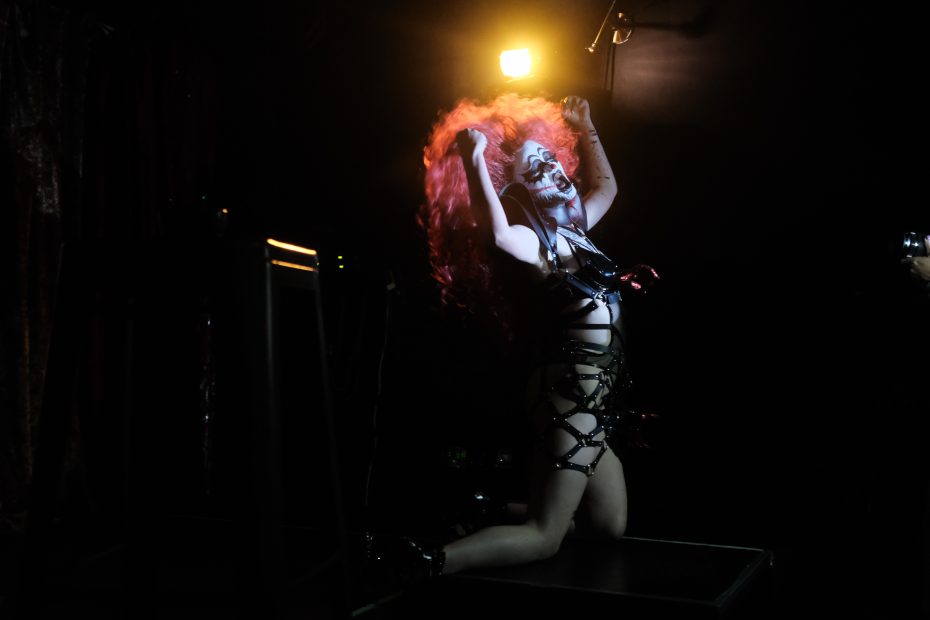
Kuntra Diction performing at The Stud at Justice 4 Heklina. Photo by Audrey Nieh. 
Mocha Fappalatte performing at Justice 4 Heklina at Oasis. Photo by Audrey Nieh. 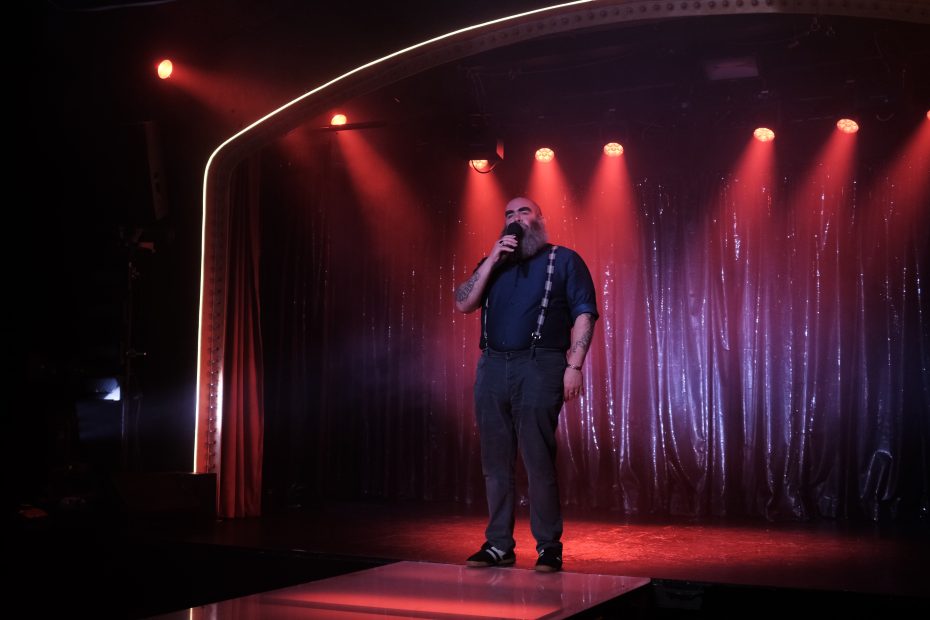
Bobby Barber emceeing Justice 4 Heklina at Oasis. Photo by Audrey Nieh. Credit: Audrey Nieh
Say, I wonder if there are any victims of crime in San Francisco.