

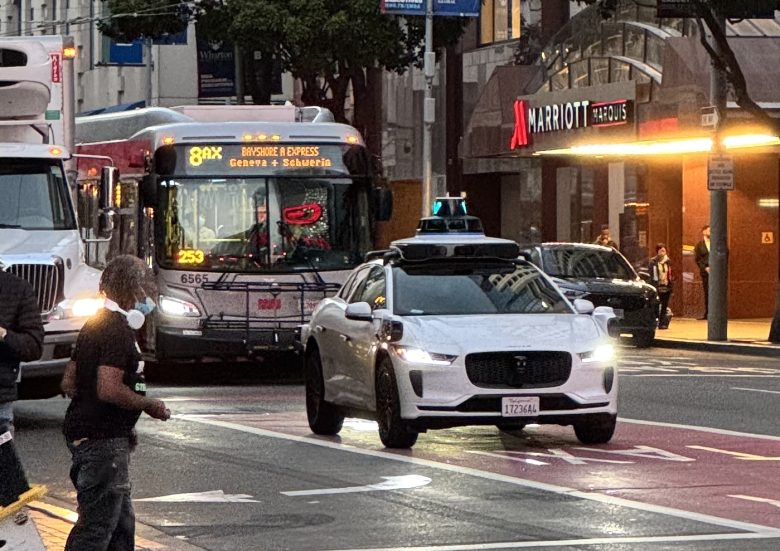

On April 10, the office of Mayor Daniel Lurie made an announcement: Waymo, the autonomous taxi company once known as the Google Self-Driving Car Project, will soon be driverlessly driving down Market Street.
“Market Street runs through the heart of our city, and we’re making sure it continues to evolve with the times,” Lurie said in the release. “By welcoming Waymo, we’re adding another safe and sustainable way to access shopping, theaters, hotels, and restaurants.”
This was greeted by surprise in some quarters. As mayor, Lurie is the boss of many things. None of those things are Market Street.
Closing Market Street (or, more precisely, the roughly 10 blocks of Market between 10th Street and Embarcadero Plaza) in 2020 required a majority vote of the Board of the SFMTA and the Board of Supervisors.
When Waymo began operating in the city in 2021, it followed the example of most other cars in San Francisco, including those operating under the auspices of other ride-hailing companies like Uber and Lyft. It drove through intersections to cross Market Street, but not down it.
Among those perplexed about Lurie’s announcement that Waymo would have access to Market Street is former Board of Supervisors President Aaron Peskin, who voted to approve the Better Market Street plan that closed Market Street, to great fanfare, back in January 2020.
“If you had asked me, ‘What did you vote to ban on Market Street?’ I would have said to you, ‘Cars!’” said Peskin, with the verve of someone who has spent the last few hours hot on the trail of a thrilling mystery. “And the answer appears to be that the action that the Board of Supervisors took and that the SFMTA took previous to that was to ban private vehicles from Market Street.”
More precisely, the Better Market Street Plan had a carve-out for commercial vehicles which, in the ancient days of five years ago, were mostly delivery vehicles and licensed taxis.
Unlike Lyft and Uber, whose drivers use private cars, Waymo has its own fleet, with commercial plates. Technically, Waymo could have driven down Market Street anytime it wanted. So could anyone who drives a vehicle with commercial plates.
When contacted by Mission Local, a representative of the mayor’s press office asked not to be identified by name or quoted directly, but confirmed that nothing, legally, has changed about the Better Market Street plan. They directed this reporter to focus on the use of the word “welcoming” in the April 10 press release.
Until now, they continued, Waymo had stayed off of Market out of politeness, rather than push the legal gray area. But the mayor wanted to make it clear that Waymo belongs on Market, because the mayor cares about Market Street. If Waymo were encouraged to drive down Market, rather than dropping off and collecting people where Market intersects with other streets the way that other ride-hailing companies have to, that will make more people likely to come downtown, hang out, and possibly spend money on things like adult beverages.
Peskin, for his part, doesn’t think Waymo is likely to do much for the fortunes of Market Street. “The actual hustle and bustle of an American downtown, the No. 1 thing to get that is to have more people go to work,” he said. To have that happen, he added, building owners “must face reality“ and bring down their exorbitant expectations of rent.” If they lower their rent, he adds, that may affect the value of their building, but they are welcome to go down to the assessor’s office and request a commensurate reduction in their property taxes.
The mayor’s welcome of Waymo coincides with a number of cuts to public transit, specifically Muni’s recent plan to truncate several bus lines that currently run down Market Street. These cuts are not mentioned in the April 10 press release; Waymo’s presence on Market is described as something that “will complement the city’s existing transportation options.” The release devotes an entire paragraph to touting Muni’s recent successes, including the increase of 13.5 million passenger trips from 2023 to 2024 (158 million total!) and its high approval ratings.
Chris Arvin, vice chair of SFMTA’s Citizens Advisory Council, is unmoved by flattery. Muni is facing a fiscal cliff, Arvin points out. There is little hope of a state or federal bailout. The Lurie administration could do quite a bit to stabilize Muni’s fortunes — Lurie absolutely is the boss of a significant chunk of the city budget — but he has yet to make a move to do so.
“Part of getting voter support means keeping Muni as good as it has been recently,” said Arvin.”Not cutting service and making it worse. If you want to revitalize downtown, Muni is crucial to that.“
“SFMTA is literally taking one of its most successful lines, the 5-Fulton, lopping off a chunk of the route that goes down Market Street, and de facto replacing the bus line there with Waymos,” former Supervisor Dean Preston wrote on BlueSky. “What happened to Transit First?”
The proposed service reductions, which the SFMTA board will vote on next week, will require several buses that used to travel down Market Street to turn back before they reach it. Arvin regularly takes one of those bus lines (the 6-Haight/Parnassus; they recommend the Rumpus Room to anyone looking to personally revitalizing a little downtown).
To Arvin, it is not civic-minded to invite Waymo onto Market at the same time that bus riders trying to get there are told that many of them will need to get off and wait to catch a transfer when they need to, say, go to the Ferry Building. “What’s happening,” said Arvin, is that the city is “shifting the priority from rides that are efficient and cost $2.75, to rides that are going to clog our streets and cost $20.”
What makes it more frustrating, said Arvin, is that they often see Waymos blocking Muni buses. Arvin has a whole collection of photos documenting this, and they are not the only one. “These are not very intelligent vehicles,” said Arvin. “And they’re, I think, being tweaked to be less safe in a lot of ways.”
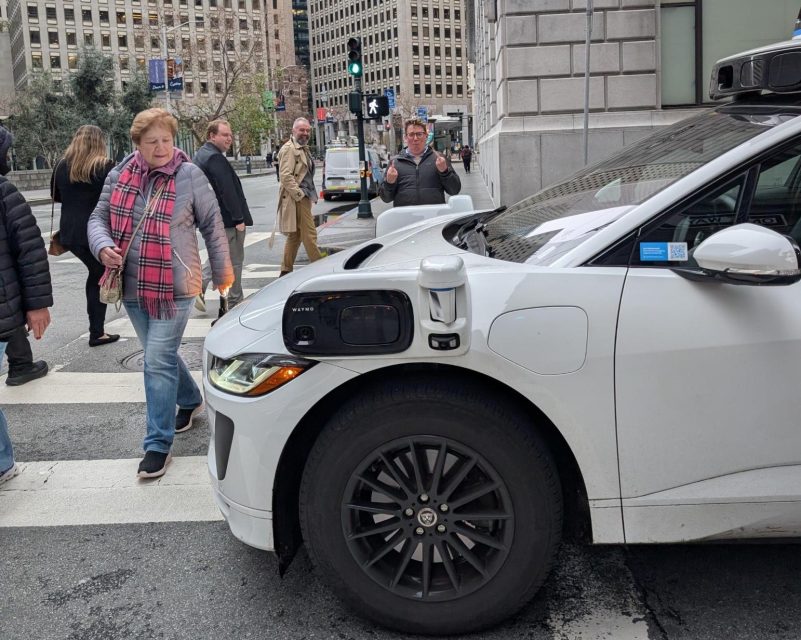
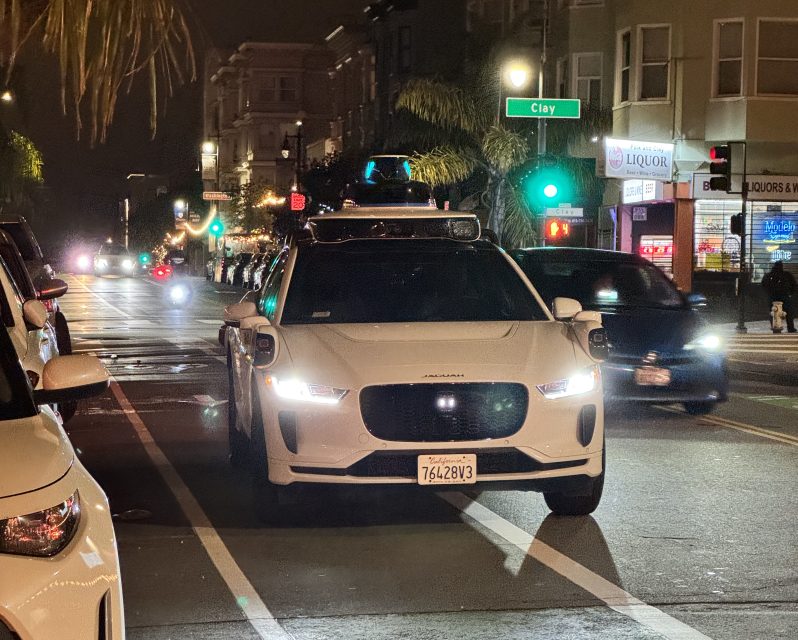
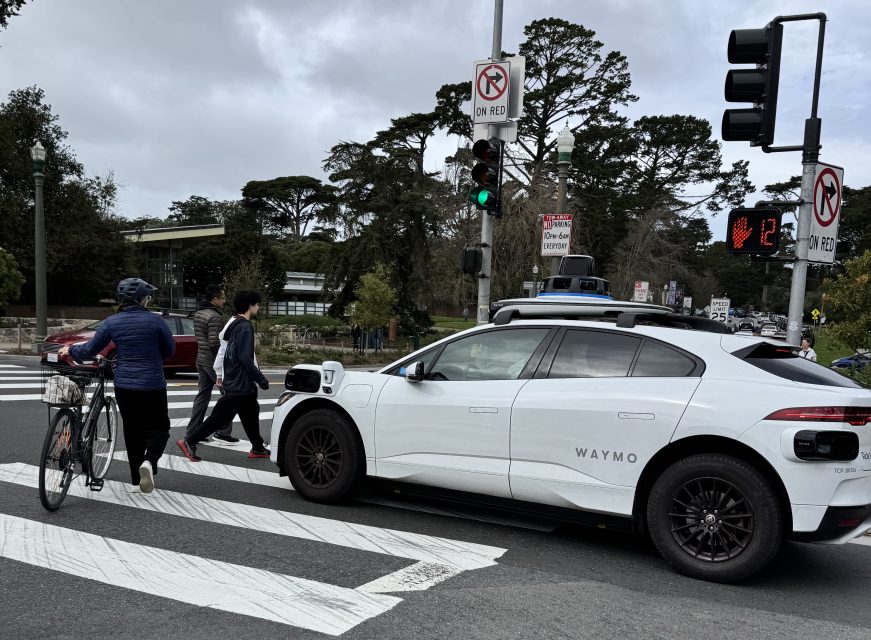
Recently, said Arvin, they’ve seen more Waymos stopped in crosswalks and in bike lanes. “They’ll actually be waiting to pick up a passenger in the bike lane,” Arvin said. The cars have a long track record of rolling gently but persistently into situations where their presence is extremely unwelcome, like firefighting.
Cars driven by humans get in the way of Muni buses and streetcars and emergency vehicles all the time. But since the Better Market Street plan, most cars haven’t been allowed on Market at all.
Waymo doesn’t need to clear the (admittedly low, very low) bar of being better than a human driver. Waymo has to be better than almost no cars, human-driven or otherwise. Nearly any argument that could be made in favor of expanding Waymo’s reach to Market, like increased convenience for travelers with mobility issues, can also be made in support of Muni, which has infrastructure like wheelchair lifts.
Last summer, when then-mayoral candidate Mark Farrell ran on a platform that included bringing private cars back to Market, architecture critic John King wrote a deep dive on how, since its inception, Market has rarely been smooth sailing for any driver.
Intersections don’t match up. Lanes vanish with little warning. Since the Better Market Street plan was implemented, King added, the time it took a bus to make it down those 10 blocks had dropped by four minutes. Collisions had dropped by 40 percent.
When asked by Mission Local what the next steps would be if Waymo turns out to slow down transit times, and if Waymo would be sharing any data with the city during the mapping phase or after the summer roll-out, the mayor’s press office directed this reporter back to the press release, specifically the section that read, “Throughout the process, the city and Waymo will work collaboratively to maintain safety and accessibility, while maintaining reliable and efficient Muni service.” They declined to elaborate further.
On Jan. 9, a few short months ago, Lurie had an inauguration party. It was spectacular. Thousands of people came to Chinatown to be a part of it — the kind of crowds that, right now, Market Street can only dream of. That night, two Waymos froze in the middle of traffic. One of them blocked a 1-California bus, which was forced to drop off and pick up passengers in the middle of an intersection, 100 feet away from its stop.
Was that night an aberration? An omen? Market Street is about to find out.
I am a non-driver and rider of public transit. I have no desire to use Waymo at all. I also do not use Uber or Lyft at present, but licensed taxis if I have to. Cutting MUNI lines is NOT the way to go, in my opinion. In fact, I am in favor of expanding MUNI service, not reducing it. There are lots of people like me in this City and we have been ignored.
I hate to see a barren Market Street. Let’s bring back everybody, every car, every truck, every bus, every bike, every trolley. Let’s not ban anybody from Market Street.
I could not agree more. I people paid their fares, MUNI would boost its revenue to expand service. I wish there were some way the doors wouldn’t open if people didn’t pay their fare.
Or, counterpoint, you just don’t seem to grasp the severe budget deficit situation and MUNI’s (and BART) role in their own (generous!) fiscal envelopes being mismanaged to this point that cuts are in fact necessary. It’s not a decision, it’s a reckoning. It’s balancing a checkbook. Unless you have a winning lotto ticket to bequeath them, cuts are necessary. Buses don’t run on virtue or sentiment.
Buses don’t need to run on virtue or sentiment. They just need to run.
Why post on comment boards when you clearly don’t understand the facts? The reason for the deficit is that SFMTA also is in charge of parking. Parking garages aren’t full. Because people aren’t going to the office five days a week anymore. That’s why there’s an operating deficit. The solution is to sell off garages and turn them into housing, or (better) remove street parking and put bus-only zones and/or protected bike infrastructure on main arterials and make people use the garages when they want to park nearby.
In the meantime, until these changes are made, SFMTA can dip into reserves to keep Muni running.
“Buses don’t need to run on virtue or sentiment. They just need to run.
Why post on comment boards when you clearly don’t understand the facts?”
Expert commentary. Well done.
MUNI cannot be balanced on the back of parking garages, if it’s going to make sense and operate as a standalone necessity. Garages are not going to become housing in any reasonable timeframe for recouping the sale, the conversion is more expensive than what could be built from scratch. If you knew anything about development you’d know that much.
Obviously you aren’t a serious mind, talking about removing all street parking for bicycle lanes and bus lanes that already exist. SFMTA doesn’t have 800 million in reserves, genius. They have to balance their income with their costs, and they have failed. You are supporting that failure with imaginary logic that has no basis in reality now nor in the future.
it is already nearly impossible to find bus service on those 10 blocks of market without waiting 10 or more minutes during the midday hours.
now i am told a private transit option costing almost 10 times more will cater to my needs. as long as i sacrifice my privacy.
is it any wonder sfmta has fiscal problems when the schitty government is willing to sell out its underprivileged population for the benefit of another corporate campaign contributor.
300 Waymos allowed on Market Street. Uber & Lyft banned, Muni and taxis in decline. It’s official: In San Francisco, robots have more rights than humans.
It didn’t take long for this mayor to show his pro-corporate, public-neglecting sympathies. That he is spending political capital in favor of Google at the moment SFMTA is chopping up routes is disgusting.
Waymos are already a traffic-congestion disaster, both in the sheer number of (mostly empty) cars roaming the streets but also their frequent and mysterious stalls. On Market, an electrified bus may be able to inch around an idling Waymo, but a streetcar on tracks is SOL.
The board actually approved the cuts at its April 1 meeting, voting 4-3 (there was a prior vote on March 18, but there were not enough members of the board present to make the vote count). The April 15th vote is just the final vote, and it’s on the consent calendar (item 10.5).
Thanks for the pics of the waymos doing all the bad things.
I see waymos stopped in cross walks and bike lanes every day. This seems, therefore to be intentionally programmed functions of the cars. I don’t believe Waymo should have privileges to SFO or market street until they can prove they can function legally 100% of the time. I’m much more forgiving of the glitches that cause the cars to freeze up in non-standard situations than I am of the casual Waymo rule-breaking. Bike lanes are for bikes.
Another commenter asked where is best to report waymo errors? Anyone got an answer to that?
Waymos are parking in the bike lane now in case anyone was under the impression they were going to be law abiding.
https://bsky.app/profile/stevewithag.bsky.social/post/3lmtedxbrdk2o
Can you tell us who were supposed to contact when we see Waymos behaving badly? I see them run red lights and cut off cyclists. Do I report this to the police, SFMTA, directly to the mayor’s office?
I’m not opposed to Waymos on Market, especially since they have the legal right to be there, but I’m sure not in favor of buses not running down Market like they do now. If the 7, the 5, and the 38 end at Market, that leaves lots of people away from where they’re going.
I’m disgusted that allowing Waymo is another assault on public transportation at a time when MUNI is suffering low ridership.
Muni is not suffering from low ridership! It’s the *garages* that are empty and costing $$$. That’s what is so very very stupid about this whole thing. People using Waymos are not going to use parking garages, but Waymos will slow down Muni and push transit users into more Waymos.
MUNI is not nearly balancing their budget with ridership, pay attention.
They OWN the garages because they were GIVEN the garages. That they’ve managed to turn a golden goose into a deficit SHOULD be TELLING even to an obviously high fanboy.
How?
$$$.
Getting out of a bus at Market Street, only to get into a Waymo….is ridiculous! The intention of car free Market Street is JUST THAT… CAR FREE. Do not truncate bus lines to make them unattractive and unproductive to your passengers.
One vital piece is missing from this otherwise excellent article: the deadly effect this will have on the already beleaguered taxi industry. Kill that off and weaken Muni,and whaddya know, our only choices for transport will be corporate-owned. As a bonus for the zillionaires, driverless cars don’t need health coverage and other benefits — and they won’t organize and strike to get them.
I just caught a bus a few hours ago. The sign and the bus stop said it would be there in 5 minutes. Ten minutes later, still 5 minutes. A family of tourists arrived and joined me for a 5 minute wait that ended up being half an hour. No traffic, no Waymos, just late.
Muni is fully capable of providing terrible service on its own, without blaming others. They don’t deserve the exclusive use of Market Street. It’s wasted on them.
For bus arrival times, wrong information is worse than no information: So many times, just like you mentioned, the sign will say 5-10 minutes wait and turn out to be much, much longer. If I’d known that, I would have taken a different route, walked, etc. But after waiting half an hour, one is stuck.
It’ll be sad and ironic when a small number of cars clog up the larger number of buses on Market, and dissuade more people from coming downtown.
Oh, that isn’t what is dissuading folks from coming downtown.
You don’t seem to get it… it’s the lack of cars and parking that have dissuaded people from coming downtown.
Sorry, Doug, but it’s you who doesn’t get it.
I’m not too worried about robocabs on Market. We already have taxis. What I am worried about is unfettered robocabs on Market being used as advertising for Waymo, etc.
Imagine a techbro getting the brilliant idea that having trains of them endlessly drive up and down the street is a great way to advertise. That would kinda suck.
What we need are robust controls on how many and how they behave. One rule could be, no deadheading, the robocab can only be on Market to pick up or drop off. Another might be concentration, with a maximum number allowed to be within a block of each other.
But this is all going to blow over. Lurie is pandering to his rich supporters. Every time you read about the Strand complaining that their patrons want to be dropped off out front, remember that what they’re saying is that the rich whales they depend on for donations want their personal drivers to be able to drop them off there.
The whole point of a street, like Market, is to act as an axis of transport. SFMTA and the BOS fired their first shot at the car culture when they closed it to private cars back in 2009 for a test run. Since then, street diets, reduced speed limits, and protected bike lanes have all become a part of the landscape. I get it, the city wants us to drive less by making driving more painful. But Market, Mission, Van Ness, and others are corridors meant to move traffic through the neighborhoods quickly to their destination. When you shut these down, cars move into the adjacent communities, creating more traffic and more gridlock in spaces that were never designed for it. Market Street was.
You say that like it means something, but Market St. But Market St. predates automobiles by how long?
If you want to talk about the traffic Market St. was designed for, then go back, way back. To when “traffic” meant omnibuses and pedestrians and horsecarts. Are you sure you still want to use that argument?
Instead of ignoring the bits of history that don’t support our arguments, we should be taking the lessons of the past learned and applying them to the conditions of the present to create a better future.
And if we do that, we have to remember what a traffic sewer Market was when unfettered private vehicle access was the norm. We can do better, and post carfree Market we have been doing better. Let’s not go back to gridlock.
market st. started out as a railway.
Before there were cars. It was a railway for public transit.
Market street was a horseway, transplant.
Make Market Great Again?
“traffic sewer” so you’re saying people actually went there?
Sure, and let’s keep the blight and all the closed storefronts as well. After all, MUNI and bicycles have really done a great job bringing commerce back so far.
Just stop with this BS. No one who has a brain thinks that ‘blight’ happened because private cars were banned from Market. Almost no parking was allowed on Market between 10th and the Ferry Building anyway.
You might’ve noticed that retail, entertainment, and dining have suffered mightily since covid. That’s a tough thing to recover from but it’s slowly happening. And it’s still too easy to drive and park in Mid-Market so that means less foot traffic in the retail areas. We need more office building-to-apartment conversions and more safe bike infrastructure. More eyes on the street, more safety, more retail opportunity.
Just stop with the BS. No one who has a brain makes excuses for MUNI’s 800 million budget being insufficient EXCEPT YOU TRANSPLANTS WHO HAVE NO CONCEPT OF A BALANCED BUDGET NOR MANAGEMENT EXPERIENCE IN ANY CAPACITY. It’s BLOATED.
Cuts are happening BECAUSE THEY ARE NECESSARY.
But they allowed all modes.
Better Market Street plan
How ironic it looks 5 years later — the most depressing street in the US
Hooray! now do regular cars…
If anything, there should be a free MUNI line that runs between Powell and Embarcadero. There should also be a tax on Waymo rides to downtown.
Mr. Mayor,
Congratulations in embracing this new Technology and please continue to do so.
The Elephant in the Room on this one is Job Loss and the answer to that one will have to be some sort of Guaranteed Universal Basic Income.
We already have this in the form of General Assistance and SSI and you can build from there with Public Hearings featuring speakers like Andrew Yang.
The Blitz pace of Automation from cab driving to lawyering and doctoring is producing a new type of Unemployed capable of leading mobs up hills and the only question is whether we get UBI before or after the bloody Revolution.
go Niners !!
h.
Here’s an unbelievable video of the L.A. robo-geddon. Two Waymos and a sidewalk robot all malfunctioning as if in cahoots, bringing traffic to a standstill (including a public bus).
https://x.com/hearinladotcom/status/1910068835723722954
Cars are a solution to our car problem? Alcohol will save downtown? Ignoring the fact public transit is going off a cliff. What else would you expect from a billionaire mayor? Clueless to the reality of the normal persons life and hand out to fellow oligarchs.
“How did Waymo get onto Market Street?”
Ok, I’ll give it a shot:
historically-extreme levels of wealth inequality?late-stage capitalism?Oh, I got it: CLASS WAR
I see human drivers blocking Market Street every single day. SFMTA even says multiple people to help folks figure out traffic lights at 1st and Market, but I haven’t seen any tickets written.
In the meantime, you will see buses and trains blocked for a while light cycle during rush hour on market.
One way to make Muni more profitable is to increase bus fares.
Ridership would drop off. In fact they’re pushing it as is, BART for sure is.
In a typically San Franciscan way, there is a huge amount of outrage and pearl clutching over what is a logical decision. The Muni cuts are what they are and have nothing to do with Waymo, and vice versa. I spent decades of my adult life without a car in SF and relied an a variety of transportation options to get around, but mostly bike. I’m fine with Waymos on Market. They are FAR safer and more predictable than drivers, taxis, Uber/Lyfts, etc. But I do think a line needs to be drawn to not allow anything more on Market, particularly personal vehicles and Ubers/Lyfts.
The idea that commercial landlords can lower their rents, and that the assessor (ie tax rate) has anything to do with it is wrong: Commercial loans are tied to a property value that’s based on the expected rent. Thus if a landlord reduces their rent, they are also reducing the value of their property, which will have ramifications for their loans: They may at very least be forced to refinance, or worse get foreclosed on by the bank and lose everything. Because the property value has been reduced (lower rent), the loan will be for a higher proportion of the property value; it’s also probable today’s interest rates are higher than those of the original loan. It’s a lot less painful to leave the spaces empty, keep paying the mortgage and hope that tenants will come back.
Multiple comments:
Waymo cars are far better “drivers” than Lyft / Uber / taxis. Yes, they are still “learning” but they pull over in proper places, they don’t speed, they “know” the traffic patterns. Your photos are pretty but let’s see the photos of drivers blocking crosswalks, making dangerous U -turns, double parking in active traffic lanes, parking in bike lanes….
People riding in Waymo vehicles are never going to get on MUNI busses.
If you’re worried about traffic load on Market street stop the F street cars at the Ferry Building.
And please please please stop giving Arron Peskin any chance to have his failed time in office noticed. He got voted out.
They’re parking in the bike lane now. I guess they are just like real drivers!
How about if we see photos of 99% of the bicyclists continually running red lights and stop signs?
” but they pull over in proper places, they don’t speed, they “know” the traffic patterns.”
I call 100% BS on all 3 claims. Going under the posted rate is a speed violation also.
Agree with you totally
This article gives time to a failed mayoral candidate and the vice chair of a completely discredited sfmta. “ market street collisions dropped by 40% “ . Stop all traffic and collisions will go away completely!!
Having 90% less traffic results in 40% less collisions, great job!
Go live there, run a business on Market street.
Waymos are a tourist attraction for SF and they bring exactly the type of tourists we need: tech-oriented people, who tend to have and spend money.
I was very skeptical of driverless cars, but now that I have been around Waymos for some time, I have come around. They do seem safer to pedestrians than human-driven cars.
And let’s stop ignoring the fact that tourism is one of our most important industries. Bringing in more tourists will boost the restaurant and retail industries. It will create more jobs.
We’ve got to stop thinking about how we can give more city resources to drug addicts from out of town, and think more about how we can make the city better for normal people who live here, and non-drug-addicted visitors.
the visitors just do more expensive drugs.
How expensive are yours, MUNI freebasers?
We do NOT need techies riding around in Waymos, you need to go live in San Jose and cut out the middleman.
To Kurt,
Who do we need in San Francisco? And what do you approve they travel in?
Who is going to support the San Francisco tax base with high employment and good salaries?
“Who is going to support the San Francisco tax base with high employment and good salaries?”
People working from home, unfortunately for downtown.
The facts do not lie.
Big Tech’s high employment and good salaries? More like its layoffs and tax breaks.