



On the first Friday of April, mechanic James Matlock took a rare day off work.
It wasn’t a day of respite. Instead, he sat in San Francisco’s windowless Behavioral Health Court at the Hall of Justice for seven hours, hoping to see his son diverted away from a criminal trial and toward psychiatric help.
He’s smart, said Matlock of his 35-year-old son, Kevin. Maybe even too smart. On medication, he’s the “sweetest person.” His family paid the cost of his prescription for six months. Then, they could no longer afford it.
That was several years ago. There have been periods of stability since then; for the past two years, Kevin has worked as a security guard. But he’s also been in and out of city treatment programs, Matlock said.
“Like clockwork,” his father sighed, there’d come an “incident” that broke the spell.
This time was the most serious yet. On Jan. 26, Kevin was arrested on charges of evading an officer and reckless driving under the influence.
“It’s sad,” Matlock said. Now, “his fate is in another person’s hand.”
If Kevin is eligible for mental health diversion, his medication will be covered, and he will avoid the up to three-year state prison sentence that he could face. But acceptance isn’t guaranteed.
At the front of the courtroom on that Friday, half a dozen defense attorneys argued before a judge that mental illness was the root of their clients’ criminal charges. Prosecutors argued that the public-safety risk the defendants posed was too great to release them to treatment.
Friends and family asked that loved ones be granted a chance to do better.
‘A new purpose for living’
San Francisco has 14 collaborative courts where judges, defense attorneys, the district attorney’s office, and mental-healthcare providers all agree to divert defendants with extenuating circumstances to treatment.
Behavioral Health Court, located at 850 Bryant St., is specifically for those with serious mental illness.
Since its creation in 2002, almost 1,000 people have been accepted. On average, the program monitors 140 clients at a time. Eligibility is determined on a case-by-case basis, though the court said it does not take on defendants who commit “certain violent charges,” meaning, usually, severe violence.
Approximately three-quarters of participants have successfully graduated from the program. On average, this takes between 18 months and three years, and, according to the court, “heavily depends on the severity of the diagnosis and legal case.”
The use of cost-saving diversion programs like Behavioral Health Court have fallen markedly under the tenure of District Attorney Brooke Jenkins, despite state policy that expanded eligibility starting in 2024. Still, every year, hundreds of people enroll across the city.
Legal professionals and social workers said a shortage of beds and case managers often slows down the process.
In August 2022, the city estimated that nearly 9,000 of the 19,000 people who experienced homelessness in the prior year had a substance-use or serious mental-health disorder. There were some 2,550 residential treatment beds at the beginning of 2024, and no new beds were added this year.
At 10 a.m. on that Friday morning, Matlock was waiting on a wooden bench in the hallway, playing Solitaire on his phone. He had arrived three hours earlier, but was told cases wouldn’t be called until 10:30 a.m.
The father watched flustered newcomers run inside the courtroom, then slowly walk back out: A woman rolling a cart piled high with bags, a man swinging a cane in one hand and headphones in the other, a family with a stroller. Across from him, two people split a breakfast sandwich.
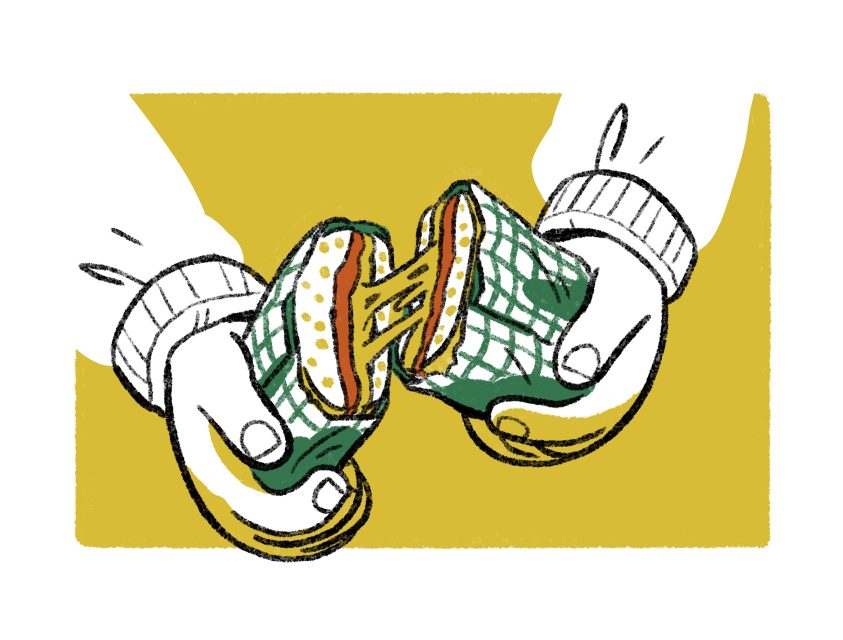
One of them, Elizabeth, started the program after she was arrested for domestic violence last year. “Thanks for showing up,” the man eating the other half of the sandwich told her. “Everything’s trying to get you not to.”
The 29-year-old transgender woman has been struggling with severe depression and post-traumatic stress disorder since she was a teenager, she later said. Through her court treatment program, she receives medication and meets with a therapist and case manager twice a week.
Elizabeth said it’s helping her find balance: “Sometimes we know we have problems, but [we need] somebody serious telling us, ‘You need to get on your treatment, you need to get yourself together.’”
Today, she’s in court for a regular check-in with the judge.
By 10:30 a.m., everyone is seated. Elizabeth is turned backwards, showing off photos of the Chihuahua puppies she fosters — her spare time is spent transporting stray dogs to the Bay Area — when San Francisco Superior Court Judge Charles Crompton emerges.
He commends her for keeping up with her support groups and appointments. His praise is succinct, but tender: “Good job.”

The structure and accountability of Behavioral Health Court is essential to recovery, according to Elijah Donaldson, who completed the program in 2023 and now works at an affordable housing organization. It creates “guardrails” for people who most need help, Crompton said.
When Donaldson meets other people going through the program, he tells them to stay busy. “Find a new purpose for living your life, instead of going into these stores and stealing and going back on drugs.”
He does have a critique, though: The court’s limited follow-up with graduates. In his experience, relapse, even for those who excel while in treatment, is not uncommon.
‘Trying, trying, trying’
And, even for those who get diverted from jail, relapsing happens. Since 2002, about a quarter of the court’s total participants, 490 people, have failed to graduate. They are typically arrested on a new charge or sent back to criminal court.
The court did not have data on graduates’ recidivism rates.
“People shouldn’t think of the diversion as a free ride or getting off easy,” Judge Compton said. “In a lot of ways, it’s harder than going to jail.”
Sitting atop Behavioral Health Court since 2014, Crompton has also seen the bulk of recent mental health diversion petitions.
Mental health diversion is slightly different than Behavioral Health Court: It’s capped at two years, while participation in Behavioral Health Court is indefinite, but both give defendants a chance to go to treatment instead of trial. Unlike in the collaborative program, where acceptance involves many parties, a defendant’s acceptance to mental health diversion is decided by the judge alone.
On the day Matlock was there, these petitions filled the afternoon calendar.
Kevin Matlock’s teachers used to say he was “special,” his father recounted during the noon lunch break. Now he wishes he realized what that had meant: “I could have gotten him help earlier.”
According to court records, Kevin fell asleep drinking vodka in a Mission parking lot on the day of his arrest. When he woke up, he reportedly drove around the lot and attempted to hit an employee before crashing into a pillar. His Dodge burst into flames.
Matlock sighed: “Maybe now he can get some help.”
Back in the courtroom, the father rubbed his head as he listened to other people plead for mental health diversion, waiting for his son to appear.
A 62-year old man with a prior homicide conviction, facing allegations that he targeted and attacked a Black woman in Dolores Park, was denied.
A 19-year-old facing allegations that he chased and robbed two women at gunpoint was also denied.
A man with geometric tattoos covering his face, a list of prior convictions, and allegations that he stabbed someone in the back was denied, too.
Judge Crompton cited concerns about this last defendant’s compliance, contrary to the defense attorney’s claim that his client is “trying, trying, trying to do the right thing.”

It was 2:20 p.m. when a deputy approached Matlock, who had his head in his hands, to ask who he was there to see. Kevin, he was told, would not be appearing.
Court records indicate that Kevin’s appearance that Friday was waived because he refused the court’s recommended treatment plan. At the time, this was unclear to Matlock, who thought there had been a scheduling error.
The decision to reject treatment, Crompton said, is “heartbreaking” every time it happens: “Sometimes you have to give up on it for now and say, ‘In the future, hopefully you’ll be ready and you’ll come back and we’ll try again.’”
Kevin’s second opportunity in Behavioral Health Court is scheduled for the end of the month.
A week after his son’s first date, Matlock remained confused about the process. The father is back at work, resigned to “wait and see.”
WHY IS NOT MY COMMENT POSTED??? HOW MANY TIMES I HAVE TO ADD MY EMAIL?
Lori —
These comments are monitored by actual people who take their kids out for bike rides on the weekend. I’m sorry you had to wait. The world can exhale knowing it’ll be gotten to shortly.
Best,
JE
I believe the answer to the help that they need. I will use me as example.MY TESTIMONY: I was a former: drug addict(meth, heroin, crack, cocaine an alcohol +) because i was born into a home where no love shown, no discipline etc…I became psychotic, out of control. from teen to adult(12 yr old to 59 yrs). spent lot a teen years in out of Juvenile halls, group homes an two mental institutions, Jails, facing prison time 3 times! arrested in 2017(felony) facing 2 to 4 years + 2 strikes Prison. beat it, only after I had prayed to the God who made all things like sum of us do when we in trouble. anyway, God answered my prayers, no Prison, but I was given given a year in county jail( half time 6 mon). I got out, went to programs but i failed in them for bad behavior, I got kicked out of one then the 2nd one too! end up back on streets, homeless again approx. 3 days drinking alcohol, then got arrested again on violation went back to Jail for 3mos, in my cell I prayed but this time it was different. i had time to reflect on why? the thing in county you got to attend all groups whether you want to or not,(i did not) most Immates did not take serious. for me, these methods did not work for me either! so I started reading Bible, christian books and everyone thought I was crazy, but it got my attention. moving on, time to get out of Jail an I end up going to a hotel, after about a year ( in meantime I was attending Christian Church. it was blessin.) I went through navigation center, another hotel for over a year.,(after almost 2 more years of hotel living, the Lord my God who is faithful to His promises,meets all my needs (not my wants,cuz God not a Genie) and as I continue to trust and obey in His word, I got my 1st Apartment studio in a brand new building here in the Mission dist. but not only that but the Lord deliver me from sin an saved me. it is so true i’m not making this up, I’m NO LONGER A DRUG ADDICT,ALCOHOLIC, HOMELESS,WORTHLESS PERSON ETC.. IT WAS NOT BECAUSE OF 12 STEP,OR PROGRAMS THAT HELP ME GET OF DRUGS,ALCOHOL. The Bible says that we are dead in our trespasses and sins (Ephesians 2:1-4) God’s way of salvation, Do I need to be saved? because God is holy. No sin will ever enter His presence, for “righteousness and justice are the foundation of HIS throne”. (Psalms 97:2) 2. All Humanity is sinful. “For all have sinned and fall short of the glory of God” (Romans 3:23). Sin separates all people from God. “Your iniquities have made a separation between you and your God, and your sins have hidden his face from you” (Isaiah 59:2). 3. It is impossible for humans to save themselves.(Romans 3:20). 4. CAN I BE SAVED? God sent his Son to be your savior. ” In this is love, not that we have loved God but that He loved us and sent his Son to be the propitiation or our sins”( 1John 4:10). 5. The living savior invite sinners to receive Him ( Matthew 11:28). 6.forgiveness of sins and salvation can be yours today (For Christ also suffered once for sins, the righteous for the unrighteous, that he might bring us to God” ( 1 Peter 3:18).7. AGREE with God that you are a lost sinner, unable to save yourself. (God shows his love for us in that while we were still sinners, Christ died for us ” (Romans 5:8). 8. BELIEVE that Jesus Christ died for your sins and ASK Him to be your SAVIOR. ” To all who did receive him, who believed in His name, he gave the right to become children of God” (John 1:12). 9. CONFESS the Lord Jesus Christ ” If you confess with your mouth that Jesus is Lord and believe in your heart that God raised him from the dead, you will be saved” ( Romans 10:9). ” Truly, truly, I say to you, whoever hears my word and believes him who sent me has eternal life. He does not come into judgement, but has passed from death to life”( John 5:24). It wasn’t 12 step or some methodology, or No harm reduction plan, or group counseling that got me to stop drugs, alcohol, crime and such, but it was when I was locked up and when I read in the bible, this GOOD NEWS OF the gospel of Jesus life, death an resurrection. ONLY WAY TO BE SAVED IS, “REPENT AND BELIEVE” Praise the Lord! BLESSINGS
Of course defendants clamor for diversion because it means they won’t go to prison.
Judge Crompton is a gem. We are lucky to have him on the bench.
The chart you presented was an interesting choice. It shows that the percentage of criminal cases resolved by diversion has fallen, but that is only because the number of cases prosecuted has risen. In terms of actual numbers of cases resolving through diversion, it is pretty much the same as, or higher than, the Chesa years: 1,195 in 2020, 1,334 in 2021, 1,689 in 2022, 1,722 in 2023, and 1,643 in 2024. One thing that has gone up substantially is the number (and %) of convictions, from 1,218 in 2021 to 2,176 in 2024. So the “use of cost-saving diversion programs like Behavioral Health Court” has not “fallen markedly under the tenure of District Attorney Brooke Jenkins,” but the numbers of successful diversions have stayed pretty steady. Chesa did not so much expand the use of diversions but simply prosecuted and convicted a lot fewer overall. Even as a % we’re above 2019 levels. And, as this article highlights, a lot of this is out of the hands of the DA as the court is involved in determining who can proceed with some diversion programs and (properly) rejects many candidates like the guy with a murder record who targeted and attacked a Black woman in Dolores Park. I’m all for diversion programs where appropriate as jail/prison is expensive and not the best option in many cases, although it is certainly the appropriate option in many others like crimes of violence.
Thanks for the article .
Most persons when they are struggling or”down on their luck” don’t take drugs .
It was a choice to do so unless forced .
It is morally , legally and medically wrong to ingest poisons .
There must be a self accountability and responsibility .
If they fail this court , then game over .
SF needs to stop the supply , dealers and access .
If the penalty fits the crime , the numbers decrease.
Why in Singapore and other countries with severe penalties are there next to none drug addicts ?
SF is harming addicts here and more are dying due to the continued lack of getting control of this.
Sad to see that more deaths happen here from the daily drug dens then in other places where they have “death penalty”
Think about it .
Death penalty is hard to agree with but it actually saves more people then our current policies and laws .
Here people just rot way .
Tragic
“Prosecutors argued that the public safety risk the defendants posed was too great to release them to treatment.”
Yeah, so put ’em in jail. Jail is really known for improving mental illness.