
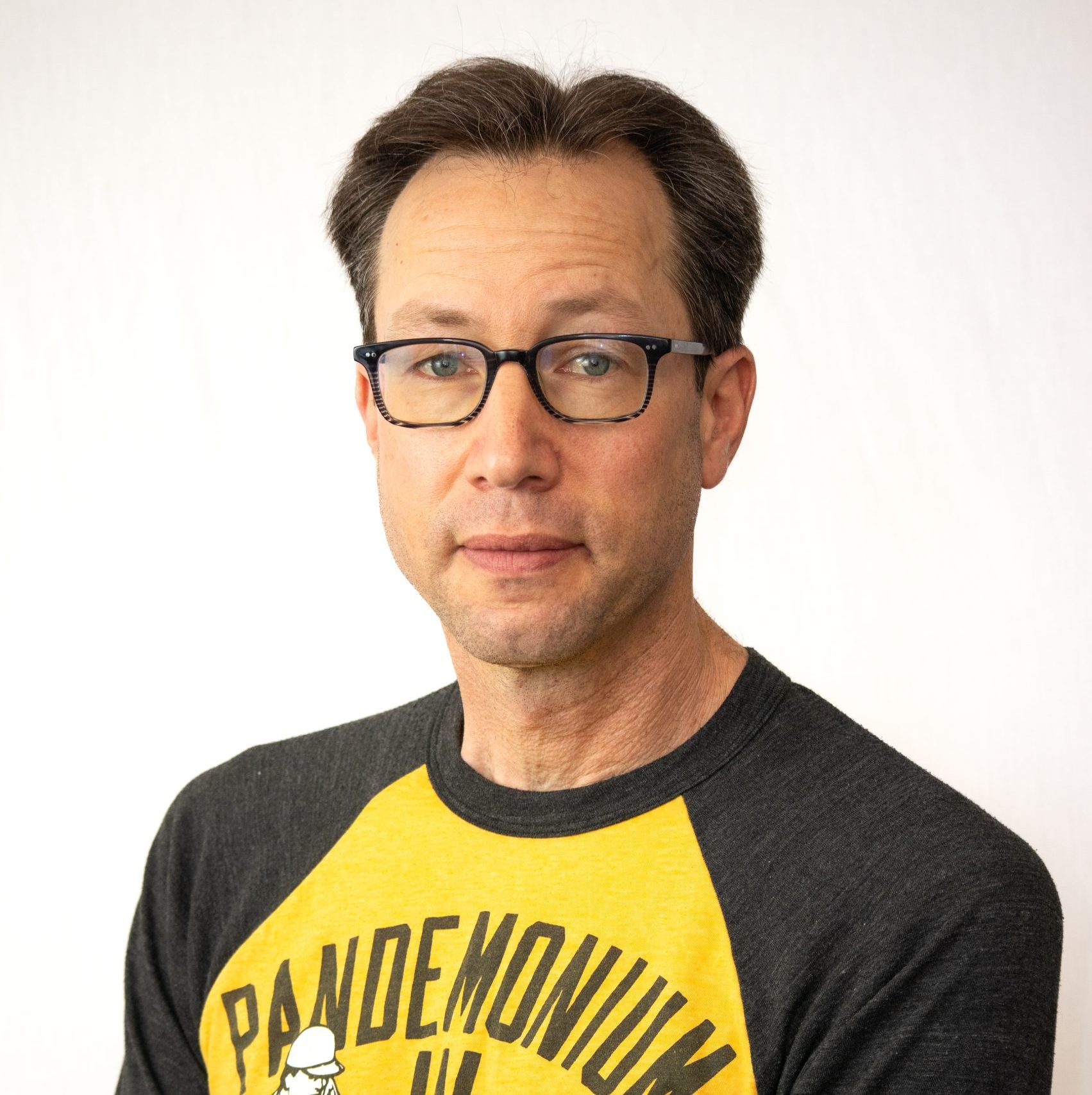


In a feat that will surely never be duplicated, George Gascón managed to get himself elected district attorney of San Francisco and Los Angeles. While running in San Diego is the logical next move, Gascón, who lost his L.A. re-election bid last year, is presently ensconced in private life.
As a DA, he at one point employed both Diana Teran and Brooke Jenkins. Both of these veteran prosecutors presently find themselves in hot water, for broadly similar reasons; computers were involved, which matters a great deal.
But the temperature of the water they’re in varies a great deal: Attorney General Rob Bonta has brought charges against Teran that could put her into prison for more than six years. In the case of Jenkins, Bonta has declined to file charges, or even apparently mount an investigation, claiming the statute of limitations had lapsed.
This state of affairs has left Gascón dumbfounded.
“If you were to put these two cases side by side, taking a pure look at the law and behavior,” he says, “if there’s any criminal liability here in these two cases, clearly it’s not the Diana Teran case.”
Teran, a former adviser in Gascón’s office, is accused of accessing a Los Angeles Sheriff’s Department database in April 2021 to obtain disciplinary materials for deputies, court documents that are public records.
If Teran had walked to the courthouse and requested these records, there’d be no case, but a computer was involved. And, even though the documents she obtained are simply PDF copies of the ones at the courthouse, the attorney general is claiming a felony crime has been committed: Teran is being prosecuted under Penal Code 502(c)(2), a statute more commonly applied to rogue hackers than to prosecutors obtaining public records in the course of their job duties.
Jenkins, meanwhile, in logged into the California Law Enforcement Telecommunications System database late on a Saturday night October 2021. She accessed the confidential rap sheet of serial criminal Troy McAlister and sent it to colleague Don du Bain’s personal email. Neither Jenkins nor du Bain were attorneys on this case. Neither had an apparent “need to know” or “right to know” this information. Within days, both would leave the office of DA Chesa Boudin to work on the campaign to recall him.
By some alchemy, the contents of McAlister’s rap sheet played prominently in the subsequent successful recall campaign; both Jenkins and du Bain would wield it like a cudgel to portray Boudin as inept and disastrously soft on crime. Jenkins was placed into a diversion program this year by the State Bar, following her accessing and dissemination of the confidential rap sheet. The attorney general, however, declined to get involved.
Gascón’s confusion is shared by Erwin Chemerinsky, the dean of the University of California, Berkeley’s law school. Based on media reports of Jenkins’ behavior and her subsequent placement into a diversion program, “What she did is more egregious than what Diana Teran is accused of doing.”
And yet, Attorney General Rob Bonta is using a novel, if not tortured and disturbing, read on an anti-hacking statute to prosecute Teran. If it’s successful, she could be sentenced to prison.
A press secretary for the attorney general declined to tell Mission Local why the office never applied 502(c)(2) to Jenkins, or if it even considered doing so. To be clear, neither Gascón nor Chemerinsky would want this; they feel it’s inappropriate in either case. But the anti-hacking statute is exceedingly broad. And whether or not it’s the right thing to do, the AG’s office most definitely could apply it to Jenkins if it wanted to.
“When you have a broad law, you can use it in all sorts of broad ways,” says Hanni Fakhoury, a Berkeley attorney specializing in computer crimes. Regarding the Teran and Jenkins cases, “I don’t see a way to draw a distinction between the two. … How discretion is exercised is inherently an act of politics, to some degree.”
How broad is broad? Before Bonta applied 502(c)(2) to a prosecutor obtaining public records about law enforcement officials driving drunk or failing on the job, it was used against bloggers in Fullerton; that city inadvertently uploaded internal documents onto a publicly accessible Dropbox and then turned around and sued the members of the public who downloaded them.
“What this shows is how dangerously broad and malleable this part of the criminal code is,” says Aaron Mackey, an attorney with the Electronic Frontier Foundation. “A prosecutor at the state or local level can broadly use the vague terms and definitions in the law to make what appears to be a benign or innocuous behavior appear to be criminal. The fundamental flaw of these types of computer-crime laws is that they can be manipulated in this way.”
To Mackey’s point, the underlying material Teran is accused of accessing is not nuclear secrets or the New York Times crime-against-humanity green pea guacamole recipe. Again, these were public documents, court files written by judges, regarding potentially problematic officers who might hamper future prosecutions. This is something the Los Angeles DA’s office would want to know, and is mandated to compile by law.
You can’t say the same thing about Jenkins, who accessed private and protected records she had no business accessing, and then sent them to the personal email of a colleague who also had no business possessing them.
“The scope of the statute is so broad, and there is so much discretion within prosecutors’ hands, that you can have a situation where someone who is using public court documents is prosecuted, and someone who is using private law-enforcement documents is not,” says Tony Brown, one of Teran’s defense attorneys. “It creates a huge amount of uncertainty about what constitutes criminal misconduct under this statute.”
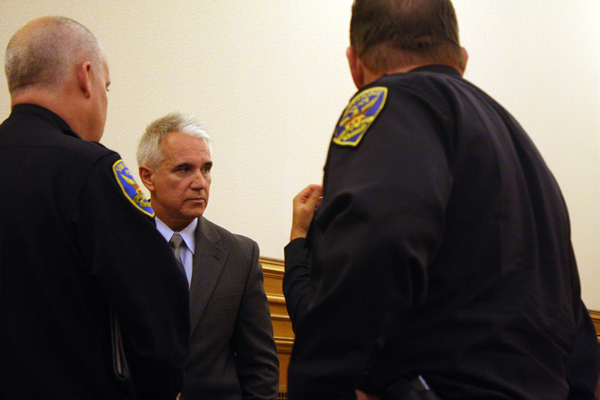
The AG’s office, again, declined to explain its reasoning. But it warrants mentioning that the public records accessed by Teran documented misconduct or poor performance on the part of the politically powerful Los Angeles sheriff’s deputies, who are represented by an influential and free-spending union. Jenkins’ dissemination of a confidential and protected rap sheet, which documented the behavior of a highly unsympathetic serial criminal, did not induce a similar political firestorm.
Unlike Teran, there has been no excuse yet publicly proffered for Jenkins’ actions fulfilling a “law-enforcement purpose” or being part of her job-related duties.
One day after Jenkins emailed du Bain the confidential McAlister rap sheet, according to records obtained by Mission Local, du Bain used his work email to send a file called “McAllister, Troy 15016964-three strikes memo.doc” to his personal email account at 10 a.m. on a Sunday. Mission Local is informed that this was a confidential memo.
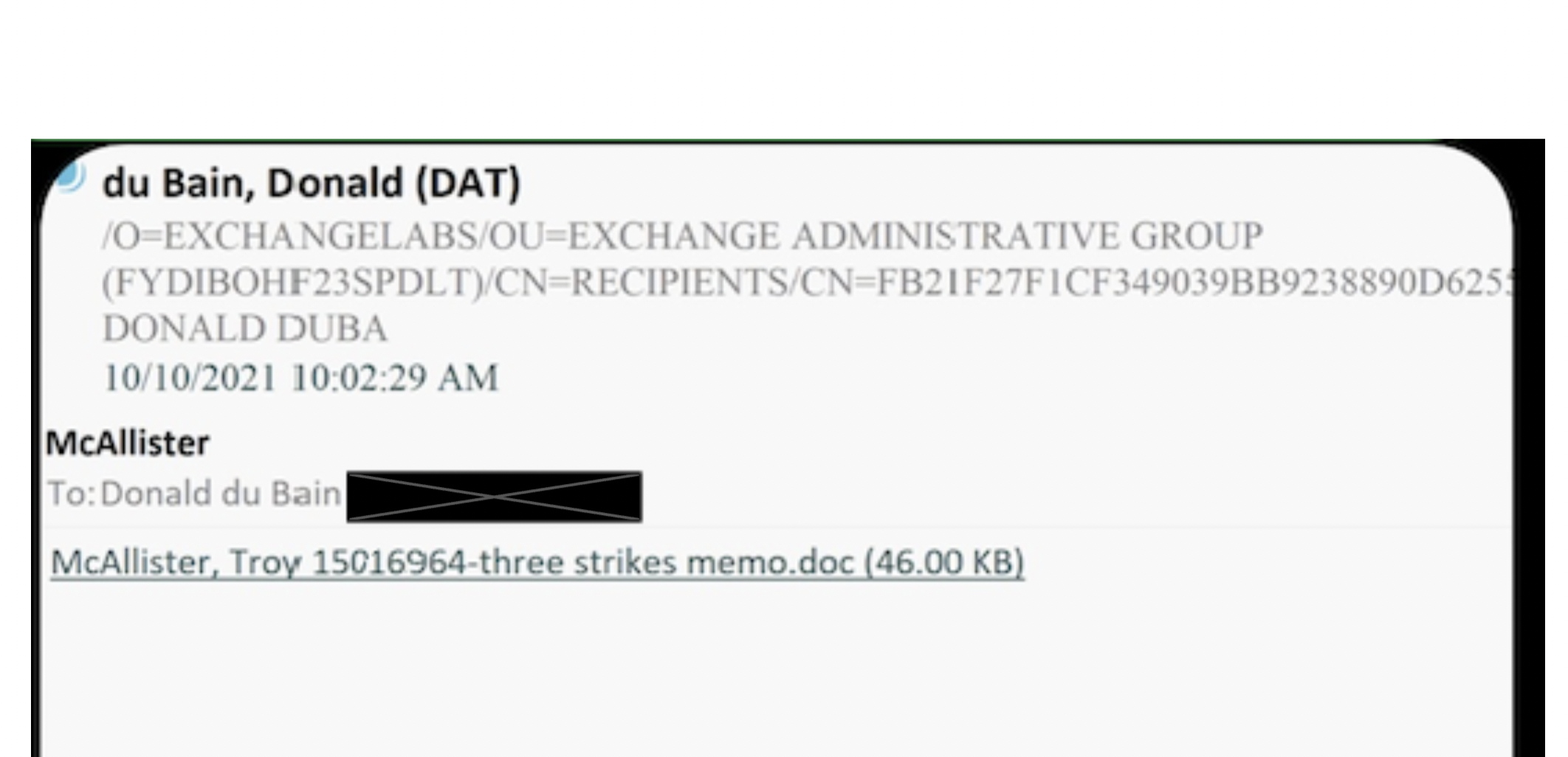
Jenkins, incidentally, received an auto-generated email alert one minute after sending the rap sheet to du Bain. It warned that an “email with sensitive information was sent” to a non-city address. If this was indeed an accident, as she has claimed, she should’ve known about it immediately.
Her office, however, has bristled at even the inference that Jenkins may have committed a misdemeanor by accessing and disseminating McAlister’s rap sheet.
“The sharing of the rap sheet would only be a misdemeanor if it was shared with an unauthorized person,” reads a statement from the office. “Don DuBain as an employee of the DA’s office at that time was in fact authorized to read the rap sheet and hence why it’s not a misdemeanor.”
This is a head-scratching claim, and one that does not appear compatible with the statements of the State Bar, which wrote last month that it is “requiring” Jenkins to attend the diversion course.
“There is evidence that Jenkins should not have accessed or handled McAlister’s rap sheet in the way she did given the statutory limits on access and use of criminal history information,” the State Bar wrote.
The term “the statutory limits” is a legalistic way of saying “the law.” So, simplified, the State Bar appears to be saying it believes that there is evidence Jenkins violated the law.
So, that’s confusing. What’s also confusing is the San Francisco district attorney office’s contention that merely being “an employee of the DA’s office at that time” renders someone authorized to read, access and possess confidential information unrelated to their actual work. This confused nearly every judge, lawyer or police officer Mission Local consulted.
Law-enforcement officials, including here in San Francisco, have been both fired and prosecuted for accessing records for which they could not establish both — and it must be both — a “right to know” and “need to know” the confidential information. Jenkins’ office in 2022 excoriated former prosecutor Lateef Gray for allegedly downloading similar confidential documents on his last day in the office, noting that the material he purportedly obtained was “stringently protected under state and federal law and regulations” and its “unauthorized use and dissemination … may carry criminal penalties.”
“Just because you work in the DA’s office doesn’t mean you have access to everyone’s criminal files or confidential information,” sums up Gascón, who ran this office for nearly nine years. “That is not the way it works.”
“The simple fact of being a deputy district attorney does not authorize you to access anyone’s records at any time,” adds Stanford University law professor George Fisher, a former prosecutor.
“I think the Teran case should never have been brought,” says Chemerinsky. “And I’m not advocating Brooke Jenkins be prosecuted. That’s not what we should be using criminal law for.”
But actions of the sort Jenkins undertook are “the very type of behavior the attorney general is prosecuting in the Teran case.”
Bonta had plenty, plenty of time to avoid the Statute of Limitations, FWIW. Now he wants to pretend otherwise like he had no control over the case? Shameful.
When juxtaposed with the Teran case this is just starkly obvious, Bonta is unfit for the AG job either by negligence or deliberate malfeasance for seemingly political purposes. Justice is supposed to be blind, not deaf and dumb and making BS excuses to explain away their cronyism in misapplications of criminal law.
Jenkins intended to break the law and continues to break the law. Teran did not, does not.
It’s very stark.
I have zero trust in Bonta (or Chiu for that matter) to faithfully uphold the law in the face of political conflicts of interest. Zero.
Excellent article and an exposure of what it means to be “tough on crime”.
Use dirty tricks to get your boss fired. Take a six-figure “consulting gig” while claiming to be an unpaid volunteer. Hire your best friend for a $300K “part-time” job. Sounds like SF politics as usual!
Can’t wait to see which non-profits she’s affiliated with that have sketchy financials.
As soon as I read the reason why Teran was charged, I figured what the difference was: One had accessed public records of criminal law enforcement officials and the other had accessed the confidential records of a garden variety criminal. That’s the difference and I’m glad Joe mentioned that at the end of this article. Bonta, Newsom et al. want to show themselves to be above Trump but their politics is just as Trumpian. Shame on those who voted for Crook Jenkins.
Great article Joe. Great comments as well. A pity that SF still suffers from the hacks like Jenkins supported by the billionaires. I see no evidence that Lurie is cleaning the cesspool, especially with his firing of the Police Commission Vice President Max Carter-Oberstone.
Why would anyone ruin perfectly good peas by subjecting them to greasy, tasteless avocado?
With great power comes great responsibility. In this case, law enforcement violating the law demands a commensurate response.
What we’re seeing here is law enforcement letting politically favored law enforcement off of the hook for violations of the law on a technicality.
Bonta is no different here than Salvadoran president Bukele when said that his hands were tied with respect to repatriating Abrego Garcia to the US. Difference is that Bonta still keeps the poker face, while Bukele, like Trump, no longer have to.
Bonta’s persecution of Diana Teran crashed and burned last week. https://www.latimes.com/california/story/2025-06-26/appeals-court-ruling-diana-teran
for opinion, see:
https://caselaw.findlaw.com/court/crt-app-sec-dis-cal-div-fiv/117418907.html
Joe,
I can’t believe I just got around to reading this.
You bring straight lines to hairballs, my boy.
Which, when done with the wrong hairballs explains why NYT hasn’t pursued you.
Our gain yet again.
go Warriors !!
h.
https://www.theguardian.com/us-news/2024/feb/26/troy-mcalister-case-boudin-criminal-justice-reform-san-francisco
Guy killed two women. It needed to get out there man.
‘ It needed to get out there man. ‘
Tell it to a judge as a sitting DA.
They didn’t care about that.
It was used for political gain.
Matthew, yes, regardless of any alleged technical breaches of protocol, I suspect that as a practical matter a lot of SF voters think that way, and are happy that this information was out there to help inform voters during the recall vote, by fair means or foul. Better that than to vote in the dark.
In the end Chesa was a bad choice for DA, for a number of reasons. 55% wanted rid of him and do not appear to regret the outcome. SF politics has always been scrappy and in general people don’t mind unless “their guy” loses, and then suddenly it does.
Chesa was an excellent choice for DA and if you want to base your opinion of him on the case that Jenkins illegally singled out, then at least read all the facts about it. In that case, the sheriff’s office in San Mateo was the one who let that guy off the hook and set him free, NOT Chesa Boudin. There’s no excuse for voting for a corrupt, unethical, petty, and vengeful person like Jenkins. A DA who appoints a nurse as her chief of staff because they went to school together! A DA who claims she was volunteering for the effort to unseat her boss while she was collecting over $160+k to do so. She gives a new meaning to the word “paid volunteer”! She’s tough on crime alright but not her own crimes!
Follow the money. The recall coincided with dark money groups moving money into SF elections in unprecedented amounts. Simultaneously a squad of “moderate” sellout liars was pushed by that money and those groups that “aren’t allowed” to coordinate, but did and continue to. Whatever the legitimate questions about Boudin’s tenure, SF voters were sold a very carefully mislabeled bag of goods promising all sorts of things – that if you’ve lived here long enough, you’ve heard before. The most obvious problem with the situation is that Boudin took office literally THE day COVID hit California and we all know how that went. CA courts mandated a 50% reduction in jails, would not allow detention for non-violent felonies, courts backed up, etc. None of that Boudin had anything in particular to do with or about, but he was blamed for.
The same people who blamed him anyway? Are turning a deliberate blind eye towards Jenkins’ lies and defacto crimes while in office. The latest, where she got “faux probation” while another legal officer faces 6 years in prison for a much lesser offense, is really just a slap in the face for anyone who believes in above-board leadership and the application of fairness and due process in our legal system, that there is one standard for everyone. It’s become abundantly clear that’s not how it actually works.