

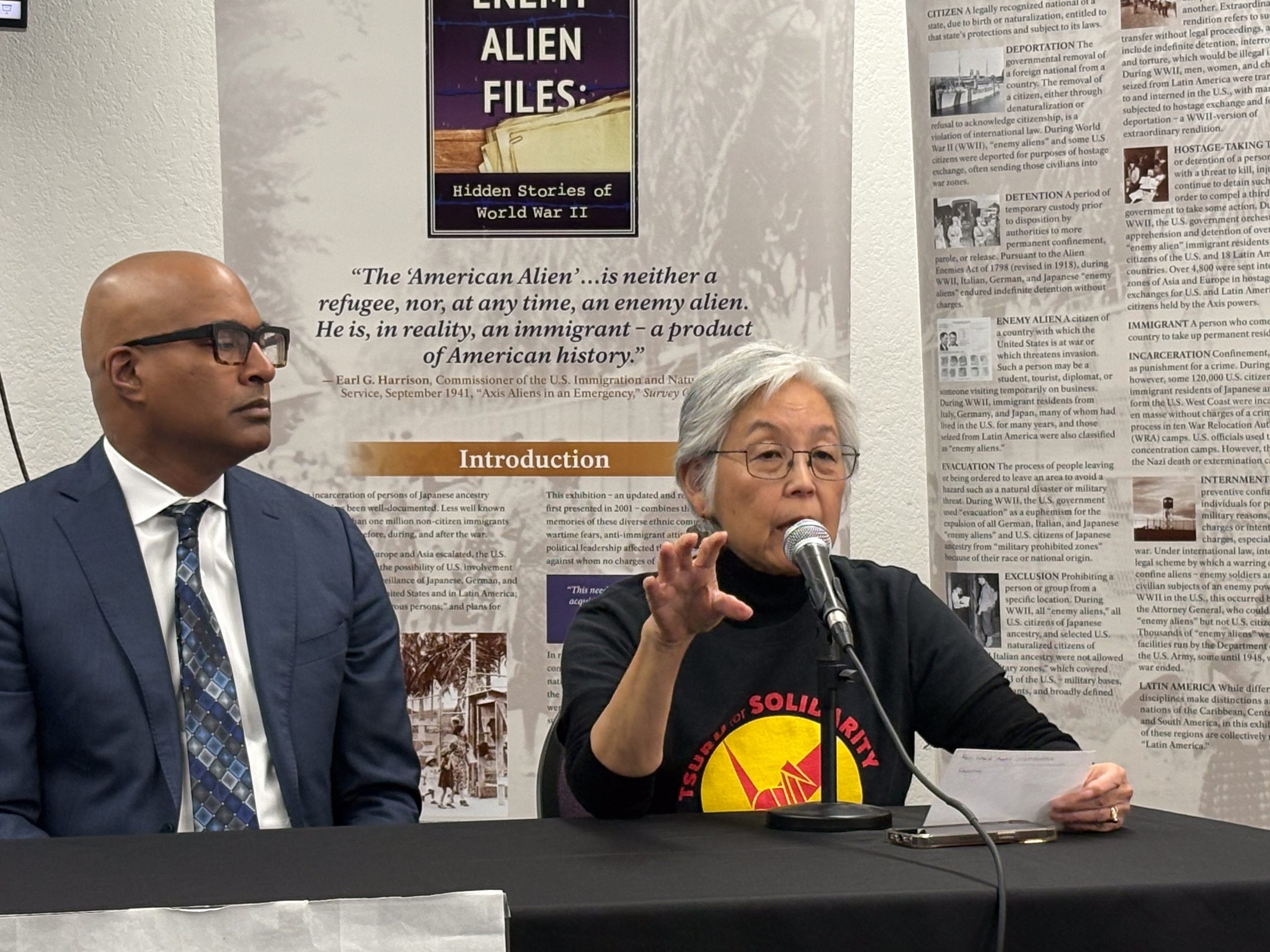

Days after President Trump used the the wartime Alien Enemies Act to deport some 200 Venezuelans to prisons in El Salvador in defiance of a federal court order, Japanese-Americans and allies rallied in support of the deportees at the Japanese Cultural and Community Center, reminding attendees of the law’s history.
The act “led to the removal of Japanese immigrants who had been living here for decades,” said Satsuka Ina, who was born at the Tule Lake Segregation Center, an internment camp in Northern California, and remembers growing up around barbed wire and guard towers. That history, she and others said, was repeating itself.
In 1942, 125,000 people of Japanese ancestry were removed from their homes and incarcerated after President Franklin D. Roosevelt invoked the act due to the bombing of Pearl Harbor.
Carl Takei, a criminal justice reform program manager at the legal aid and civil rights organization Asian Law Caucus, spoke of how his great grandfather heard a knock on his door from FBI agents shortly after Pearl Harbor. He was declared an alien enemy, and taken away.
“This is an effort to silence dissent and disappear our community members without any semblance of due process, without any hearings,and to pack them up and take them away to these faraway prisons,” Takei said, standing alongside seven speakers.
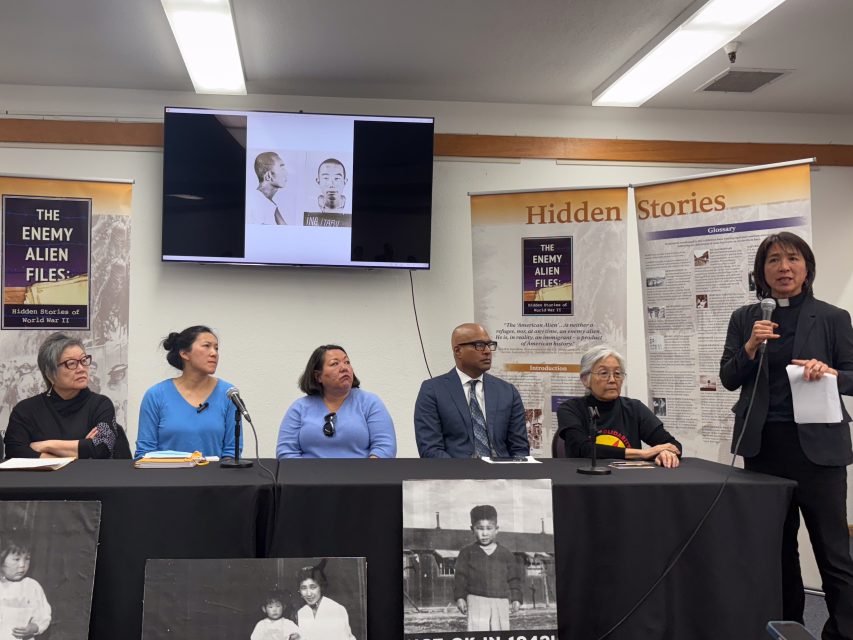
Ina, who experienced the internment firsthand, said the act caused the “removal of not just Japanese immigrants, but what the government called non-aliens, which are American citizens.”
On March 15, the Trump administration justified its invocation of the act by declaring the “invasion of the United States by Tren de Aragua,” a prison-born Venezuelan gang. The administration has claimed that the deportees were gang members, but lawyers for those deported have said that their clients were singled out for their tattoos, and have gathered testimony from deportees denying gang affiliation.
U.S. District Court Judge James E. Boasberg ruled on March 15 that the Trump administration cannot use the wartime Alien Enemies Act, a 1798 law, to deport people without a hearing and, in increasingly frustrated missives, has asked administration attorneys why they did not comply with his orders to turn around the deportation flights.
Scholars of authoritarianism have warned that Trump’s dismissal of judicial rulings is driving the United States towards a crisis far faster than other 21st century autocracies. Until Feb. 1, many Venezuelans automatically qualified for “temporary protected status” because the political and environmental conditions in Venezuela are considered so dangerous.
“Everyone deserves their day in court. Everyone,” San Francisco Public Defender Mano Raju said at Thursday’s press conference.
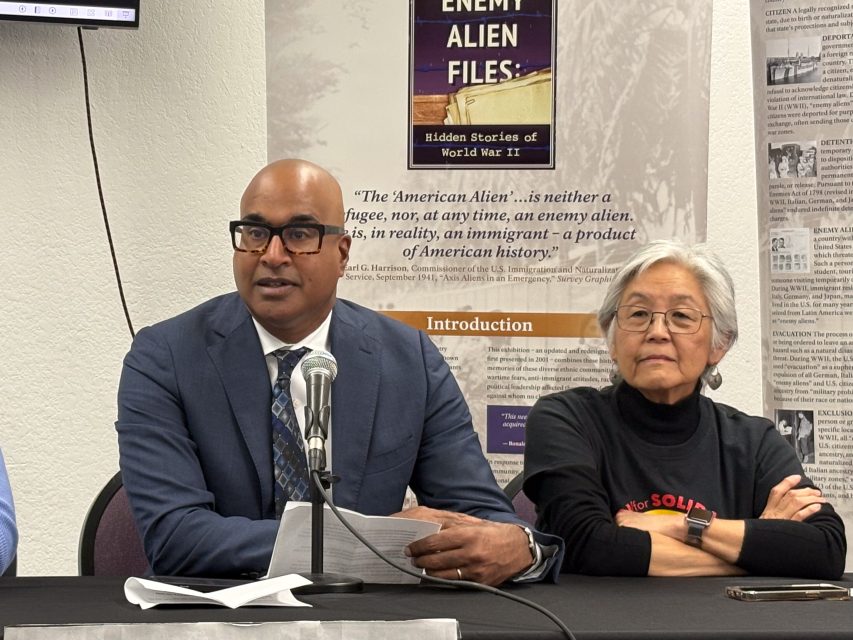
Raju said some of the deportees have “pending civil court dates in order to obtain their immigration status. Deportees who are currently in the El Salvadoran prisons, he added, did not have the chance to present evidence. “When those fundamental due-process rights are violated for the most vulnerable, it’s not long between those before those rights are eroded for everyone else,” Raju said.
Raju also called for a “massive, nationwide, aggressive, peaceful and nonviolent resistance” against the invocation of the Alien Enemies Act. “Today, as witnesses to these gross human-rights violations, we will not be complicit,” Raju added. “We will not relent until those rights are restored.”
Similar actions have led to widespread resistance in the past. In 2017, when the Trump administration banned citizens of mostly Muslim countries from entering the United States for the next three months, and officials detained several legal permanent U.S. residents and green card holders who were traveling when the ban was announced, protests broke out at airports across the country, and several detainees were released.
Annie Lee, who works at the advocacy groups Chinese for Affirmative Action and Stop AAPI Hate, said it is “simply unjust to take people from their homes and boot them out of the country.”
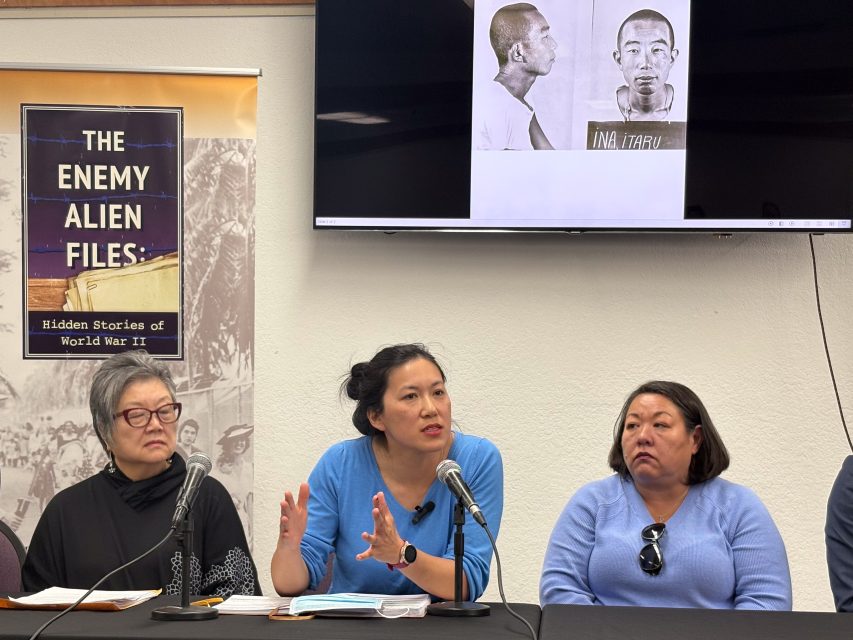
“Like Martin Luther King, Jr., said, ‘Injustice anywhere is a threat to justice everywhere,’” Lee added. “Today, they are coming after Venezuelans. Tomorrow, they will come after other people.”
“This is not a Japantown problem or a Japanese problem,” said Dean Ito-Taylor, the executive director of the Asian Pacific Islander Legal Outreach. “This is an American problem.”
“This is an effort to silence dissent and disappear our our community members”.
Or anyone who’s not toeing the MAGA line. If you think this isn’t just the beginning, that this couldn’t possibly happen to you, think again.
Palestine.
The internment of Japanese was one of the lowest moments in American history. President Reagan apologized, and we paid every interned person $10k.
I do think that we need to recognize that deporting foreign citizens and or interning foreign aliens in war, is a different matter.
We interned Germans in ww1. Not Americans of German ancestry, but German nationals. In ww2 we interned German, Italian, and Japanese nationals. Some were repatriated in exchanges during the war. A piece on this process is here: http://www.usmm.org/exchange.html
The Venezuelans are not American citizens. If Muduro declared war on the us, expelling Venezuelans might be appropriate,
The issue is not expelling people, it’s that in a non-war situation you can’t do this. Everyone deserves due process. There is no rush. No emergency. In a war you can says “well you are a citizen of a country we are at war with, get out” but you can’t do this without the urgency of a war, you need some proof the person is hostile to the USA.
This is where trump has completely violated the law. I wish people would focus on the fake basis to deport these people, rather than as the left often does, pretend that millions of people can cross the boarder as economic refugees and just stay here.
That thinking was what got trump elected.
The US also abducted Japanese nationals from other countries, such as Peru, “interred” more than 2,000 of them in a camp in Texas to be deported, used to trade with the Japanese for US POWs. How is that covered by the “urgency” of war?
I think the original people should come and knock on doors to tell the cowboys or city slickers to get the hell out of their land, take their properties away like they did to them and send them packing; how about that? or at least move to Florida.Oh I see, not a good idea, little Timmy does not like to be told the same thing he impose on other people.it is too inconvenient. Poor Timmy.
Do they have weaponized drones and robots? Otherwise that would be just as effective as bow and arrows against Winchesters.