

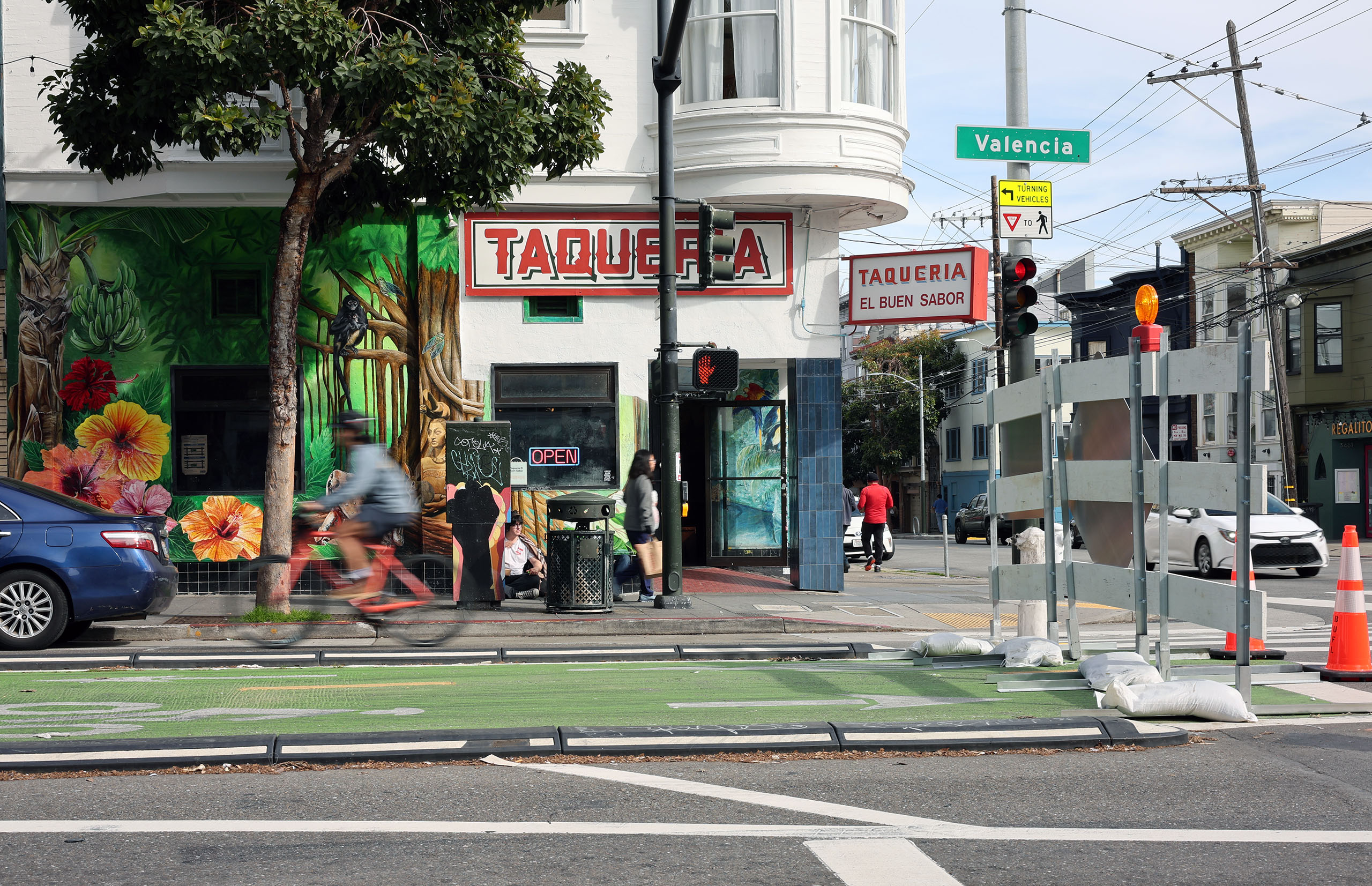

The San Francisco Municipal Transportation Agency’s board of directors unanimously adopted the city’s “Biking and Rolling Plan” on Tuesday, kickstarting a 20-year effort to connect hundreds of bike lanes across the city.
The goal is to make bike lanes accessible to every San Franciscan within a quarter mile of where they live. The project would change 385 streets across the city, from busy thoroughfares like Market and Valencia streets to sleepy streets like Steiner Street, a go-to route along The Wiggle.
The roadways, representing about a tenth of San Francisco streets, would see their existing biking infrastructure updated by barriers, speed bumps, clear crosswalk markings, and other changes.
In some cases, the city would build new bike lanes and, in others, add barriers to existing lanes, install speed bumps, and redesign intersections to connect bike lanes across the city and create a more seamless transition for cyclists. Construction would take 20 years in all, finishing in 2045.
But, in a welcome surprise for San Francisco’s often-put-upon transit planners, the majority of those speaking at Tuesday’s hearing embraced the plan. Some even called for it to be built far sooner.
“Twenty years is too late,” said Tom Radulovich, representing the nonprofit Livable City. “Make it a five-year plan, like the bike plan implemented in Spain,” referring to a project that created nearly 50 miles of bike lanes in Seville between 2006 and 2010.
The City Hall hearing room was packed with supporters, though a handful of opponents came up to the mic during the three-hour public-comment section. SFMTA planner Christy Osorio said that nearly 80 percent of more than 1,000 San Franciscans surveyed in the summer of 2023 expressed interest in biking or rolling, provided they would be safe doing so.
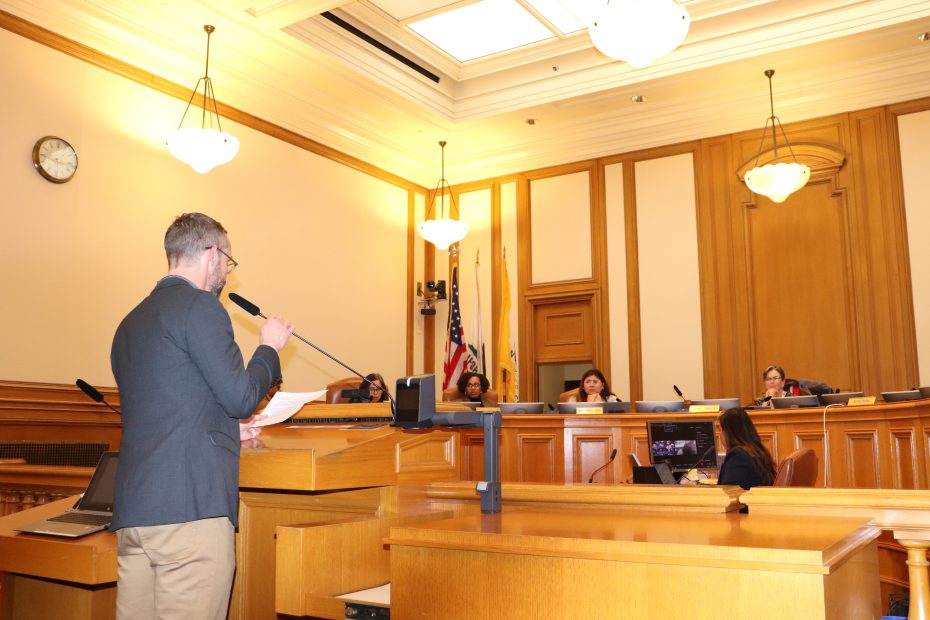
The city’s current biking infrastructure is “inadequate,” said Stephanie Cajina, an SFMTA board member. Though San Francisco is considered one of the safest cities in the United States for bicyclists, SFMTA reported that only eight percent of city streets include a bikeway for “all ages and abilities.”
One member of the San Francisco Bicycle Coalition, speaking during public comment, said she has been hit twice on designated “shared streets” by oncoming motorists making a left turn and suffered cracked ribs, cuts and significant bruising.
Multiple supporters of the plan recounted similar stories. One commenter said she was hit so hard that she was pushed onto the hood of a car. “Motor vehicles pose a significant threat to San Franciscans,” said Kyle, a commenter from District 9. “It’s time we prioritize the safety of people over parking spaces.”
The handful who spoke against the project largely said that bikes were bad for business, and that more of them would restrict customer access to storefronts, impact traffic flow, close streets, hinder pedestrians, and increase SFMTA’s budget deficit.
One commenter from District 2 argued that delivery drivers can’t park if there’s a bike lane on the corridor. “Businesses survive only if customers can reach them,” she said.
SFMTA has held community meetings in a bid to win over residents to the plan since last summer. In North Beach last July, attendees of one such meeting largely opposed the plan, echoing the comments from opponents today. “Respect should be done to businesses first,” said Marc Bruno, the vice president of the District 3 Democratic Club, at the time. Many compared the rollout to the controversial Valencia Street center bike lane, which is now undergoing a transition to more traditional side-running lanes after an unsuccessful year-long pilot.
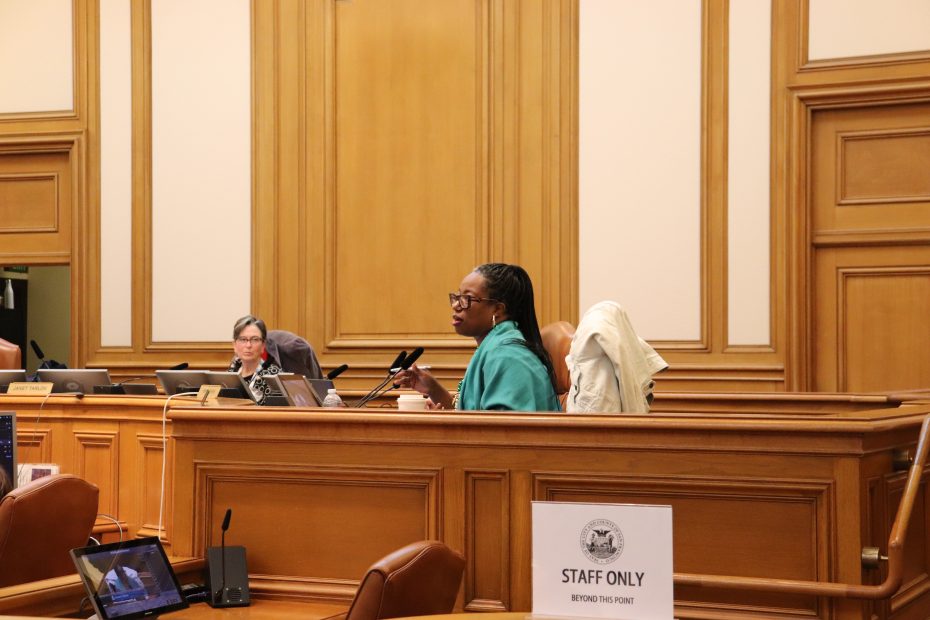
Osorio, for her part, said that no bike lanes in the plan would be installed on merchant corridors, and that less than 10 percent of the city’s streets would be impacted by the project. No streets will be closed, she added.
SFMTA staff also said the biking and rolling plan would not increase Muni’s admittedly terrifying budget deficit. The SFMTA has predicted a $240 to $320 million deficit for 2026 and is considering cuts to bus and tram lines this summer to help fill an immediate $50 million shortfall.
Instead, the biking and rolling plan would be funded by voter approved measures: Props. B (2014 ), D (2019), and L (2022) and Caltrans Sustainable Communities Grants.
The SFMTA board did ask for further clarity on the plan’s costs and which streets would receive which upgrades. Right now, the agency does not have a price tag for project costs over the next 20 years, because the plan does not yet “identify projects for implementation, and therefore does not have a cost estimate.”
The board, echoing commenters, also urged SFMTA to consider fast-tracking the plan to construct the network long before 2045. Some attendees even suggested that the project could be built out within five years.
They also directed SFMTA staff to return with amendments to the current plan. Namely, they wanted more details on how the plan would connect bike routes with school zones and create safe crosstown routes in neighborhoods that have historically been underserved, like the Mission, Excelsior, Bayview Hunters Point, SoMa, the Tenderloin, and the Western Addition.
“Though I have questions, I can see a clear path forward for us to get there,” said SFMTA board director Dominica Henderson. “I just hope to see it before 20 years from now.”
Hopefully the planning has been performed with a proper engineer rather than what we got on Valencia St where fire trucks and delivery trucks couldn’t make turns on Valencia without crushing bollards and driving over the ridiculous curbing.
March 4 was a day of protests. At least 1 outside City Hall was called and I drove across town to record on at Ocean Beach. on my way I passed only 2 people on bikes around 3:30 PM. Coming back a little later, I saw very few out side the Mission. When I turned right on Harrison off 14th Street there were a few. SF is not ever going to be the bike riding capital that some claim it “is”. Very few people are biking these days. Most are in cars of on the bus. The City Hall administration is out of touch with reality when they spend more money on bike infrastructure and remove bus stops and routes!
Gee Sebra, why don’t you go ahead and write up that gem of a white paper. Call it “I don’t see things. Therefore, they don’t exist.”
You’ve probably never been anywhere else in the US much else the world but try taking a tour with Google Maps (or maybe Google Earth since you’re a Boomer and probably still have that on your desktop computer) and look at places in the US with no sidewalks. Do you see lots of people walking around? No? Gosh, why would that be?
He’s right though, the % of bikers is not going to suddenly jump up because you advertise that. There’s no way to placate an implacable lobby on either side. Bicyclists (the severe ones) will never be happy until they get special roads just for bicycles, and that’s not happening – and if it did, they’d still complain about all the other roads. They live to complain and waste money, it’s not reducing the number of accidents or improving a nebulous idea of safety. The opposite, if you follow the stats. So now we have a Billion dollar deficit and we’re spending Millions on green and red paint to just slather our streets (and sewers, environment) with in the hope that it miraculously results in what we advertised. But it doesn’t – so they demand even more. It never ends until you say NO MORE, because there is no more!
Not with that attitude it won’t.
RECALL ENGARDIO AND THE REST OF THE LIARS.
I saw the trucks on Valencia. They’ve made it all the way to 19th St. They tearing up those dividers that divide the traffic lane to the bike lane. How many man hours did they need to do that? So this crew they look like painters, couldn’t be repainting, double yellow lines, stop, sign, limit lines, refresh red, curbs? What are you guys doing with the money? This is no time to play games!
Shouldn’t an ambitious funding plan to keep public transit moving take precedence over cycling at this time?
San Francisco has upzoned most of the city for “transit oriented development” and is poised to cut transit service significantly. Someone should sue to invalidate the upzonings by challenging the EIR that green lit the plans based on transit that will no longer run.
That’s an interesting point. Perhaps the only way San Francisco can be saved from The Wiener’s vision of massive demolitions and dislocation so we can look like “Paris” is the impending implosion of Muni service.
Exactly. The parasites have killed the host city.
You would think so, but even under Lurie SFMTA continues its aspirational focus to the detriment of practicality and servicing the vast majority of San Francisco residents. This is incredibly disappointing.
Gosh, you sound just so confident that your preferences = “servicing the vast majority of S[…]F[…] residents. This is, of course, provably false given 1/3 of city residents, including children, do not drive.
I’m also addressing Marcos/Marc Solomon since he’s such a snowflake that he blocked me: Marc, you have so much time on your hands, gimme a freaking break dude, you know as well as anyone the Biking & Rolling plan is funded by propositions. Nobody is robbing Peter to pay Paul here. Anyone with a brain in SF knows Muni shouldn’t get service cuts. But here you are criticizing planners who just want housing to become more affordable and for people to get around safely without a car, because you enjoy being that tedious contrarian windbag who wants SF frozen in amber and for it to fall into the extreme economic malaise it was suffering back in the 1990s when you moved here and bought your condo. It never ceases to amaze what unbelievable hypocrisy you exhibit as a dotcom-boom gentrifier.
When VisionZero is actually ZERO, then we can decide how else to spend all that budget surplus we have.
We failed at VisionZero so we passed a “Daylighting” law. Then we tired of that before we even decided to enforce it.
Now we want more bike lines??
We really know how to come up with great ideas, but then we just give up as soon as we pass the measures, laws, propositions.
No wonder everyone looks at SF governance as a joke.
Vision Zero was always a bottomless pit of BS. Breed bought it.
Nice to be an adult child who lives with roommates, rides a bike to work and it’s all free, bike riders don’t even pay a tax for it.
Clueless pandering to the yuppie 5% is not a plan.
Judging by the comments here 100% think that this plan panders to the laptop and leisure class while ignoring the needs of everyone else, and so do I. This is about a well connected and wealthy minority giving the impression of a majority but it’s not.
The VAST majority of San Franciscans use their cars or Muni to go to work, school, and shop. Making daily life for the majority of citizens even harder and more oppressive for a tiny minority of entitled children to ride their bikes around the city is inexcusable. It just adds to the hardship of living in the City, and pushes families, older people, and the disabled out, so that a handful of bikers can have fun. Nice job SFMTA.
There are too many bike lanes, already, IMO. IF the City wants to expand them, let’s put it on the next election. The City has problems maintaining the street infrastructure. Painting of lanes, bots dots, potholes, street lighting are all neglected. In the rain, drivers cannot see lane markings between the puddles and bright headlights. You can sometimes see the green painted all over the right side- but you don’t drive there.