
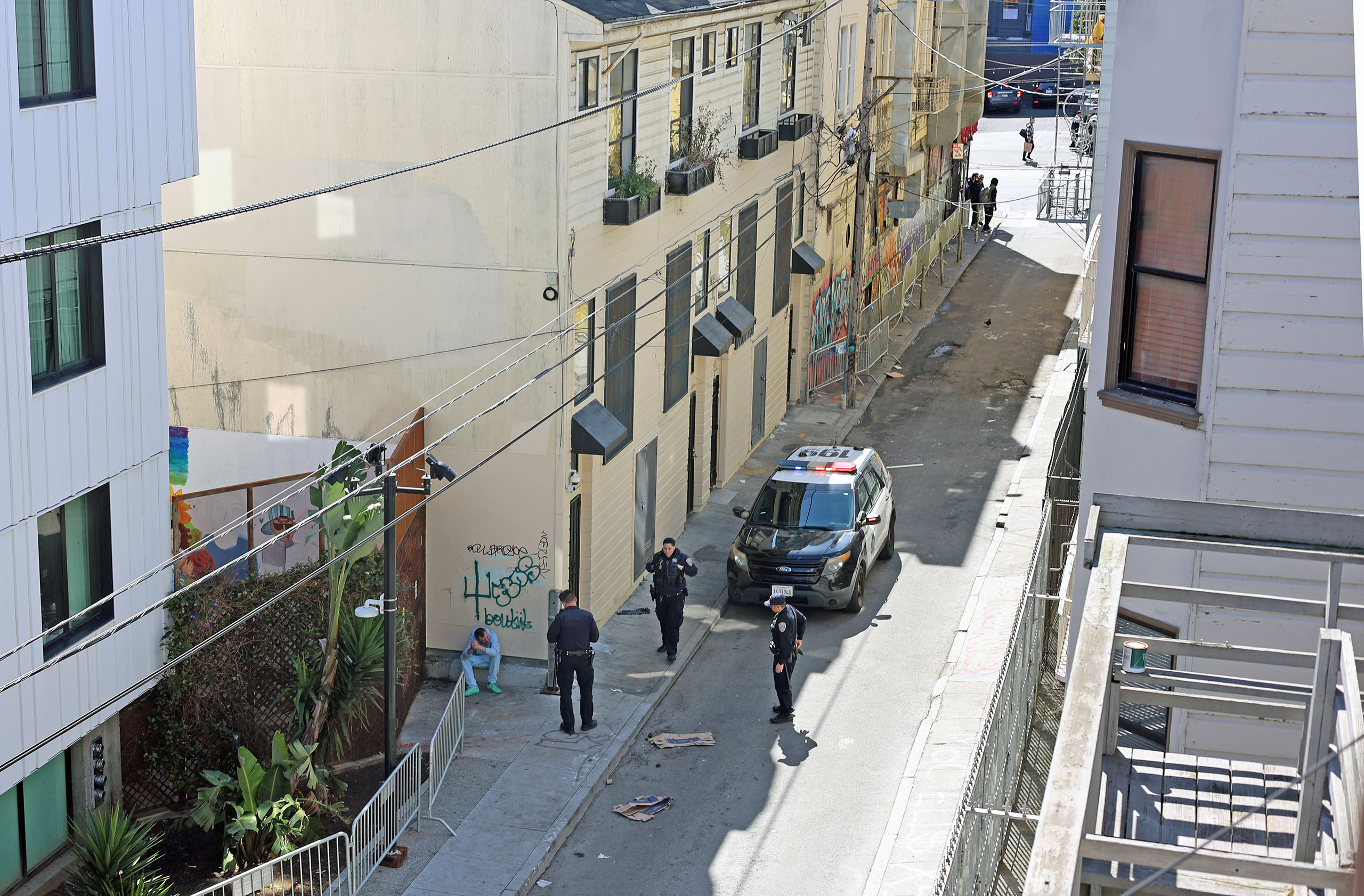

Wiese Street was never perfect.
Twenty years ago, when one resident of an apartment overlooking the alley near 16th and Mission streets moved in, sex workers would hang out on the corner, addicts would smoke in alcoves, and unhoused people would spend the night.
He brushed it off as “street culture,” and taught his daughter to be respectful of their “neighbors without roofs over their heads.”
In return, he said, street dwellers were discreet: “You wouldn’t even hear them … They had a fear of the police. They had a fear of waking the neighbors.”
His daughter grew up running up and down Valencia Street, listening to mariachi at Pancho Villa Taqueria, and playing in Kid Power Park.
But this tacit agreement has lapsed in the last year. “Now, there’s adults hanging out there shooting up drugs.”
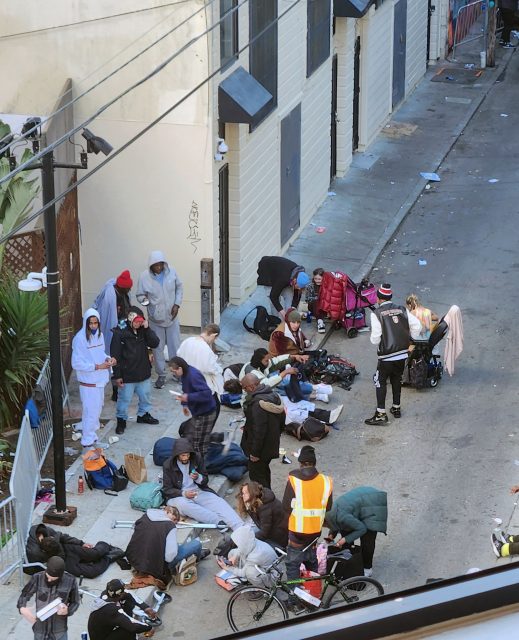
He’s stopped recognizing familiar faces among those who hung out outside his building. The usual crowd, he said, was replaced by legions of strangers unfazed by the cops. Garden plots along the alley became public toilets. A homeless man told him he’s now afraid of the dealers.
These days, the family is cautious about even being seen from their bedroom windows, much less descending their stairs onto Wiese.
“I have to get her out of here,” the father said. “You don’t realize what it does to people to walk out and see human degradation every day. To see people with open sores. People slumped over in a wheelchair with a dog licking their wounds on their foot.”
Inching a way through the throng of dazed people blocking your doorways, knowing the poop on the sidewalk is definitely human, pleading with users to be mindful of smoking in front of children: Such is the life of the residents of Wiese, Caledonia, and Hoff Streets and Julian Avenue, a handful of alleyways near the 16th Street BART plaza.
The blocks between Mission and Valencia Streets have always been a little “crazy, noisy, and busy,” longtime residents acknowledge, with “ebbs and flows” of activity over the decades.
But in recent months, they say, it’s gotten worse.
“It’s hell every single hour of every single day.”
“A zombie graveyard.”
“A drug carnival.”
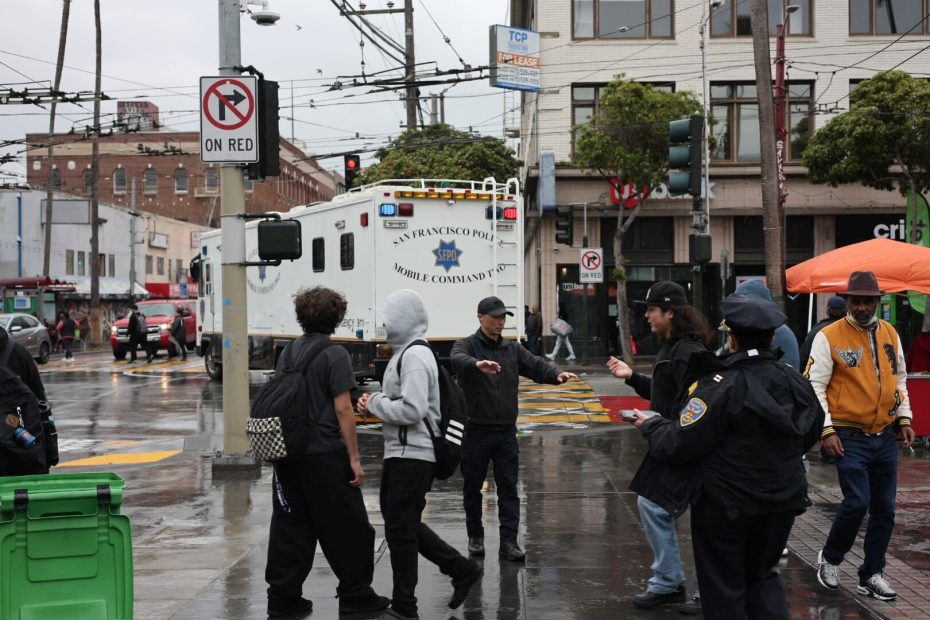
Earlier this month, the plaza became the home of the San Francisco Police Department’s “Mobile Command Unit No. 2,” part of what Mayor Daniel Lurie has described as a citywide effort to stamp out San Francisco’s open-air drug markets.
Mission Local spoke to more than a dozen tenants and merchants who agreed that the 16th Street BART plaza has been visibly cleaner since the introduction of the bus-sized mobile command unit.
Many, however, suggested that improvement came at the expense of the surrounding streets, which have absorbed the drug dealing and loitering displaced from the plaza. In an area where conditions can be dramatically different from street to street, one said, police setting up even three blocks away is too far.
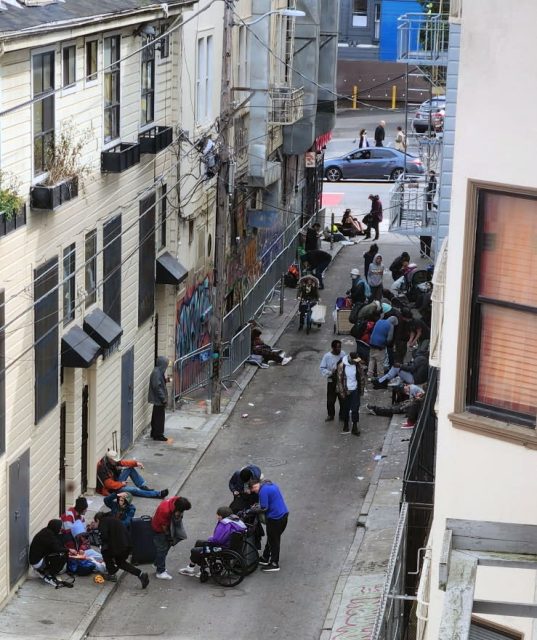
Dealers in plain sight
The leading theory among residents is that the problem was pushed into the Mission by the city’s crackdown on drug use in the Civic Center, South of Market, and Tenderloin neighborhoods.
Seven residents of Julian Avenue said they have witnessed drug deals occurring in broad daylight. They all pointed to the same locations along the street as hotbeds for dealing.
While they asked for anonymity because of fear of retaliation, they said they have shared photos and videos with the police, examples of which Mission Local reviewed. (Mission Station Captain Liza Johansen, in a meeting held Wednesday with Mayor Lurie, urged neighbors to keep sending them in and calling the station’s non-emergency line as a means of data collection.)
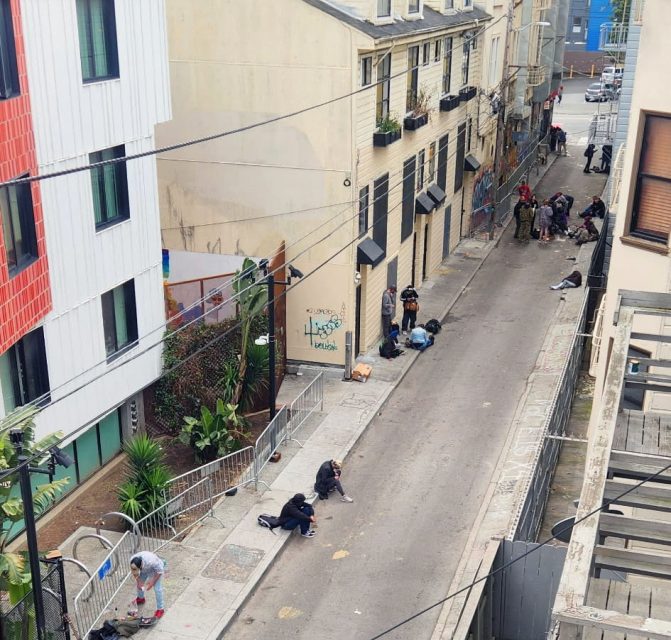
The neighbors are a mix of people. Some speak English with heavy accents. Some have young kids. Some have lived here for decades. Others arrived in the last six years.
They all repeated the same descriptions of life on the street: Insane. Intimidating. Nerve-wracking. Scary.
One man said he starts to shake when he sees people on the sidewalk wearing face coverings.
A woman said she asks her building manager to walk her to her car at night.
A second man described sweeping away the rotten skin picked from a scab on another man’s leg. At a community meeting, a third described how street debris had attracted rats that “look like rabbits, they’re so fat.”
A Julian Avenue landlord said only one of the 15 people who expressed interest in his vacant unit showed up for a tour. He was told the prospective tenant’s girlfriend would “never feel safe” visiting; he had to reduce his rent.
The conditions, parents on the street said, leave their children afraid to leave the house. Mission Local spoke to five families on Julian Avenue. Even more kids, they said, live at 1950 Mission St., a 157-unit affordable-housing complex on the east side of Wiese Street.
Veering around someone shooting up in the middle of the family’s morning walk to school isn’t always possible, said Jun, who has had a kid on Julian Avenue since the ’90s.
Waking up in the middle of the night to loud music, shouting, or the blare of a police vehicle is common. So is having to call the police.
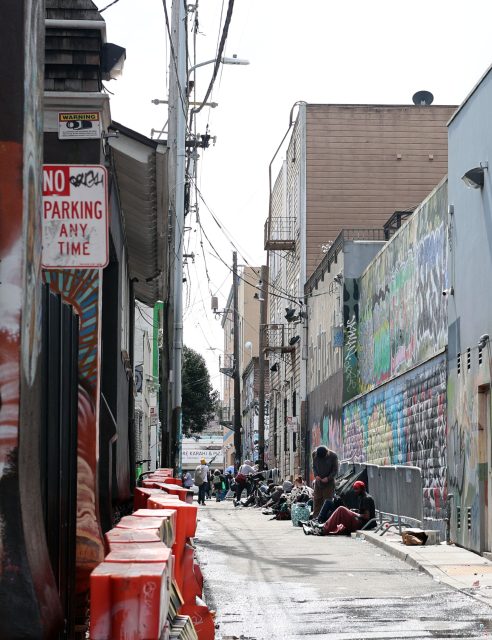
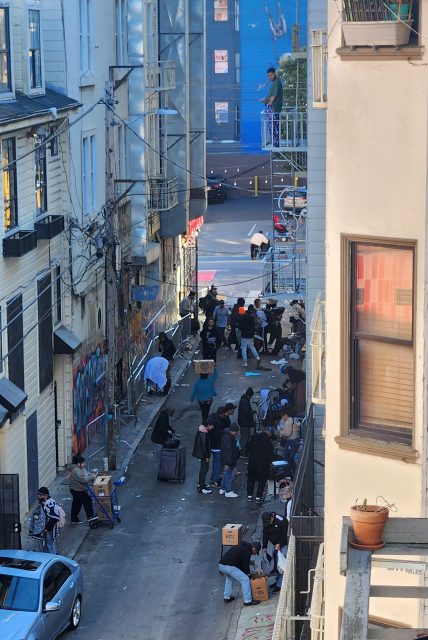
‘Cat-and-mouse chase’
Officers have started making more frequent sweeps of the alleys in recent weeks, housed residents reported.
This, they said, involves driving slowly down the block, requesting over a PA system that loiterers “move along” and, on occasion, stepping out of the vehicle and making an arrest. (At Wednesday’s community meeting, Captain Johansen noted that officers cannot issue a citation without witnessing a crime.)
Still, the drug activity and loitering is “relentless.” Neighbors described seeing Wiese Street eerily empty one moment, after a sweep, then teaming with almost 50 people the next.
It’s sometimes only a matter of minutes before more people, many of whom are actively using drugs, housed residents said, return to the alley “like the ocean coming up on the sand.”
On a recent afternoon, as police swept one block, a group shuffled around the corner to the next street over.
The officer drove up Wiese Street, then down Julian Avenue, where he waited until a group of people had scattered. Meanwhile, dozens of people lined the sides of Caledonia Street a block away. Some sat on cardboard; others were unconscious on the cement.
Just a couple of men remained on Wiese, slumped over on a decaying mattress. One, who was awake, said he was unsure where he’d go: “All I do is move.” The police, he said, drove by every 30 minutes.
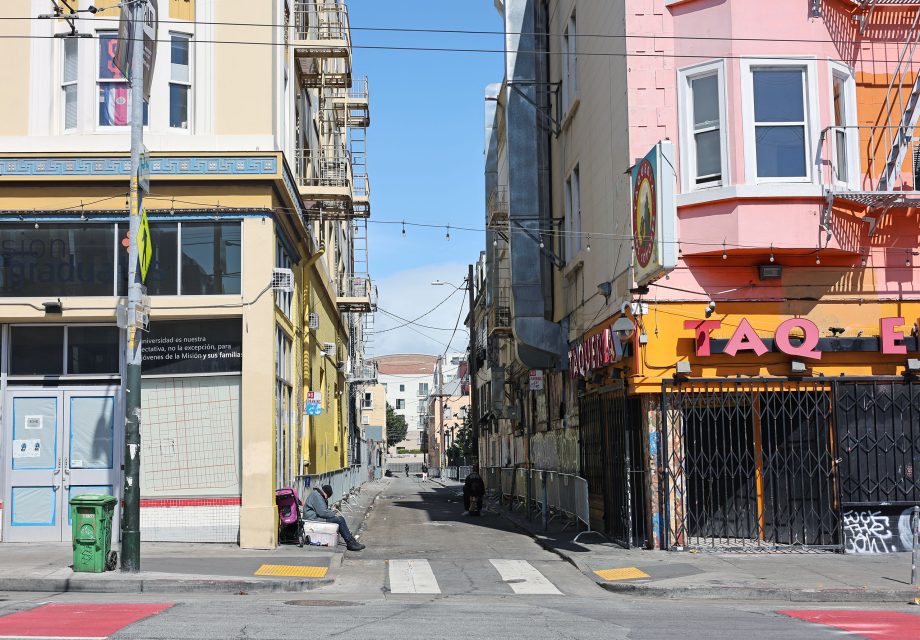
Meanwhile, Aleya and Santiago shared biscuits at a fried chicken and pizza place next to the BART plaza, where they had settled after being “harassed” by police. Having to “bounce around” side streets, they said, is nothing new.
Authorities “should focus on people killing each other and gang-related violence,” as well as providing safe-use sites, said Aleya, who was open about being homeless and using drugs.
It’s the same-old “cat-and-mouse chase around the block,” one neighbor sighed. The police come, added another, “but the game is just continuing.”
“Blocks’ worth of trash” and feces follow the hyper-local migration, added Mari, a Hoff Street resident who said she’s had to call the police almost every day for the last two months.
Moving isn’t a solution everyone can afford. “We’re stuck,” said Jun, who has lived in his rent-controlled unit on Julian for decades.
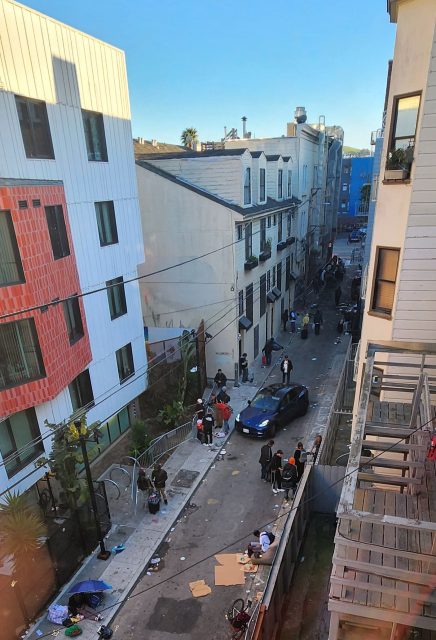
‘Compassion fatigue’
But even those who could leave wouldn’t. They say they love their neighborhood for its vibrance, diversity, and community, which, some said, has been trauma-bonded by feelings of neglect. They’re just sick of seeing the blight.
This frustration has manifested in different ways.
One tenant said she primarily felt sadness for the “desperate people” spilling out onto the street below her apartment. “How do you stop the pain?” she asked. “How do you expect a cop to fix a public-health problem?”
She asked a drug user what would help. He responded: “I guess what I need is to want to get clean.”
Her neighbor, on the other hand, said the uninhibited drug use had “radicalized him;” he now wants to see users prosecuted, and SFPD raids like the one that led to 23 arrests earlier this month happening every day.
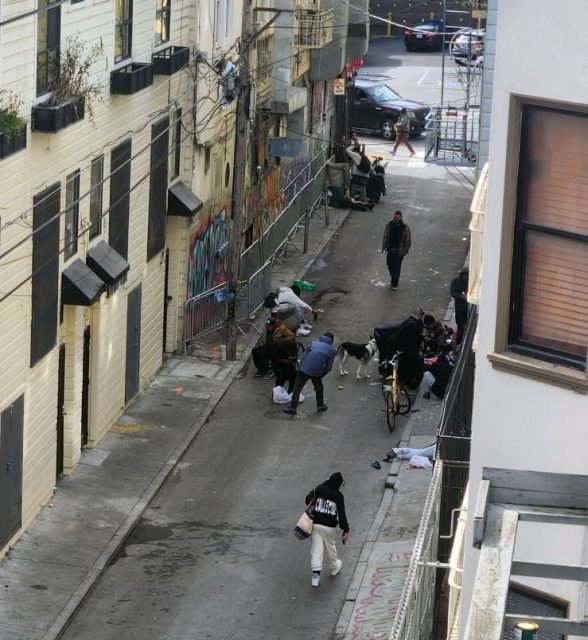
Some housed people in the neighborhood blame local social-service providers for offering food and shelter that attract displaced people.
In the past three weeks, the Gubbio Project, a nonprofit that offers food, cots, and counseling during the day from St. John’s Church on Julian Avenue, has served three times more people than usual, executive director Lydia Bransten said.
Bransten could empathize with housed residents’ fears of being “under siege.” She noted that the Mission has long been home to a mix of SROs, residential apartments, BART traffic, and social services. Providers, she continued, are tasked with supporting people experiencing poverty, homelessness, and addiction through a “continuum of recovery that takes time.”
“It is a huge crisis for these people,” Bransten said. “And at the same time, the people who are housed are exhausted from having to experience the vicarious trauma of seeing people in this condition when they feel like there’s nothing that we can do to help them.”
Several others said the same: They are tired of feeling ignored by the city.
“We have no say,” said a longtime Julian Avenue resident as he watched a man stumble down Wiese. “We have no voice.”
Jennifer Friedenbach got what she wanted – San Francisco no longer enforces laws against illegal drug use. Users have no fear and feel empowered to take over public spaces to do drugs. This is the inevitable result.
Children without parents or legal guardians are forced into foster care because they lack capacity to live on their own. I think a similar case can be made for someone passed out in an alley from drug addiction.
Thank you for this article . Wish you would cover our destroyed and devasted neighborhood as well.
Everyones behavior affects others
This same horrific scene is going on in on Lower Polk Street for seven plus years .
Cedar at Polk
Geary at Polk
Alice B Toklas at Polk
Myrtle at Polk
Olive at Polk
Ellis at Polk
Willow at Polk
Drug dealers distribute lethal poisons like candy ,
They kick addicts to wake them up to buy more drugs
The addicts keep coming and will not leave until the drug supply is stopped .
20 percent of all drug deaths happen just on these above listed streets/area .
Unsafe and unfair .
District 5
Please visit and help. Come and see for yourself .
The only business here is drug dealing.
The only people who come here are the addicts .
Why does this city allow and tolerate this ?
It is wrong to support and allow this illegal harmful activity to go one . FOR SEVEN years.
Both Law enforcement and services are needed.
No one helps here.
No Ambassadors ever .
Never dph , or even one nonprofit funded by taxpayers ever come.
Hell on peoples doorstep everyday , every block for years .
Enough . We have done our goodwill here ,
Close it down
Clean it up.
Thanks
That’s not true. I was recently out in the area with a taxpayer funded nonprofit doing harm reduction.
I disagree. You were there recently, that’s fine. But I’m in the lower polk area almost daily, at various times of day, and what the poster describes is absolutely accurate. Groups of addicts and dealers pop up in the alleyways, bringing noise, filth, and often violence with them. Twice I’ve helped revive someone while on the phone with 911. On more than one occasion I’ve seen the coroner’s van. So-called harm reduction supports a drug culture that is toxic to the very social fabric of the city. I really wish the harm reduction advocates would wake up and take a wider view of what is going on. You can’t just advocate for the addicts at the expense of everyone else. People won’t stand for it, especially after so much money has been squandered on this problem over the years. Lurie sees to get it. I wish the drug advocates would too.
I was born and raised on 17th and capp i lived there 1952 until 1974 it was never this bad
Lydia Bransten calls it “vicarious trauma”. I don’t think that it is vicarious when you live frightened of violent drug dealers that are operating brazenly on the street where you live. When you have to step over or clean up human feces on your sidewalk or entryway. When you have to dodge needles.
I think that is direct trauma. I don’t know where Bransten lives. It would be interesting to know if she lives in an area as directly impacted as the residents near 16th st.
When the neighborhood votes consistently for folks that do not want to enforce laws, this ends up being the result. Why did these zombies choose to come to the mission vs Hayes valley, lower pac heights, Duboce Triangle, or the Castro? Is it because the Mission has alleyways? It’s because Mission Residents compared to other neighborhoods do not call out lawlessness when they see it. Think about it, the Mission has more people than most and more crime than most districts, yet they call the police less than the average neighborhood. https://www.sfchronicle.com/crime/article/police-staff-districts-sf-19871314.php
It’s because the mission is made up of many immigrants and working class. They are too busy working multiple jobs, surviving, and probably don’t have spare time to call out lawlessness. That is a luxury of wealthy, with more time on their hands. Putting this madness here, is just madness
So the wealthy have the time to make their society law abiding? And the poor (working class?) can’t take the time to make their society law abiding? Is that really what we teach our kids…..? Is that the reality of where we live?
Basically yes. The wealthy advocate for themselves. The poor have their voice usurped by professional community advocates like Calle 24 or MEDA. Whether those advocates actually represent their preferences is a different story. I’m reminded of prog supervisor Cheyenne Chen noticing that it was Trump voting Chinese people who won her the district.
Sir, If you are correct it’s the best argument I’ve ever heard against 100% affordable housing.
I live right there and I’m sick and tired of the behavior of the drug users and drunks! I don’t go for booze and dope! There’s a school and a rehab place right there. Those
street people need to go.
6 cops cars, 3 on each side of an alley, march down the street and round up all those people and send them packing. Make their life miserable, not the people living there. You have to do this every day and pack the jails; and judges who lives in the nice part of town and think it is ok to have that lifestyle where they don’t live and let them go out of jails, recall them. No more drug paraphernalia distributions neither. Send them back packing, 99% are not from here, i bet most of them come from republican states. No more Mister nice guy.
Send them where? There needs to be more of a plan (and much more humanity) than, “Round up the people I don’t like and put them somewhere else.”
Why does there need to be more of a plan? Any plan is better than the current plan.
It’s interesting that someone is finally mentioning the Gubbio Project – but what they don’t realize is that this project attracts drug users to the area, which then brings their dealers as well, along with the associated filth, crime and violence. It’s unfortunate, because the Inner Mission is also home to immigrant families and working-class folks (like myself) and is one of the last affordable areas of this city. Our small businesses are hanging on by a thread, and it’s so sad to watch innocent people suffer because wealthy people like Ms. Bransten, who doesn’t even live in SF, let alone the Inner Mission, thinks it is compassionate to aid and abet drug use regardless of the negative consequences on the neighborhood. There is a recovery center, serving Native Americans and underprivileged people of color, on the same block, and an elementary school on the next block, where young immigrant children have to dodge fentanyl dealers and users on their way to and from school. If Bransten wants to help people, she needs to be required to keep them inside the walls of her misguided project, so that the rest of the neighborhood won’t be impacted. Or she could ask them all to join her where she lives in the East Bay!
Boom!
> If Bransten wants to help people, she needs to be required to keep them inside the walls of her misguided project, so that the rest of the neighborhood won’t be impacted.
As I understand it, this isn’t legal. It was, briefly, but Newsom pushed to make it illegal at the state level.
Post signs of no loitering at all the alleys, 3 block radius, & routinely round them ALL up, (unless they live on that alley or are delivering something), no exceptions.
Identify those who can be helped and those who cannot.
I hear only 20% really want help.
You get 2 chances to get clean, if not you get prosecuted, & jailed.
Anyone w drugs on them gets jail & fine.
For gods sake, people live here and it’s gotten ridiculous.
– If not for rent control many tenants would have moved already.
– If not for these conditions property owners could sell already.
Everyone is stuck with current conditions.
THANK YOU Mayor is doing something, and ML for taking it seriously. FINALLY!
Next: No tolerance for street vending. Everyone gets cited, no exceptions. Change the laws if you need to.
Oh, while at it, how about phasing out that stilted, euphemistic language exemplified by Ms. Branston? Let’s see.
‘Providers, she continued, are tasked with supporting people experiencing poverty, homelessness, and addiction through a “continuum of recovery that takes time.” ‘
Be like:
‘Providers, she continued, are part of the problem, enabling addiction and squalor as long as funding flows their way, for a long time to come, hopefully.’
“he had to reduce his rent”
It’s working!
Anti-gentrification and affordable housing all in one go.
Conjecture this is music to the ears of our esteemed supervisor – wherever she’s hiding out these days.
True tenants only deserve cheaper housing if they can tolerate crazed out meth addicts at their doorstep. Only the worst for the poor.
We are getting close to seeing angry residents assembling at the BART station with pitchforks and torches to get the cops out of their cruisers and onto the sidewalks on the blocks surrounding the 16th/Mission, disrupting fentanyl dealing and using in public, so that continuing to do that here is intolerable.
Long-time native San Franciscan male
Lived and loved San Francisco. I no longer
Live SF. Breaks my heart the city has
got to this point. ( post covid) they let
It ride too long, should have been more
Pro-active. Instead of grandiose about
The United Nations Plaza. It’s like they
Quit there( London Breed) glad the new
Mayor is serious about tackling the issue.
People around the country use SF, as
A punch line. Please keep
Up the good hard work, I appreciate the
Updated pictures of 16th areas. They
Need to be sprayed down after clearing
These People out. Looks so dirty. Charle
Barkley is right. Very dirty. Thank you
San Francisco City by the Bay, I lov you!
Alex, I hope you are not referring to the failed “Tenderloin Linkage Center” that not only failed to “link” more than 2 or 3 individuals to services, but also literally destroyed the Mid-Market neighborhood, and forced almost half of the businesses on that stretch to close? And did irreparable harm to San Francisco’s tourism and retail industries as well, by encouraging rampant shoplifting, open-air drug dealing, and squalor that destroyed our reputation and drove away taxpaying residents and businesses? Or were you referring to something else? Please let me know! I am curious.
Classic problem of street issues being squeezed in one neighborhood and being pushed into the next. The leadership of the Mission needs to become less tolerant of deviant and dangerous behavior. The leadership of the City needs to locate fewer social services in the Mission, and spread the joy around the City, including in the wealthier neighborhoods. The City in general needs to become less welcoming of behavior like taking illegal drugs, providing ‘safe’ places to shoot up, etc. The city attorney and police need to arrest and prosecute real crimes, and spend less time and money on silly violations like parking ones. The district supervisor for the Mission needs to work much more on the needs, wants, and desires of the good hardworking people of the Mission, and less on bleeding heart issues that some progressives love.
I appreciate the information shared, and the commitment to bringing the Mission District back to what it could, and should be. I was raised in the Mission, lived in the Mission years passed and now work adjacent to the very streets you speak of. I look forward to hearing more about the solution, and how local businesses can help.
to Mitch who says at 2.13pm:”That’s not true. I was recently out in the area with a taxpayer funded nonprofit doing harm reduction.” to respond to someone.The taxpayer funded nonprofit have to go as well because obviously they are not doing a great job, just hitting the can down the road.There are a lot of “non profit” who are making a living out of this; the day the problem is solved, what happens to them? unemployment so there are reasons not to work too hard. Reality.
That is truly unfortunate! I empathize with everyone living in those buildings. Since the police and the city have limited options at the moment, could the neighbors come all together, organize and try to find ways to deter those individuals from taking over their block? Perhaps they can collaborate to create a plan that reclaims the space and transforms it into an area that all residents can enjoy. Occupying the space so the addicts and dealers don’t have a place to stand or to sit… I think the city should have no right making a fuss about it since it isn’t really fixing the problem through their bureaucracy.
To be blunt the issues preventing these problems from being solved involve issues with federal policies that need to be changed as well as health care requirements. When it comes to substance dependency treatment it’s something that doesn’t take into account the difficulties of living on the street as well as it doesn’t differentiate between people in stable housing vs people on the street as well as people who have true issues with addictions and those just suffering with substance dependency combined with self medicating neglected undiagnosed and untreated health issues. Now I’m not saying drugs should be flat out legalized, but what I am saying is that substance treatment programs need to have more capabilities to develop individualized treatment plans rather than treating everyone like they are junkies using to escape their problems who would have no control in how much they use even if they were given something like a multi-day/week supply. The problem is that such treatment systems can’t be changed by state policy while at the same time the general stigma regarding substance use is making it impossible for those changes to be made. The sad truth is as long as people on the street, as well as people who do have housing, are left without an option that doesn’t involve turning to an illicit street supply not only will the problem of people’s reliance on illicit drugs continue, but the illegal market that promotes crime will continue. The answer is extremely simple in theory, but in practice it’s near impossible because of the suicidal misconceptions fueled by general stigma that continues to get worse as the problem continues to go unsolved. It would be great if the changes that need to occur could happen, but it’s not something that will any time soon especially if the push to regress into criminalizing the misfortunate continues along with the lack of recognition that these problems aren’t state level problems and are country wide problems that require federal policy change as well as health care system reform regarding how substance use, dependency, and addiction is viewed and treated where it needs to be recognized that those three aspects aren’t necessarily inheritedly intertwined even if it can be where there’s no one size fits all treatment method like the few available options are modeled as if that is the case.
Maybe if they decriminalized prostitution and provided a clean place for drug users it would clean up the neighborhood.
If only there was a place for these drug users to go when they need to use. A place where they could get treatment. A place that could help them break the cycle. Wait, we had that? And it really worked? And the governor shut it down? The same one who is cozying up to right-wing nuts as we speak? Well, there’s the problem. Kick Newsom to the curb.
Somehow my original post became detached from the post that I was actually responding to, leaving it disembodied and perhaps not seen by Alex, to whom my comment was directed. I am reposting it: “Alex, I hope you are not referring to the failed “Tenderloin Linkage Center” that not only failed to “link” more than 2 or 3 individuals to services, but also literally destroyed the Mid-Market neighborhood, and forced almost half of the businesses on that stretch to close? And did irreparable harm to San Francisco’s tourism and retail industries as well, by encouraging rampant shoplifting, open-air drug dealing, and squalor that destroyed our reputation and drove away taxpaying residents and businesses? Or were you referring to something else? Please let me know! I am curious.”
That’s the one. Though the published data paints a very different picture than your portrayal: https://www.sf.gov/resource–2022–tenderloin-emergency-initiative-data-and-reports
The closure itself was also for very different reasons, as detailed by Mission Local: https://missionlocal.org/2022/12/san-francisco-fentanyl-tenderloin-safe-injection-drugs-crackhouse-statute/
And I don’t agree that the center “literally destroyed the Mid-Market neighborhood, and forced almost half of the businesses on that stretch to close”. It seems much more likely that these were the cumulative result of the ongoing COVID-19 pandemic.
I’d love to see any studies or data you have though. My mind is far from made up on this topic.
Which issue has a bigger impact on the community? Hundreds, likely thousands of drug users with communicable diseased bodies decaying on streets or housed gang members?
Gang members may seem more seem more like an urgent threat, but they are far less a strain on public welfare than people who have no where to go but (if those fortuned enough to have a phone- that’s not stolen and they maintain conditions-on a wait list sometimes exceeding 6 months) poorly run public shelters/rehabs/halfway houses-run by former addicts with damaged brains and a need for power and control after having none for so long.
The lack of emotional intelligence from the wealthy tech transplants, their unwillingness to look at that kind human suffering- that’s what’s brought this new normal to San Francisco. There was always a level of danger to living in the city. This is horrific.
Get off tik-tok . Leave your mountain bike at home one weekend. Tahoe doesn’t need you. Tahoe needs less people. Teach someone how to fill the void in their life at a shelter with something you know how to do so when they leave they have a skill and feel comfortable making eye contact with one more person. Leave the designer dog at a puppy day care for 4 hours and love a human that hasn’t known that kind of dignity maybe in a lifetime.
What are they gonna do next, put a command van in every alley? This response is laughable.
Who knew that basing an economic system on debt, speculation, exploitation, addictive pharmaceuticals, and unilateral, top-down class warfare would produce an underclass of deadend addicts who need facilities and treatment the class warriors of the .01% refuse to pay for?
Are you high as well? California has Scandinavian levels of income taxes.
Hey, stop making sense! Move along, nothing to see here, just capitalism in its death-throes. http://www.wsws.org
People like to talk about prosecuting dealers because they feel bad about prosecuting users but the magic of capitalism is that as long as demand exists, supply will exist. Personally I’m still a believer in legalization, but I am sympathetic to people whose blocks have become unlivable. Either way “we need to go after the dealers” is just BS.
Legalizing what exactly? Smoking meth next to kids and shitting in planters? Boosting from local stores to fund the habit? It’s not the drug use per se that people are fed up with; it’s the antisocial behavior of the druggies who think they own the sidewalk and the NGO empaths who want to blame everything besides the loser behavior of their “clients”.
We need new leadership . tRump has taken people out of the closet and into the streets . He has grabbed LGTBQ+\-genderbinary back into the closet . Time to lower rents . Housing is a right . These people need housing and medical care , not police ruining their sleep and naps .