


It was the year 2000. Henry Ha was 16 years old, and had just arrived in San Francisco from Vietnam two years earlier. Out of nowhere, Sarah Wan popped the question: “Do you wanna go paddle?”
Wan worked at the Community Youth Center, a nonprofit working with immigrant youth in San Francisco. Ha was confused. His English vocabulary was okay, but he had no idea what “paddle” meant.
But, soon after, there he was, standing in front of a 40-foot-long, canoe-like boat floating by a dock at Lake Merced, in the southwest corner of the city. He hopped on with a group of friends.
Nearly twenty-five years later, Ha, now 40 and a father of two, is still on dragon boats on Lake Merced as a program director at the Community Youth Center. Three times a week, he coaches middle and high schoolers from all over San Francisco.
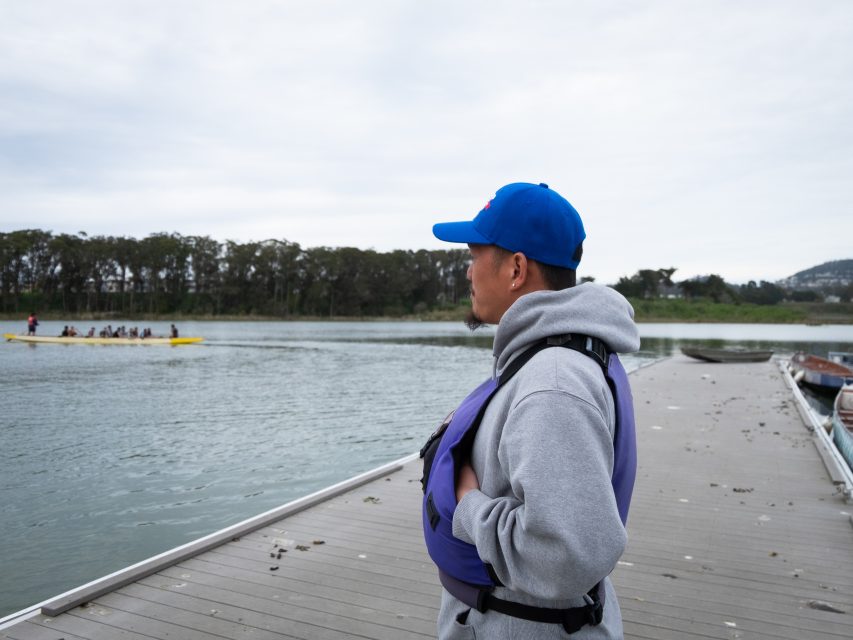
“When I coach, it makes me happy, makes me feel good about myself, because I can see dragon boats help kids change their attitude, their behavior,” Ha said. On Wednesdays and during the weekends, Ha pulls up to Lake Merced in his baseball hat, hoodie and jeans, his face tanned, and coaches teens, many of whom have never played any water sports before.
Ha remembers that feeling. When he first jumped on the boat 25 years ago, his coach couldn’t speak Cantonese, and they had a hard time communicating. Today, a few Spanish speakers are on the team; Ha and the other students use hand gestures to communicate with each other.
“Uno, dos, tres,” students counted as they paddled on a recent Wednesday. “I don’t care if you count in Chinese, Spanish or English,” Ha said, “as long as it’s in sync.”
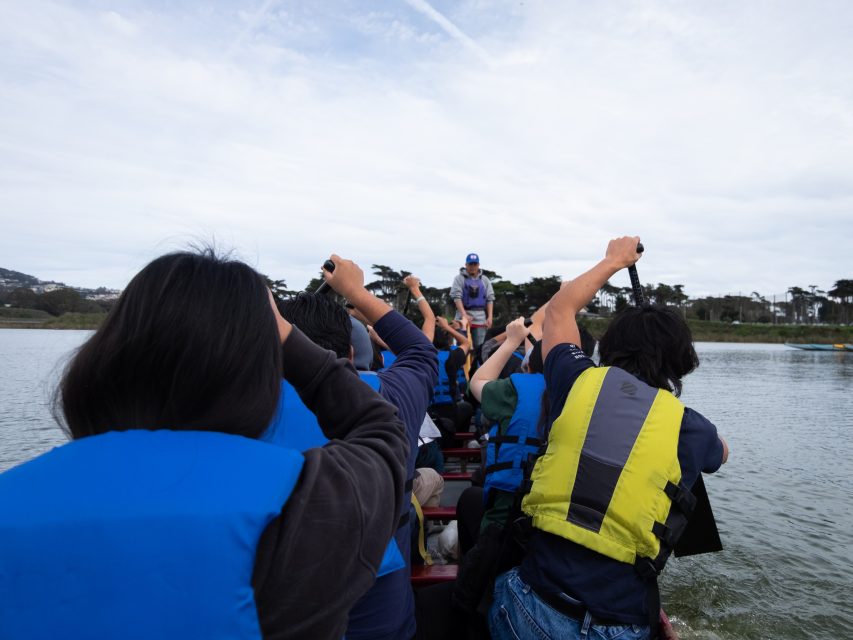
Dragon boats are 40 feet long, pointy on both ends, and painted with Chinese dragon-scale patterns in green, blue or red. On race days, a head and tail are installed on each end, turning the bare-bones vessels into floating beasts.
Dragon boat racing is a team sport: Twenty-two people aboard in 10 rows, each with a left- and right-side paddler. A helmsperson sits in the back, making sure the boat goes straight. A drummer is in the front, beating a large, sturdy barrel-shaped Chinese drum and keeping the team paddling in sync.
On Wednesday, five weeks from a race for Ha’s boat, “the Thunder,” and its crew of newcomers did not yet have a drummer, but that was just the start of it.
The students, strong and in sync at the beginning, were tiring. Their strokes had lost their rhythm and form. Out of sync, they clacked their paddles together, slowing down the boat further.
When the dragon boat reached the middle of the lake, Ha rose and walked down its narrow aisle, instructing students, one by one, on how to dip their paddles and pull with their whole bodies.
“Do you feel how heavy the water is?” Ha asked a student in Mandarin — he switched between English, Mandarin and Cantonese throughout — while taking the student’s paddle and showing her how to fully submerge the blade and pull. She nodded, and followed along.
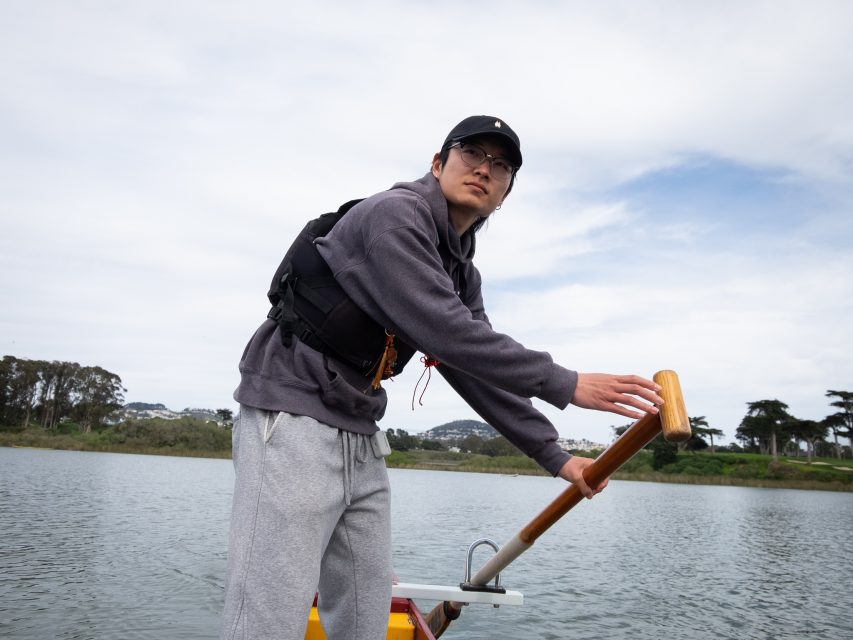
Around 4 p.m., an hour in, the team started practicing the first stroke. A strong, long stroke right at the beginning, Ha explained, is essential for winning a race. Synchronization is key.
“Paddlers, are you ready?”
They faced down and leaned forward, elbows up. They planted their feet, and buried their paddles deep into the water.
“Attention, please!”
They got ready to pull.
“Go!”
The whole team lurched forward and dug in, propelling the boat ahead.
The first stroke was neither long nor strong, but wonky. The students didn’t pull at quite the same time and the boat, 700 pounds empty and now carrying 17 people, barely inched forward.
“That’s embarrassing! They’re gonna smoke us,” Ha said.
But again, Ha walked down the center aisle, asking each student to follow his commands and paddle 20 times. For the home stretch, they got it; their bodies moved up and down, and the boat, unsteady from the out-of-sync strokes just 20 minutes ago, now glided to the guano-covered dock.
Two decades of paddling
The dragon boat program at the Community Youth Center started in 2000. It doesn’t represent any single school, and accepts students from across San Francisco at any level, with no tryouts.
It’s become a seed for dragon boating elsewhere: Teens who join the dragon boat teams have graduated high school, gone on to college, and then started their own college teams, like at University of California, Davis and University of California, Los Angeles.
Most participants of the program have been Asian students from the Sunset, the Richmond and the Excelsior. But Ha’s new boat, No. 3, which he calls “the diverse boat,” consists of not only Asian students from the Westside of the city, but Black, Latinx and white teens from Bayview, Daly City and as far away as Hayward.
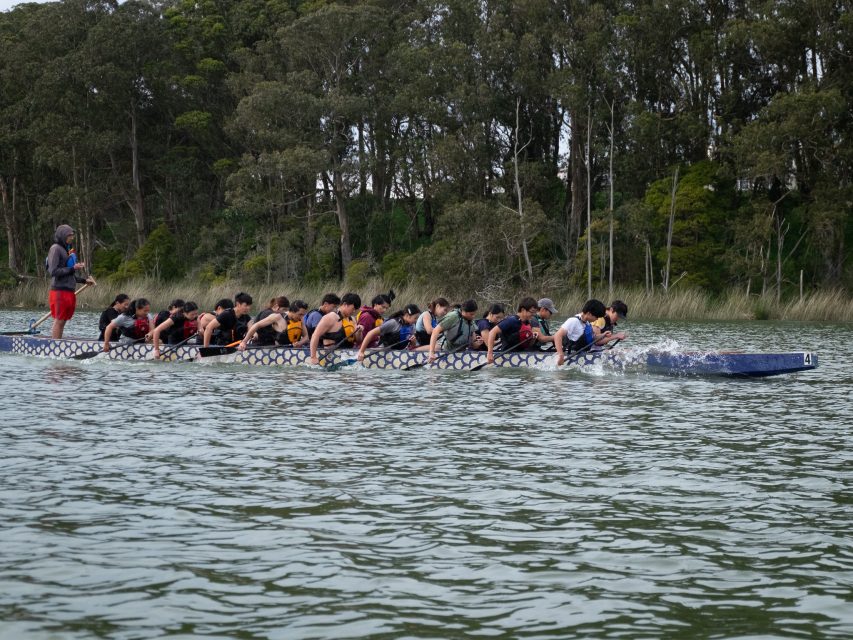
Students on this boat reminded Ha of his younger self: Many are new immigrants who don’t speak English well.
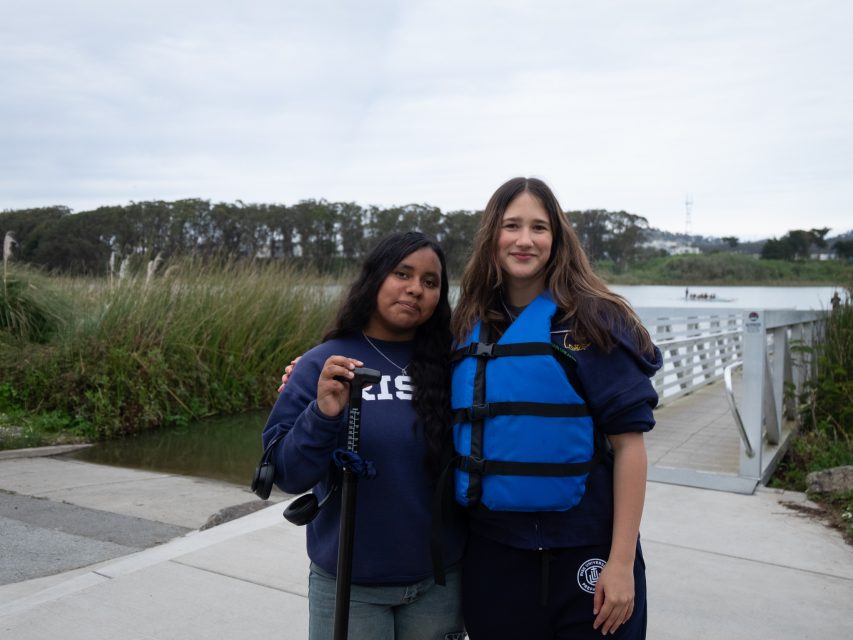
Sofia, 16, and Joselin, 15, students at Rise University Preparatory School in the Bayview, found each other at the dragon boat practice. “We don’t hang out as much with people at school,” said Sofia, gesturing at her friend Joselin. “I’d never talk to her if not for this.”
Sofia and Joselin, two self-claimed team-spirit builders, have since created five group chats for the team. They eat dinner together outside of school, or go over each other’s houses and bake.
“I thought, if we didn’t know each other, we would never be in sync,” Sofia said.
Back in 2014, Ha created a team for high-risk kids; those who had been kicked out of high school and were likely to join gangs, or were on probation. While most teens have someone who can give them a ride, the high-risk ones took public transit to Lake Merced. Not a lot of people believe in them, Ha said; not the probation officers, the school teachers, sometimes not even their family.
But on the dragon boat, they “can’t win without their friend,” Ha said. They build camaraderie.
“You can’t mess around on the street or get locked up again, because we need you to paddle with us,” Ha would tell the kids. “If you are not on the boat, we will lose the race, because we are short a paddler.”
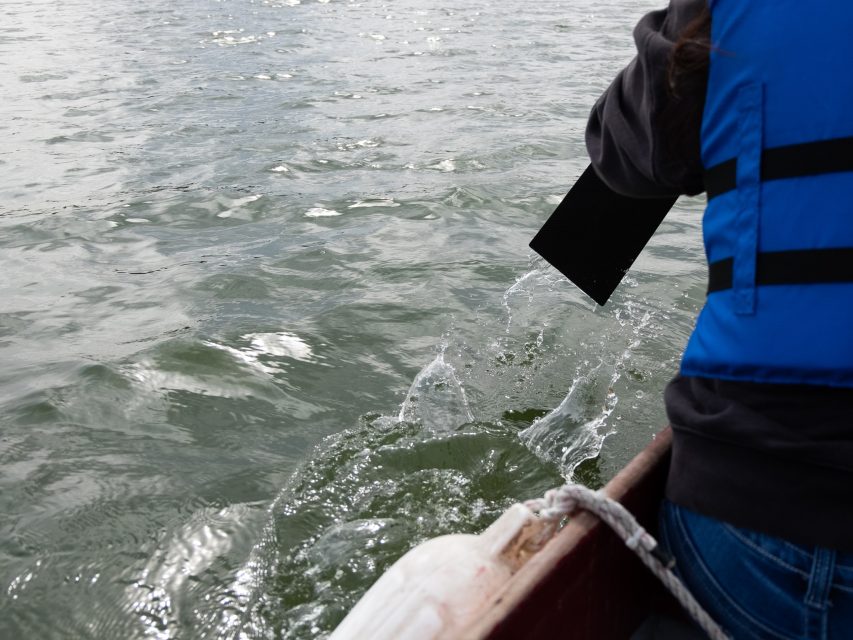
Briseida, a Spanish-speaking teen who lives in the Mission, has been coming to practice for three years.
When asked why she likes dragon boats, “I relax,” she typed in Spanish in a translator app. On the lake, the water glistened as the sunlight peeked through the clouds. Briseida’s long, dark hair was tucked under her blue life vest.
During a break from paddling, as the boat was cruising along, she stared at the lake and put her hand in the water. As Ha belted instructions, she sat at the back of the boat, gazing out, seemingly lost in thought.
Good job Henry Ha. Please let people know if you are needing any financial assistance. I know any team sport requires funding……..
This is the way people make a difference in their communities. Kudos to Henry.