

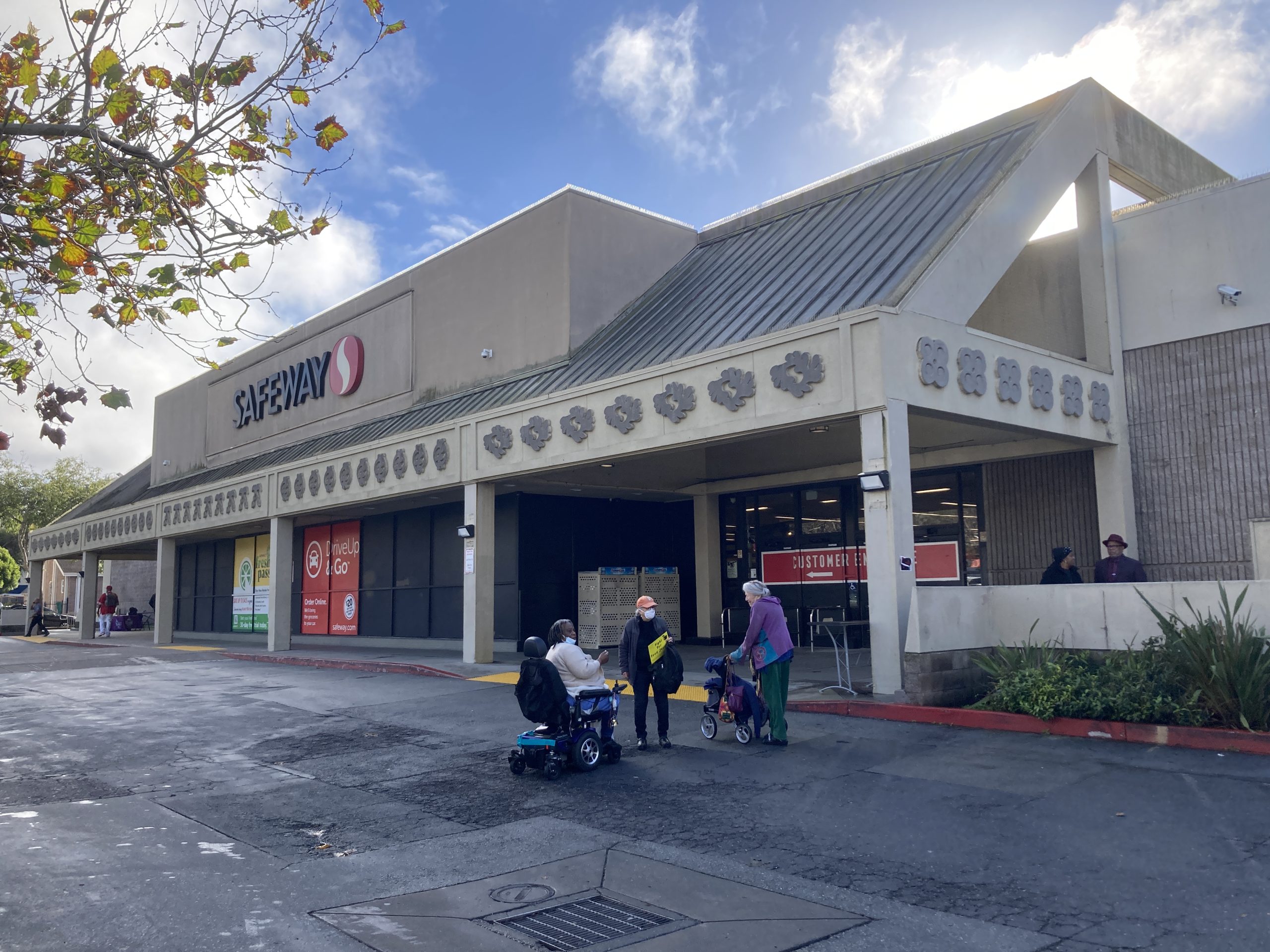

In 1981, San Francisco’s Redevelopment Agency sold more than four acres of land in the heart of the Fillmore to the Safeway corporation. It was a sweetheart deal, according to public records and interviews: A massive parcel for just $1.5 million.
Today, the 3.7 acres of land Safeway still owns could be worth tens of millions of dollars.
The initial deal included the transfer of public streets into Safeway’s plot, free of charge. Safeway meanwhile agreed to build a grocery store on the site and remain there for the next 40 years — or longer, many hoped: It was a needed resource in a neglected part of the city.
But, just a few months after that 40-year mark, Safeway began closing up shop.
A sweet deal
Safeway was supposed to stay “for a minimum — minimum — of 40 years,” said commissioner Bivett Brackett of the Office of Community Investment and Infrastructure, the Redevelopment Agency’s successor, at a Board of Supervisors committee hearing last week on the issue. “It was not sold to Safeway for them to later make a profit off of it and resell the land, therefore robbing the community of a community resource.”
The grocery store’s 40th anniversary was in the fall of 2023; by January 2024, Safeway had announced its imminent closure. Then-Mayor London Breed persuaded the store to remain in place an extra year. Residents protested, and city leaders urged the grocery store to stay, but Safeway stopped selling groceries early last month and closed its pharmacy last week.
Now, the company stands to make millions off a sale that was subsidized by city coffers.
“It’s a hugely valuable site,” said David Noravian of Beckett Capital, who said current market conditions make it difficult to put a dollar value on the lot. A smaller 2.3 acre shopping center that didn’t involve a potential major housing development sold to H Mart last year for $37 million.
Louis Cornejo of Urban Group Real Estate said Safeway might not make a massive profit in today’s real estate market, but the company profited for years by owning and operating on the land it acquired for so little.
No paperwork has been filed by Align Real Estate, the company expected to build a mixed-use development on the lot. Cornejo said that, in the current market, he expects any development on the site to come slowly. In the meantime, he said, the land could become a vacant “blight” on the neighborhood.
Safeway has offered no details about the development, but said the site will change hands soon.
“They are sitting on very valuable real estate that they got for a huge discount back in the ’80s to provide a grocery store for the community,” said former District 5 Supervisor Dean Preston. “Why would they not try to work with the city or the community to find a new grocery store to come into the location?”
This scenario shouldn’t come as a surprise. A 1980 Chronicle article mentioned Safeway closing a nearby store, part of a pattern of grocery stores “abandoning relatively poorer urban areas for the lucrative suburban trade.” Over the years, the East Bay-headquartered grocery chain has pulled out of different store locations throughout the city, giving little notice to the communities that rely on its services.
Yet, despite the store’s track record, generations of San Francisco officials have bent over backward to accommodate it.
The Fillmore store was championed as part of a plan to reinvigorate the neighborhood, which saw the razing of businesses and homes in the 1960s and ‘70s and the displacement of its Black and immigrant community members in the name of urban renewal and “redevelopment.”
The landmark Booker T. Washington Hotel that once sat on the Safeway site met this same fate. The land sat empty for more than a decade before the sale to Safeway, “in the vital and best interests of the city and the health, safety, morals and welfare of its residents,” according to the contract signed between the San Francisco Redevelopment Agency and Safeway in 1981. The contract referred to the area as one of the city’s “slum and blighted areas.”
The agreement waived a $68,000 deposit, more than $230,000 in 2024 dollars, and allowed Safeway to apply that money toward permitting and other costs. A December 1980 Chronicle article refers to a $2.5 million federal grant being used to prepare the land for the “long desired” Safeway. And the Board of Supervisors in 1981 approved the clearance and transfer of two streets to Safeway’s ownership, without charge.
Then-Supervisor Quentin Kopp pushed back against the street transfer, calling it a gift of a public street to a private corporation. But the transfer and sale ultimately went through, and Safeway opened what was reportedly the largest Safeway in Northern California on the lot in 1983.
Kopp said he always opposed redevelopment, and said San Francisco should sue Safeway to retrieve the amount of money the company saved in the discounted sale more than 40 years ago.
“It’s Safeway’s prerogative to sell a store which isn’t making money or is even losing money,” Kopp said this week. But city leaders who “cared enough” could sue the company, as the city subsidized the original purchase.
It is unclear how much Safeway stands to make off the sale. The company has remained tight-lipped about its agreement with Align Real Estate.
A familiar story just blocks away
Around the time Safeway opened its Fillmore store more than 40 years ago, residents about 12 blocks away in Lower Nob Hill were taking action to save their Safeway store, action that may be familiar to those in the Fillmore, Western Addition and Japantown today.
In October 1983, Safeway abruptly announced the closure of its location at Bush and Larkin streets; it would close within five days. Residents mobilized quickly, with protests and petitions to persuade the store to stay. News reports said the Bush Street store was the last of five Safeway outposts to depart within that decade.
Just as Fillmore residents have done over the past year, Nob Hill residents in 1983 “bemoaned the hardship that the closing will have on area residents, particularly seniors, who will lose their access to a conveniently located full-service market,” according to a November 1983 Tenderloin Times article.
The Fillmore Safeway sits among census tracts with some of the highest populations of senior residents in the entire city. Its once majority-Black population has dwindled, due to displacement, to around 10 percent in the last census.
Then-Supervisor Nancy Walker accused Safeway of also abruptly closing a Visitacion Valley store it had “promised to keep open,” and said the Bush Street closure was another example of the company failing to keep its word.
“I don’t think Safeway has any regard for this community,” resident Don Feeser told the Tenderloin Times in 1983. “They made their money in this community, now they’re leaving.”
The late Rev. Arnold Townsend, upon learning of Safeway’s planned closure in 2024, said something similar.
“I have been in this town for 56 years, and Safeway has been probably the worst community partners you would ever know,” Townsend said before a town hall meeting at Third Baptist Church last January. “They certainly have not contributed to the community, but they’ve taken millions of dollars out of this community.”
Similar to Breed’s action last year, then-Mayor Dianne Feinstein in 1983 sent Safeway’s CEO a letter, urging him to negotiate with possible replacement supermarkets to take over the Bush and Larkin space, on which the company held a 75-year lease. The store extended its closure by an extra month, but maintained it was losing money, and shuttered in October 1983.
Walker proposed legislation to require supermarkets to give six months notice of closure and hold community meetings, much as former Supervisor Dean Preston did last year before he left office. Records show Feinstein vetoed the legislation in 1984, but Preston’s legislation, though left unsigned by Breed, passed in November. The Board of Supervisors also passed a resolution in February urging the store to stay.
But again, the present-day legislation and resolution had little effect on the Fillmore Safeway closure.
Align and development
Last year, Preston pushed for Safeway and Align Real Estate to offer up the land for affordable housing nonprofits, to no avail. He urged Breed to consider acquiring the property, and got no response.
Safeway, which is today part of a supermarket conglomerate owned by private equity firm Cerberus Capital Management, also showed “incredible disrespect” by never meeting with a community that has been “wronged for generations,” Preston said.
“If they want out, the respectful thing to do is meet with community groups and involve the city,” Preston said. “They want to cash out and get top dollar selling the lot.”
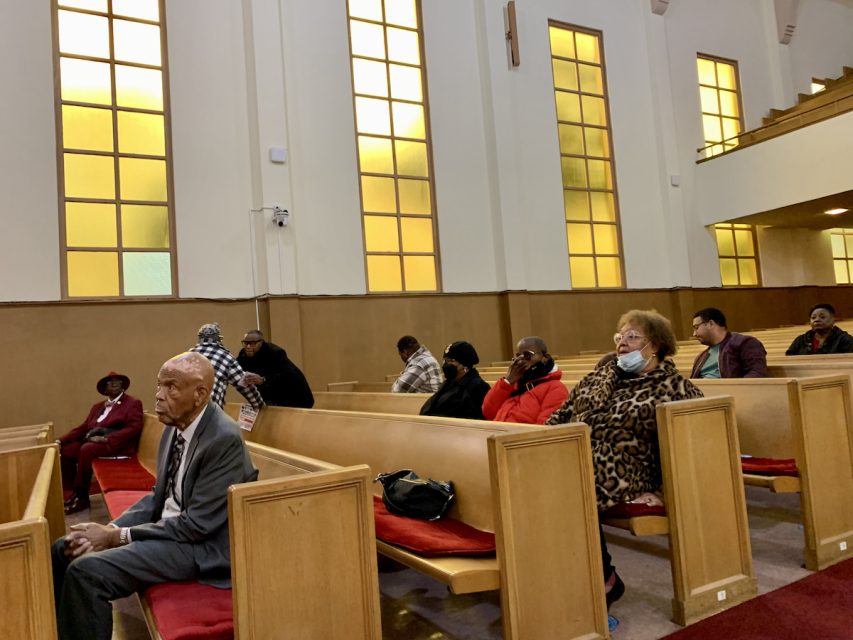
Preston’s successor, Supervisor Bilal Mahmood, held a hearing last week to assess the situation, and promised residents who filled the City Hall chamber that he is dedicated to fulfilling the community’s needs. Residents were not convinced, and filtered out of the room grumbling their frustrations.
“Terrible! Shame!” shouted Gloria Berry, a member of the African American Reparations Advisory Committee, across the room as Mahmood and his fellow supervisors ended the hearing without any new answers or plan. “You should be ashamed of yourself … how dare you have us all come down here!”
“The frustration, overall, is valid,” said Mahmood in an interview. “It’s been a year, and there’s been no action.”
Safeway and Align Real Estate were notably absent from the hearing. Mahmood didn’t call them, and he told Mission Local that he still has not managed to meet with the grocery chain.
“We take pride in our 40-year history of serving the Fillmore district and are grateful to our neighbors, customers and community members who supported us throughout the years,” a Safeway spokesperson wrote in a statement after the hearing, noting that 15 other stores remain in the city. “We look forward to seeing more of the exciting proposal Align has in store as they develop their upcoming mixed-use project on their soon-to-be-acquired site.”
City leaders seem unwilling to explore options, like acquisition through an eminent domain process to intervene in the sale.
“Safeway is a hard-nosed corporate partner, and all they are interested in is a dollar sign,” said The Rev. Amos Brown at last week’s hearing. “What we need to do is to put the brakes on and tell Safeway: ‘Since you don’t know how to be good partners, you don’t deserve being in this town.’”
Another way to look at it is that the subsidy given 40 years ago was to induce Safeways to operate what was always going to be a low-margin business there.
Safeways kept to its side of the bargain and stayed for the required 40 year term, and were then allowed to shutter the store as per the contract.
Nothing illegal or wrong here.
Where exactly are you getting the financials that prove it’s low margin?
The business model is low margin, which means very little without further context. Why is it the trolls love mentioning it? I have no idea.
The contract should have been written better 40 years ago.
It was probably the best deal they could get on a blighted lot in a neighborhood where crime was rampant and would continue to be rampant for the next half decade.
Major retailers that use loss prevention policies don’t seem to have the problems that Safeway/Walgreens/etc do in terms of rampant theft. They made a “business decision” to use hands-off “security guards” instead of LPO detentions, and eventually it came full circle. Shrinkage/theft is a real issue anywhere in the world, but where other companies put time and resources into stopping it they don’t seem to be shuttering stores and using theft as an excuse. Also it begs the question – how bad is the actual shrink %, and what are the actual profit margins / gross profits at these locations? Walgreens was caught lying about their rationale when they said their stores were “losing money” when they were not. They had simply over-expanded and the market took a downturn at the same time as the pandemic – people have been stealing from retailers for decades on end. Yet they still ALWAYS made a profit, perhaps not as much as they’d like, but they’d be again lying to claim otherwise.
Agreed. If the city or the “community” wants another sweetheart deal that induces a business to operate with low margins in a low-rent high-crime area then a new bribe is needed.
Again, where’s your proof that it’s low margins?
It’s actually not, you’re making things up again.
The City isn’t known for writing good contracts; the settlement agreement with Walgreens, for example, should have limited store closures. They are starting to feel vindictive, not surprising after a $230 million bill.
That would’ve been a hilarious contract: you allegedly poisoned our citizens so as punishment you must keep operating in our city. LOL!
A few thoughts on all this. It certainly does appear that the SF Redevelopment Agency cut Safeway a sweet deal 44 years ago – of course, hindsight is 20-20. Quentin Kopp says SF “should sue Safeway to retrieve the amount of money the company saved in the discounted sale more than 40 years ago.” A good follow-up question would have been “under what legal theory?” There is none. A deal is a deal, and the city cannot just do anything it wants because the redevelopment agency made a deal 44 years ago that in retrospect turned out to be a bad one. As for Dean Preston’s urging SF to just buy the property itself, that is an option, but under both the stated and federal constitutions, it would have to pay fair market value, meaning the price the property would sell for in a competitive market. A reasonable estimate for this large parcel is that SF would have to cough up maybe $80 million or more. A viable option? Maybe, but that would be the likely cost, and the benefits would have to be weighed against that cost – that is the question to consider, and most of the discussion simply ignores the cost side of that equation. Finally, it’s not really true that Safeway “is today part of a supermarket conglomerate owned by private equity firm Cerberus Capital Management.” Safeway is a subsidiary of Albertsons, which is a publicly traded company (ACI on the NYSE). It is true that Cerberus owns about 26% of the outstanding shares. Anyone can buy shares, and with a P/E ratio of 12 and a 3% dividend, it looks to be priced pretty cheap.
Cerberus is a $66b hedge fund with a private equity arm. Albertsons Companies is their largest PE investment. Cerberus took Albertsons public.
Cerberus owns 26% of ACI common stock, but they own more than 4x more shares than the next closest stakeholder. They maintain controlling interest in that the Albertsons board is stacked with Cerberus people and Cerberus loyalists.
Bottom line, Cerberus controls Safeway. Your quibbling doesn’t express that, and the sentence in question does.
> Cerberus is a $66b hedge fund with a private equity arm. Albertsons Companies is their largest PE investment
Irrelevant.
> but they own more than 4x more shares than the next closest stakeholder
Irrelevant.
> Albertsons board is stacked with Cerberus people
False. 2 of 11 board members are associated with the firm.
> and Cerberus loyalists
Claimed without evidence.
It’s funny that people are happy spinning conspiracies about PE being the cause a store subject to endless theft and crime is closing. Why weren’t you thanking Cerbus for keeping a grocery store open in a bad neighborhood for the prior 20 years they owned it?
There are three Cerberus people on Board. There are four or five loyalists — ie those who hold or have held Albertsons executive positions before ACI went public, or those who were on the board since before ACI went public.
It is relevant how much stock Cerberus owns as that decides board seats and voting majority. (Note: I should have said *preferred* stock in my above post.)
The conspiracy theory is you alluding that the Fillmore store closed due to theft. I didn’t speculate on why it closed.
I don’t have to speculate. They plainly stated it to a real news outlet:
> Safeway has announced it will close its Fillmore district store early next year due to theft, and during a Wednesday visit, The Standard may have seen why.
https://sfstandard.com/2024/12/12/san-francisco-safeway-closing-theft/
It is SOP for companies to have executive officers as board members. Just because someone held that role while private does not mean they are particularly beholden to the capital providers.
“The conspiracy theory is you alluding that the Fillmore store closed due to theft.” Then Safeway and Walgreens are pushing a conspiracy theory, not us. That’s my point, Walgreens got caught lying about this. Safeway may also be. Let’s see the truth or they need to come up with a more plausible rationale.
But there was more to the original deal in 1983, wasn’t there? Wasn’t Safeway also required to construct and hand over a whole building to the Redevelopment Agency? Could that be the adjacent, mixed-use development at 1426 Fillmore? Which cost something like $5 million at the time.
“City leaders seem unwilling to explore options like acquisition through an eminent domain process to intervene in the sale.”
And this is (part of) what’s wrong with corporate-backed “city leaders.” They bend over backwards to “explain” how the free-market trickle-down economy is the solution to everything, but have no problem whatsoever when big business gets a handout. Twitter tax break? Check! Reduction in impact fees for developers? Check! Nearly-free land for Safeway? Check!
Arguing that Safeway can’t be required to stay in business does not mean that Safeway can get well-below market price for a huge patch of land (that, not incidentally, didn’t really belong to the city to sell but just got redeveloped over to the city) and then 40 years later sell it at market-rate.
The most generous gift to Safeway would allow them to sell it according to the same index that someone who buys a BMR condo can sell it for sometime in the future. Eminent domain at subsidized rate, not “free-market” rate. The board and mayor can craft some emergency legislation for “greed clearance” akin to the “slum clearance” legislation that caused the problem sixty years ago.
I hate to shock you on this but eminent domain requires paying fair market value according to the United States Constitution. It doesn’t mean you just take it like a snatch and grab which you’re probably more familiar with.
Changing the zoning on the property could have a similar effect on the market value, without involving eminent domain. Just some slightly more creative legislative wizardry.
Deliberately rezoning a specific property for the sole purpose of lowering its value so it can be bought on the cheap, and then removing that rezoning afterwards, would be blatantly illegal, immoral and an abuse of power.
“Greed clearance.” Muchly needed.
The “greed” that is destroying San Francisco is not the greed for money. It’s the greed for drugs, vain value signaling and cheap below market rate apartments.
By greed for drugs, do you mean Newsom’s cocaine addiction, or Dorsey’s speed freakishness, or the multiple desperate attempts to make tourists come back by opening booze zones, or all the pot dispensaries and the official 420 celebration, or the mushroom churches, or the drug-fueled techbro murder initially in blamed on a homeless person, or something else?
Let me know when you catch Newsom and Dorsey selling the bikes they stole from your garage on OfferUp out of their taxpayer funded Tenderloin SRO.
They sell much more lucrative things than bicycles – they sell our government out from under our feet, if you let them.
Well, the permissive nature of shoplifting and theft sure didn’t help the situation. If Safeway was making a consistent profit I doubt they would close the store.
An entire article that alludes to a discount but provides no evidence of such a discount. How much was the discount and what’s the proof? Is this reporting or a PR piece?
Sounds to me like the neighborhood/city got 41 years worth of groceries that otherwise wouldn’t be there and Safeway got land in a place which they otherwise wouldn’t have invested. Did anything illegal happen here? If not, best of luck to all parties involved here – you both got deals.
Every neighborhood needs businesses.
Grocery stores , pharmacy etc
Unfortunately , due to the lawlessness and lack of law enforcement to clean up the mess in aisle 5, and the city red tape doesnt help.
In a democracy , business wants to make money .
It takes a village .
Look no further then Lower Polk .
All business is gone except drug dealing , graffiti and shelters.
No jobs even if people wanted to work ,
Until the city cleans it up and stops the crime on the streets , nothing will change .
No one wants to come here anymore .
Why is the Penisula thriving ?
They dont allow the thugs and idiots to hang out all day and take drugs and wreak havoc .
If Whole Foods had to leave on Market then Safewy leaving here only makes sense .
I wish and hope every person here would stepup and contribute to improving this city rather then complaining and expecting free hand outs .
SF cannot be expected to pay for everyone who shows up here .
At the Board of Supervisors Land Use Committee public hearing on 2/3, heads from various city departments stated that the timeline from real estate negotiations to sale through permitting to development and construction is BASICALLY THE SAME TIMELINE AS EMINENT DOMAN PROCESS: likely 7-10 years. Meanwhile, the area is now a food desert and SFPD Northern Station’s (which is directly across the street) police captain is deeply concerned about what will become of the parking lot with Safeway’s exodus.
Why would anyone expect real-estate darling Mahmood to offer anything more than lip service to this gross situation?
But Preston failed as well; the closure happened on his watch. Basically the city has no leverage here.
The City has leverage, Preston is/was a single voice and Breed basically didn’t want to do anything that didn’t enrich her friends. Preston was much more of a leader to the Fillmore community than Breed’s BS act ever tried to be.
Exactly. During the election campaign, he agreed with the incumbent on virtually everything and offered no ideas of his own, yet the billionaire astroturf and mudslinging campaign on his behalf bought the D5 seat.
This is but his first installment in repaying that debt.
He literally is not even trying: “Mahmood didn’t call them (Safeway & Align)… he still has not managed to meet with the grocery chain.”
With such a stellar group representing the community, the African American Reparations Advisory Committee ($5,000,000 for each African American resident and even though they would be gifted with 5 million dollars, they should also get to buy a house in San Francisco for just 1 dollar) , I can’t imagine why Safeway wants to exist this amazing progressive city ?
I remember sitting in class at Raphael Wiell seeing all these abandoned buildings and empty lots. Someone made money but it’s not all the property owners who were forced to sell to the “redevelopment agency.” It just funded government jobs and the developers. Bring back Virgo’s Liquor Store.
Isn’t the Market Street Safeway also partially built on public land? I don’t mean to hate on Safeway but it seems like we’ve given them enough handouts.
As the community warned, the Fillmore area has now become a food desert with the closing of the Fillmore Safeway supermarket/bank/pharmacy. At the 2/3 Land Use Committee hearing, there was a tremendous outpouring by members of the impacted communities, including The Fillmore, Japantown, The Tenderloin, Cathedral Hill, and Western Addition. Residents spoke of the catastrophic results of the closure and the hardships and suffering that it will cause, particularly on the area’s most vulnerable: low income seniors, families with children, and those with disabilities. Many at the hearing voiced their desire for the City to exercise Eminent Domain as the most just and expedient way to secure a permanent affordable full-service supermarket for the neighborhood.
At the hearing, City employees estimated it would take 5-10 years to get a full-service market on this site using the Eminent Domain process. Oddly, this appears to be the same amount of time estimated for private development to build space for a replacement full-service supermarket. This supposed equality of timeframes may lead some to believe Eminent Domain would not be a significant improvement over the private development process.To the contrary, the Eminent Domain process would be an improvement in both speed and meaningful, stable results. Keep in mind: the stated time estimates for Eminent Domain are not applicable to this situation. The Eminent Domain processing time is certain to be greatly reduced in this case where the Community, the Mayor’s office, City departments and the Board of Supervisors should unite in full support of “streamlining” and “red tape cutting.”
The City should immediately begin the Eminent Domain process and the subsequent City leasing process for the Safeway property (which includes much of the parking lot). It is important to state City intentions NOW, while any proposed private sale has not been finalized.Eminent Domain is the only way to adequately, justly, and speedily guarantee an end to this supermarket, banking, and pharmacy mass deprivation. Why reinvent/rebuild the wheel, when the space is already built and ready for a tenant? Short and medium term stop-gap “options” are just more ways to fail the impacted communities if the City doesn’t simultaneously, immediately and whole-heartedly follow through with commitments securing a permanent full service market as fast as humanly possible.
Why the City? Because The City has the greatest responsibility to make this right for the Community. It was the City that confiscated this land from the Community through an unfair and severely destructive City redevelopment process. The City then gave away the land to a private corporation, Safeway, that does not recognize obligations to the Community. Safeway now stands to make a substantial profit by closing the supermarket and reselling the land to another private corporation. This next corporation intends to demolish the supermarket building and put in its place new, likely unaffordable housing while offering no guarantee of ever producing an affordable full-service supermarket…….and all of this taking 10 years; likely more.