

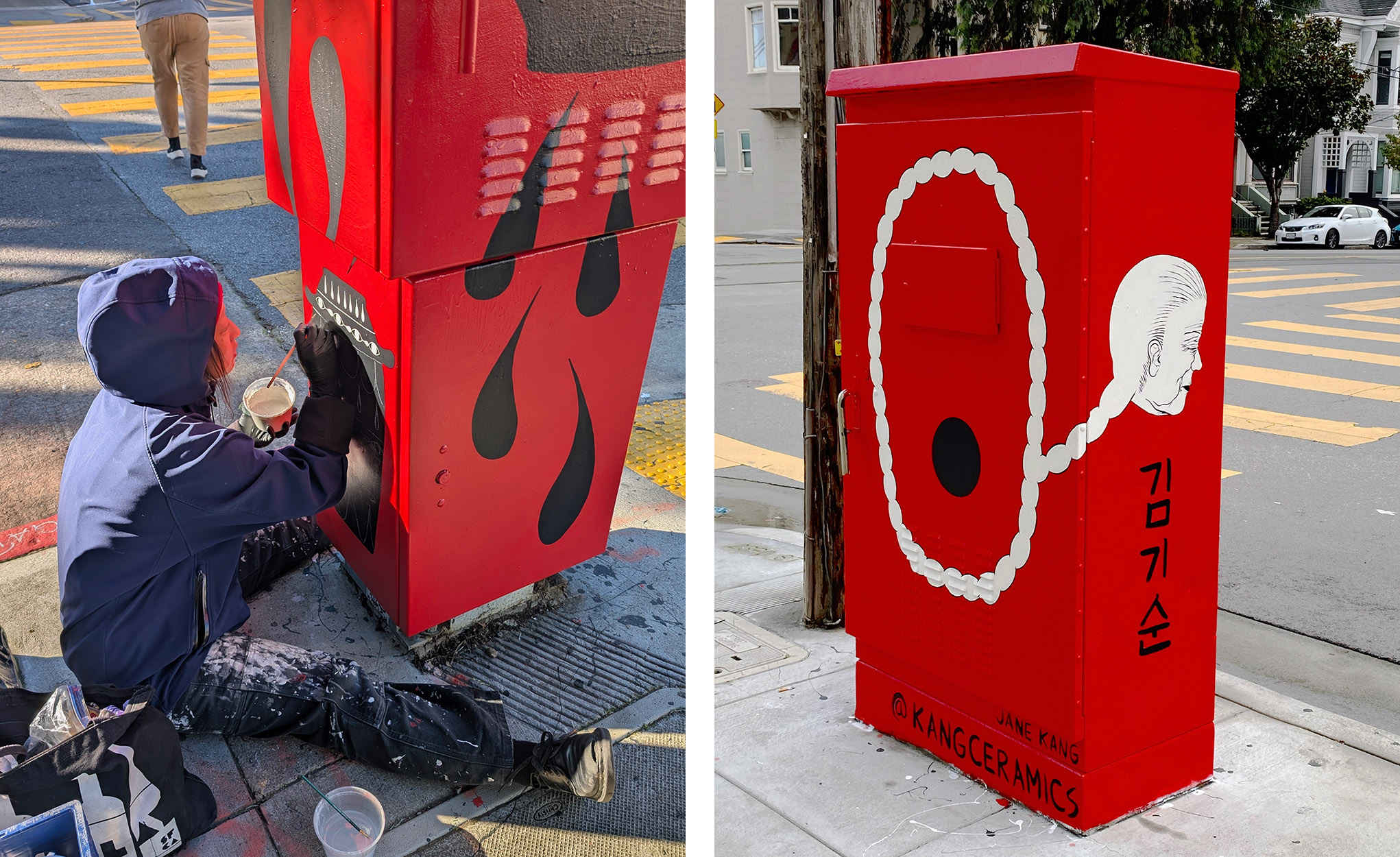

In December 2024, a handful of city utility boxes in the Mission underwent a transformation, their forest-green hue painted over with a vibrant red.
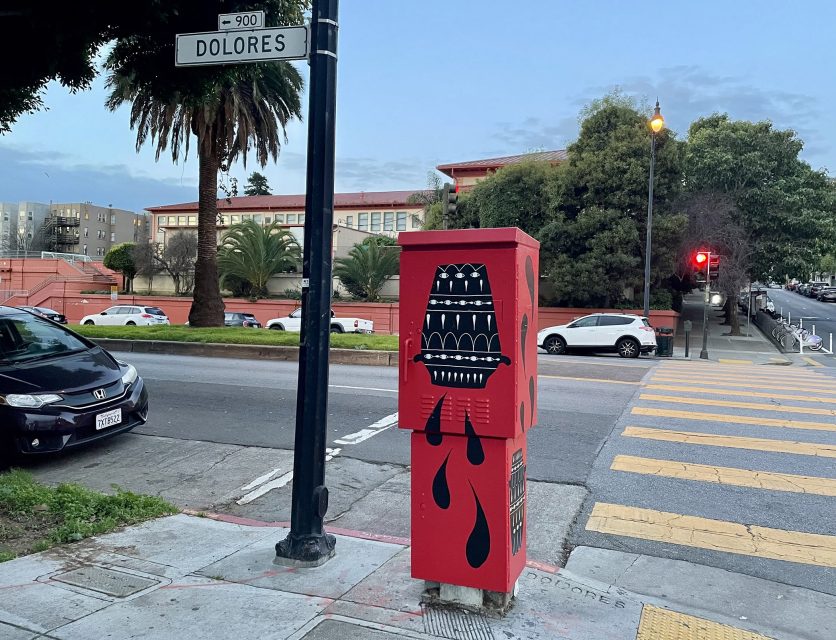
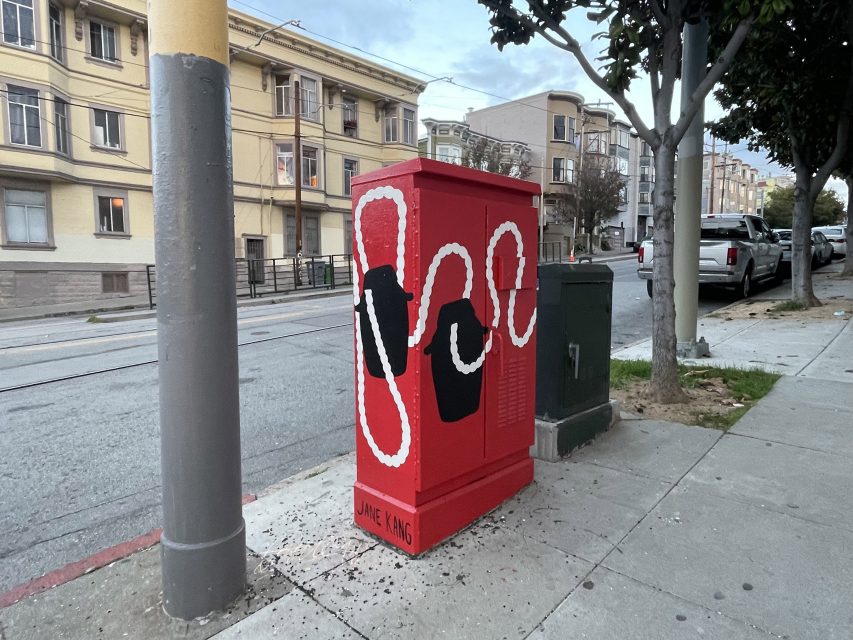
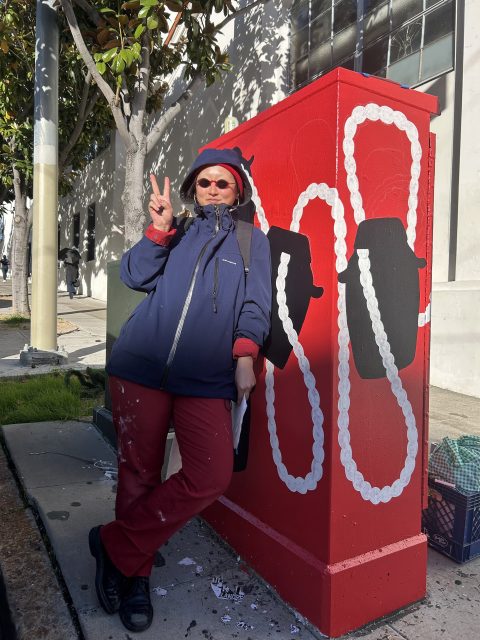
At 22nd and Dolores streets, one bright-red box with jet-black Korean onggis — fermentation vessels — juts up from the concrete, jarring against the drab-colored houses and parked cars. At 23rd and Church streets, another blood-colored box, featuring two figures with braided hair, stands out from its duller surroundings.
In front of Dolores Park, the deep red contrasts with the green lawns and palm trees in the background, and a golden circle lies next to the Korean words “끼리 끼리” — “Kkiri Kkiri” — meaning “all together.”
For Korean-American multidisciplinary artist Jane Kang, the woman behind the makeover, it was an intentional, and meaningful, change.
“Red is a color that isn’t static; it has energy. It communicates something at all times,” said Kang. “It’s not a passive color. It’s a celebration of life.”
And, she said, of Korean culture.
“The specific shade of red I chose makes me think of red pepper paste and kimchi,” she noted.
Atop the crimson background on each of Kang’s completed murals are illustrations of onggis, traditional vessels used for fermenting and storing staples such as kimchi, pepper paste and soy sauce.
“Fermentation is something so incredibly core to my culture. I want to be able to share my narrative, my history with fermentation, and reimagine it,” she said.
Her work, both in her ceramic pieces and in paintings, emphasizes a repurposing, or extension, of onggis in terms of their use and symbolism. They appear on Kang’s utility box mural at 22nd and Dolores streets titled ‘Onggis of Tears,’” which Kang described as a meditation on grief.
“These onggis are decorated with eyes surrounded by tears, releasing the energies of grief they have been holding. Grief cannot be contained; it moves through us all. … Thinking of L.A., of Gaza, of the climate crisis, and of our city here in San Francisco, I hope our grief moves us to connect and grow together, [to] release and transform compassion for ourselves and each other,” she conveyed.
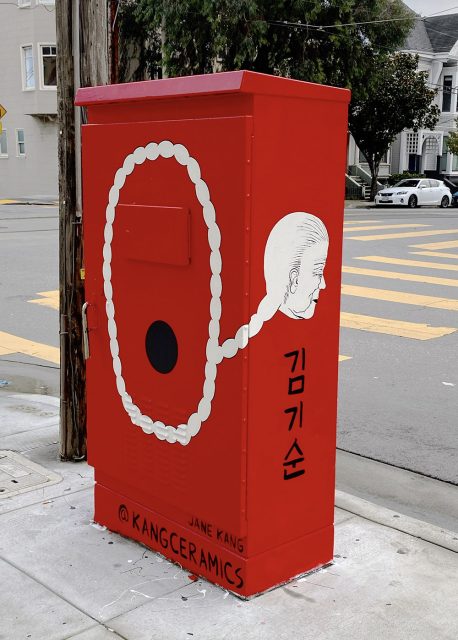
Another feature of Kang’s murals are braids — some painted black; others painted white, all representing links to tradition and family.
“Braids are something that come up for a lot of diasporic artists. … I think about whenever I was a little kid, and my mother would braid my hair. It’s the same thing her mother did for her, and her mother’s mother did before her. I find it’s a beautiful way of connecting the past to the present and my culture to other people’s cultures as well,” she shared.
Kang is one of the San Francisco artists participating in the “Paint the City” project backed by two San Francisco-based nonprofits, Paint the Void and the Civic Joy Fund. The first round of the project, as detailed in the 502-page “Paint the City: Utility Box Murals 2024” plan submitted to the San Francisco Arts Commission, involves 24 artists and 241 city utility boxes, 39 of which are in the Mission.
Already, along South Van Ness Avenue and Bryant Street, the Peruvian artist Claudio Talavera-Ballón has repainted almost a dozen utility boxes, adding chickadees, warblers, and other Bay Area birds atop a sky blue. Elsewhere in San Francisco, artists have added astronauts, pandas, and more.
Kang was assigned nine utility boxes in her neighborhood. When she spoke to Mission Local, she’d completed murals on five of them.
“I’m technically supposed to be done by now, but because of the rain and also because of one of my paintings being painted over [by a nearby landlord], I think that I’m just going to work until they’re finished,” she said.
As a sculptor, Kang’s artwork usually leans toward the three-dimensional, but the Paint the City opportunity, stemming from friend and fellow artist Maya Fuji’s recommendation of Kang for the project, was not one she wanted to pass up.
“I’m actually a ceramicist mainly, and I hadn’t painted in quite some time, but I do focus so much of my work on Korean heritage, and also the communities I’m involved with here in San Francisco,” Kang explained.
Her mural on a utility box at Mission Dolores Park, titled “Kkiri Kkiri,” is an homage to the spaces she finds as a member of Kkiri Kkiri, a Bay Area-based Korean samulnori drumming group. She plays the kkwaenggwari, a small handheld gong.
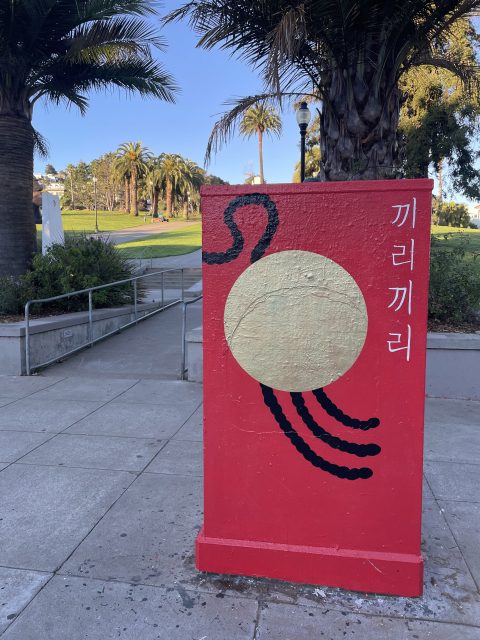
“I was thinking of how Dolores Park is such a special, iconic, historical space where so many things have happened,” she shared. It’s where she painted the “all together” message, seeing the park as a city-wide, and global, meeting place.
“I think it’s very appropriate to write that in front of Dolores Park. It’s where so many of us all throughout the city, and even across the world, gather,” she said.
Thank you artists and supporters for these wonderful, beautiful and inspiring civic art pieces. A few weeks ago I realized what joy I felt while watching an artist transform the butt ugly utility box into something that WE THE PEOPLE can enjoy everyday.
Great job, thank you!
I take issue with the “ethnicizing” of public art. Red is a “Korean” color because kimchi…? It’s a little much. Yes, you’re Korean, great job being proud of existing, but what the actual if people other than Koreans can’t READ the public art installation? “All together” except written in a language only X ethnicity can understand or appreciate, and repping the artist’s (mono?) cultural identity instead of the multitude of cultures around? It’s a reach to say this is inclusive of other cultures when it’s by and exclusively for only one culture. Not everything you create is about your individual heritage – nor should it be – and what a strange statement to claim that, really. Maybe the artist could think about that a little longer, avoid “claiming colors” as specifically ethnic. A lot of peoples appreciate RED, in fact. I appreciate beautification of public works, but this borders on cultural appropriation in plain sight.
I don’t understand your point that only Korean people can enjoy and appreciate the boxes. I’m not Korean and I’m not offended that I can’t read the Korean on the boxes. I think it’s interesting to see how other cultures interpret a universal color. I really don’t see anyone “claiming” a color in this article, and the idea that showing one specific culture inherently erases all other cultures is a simple-minded fallacy. And “cultural appropriation”? Huh? The artist is Korean, creating a piece of artwork based on her Korean culture. No one is appropriating anything from anyone. Nothing in this comment makes sense.
Who said you were offended, Wendy? People can’t read what is written because they don’t speak the language, so writing “all together” is particularly ironic – unless the author means “only Koreans” are all together, which has the obvious geographic problems of a North/South variety. No, the artist did not “create a piece of Korean culture” by painting a box red and putting Korean letters on it. No, “Red” is not a “Korean color” because Kimchi is red. No, “Braids” are not a specifically Korean cultural invention either. Yes, the way it’s phrased is (mindlessly) claiming those in cultural appropriation and giving no mention to “other people’s cultures” at all. No, “art” based loosely on the ethnicity of the artist, and only representing that, does not really represent all cultures or even that single culture, in fact. I’m pretty sure fermentation is pretty darn important to cultures all over the world, despite the attempts to own it along with the color red, braids, or anything else you can think of painting on a sidewalk art box. It’s trivializing and mindless. I can still “appreciate” the red box with black and white lines on it, but calling it “cultural heritage” is laughable to the point of being insulting, and the way it’s phrased here is cultural appropriation being claimed for the sole specific mono-culture of the artist. That’s the problem, not the red box.
And I understand that my critique will be probably viewed as both contraversial and racist, but it’s meant as neither. It’s an attempt to understand what labels we apply to art, public art, culture, all of it. We are not the ones who decide how it will be intended nor interpreted. I would submit that avoiding nationalist messaging is the singular evangelism.
Looks a lot like advertising for a ceramics shop… how is that even allowed?