

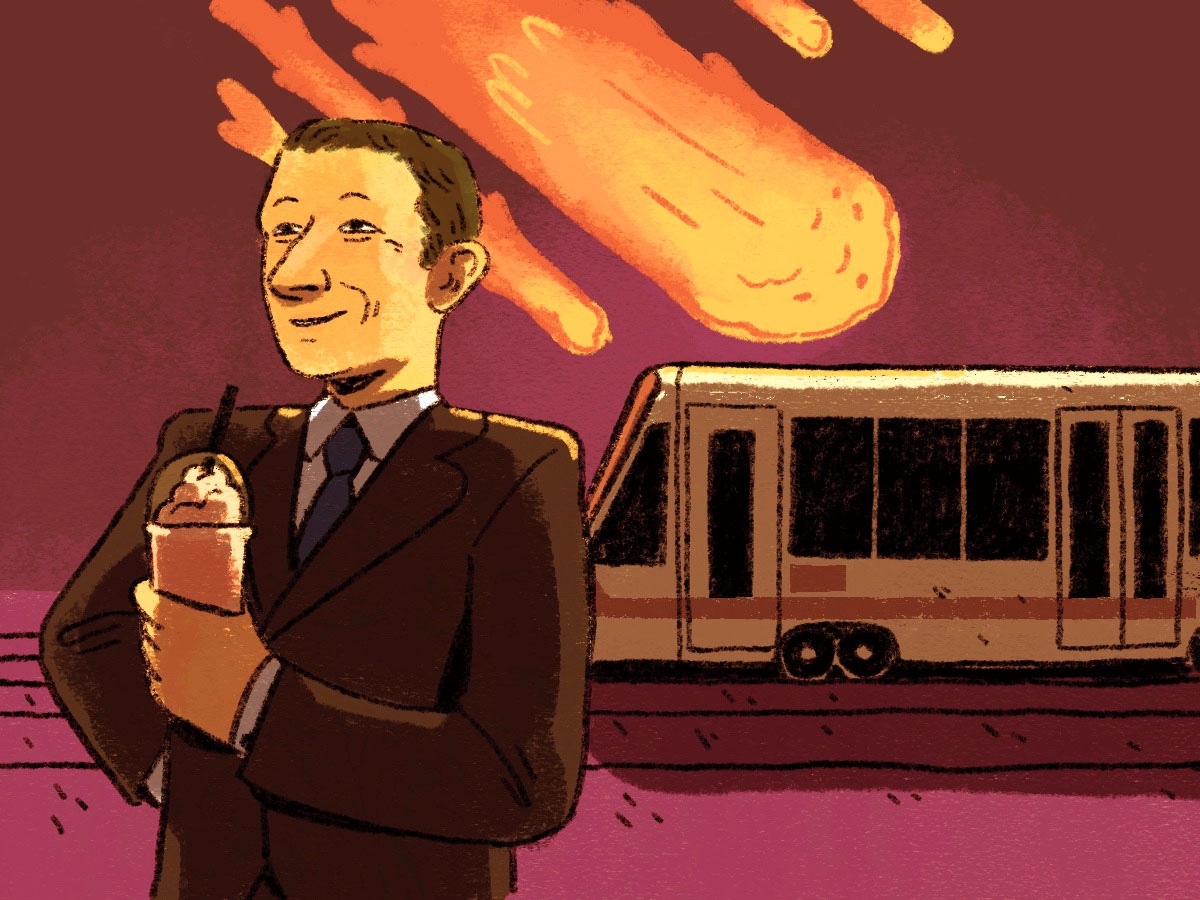

In his first seven weeks in City Hall, San Francisco Mayor Daniel Lurie has made downtown recovery a priority.
He pushed the Board of Supervisors to relinquish some of its oversight power for city contracts related to homelessness, drug overdoses and substance use, a law that was swiftly enacted. At his request, the San Francisco Police Department spun up a “triage center” on Sixth Street to deal with the notorious drug market nearby, and launched a “Hospitality Zone Task Force” to increase police presence around downtown tourist hotspots like Union Square, Moscone Center and Yerba Buena Gardens.
Lurie eliminated affordable housing fees for office-to-housing conversions downtown, pushed for a state law to authorize 20 new liquor licenses downtown, and urged businesses to “come back and invest” in San Francisco at the Chamber of Commerce this week.
But a key piece of downtown recovery is missing from his policy announcements and speechmaking: Transit. How can Lurie ensure the survival of downtown if the buses and trams that shuttle people who will reinvigorate the city’s urban core — the shoppers, bon vivants, and hospitality workers who cater to them — need a lifeline?
“I don’t believe that there has been a Muni funding ‘State of Emergency’ ordinance,” said Todd David, the political director of the YIMBY group Abundance Network, referencing Lurie’s name for his fentanyl measures. “I am a little bit shocked that the Muni and BART fiscal cliff has not received the political attention that it absolutely deserves.”
Muni is facing a $50 million shortfall for the upcoming budget cycle, and, beyond that, a ballooning deficit that is expected to hover between $239 million and $322 million by fiscal 2026-27. The agency is considering service cuts to some 20 lines this summer that would trim that shortfall by $15 million.
“Downtown success — public transit is intrinsic to it,” said Tom Radulovich, a transit advocate and former longtime elected BART commissioner. “And there’s never been a greater threat to it.”
When Supervisor Myrna Melgar asked about Muni’s looming service cuts during a Lurie appearance before the Board of Supervisors on Feb. 11, the mayor did not unfurl a plan of action.
“No one wants to see Muni service cuts,” said Lurie. But, he added, “The reality is: This is what Muni may need to do to solve the wider budget crisis they are facing.”
Lurie’s team, for its part, also seem resigned to cutting Muni’s service.
“The process the MTA is going through is necessary. We have to evaluate among what are really tough choices,” said Alicia John-Baptiste, Lurie’s chief of infrastructure, climate and mobility, who added that service cuts are likely, especially before the agency’s financial outlook worsens next year. “I don’t think we will regret having reduced our costs in advance.”
The mayor could allocate money from the city’s general fund to support transit, but a spokesperson for Lurie did not respond when asked whether he would do so. John-Baptiste emphasized that the city’s budget at large is also facing major cuts. “The general fund itself is facing really significant shortfalls. We are committed to putting our dollars where they matter most.”
But accepting cuts to Muni would endanger Lurie’s other downtown recovery priorities. Vibrant streets, more housing and thriving businesses are all dependent on more people going downtown, during and outside of working hours. Cutting transit would also affect those who don’t ride it: Fewer trains and buses would mean more cars on the road and more congestion.
“Downtown San Francisco’s competitive advantage, relative to other places where people might shop or live, is its public transit,” said Radulovich. “The private car mode shift is not viable for downtown, unless they want fewer people to come downtown.”
Currently, Muni is looking at three different service-cut scenarios, said Chris Arvin, a transit advocate who is part of the SFMTA’s Muni funding working group:
- The first scenario would end Muni metro service — Muni’s light rail lines — at 10 p.m, reduce frequencies on nine bus lines, and eliminate several others, including the 6-Haight and 31-Balboa that go downtown.
- The second would reduce the frequency of buses along 13 lines, including some of the busiest lines, like the 38-Geary. That would lead to more crowding along those routes.
- The third scenario would both eliminate select lines (including downtown feeders: 2-Sutter and 21-Hayes) and reduce the frequency of 11 others.
All three of them, Arvin said, would threaten downtown recovery.
When service cuts like this happen, added Erik Mebust, a spokesperson for Sen. Scott Wiener, it can trigger a so-called “transit death spiral:” Service gets worse, fewer people ride transit, and Muni loses money, forcing more cuts that worsen service further and trigger even more people to leave. “Transit systems can completely fail when they do that.”
Part of the frustration for transit supporters is how urgent these issues are. Currently, ridership is improving for both BART and Muni, and is higher than pre-pandemic levels on several lines. “People just expect it to continue to exist,” said Edward Wright, the BART commissioner for areas covering the Mission, Civic Center and the Embarcadero, “and that the funding will take care of itself.”
“Nobody is against it [public transit], but nobody is putting a lot of energy into solving it,” added Radulovich. “Nobody seems to be willing to expend political capital. No politician wants to say, ‘Hey, public transit’s important, we all value it, but we need to pay for it.’”
The transit fiscal cliff
If it doesn’t cut lines, Muni is considering other ways to save $15 million this summer, like cutting back on maintenance and tow-subsidy programs, or spending some of the agency’s $141 million reserves. (It is recommended to keep 10 percent of its total budget in reserves.)
The agency has ruled out extending parking meter hours in the evenings and on Sundays to generate more revenue, due to strong community opposition. (Golden Gate Park may see its free parking go away, but that is a decision from the Recreation and Parks Department to address the city’s general fund deficit.)
The short-term cash crunch is one problem, but so are the long-term funding issues: The deficit will rise to a projected $322 million in 2026-2027, in large part because that is when state and federal pandemic relief funds will run out.
BART, too, is facing a deficit for the next fiscal year: $35 million. If it, too, has to cut service, that could sever movement between downtown and other cities in the Bay Area, and make bridge traffic even more unbearable. Addressing that budget shortfall would likely require city support of both local and regional ballot measures to keep BART and other cross-city transit afloat.
Some work is afoot to secure more Muni and BART funding in the longer term. Wiener and East Bay Sen. Jesse Arreguín are leading efforts to secure $2 billion in transit funding from the state budget this year, which Lurie has been lobbying for in Sacramento. Supervisor Melgar has introduced a resolution that would prioritize using revenue from any SFMTA-owned land to stabilize SFMTA finances.
Because the SFMTA is a public agency, it’s tempting to try and secure Muni property for civic goods, Melgar told the San Francisco Chronicle. “Every community is going to want something out of the MTA: Open space, childcare, affordable housing, whatever.” But, Melgar added, those things aren’t the agency’s primary responsibility. “The primary responsibility is to be a financially sound agency that transports people around.”
The important thing, added Wright of the BART board, is to understand the way that good transit underpins every big civic vision. Whatever it is that residents are concerned about, whether it’s safety, or the economy, or clean air, said Wright. “Any of those problems will be made worse if transit gets worse. Any of those problems will be made better if transit gets better.”
Correction: An earlier version of this article stated Muni’s 2025-2026 budget shortfall as $15 million. It is $50 million.
He’s asking City employees to come back to work in person while allowing Muni service cuts to stay on the table.
How does he think City workers get to work?
Does he want them to be on time?
MUNI cuts are inevitable because the previous administration didn’t make them.
Deal with it. Billion dollar deficits don’t go away by themselves, Breedites.
Tumlin wanted to spend money on all the things his YIMBY agenda demanded, then dipped out when the bill came due and they haven’t even started paying down the principal on the 2.x Billion dollar short-bus train to nowhere. Then they use their mismanagement as proof that their mismanaged agency needs ever more funding, despite never addressing the lies about the spending that brought this to a head in the first place. Get the non-profits out of transportation, they are a graft machine and Tumlin and Breed and Wiener are all too happy to enable that theft. We need a fresh start but there’s so much debt now it’s impossible, so cuts are the inevitable conclusion of that charade.
For those of us who do not drive or who do not own cars, ignoring or cutting transit services is anathema. The main reason I am a city dweller is because of public transit. I could never live anywhere that required cars just to get around. Cars are polluting and wasteful. Land wasted for parking lots is bad planning. We should be working toward reducing car use in the City, not cutting transit services
Lurie can ask Mommy Mimi and the other billionaires who like him to chip in a some dough. He likes the kind philanthropist model. …. Alternatively, he could push for fees and taxes on the assorted companies that have pushed ever more cars onto the street: Uber, Lyft, Doordash, Amazon, …..
And what is to stop those companies moving a few miles to San Mateo County, and avoiding all those fees and taxes?
You are proposing the very same policies that drove out the city’s tax base in the first place
Awesome. No ride shares in SF sounds awesome.
No MUNI deficits sounds better.
I’d be okay if Lyft, Uber and all the other road-clogging vehicles didn’t come to SF anymore. I don’t think their business models would work if they couldn’t actually operate in SF.
Would you take the bus to San Mateo County, app up an Uber, ride for a bit, then get on a bus back to SF to take you to the place you really wanted to go to? Would you take BART to Daly City to pick up your Amazon delivery? Your dinner from the restaurant that couldn’t be in San Francisco picked up from outside the city and delivered to Brisbane so you could schlepp out there to pick it up? I thought not. But even if you were okay with that approach, you’d still need the bus and BART (which means service, not service cuts) to make it work.
I know Bezos is so concerned about the non-stop anti-big business rhetoric that has such a bad impact on the billionaire class that he has gone full stupid with the Washington Post, but I’m not one to believe his talking (yakking) points.
Sure Tom, move to Texas anytime.
Those companies would be instantly replaced, thanks for playing the rube.
Nah, MUNI needs to be gutted and started over from necessity, ^& SFMTA. It doesn’t take millions of dollars to do basic things, EXCEPT IN SF. The graft is institutional at this point and it needs to go away. 2.5 Billion for a subway station nobody uses (that’s already closed for repairs) with borrowed money, quarter-million dollar salaries because middle managers abuse overtime, seniority hell, pension landfills, it’s all bad. The Tumlinites spent spent spent and now the bill for their BS has come due. Well, it’s cuts then. Taxing everything else you can think of just to placate the International Bicycle Lobby isn’t going to work. Don’t even get me started on BART.
very true
I’m confused how things like MUNI and the school system are expected to somehow meet a magical number while things like road maintenance is like, “oh, I guess it’s gonna cost X this year, where do I sign?”
Muni isn’t having a “Shortfall”, they’re having a *lack of funding*
And the homeless have been a problem forever, but anyone with 2 brain cells to rub together knows that poverty and drugs are the root cause of homelessness, and the longer someone is on the street, the *more expensive* it is to get them off the street. You know what gets them off the street? We need more Cops…. oh, wait…. that’s actually been proven over and over and over and over and over and over again to be NOT a solution that works.
Maybe the solution could be that Lurie and all his little billionaire friends and all their little billionaire friends could spend like .00000001% of their wealth (the equivalent of a normal human putting a dollar in the Salvation army bucket) to help fix this instead of spending their entire lives pretending this is some kind of game where, if they do it JUST right, they can win and still get a tax break.
Pay for asphalt and concrete and traffic signals etc for streets you can not use. 50% of San Franciscans do not drive. What could possibly go wrong here?
MUNI wastes money, roads do not. Graft costs more than basic stuff should.
SFPD wastes money……audits show millions of dollars. MUNI does not. Fixed it for you. You’re welcome.
You making the claim MUNI doesn’t waste money is laughable, except you aren’t funny. SFPD has fewer employees than MUNI and a much harder job, but you prefer silly painted lanes and hybrid trains to nowhere over a lawful and safe city, we understand.
I ride the 33, 22, 14, 49, JChurch, & NJudah frequently. The last couple of weeks I’ve seen more fare collectors. I’m not sure how efficient or productive they are, but at least they’re visible. I’ve seen people start to get on the bus and then back off when they see collectors. I don’t know the best way to ensure people pay/tap, but I think that would make a difference. Collectors: start at the back of the bus!!
The inspectors cost more than they bring in by a factor of 2-3x. Whoops.
Defund the police, invest in transit. Easy, just requires political will.
Progressives encourage drug use and crime ! They pat addicts on the back and say, “Good job! Here’s some money for drugs, and here’s a switchblade to cut up grandma on the bus.”
Gimme a break. Crime in big cities is not an invention of the modern age. Crime rates have dropped, but some people love to yell “Scary crime! Out of control!”
If the crime rate was zero, they’d still say we need more cops and more jails.
I ride Muni all the time. It is NOT unsafe. Do poor people ride Muni?
Yes. Do disreputable, scary-looking people ride Muni? Yes. Do smelly vagrants ride Muni? Yes.
Does that make Muni dangerous?
No.
Funding public transportation is a vital part of any successful city.
If Mayor Lurie allows Muni to fail, he will be a failure as mayor.
Keep talking, this is great stuff.
Someone give ^ London Breed here a job to do.
Never understood how people expect a billionaire to solve our problems. They inherently have no clue what our lives are like. A bad commute for him is driving himself from one garage to another because his driver isn’t available.
SFMTA just found the $$ to repaint the bike lanes on 17th St. It plans to forge ahead with its ill-advised “Biking and Rolling” plan despite not having even formulated a budget. It’s not surprising that the department has a budget shortfall. San Franciscans aren’t in the mood for service cuts. Taxpayers are not in the mood for more parcel taxes and bonds. City government needs to rein in this profligate department.
No way rich boy Lurie has ever taken Muni
Have you Tom? That would cut into the spleen venting time.
I thought you pretended to be a republican?
New mayor doesn’t seem to have much common sense. His dream of a vibrant, revitalized downtown isn’t going to get done by enlisting magic carpets for public transportation.
Lots of platitudes and poorly thought-out, harmful solutions. What else is new? We really beed better leadership on these boards and commissions. Muni can start now by making sure everyone pays when they board the bus, and stop with the free days when drowning in red ink. For big cuts / minimal service disruptions: eliminate & curtail the massive amount of duplicative routes (strategically streamline the system). Above all, secure a new source of stable funding.
The fiscal cliffs Muni and Bart are facing is from their own mismanagement by prioritizing ineffective transit vanity projects over improved efficiency in operations. Efficiency isn’t anywhere in the vocabulary of any the over 3 dozen independently operated Bay Area transit agencies; one of the least effective transit government structures anywhere in the world, and our poor ridership shows. The Bay Area spends more money to move fewer people at a slower average speed than any other city on the planet.
Before we bail out our transit agencies, it’s prudent to ask whether this money can be spent more efficiently. The central subway is a major reason why Muni is facing a fiscal cliff; a billion and a half squandered on a slow service redundant service that carries half the passengers that the buses do that run right overhead. The central subway, along with most Bay Area capital transit projects serve a political need rather than a transportation one. No more transit bailouts until there is political reform to end the stupid the Bay Area transit systems are all notorious for.
It’s 2.5 B. Of borrowed money. Fittingly, they named it after a criminal fraud.
My understanding is that the capital costs of the Central Subway have been covered, and that the additional operations costs of a whole subway to serve two car trains every 10 minutes is what’s gobbling up significantly more $ per rider than surface buses.
The entire project is borrowed money with interest running.
Maybe but if the CS is transporting doctors to Mission Bay, high value professionals off CalTrain or high-spending conventioneers to Moscone then the City can justify the subsidy.
That’s not how balancing budgets works. You can’t say “oh it helps so and so, so we don’t have to make it fiscally responsible” because that’s an excuse for anything.
Lurie’s big fix of forcing city employees back to in-person work because they will revitalize downtown is foolish. Those are the type of employees throwing around money at lunch and bars after work.
oops… NOT they type.
“The Abundance Network” breaks into a sweat over the most marginal luxury condo projects but passively laments the absence of abundance for funding Muni.
Comprehensive urban planning would mandagte adjusting the zoned residential envelope of transit oriented development upzonings downward to reflect the decreased intensity of transit to service those new residents. Transit is the bait, luxe condos serviced by transit snarling Uber and Lyft are the switch.
Why do respectable journalists at Mission Local platform such billionaire astroturf nonsense?
How about eliminating a lot of bike lanes, re-installing parking meters, quit funding the bicycle coalition, and make riders pay.
Too many riders enter from the rear without paying.
As for BART, the trains going east bound early in the morning are
Rarely full yet people line up in the east just to get on a train. Run Bart every half hour going east in the very early morning or decouple the cars and shift them to west bound trains in the morning.
More importantly, the government needs to take unstable into locked treatment centers. Having dangerous people on buses and Bart is a deterrent to using public transportation.
There are ways to pay without scanning anything.
Unfortunately, the progressive’s encouragement of more homelessness and public drug use downtown, and tolerance of property crime (which effectively encouraged it) starting in 2019 and continuing until 2023 destroyed the economic engine that was downtown.
It also made muni unsafe. I used to ride it, now am weary. My kids no longer want to ride it.
Retail is gone, tourism is down, and workers don’t want to go downtown.
Unless the city wants to cut bureaucracy (how about cut 80% of the planning staff, kill off commissions) where is the money going to come from?
Pushing back on crime, homelessness, and public drug use is far more important. Without fixing these issues no one is gonna take muni anyway.
SF has been progressive forever. What happened between 2019 and 2023 was covid. Office vacancy is still 30%.
Simple. Cut the non-profits (save 1 billion?), cut 15k government jobs ( save +/-1.5 billion) and bingo, a balanced budget and probably enough to have cleaner streets, law & order, conditions that attract businesses & development, and some shleter beds – then we can all enjoy the good times again. No more stepping on the free needles, poop and watching people pee in the Bart stn. Yup I saw that this wk.