


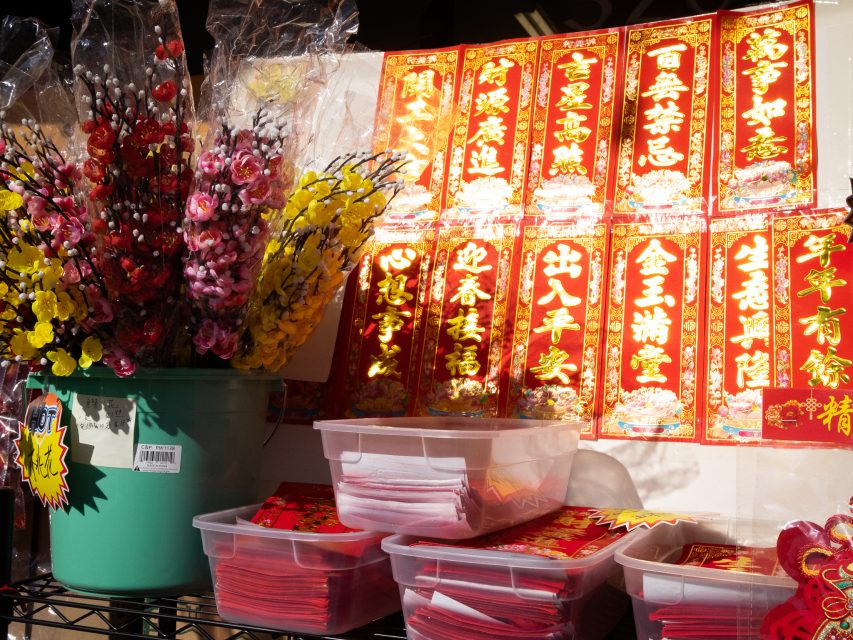
Clement Street was sprinkled with bits and pieces of red everywhere on Tuesday morning: A bouquet of red gladioli. A red purse, embroidered with the Chinese characters “happiness and safety.” And the red plastic bags from the various BBQ shops, filled with containers of char siu, roasted duck or crispy pork.
It is the eve of the Lunar New Year, and the city’s Westside residents are looking for the best red-and-gold decorations for their house, or doing last-minute grocery shopping for Tuesday night’s feast. The festivities — including special food, traditions like burning incense at temples and visiting friends and relatives — will go on through the 15th of the lunar calendar, which is Feb. 12. The parade, however, extends the holiday, as it will take place on Saturday, Feb. 15, this year.
At the flower shop
At the 6th Avenue Aquarium and Flowers in the Richmond, red gladioli were a popular choice. So were chrysanthemums and lucky bamboo.
“I want the flowers more open,” one customer said, as she looked through bouquets of gladioli.
“This one’s leaves are kind of brown,” another murmured, scrutinizing a potted peace lily.

This is one of Lauren Li’s busiest days of the year, followed by Christmas and Mother’s Day, she said as she wrapped up flowers for customers. Her own decorations may have to wait “until late tonight,” she said.
Charlotte and Catherine Chao arrived at the shop on Clement Street after finding the flower options on Irving Street underwhelming.
Holding a bouquet from Li’s flower shop, Chao said the secret to having the best blossom out of the gladiolus is “to nip the tip off and it will bloom like crazy.”
Growing up in Hong Kong, Chaos said the Lunar New Year there was much more exciting, with “all kinds of goodies:” rice cakes, red bean cakes and flower markets.
What’s for dinner?
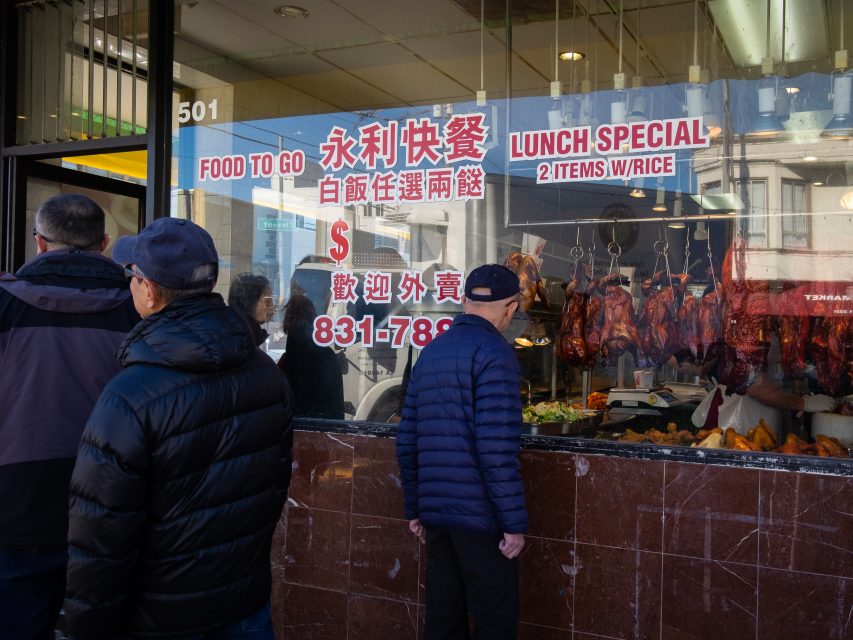
Around 11 a.m. on Tuesday, the line wrapped around the corner at Wing Lee BBQ. Inside the shop, roasted chicken and ducks glistened with animal fat as they hung on hooks.
Ying, in a white down jacket, stood at the back of the line. Having a satisfactory Lunar New Year’s dinner requires a lot of planning, she said.
“Some people are very capable, so they make the dinner at home themselves. Others either buy ready-made food, or maybe you can go to a restaurant. But you have to make a reservation a week in advance,” she said.
Ying was planning to buy a chicken at Whole Foods and cook it herself. But, as this year’s Lunar New Year falls on a weekday, she was in a time crunch. Waiting in line, she looked inside the display window, eyeing a roast chicken to take home.

The items at a traditional Lunar New Year’s dinner are full of homophones. Fish is non-negotiable, as it sounds, in Chinese, like “surplus,” which implies prosperity. A whole chicken means “luck.” The round shape of meatballs means “togetherness,” making them another Lunar New Year dinner favorite.
Anna, a 72-year-old who was born in the Year of the Snake, says she follows her mother’s script: Fish is a must. Roast duck instead of chicken, because her boys asked for the switch. Two types of soup, one with seaweed and the other with bean curds and dried oysters.
She pulled out a bag of peanuts from her grocery bags to illustrate the dessert she would make. Peanuts and sugar wrapped in wonton skin, made in the shape of a dumpling, and deep fried.
Hanyang Liu, who moved to the United States 12 years ago, has a very different menu. Originally from Chengdu, the capital city of Sichuan province, Liu’s Lunar New Year dinner consists of signature Chengdu dishes: Soup with beef slices dipped in ground chili pepper flakes, slow-cooked pork knuckles with chili oil sauce, and rice balls with sweet fermented rice.
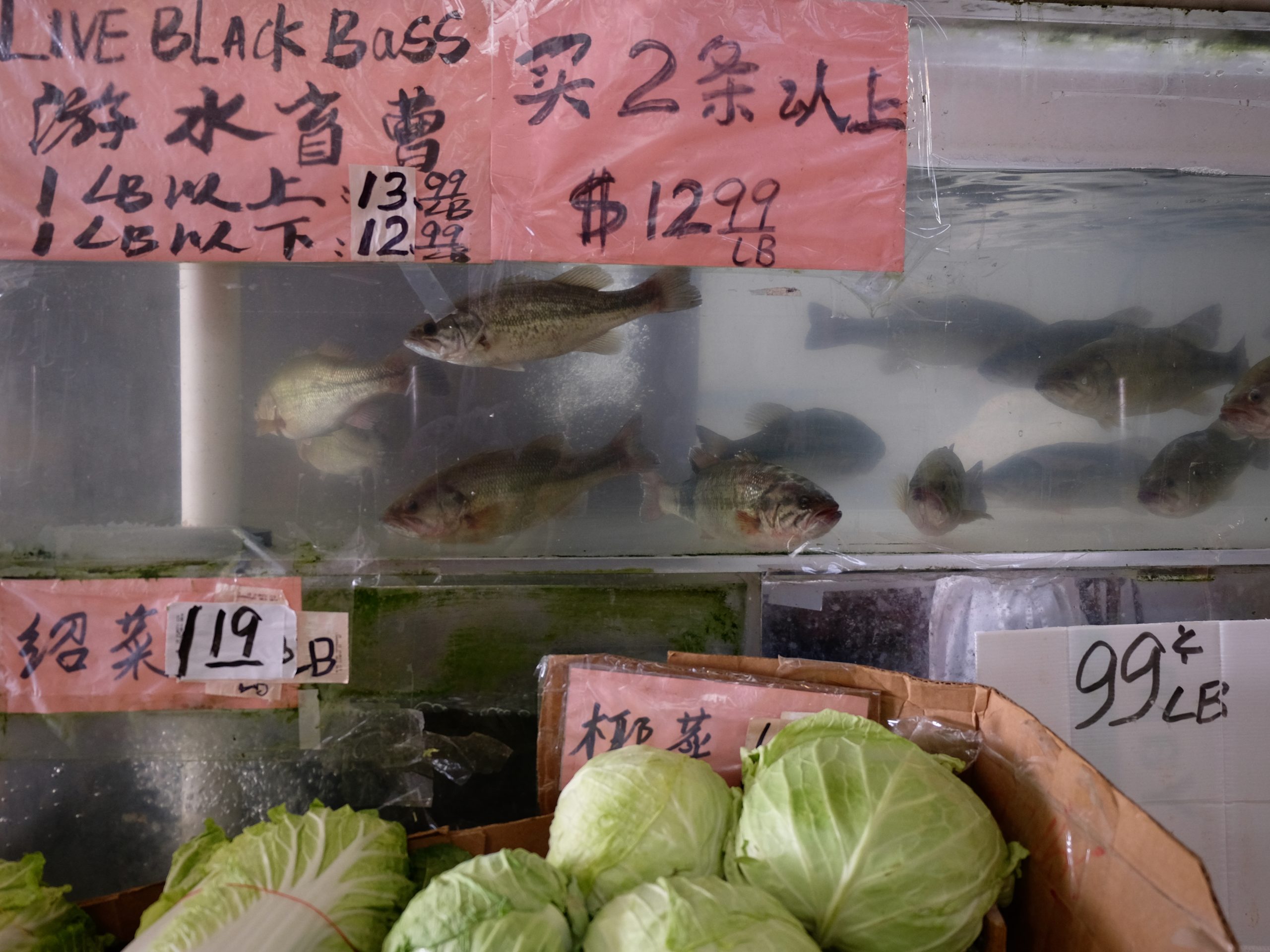
Around noon, Wing Hing Seafood Market caught a quiet moment from the shoppers. Danny Jin, who migrated to the United States when he was 25, was working at the back of the market, skillfully cutting a big chunk of pork into smaller pieces. “Most people have bought what they need yesterday or the day before,” Lin said.
“We didn’t have anything to eat,” Jin said, looking back at the Lunar New Years when he was younger. “Even eating some chicken fat was the greatest thing.”
Life was bitter back then, he said, but it has gotten better — “a lot better, not just a little better” — after coming to the United States. “We didn’t go to school. We can only do this kind of work,” he said. But now, his daughter is a graduate from the University of California, Berkeley, and works as a doctor.
As for his wishes for the New Year, “Health is the most important,” he says and, as if to underscore that thought, he is taking off the first day of the new year to take tea at one of the bakeries nearby.