


Last March, 58 percent of San Franciscans voted to pass Proposition F, which mandates drug screening for certain welfare recipients in the city. It was one of the most well-financed measures on the ballot; donors poured in more than $1 million, including $500,000 from cryptocurrency billionaire Chris Larsen. National TV coverage, at the time, heralded its passage as a sign of the city’s rightward turn.
But the implementation of the measure has not gone entirely smoothly, and may not come to pass at all.
In March, SEIU 1021, the city’s largest union, filed an unfair practice charge against the city for not notifying and bargaining with the union before putting Proposition F on the ballot. A hearing on the charge started on Monday, and could void the measure entirely.
Additionally, questions are swirling regarding the $1.6 million contract to administer the program, which the city awarded to the nonprofit Positive Directions Equals Changes in September. It runs abstinence-based transitional-housing programs. Both co-founders of the nonprofit, Cregg Johnson and Cedric Akbar, sit on the Proposition F steering committee, meaning they provided feedback on its implementation and will be responsible for overseeing their own performance. Akbar was also one of Proposition F’s most outspoken supporters.
“You have someone who was hand-in-hand with the mayor. He’s publicly involved in pushing for the campaign for the measure to pass,” said Sara Shortt, a Proposition F opponent and housing organizer, referring to Akbar. “Then there is a ‘process’ around implementing the measure that he is a part of. And finally, guess who gets the contract?”
Akbar, in an interview, denied any conflict of interest. He said sitting on the committee did not give his nonprofit control over the contracting process. Westside Community Services, the fiscal agent for Akbar’s nonprofit, will control the funding received. “All we do is get paychecks,” he said.
Akbar, who now earns about $110,000 a year, will receive a pay bump to $130,000 with the new contract. But, Akbar said, only 20 percent of that total salary comes from this contract. The rest comes from other contracts with the city, mostly with the Adult Probation Department.
Shortt also sees a discrepancy between the interventions Proposition F supporters promised and the services that are required. In campaign ads, supporters emphasized how the measure will force people to “receive treatment” and “save lives.” But the measure didn’t always specify what treatment that would be, and it was opposed by a group of medical professionals and treatment providers.
The “treatment,” however, may not include medical services. Positive Directions can refer clients to a list of services from the Department of Public Health and other providers. But also to its own, such as the Billie Holiday stabilization center, where clients get a temporary bed, or its Clubhouse program, which provides a hang-out space with free meals, classes and peer support. It may also, Akbar told the San Francisco Chronicle in December, prescribe activities such as attending a church service or a ballet class as a “step toward treatment.”
“Voters passed it believing that people would be sent to a treatment program, given clinical support with substance use counselors, medically assisted treatment and residential beds,” said Shortt. “That’s not what happens at all. I believe voters were swindled that way.”
Additionally, Akbar’s nonprofit was the only one to submit a bid, according to the Human Services Agency.
Asked why the city did not look for more contractors, the agency responded that it “could have sent the Request For Proposals out again to get more interest,” but “decided to work with Westside,” referring to Positive Directions’ fiscal sponsor.
The city’s process in seeking and approving this contract, which took four months, was criticized as too short by some.
“It’s completely rushed, which creates a lot of accountability issues,” said Xiu Min Li, field supervisor of SEIU 1021, the city’s largest public employee union. The union opposed outsourcing the work to a nonprofit provider. “They are using the timeline as a weapon to basically ram this forward.”
Minutes and notes were not kept from the committee meetings, according to the Human Service Agency, which is “absolutely not normal,” according to former Board of Supervisors President Aaron Peskin.
“By all appearances, the granting of this contract was untoward, and reeks of political interference by Mayor Breed and her administration, and should be investigated,” added Peskin. The city’s new inspector general, a position created by Peskin’s Prop. C in November, “should look into” the matter, he said.
At present, about 5,500 people in San Francisco receive welfare monthly from the County Adult Assistance Program, which awards up to $712 every month.
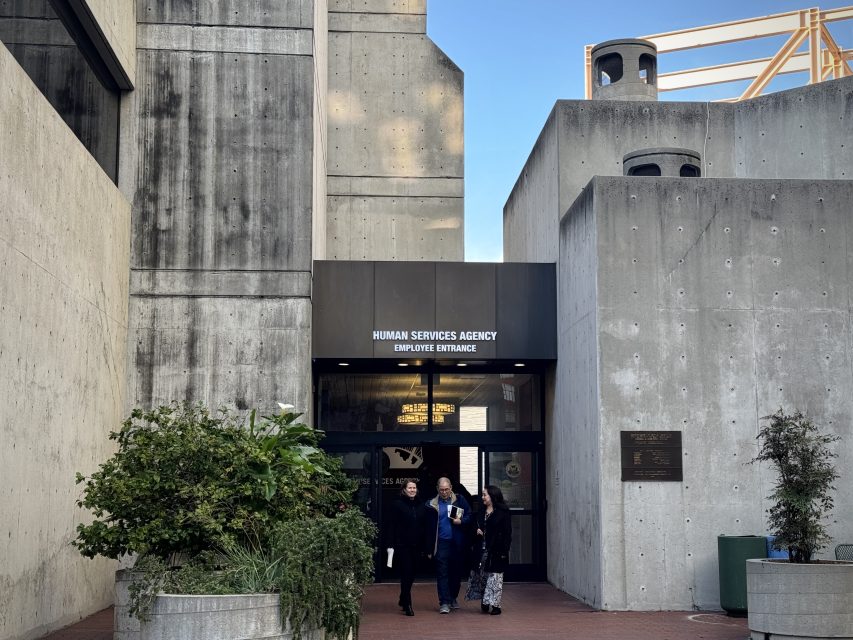
As of this month, when people apply for welfare, they are evaluated by Richmond Area Multi-Services, another nonprofit, to assess their use of drugs.
Those suspected of having a substance use disorder are then sent to Positive Directions for a more intense assessment, developed by the University of California, Los Angeles.
If Positive Directions finds that someone is likely using illegal drugs, they will be required to participate in “some kind of substance-use treatment or intervention to keep their benefits,” according to the Human Services Agency.
Positive Directions will refer clients to those treatments and interventions, but cannot provide any clinical substance abuse treatment themselves, since the nonprofit is not a licensed treatment provider, according to the Department of Health Care Services.
It also tracks the client’s participation, and reports it to the local welfare office, the County County Adult Assistance Program.
After three instances of non-compliance, the cash benefits will be discontinued.
The Human Services Agency in May created a 13-person advisory committee to implement the measure.The committee included three public health professionals, as well as Akbar and Johnson from Positive Directions. Also on the committee are die-hard opponents of harm reduction strategies in San Francisco: Tom Wolf, a formerly homeless recovery advocate, and Steve Adami, the director of the Salvation Army’s “The Way Out” program.
All were part of TogetherSF’s “That’s Fentalife!” campaign, in which the billionaire-backed pressure group took out billboards across the city that were widely lambasted for trivializing a deadly overdose epidemic.
Khyla Bussey, Positive Directions’ director of programs who is overseeing the measure’s implementation, denies any favoritism.
“We are in the same game that everybody else is in,” said Bussey. “We filled out the [request for proposal] and those were scored by [the Human Services Agency]. That’s the process.”
Akbar, for his part, added that Positive Directions has been doing the work for a long time, “even without funding.” The nonprofit was founded in 1993 as a support group for formerly incarcerated men, and in its early years, he said, they had to pay money out of their own pockets, hold fundraising events, and volunteer time to support their work.
The organization got its big break early in the Covid-19 pandemic: Akbar started to speak up for abstinence-based treatment and call attention to the reality that substance abuse affected Black people disproportionately.
Between 2020 and 2021, Positive Directions opened three new facilities.
“It took 20 years before we even got a damn contract,” said Akbar, referring to early years when the organization did not receive city funding. “But that never stopped us from doing what we’re doing. And even if they took all the money away, if I make a commitment to do something, that’s what I’ll do.”
Taking the money away is a distinct possibility. SEIU 1021 on March 7 filed an unfair practice charge with the Public Employees Relations Board against the city for putting Proposition F on the ballot without giving the labor union an opportunity to bargain, even though it will impact its members’ working conditions, the union said.
A similar case unfolded in Sonoma County in 2023, when the California Public Employment Relations Board sided with the county’s law enforcement unions over a ballot measure. The board ordered the county to “cease and desist from such conduct in the future and to post a notice of its violations.”
The hearing is scheduled this week, and if the board sides with labor, the implementation may not go forward.
If that happens, the implementation committee will “have to go back to step one,” said Li, the SEIU 1021 field supervisor.
(Poster voted No on F)
“Akbar, in an interview, denied any conflict of interest. He said sitting on the committee did not give his nonprofit control over the contracting process.”
The typical bar is *appearance of conflict of interest*. There should be no way Akbar can weasel himself out of this situation. But then, city family. Anybody involved in qualifying Akbar’s organization, let alone awarding a contract, is a straight (fill in yourself).
And Lurie wants to eliminate oversight on City contracting with poverty nonprofits?
First I have heard of the human services agency. Seems like addiction treatment/“treatment” programs are administered by dph, hsa, maybe some others too? Hope some experienced observers can throw relevant links or reading items for me to learn more about San Francisco human services agency.
As far as positive directions and the prop f steering committee, goes without saying the whole situation reeks pungently.
HSA administers social services such as in home adult services, child protection services, welfare/general assistance, etc. HSA is the city agency that’s supposed to to implement Prop F as a gateway to any of those services.
will this actually help people or cost more
money than it saves when people are kicked off of welfare?thinkprogress.org/states-waste-hundreds-of-thousands-on-drug-testing-for-welfare-3d17c154cbe8/
“It may also, Akbar told the San Francisco Chronicle in December, prescribe activities such as attending a church service or a ballet class as a “step toward treatment.”
Those of us who voted against this KNEW THE CITY WOULD NOT OFFER REAL TREATMENT. And it’s been shown over and over that drug testing costs more than saves and is a grift.
This is a great and well-researched piece.
The people did vote for the proposition..in typical SF fashion, we are going to overrule the will of the people to please just a few on technical grounds. So tomorrow let’s just press the repeat button regarding fixing this city and trying to tackle the problems…and repeat again..ad again..and of course the “few” will complain again and ask for more money to secure their jobs..No homeless or drugs addicts in the city means no jobs for those people..those jobs pay very well, so it seems it is never in their interest to actually solve the problems..
>we are going to overrule the will of the people to please just a few on technical grounds
If you read the article, reality states it has legal precedent and also states possible corruption.
Those aren’t technical grounds, and reality sure doesn’t care about your feelings.
I am afraid you got all this the other way around: elections have consequences, and your frustration doesn’t care about your feelings! But sore loser wants to overturn the end result anyway; it became customary. Similar reasoning with your “legal precedent”, you are just turning the spotlight on a corrupted alleged “legal” system rather than an authority.
Totally agree with you +10. They’re denying voters of their rights, they should be sued! I am totally anti-trump, but would leverage the monkey happily to clean SF from those parasites and their protected hobos. Crossing fingers this is going to happen soon.
How does Daly City resident Tom Wolf keep getting appointed to these kinds of committees? He is making a living exploiting a city he pretends to call home.
T Wolf and these other abstinence only folks are not acting in good faith. They want MORE punishment for a population that is already endlessly punished.
Mark my words. This will either not get implemented or will fail miserably just like every drug war based/prohibition-based/criminalization based intervention before it. And the thing is: we don’t agree on what success would look like. Again- these people are not acting in good faith and do NOT want what’s best for our unhoused neighbors and our drug dependent neighbors. But regardless – this ain’t it. Drug testing only increases distrust with providers and these relationships are what makes changes for people. This is simply more of the same and most everyone will fall through the cracks and be further negatively impacted by this and will be even more desperate and will result to more low level crimes, etc, and again/ that’s exactly what theee people want. BOOOOOOOOOOOO.
The implementation of Proposition F raises important questions about equity, accountability, and the effectiveness of drug screening for welfare recipients. The concerns about the contracting process and the lack of transparency in decision-making are particularly troubling. It’s crucial to ensure that such measures are implemented fairly and provide meaningful support to those in need. This is a complex issue that requires careful consideration and collaboration among all stakeholders.
good riddance to the city crime family and london breed.
Funny, from your previous article on this frivolous lawsuit – the union says: ““We have workers who do not go out to lunch at 1235 Mission, because of security concerns.” Uh, yeah, so these cowards are afraid to leave their building in broad daylight?? WTF do they expect the rest of us schlubs who actually pay good money to live on that block to do when we have to – uh – come and go from our own apartments? Why are they blocking a decent measure – designed to help people get off of drugs – and costing the city billions more dollars in legal fees in the process? And why are Mission Local – and Aaron Peskin – supportive of this terrible action on the part of this union? I’ve met Akbar in person – and he cares about helping people get off of drugs and find their way to a valuable life. It’s sad that the so-called “Harm Reduction” folks would be against that.
^^^^^^”Why are they blocking a decent measure – designed to help people get off of drugs – and costing the city billions more dollars in legal fees in the process?”
“I’ve met Akbar in person – and he cares about helping people get off of drugs and find their way to a valuable life. It’s sad that the so-called “Harm Reduction” folks would be against that.”
1. If you think or believe that this is a ‘decent measure – designed to help people get off of drugs “, then you are either misinformed or ill informed. Urinalysis is an ‘intervention’, that is not only proven not to be helpful and many believe to be a violation of civil liberties/rights, but, it is proven to be a monumental waste of money and when specifically used within the context of the welfare process in similar situations, has been an ineffective joke – for both the welfare recipient and the taxpayer.
2. I’ve met Akbar in person, too. I also worked with him over the years in various capacities, including methadone treatment (an evidenced based Harm Reduction public health intervention which is considered the best in reducing/eliminating illicit opioid use.) When you meet Cedric and decided that he, “cares about helping people get off of drugs and find their way to a valuable life”, did he also mention the Many women (both clients and staff coworkers) who’ve alleged that he was abusing his power and inappropriate with them in a variety of ways, including allegedly pimping women out at one of the treatment facilities? (Allegedly). While I can’t say that I followed any of the situations to their final outcome, I do know that one of them involved an abrupt resignation of full time employment, and I’m of the firm belief that where there is smoke, there’s fire. But sure, maybe he’s totally genuine about wanting to help people…I just hope my wife/daughter/friend never need any service that he may be in a position to provide. I wouldn’t trust him at all. Not with the keys to a public toilet.
Last, let me enlighten you a little bit about Harm Reduction, and what the Harm Reduction folks might be for or against by simply providing some brief education about what harm reduction is:“Harm reduction refers to a set of strategies and practices aimed at minimizing the negative health, social, and legal impacts associated with drug use and other risky behaviors, without necessarily requiring abstinence. It focuses on providing support and resources to individuals to help them make safer choices and improve their overall well-being.” in harm reduction we deal with common sense, not fantasy and we deal with what the science in the evidence supports in working, we don’t provide treatment, public health intervention, or any services based on wishful thinking. Quite simply, we do what works and we also like to make sure not to suspend compassion or love Under the hospices of “tough love”, a non-evidence based approach. It’s time to stop doing opinion based treatment with its low success rates and disrespect for the consumers needs and desires, stop running back with tails between our legs for tired, failed drug war 2.0 “solutions”, when we’ve barely stepped outside the box to begin with, and start embracing a common sense, evidence based harm reduction framework with big picture, goals, interventions, and resources to back them. Guess what? Punishment and incarceration still don’t have positive outcomes in 2025!
“Punishment and incarceration don’t have any positive outcomes …”. I guess I’ll ponder that the next time I get hit over the head by a repeat offender walking the streets because of “bail reform”. Incarceration – lengthy incarceration = deterrence and incapacitation. That is a positive outcome.