

Mission Local is holding intro interviews with incoming and incumbent supervisors, including Shamann Walton, Chyanne Chen, Jackie Fielder, Joel Engardio, Danny Sauter, and Stephen Sherill. You can read those interviews as they are published here.
Mission Local also held exit interviews with elected officials leaving office after the Nov. 5, 2024 election: London Breed, Aaron Peskin, Hillary Ronen, Ahsha Safaí and Dean Preston.
Longtime labor organizer Chyanne Chen won the race for District 11 Supervisor by just 198 votes, defeating Michael Lai, a recent arrival to the district. Chen, who first moved to District 11 as a 15-year-old immigrant from Guangdong, China, is replacing termed-out supervisor and mayoral candidate Ahsha Safaí. Her campaign was bolstered by some $700,000 in outside spending by labor unions and an Asian American political group.
Mission Local sat down with Chen to talk about her transition from organizer to legislator, her priorities as supervisor, and her approaches to some of the top concerns in the district: Public safety, child care, fostering a better environment for small businesses, and a new Oceanview branch library.
This interview was conducted on Dec. 16, 2024. It has been edited for clarity and readability.
Mission Local: How’s your transition going?
Chyanne Chen: I had the opportunity to connect with the mayor-elect and current supervisors.
We had a very open dialogue about making sure that we collaborate on important issues, like public safety and accountability — collaborating towards a goal of making San Francisco better. We have to have hope and change.
ML: Is there anything specific that you and Mayor-elect Daniel Lurie talked about?
CC: Yes. My library. I made sure that he knows the library is one of our top priorities. Our district has the most number of children under age 14. It’s the most diverse district — multigenerational families, lots of seniors.
Public safety is also our top concern. Our business corridor needs attention and resources.
ML: How would you address public safety?
CC: I’m meeting with the Ingleside and Taraval police station captains. All the captains have done amazing work, so I want to give them credit.
We have a police officer liaison, Sam Berenson, that’s really trying to help troubleshoot. These are resources that are existing and beneficial. So I would like to make sure that, even during budget-deficit times, we’re able to keep existing programs that are serving the business corridors, like ambassadors and Sam, who is the safety patrol of the community, but not a police officer.
ML: How do you plan on addressing the business vacancies on Mission Street and Ocean and Geneva avenues?
CC: Events that are bringing people back to the business corridors, like Sunday Streets, Lunar New Year, African American History Month; we have opportunities where we can create events to support our small business.
Districts 1, 3 and 4 heavily celebrate Chinese New Year. District 11 is 57 percent API [Asian Pacific Islander]. We deserve some local celebrations.
ML: What are the other things that you’re doing during this transition period?
CC: Meeting with nonprofits: We Are OMI [Oceanview, Merced Heights, Ingleside], Slowyuga, Friends of Balboa, EAG [Excelsior Action Group], Cayuga Terrace Association, District 11 Democratic Club, Ocean Avenue Association, SF Walk, Hummingbird Farm, and Sisterhood Garden.
As for citywide, labor unions like SEIU 2015. They have lots of services in the district.
And people who have helped me during the campaign, or people who have a strong participation in District 11; I will continue to try to meet with them and hear their priorities.
District 11 is a forgotten district. Their needs were never met. So my priority is to make sure that I hear from them (the neighborhood organizations) and make sure of their needs, at the minimum. Make sure that we have enough resources to serve our kids and our seniors.
ML: You’ve always worked as a labor and community organizer, and now you’re stepping into the role of a legislator. Who do you call when you need advice for government matters?
CC: I have been a community organizer and union advocate, but a lot of the work that I have done is related to policy, like paid sick leave and minimum wage.
As a supervisor, there are two really important roles. One is constituent services. Second is making sure that we have good legislation that is not just impacting District 11, but the entire city.
There are so many people in my team alone that are very knowledgeable about the community and the legislation process.
ML: Who are going to be your staffers?
CC: My campaign manager, Linshao Chin. Linshao was a former aide to Eric Mar. A former aide from Hillary Ronen’s office, Jackie Prager. Another community leader named Charlie Sciammas.
We have not talked about what role each of our legislative aides will play. I believe in a working style where we actually feel ownership of each other’s work. There are a couple of ways to structure the office. My way is to bring them all together, talk about the potential ways, and test out what makes the most sense.
I cannot disclose the fourth person yet because she has not officially finished her transition. (Chen confirmed on Jan. 13 that the fourth aide will not be announced until Feb. 1.)
ML: Why did you go with these three people to work with you?
CC: So my campaign manager (Linshao Chin) — we worked really well throughout the campaign, and she learned a lot about District 11. She was born and raised in San Francisco, and she has lots of knowledge about both community and City Hall. Jackie (Prager) and I know each other, worked together, but not in depth.
Charlie (Sciammas) has been a community organizer. I’ve known him since I was a kid. He is also someone who knows the Latino community really well. Charlie speaks a lot of languages: French, Arabic, Italian, Turkish, and Spanish. Jackie speaks some Tagalog, and Linshao speaks Chinese and Spanish. I’m telling you, my team is pretty fluent in terms of serving the Latino community.
ML: Do you speak any Spanish?
CC: My daughters are learning Spanish. They both speak more than I do. (Switching to speaking in Mandarin) My daughter once filmed a video saying “vote for my mom” in Spanish. (Back to speaking English.)
ML: What do you think, specifically, is required of being a District 11 supervisor?
CC: This is a district where I see a lot of residents who really love, and have spent lots of their time investing in, the community. If you knock on the door, you can find a household that has lived in the district for the last 50 years. This is something very unique.
You see a lot of associations like New Mission Improvement Association, Cayuga Terrace Association — a bunch of very strong activists starting maybe as early as the ’70s. They’re trying to really fight for attention and resources for District 11. We have to make sure that we continue to carry a legacy of making this not just a short-term home, but a home for families.
ML: What kind of a supervisor are you hoping to become in comparison to John Avalos and Ahsha Safaí?
CC: A unifier. It’s important to bring people together. A lot of our needs are similar.
For instance: Public safety, right? Everybody talks about public safety. Everybody talks about pedestrian safety. This is not just Excelsior or OMI. How can we make sure that we all fight together, and District 11 really comes together?
ML: Do you think that Ahsha and John didn’t do that enough?
CC: It was pretty confrontational when they were running against each other. One group would be like, you know, “They would never really come to us or talk to us — John is only with the Excelsior, and Ahsha is only with the OMI.” Which I don’t think is the most accurate way of describing their politics. Or the way that they have done for the community.They both claimed they represented the entire District.
But to me, this is why it’s really important that we’re building community. In my race, we were not about confrontation. We were not attacking each other.
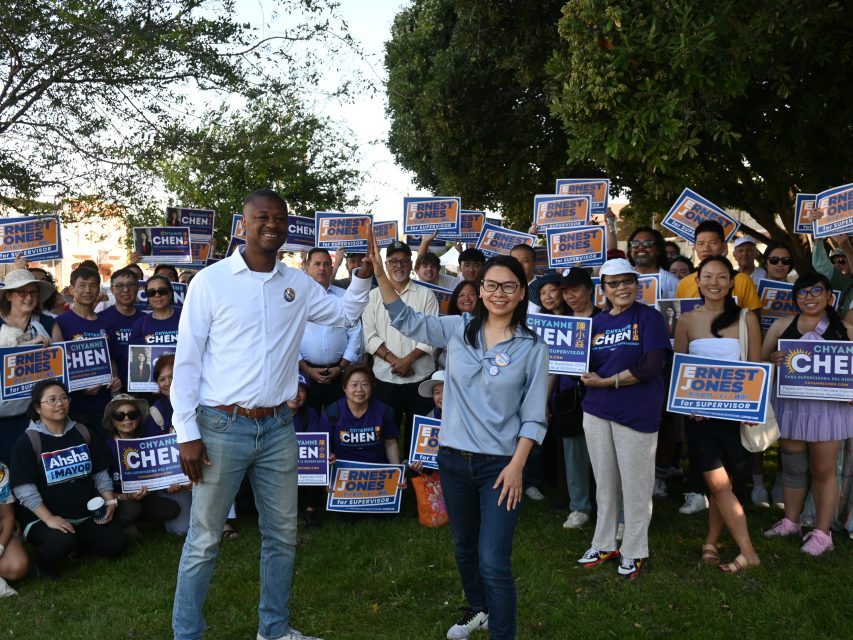
EJ (Ernest “EJ” Jones, another candidate for District 11 supervisor) and I are very similar in terms of this. We didn’t attack Michael (Lai) that much, except that people will keep calling out the fact that Michael just moved in.
ML: You come from a labor background, and labor also helped you a lot in the campaign. What kind of cutbacks must the city make? And are you in a position to tell labor “No” in some circumstances?
CC: I’m elected to represent District 11 but, at the same time, San Francisco. I want to make sure that we understand the budget a little bit more, and have a practical conversation when we are balancing our budget.
I do believe that labor is the backbone of how San Francisco continues to be able to operate. So I wouldn’t be able to say yes or no, but I want to make sure that we have more understanding of the budget and some of our options before I say “cut” or “no cut.”
ML: There are a lot of neighborhoods, and they all have needs and, collectively, they all feel like they’re forgotten over the years. How do you prioritize?
CC: The big context is we are facing a huge budget deficit. My priority is making sure that the existing programs don’t get cut. The next step is to make sure that in the next round of budget, we can negotiate more resources.
For one instance, I learned that for OCEIA‘s ambassador program, District 11 is not included in it. They fund it for Districts 3, 10, 1 and 4. I’m going to meet with OCEIA’s director and say, “Hey, thank you so much for doing all those important services. How can I support you so that District 11 can also get the same attention when you’re doing the budget? We also need ambassadors.”
And Rec and Parks: What can we do to make sure that Rec and Parks has more programs in District 11 during the summer and during breaks? Families do not need to spend an hour just to drive the kids across town.
ML: How do you, specifically, envision yourself fighting for District 11 in terms of resources and funding in City Hall?
CC: I’m committed to doing more community participatory budget processes. Maybe town halls to hear people’s priorities, then consolidate and do an analysis. I’m really trying to find common ground.
ML: So, other than the library, and not cutting the existing programs, what are some of the other priorities you have?
CC: So my No. 1 priority is still looking into how we can serve children better. What can we do for our kids? That is going to be my mindset going into the different departments.
I want to make sure that this is a district where we have the highest number of family childcare centers. What can I do, as a legislator, to make sure that we continue to create policy that uplifts worker families and children. What’s up with the Prop. C money? Where are we at?
Long-term goal is making sure that District 11 continues to have a stable structure to serve our residents. Family-related activities, whether that is after-school programs, before-school programs, summer programs. The library, hopefully the renovation of Crocker-Amazon [Playground] and the baseball field. Making sure that our vacancy rate goes down, that we are really able to continue to attract more neighborhood-serving business owners.
ML: Different supervisors have different styles. How do you envision yourself balancing that as a working mom? And, you mentioned your campaign, you’re caregiving for your parents too. And how do you balance that?
CC: Work-life balance is really important. I have a six year-old and an 11-year-old. This is why I have an amazing team of staff. I want all my team members to feel ownership. They will take turns going to events. I’m committed to go to as many as possible. I have been a really hard worker my entire life. I am continuing to bring in that mindset.
ML: District 11 voters elected you. Aaron Peskin was very popular here for the mayoral race. But the district also voted disproportionately for Donald Trump. What do you make of that?
CC: I actually attribute that to a lot of disconnect. A lot of misunderstood information. Even our Mayor [London] Breed said that the crime rate has gone down.
But people are disconnected. In social media and Chinese disinformation, you still see the $950, and attacking Asians. (“$950” here is in reference to Prop. 47, a state legislation approved by voters in 2014, allows stealing items worth $950 or less to become a misdemeanor instead of a felony. In this past election, a new state ballot Prop. 36 passed, would roll that back.) People feel like the system is not working for them.
ML: How concerned are your constituents about the Trump administration and the immigrant crackdown that’s going to come?
CC: Very concerned. I heard a lot from the constituents. San Francisco is a sanctuary city. A lot of agencies and nonprofit groups are already working together to make sure that, when January comes, there’s a lot of support for people who feel scared about anything that we heard on TV or social media, that they’re going to come and arrest you. We will continue to fight for more support for groups that are serving immigrants.
ML: During your transition, what have been your biggest learning curves? Is there something that you learned that you didn’t know about this job?
CC: I find everything is about the same. It requires dedication. Like the meeting with our city attorney, right? Lots of laws. About immigration, because of the new administration at the federal level. I’m dedicated to continue to understand the issues of San Francisco
I actually didn’t find it challenging, but I find it valuable. Because we are actually in a kind of crisis. It’s a lot of information. And this is why I have a team of people to serve the community. I’m not alone.
I feel like I’ve been giving myself a lot of grace. I’m not a superwoman. I cannot know everything. Right? It takes time.
Thank you for this informative sitdown interview. I really learned a lot. Feeling hopeful.