
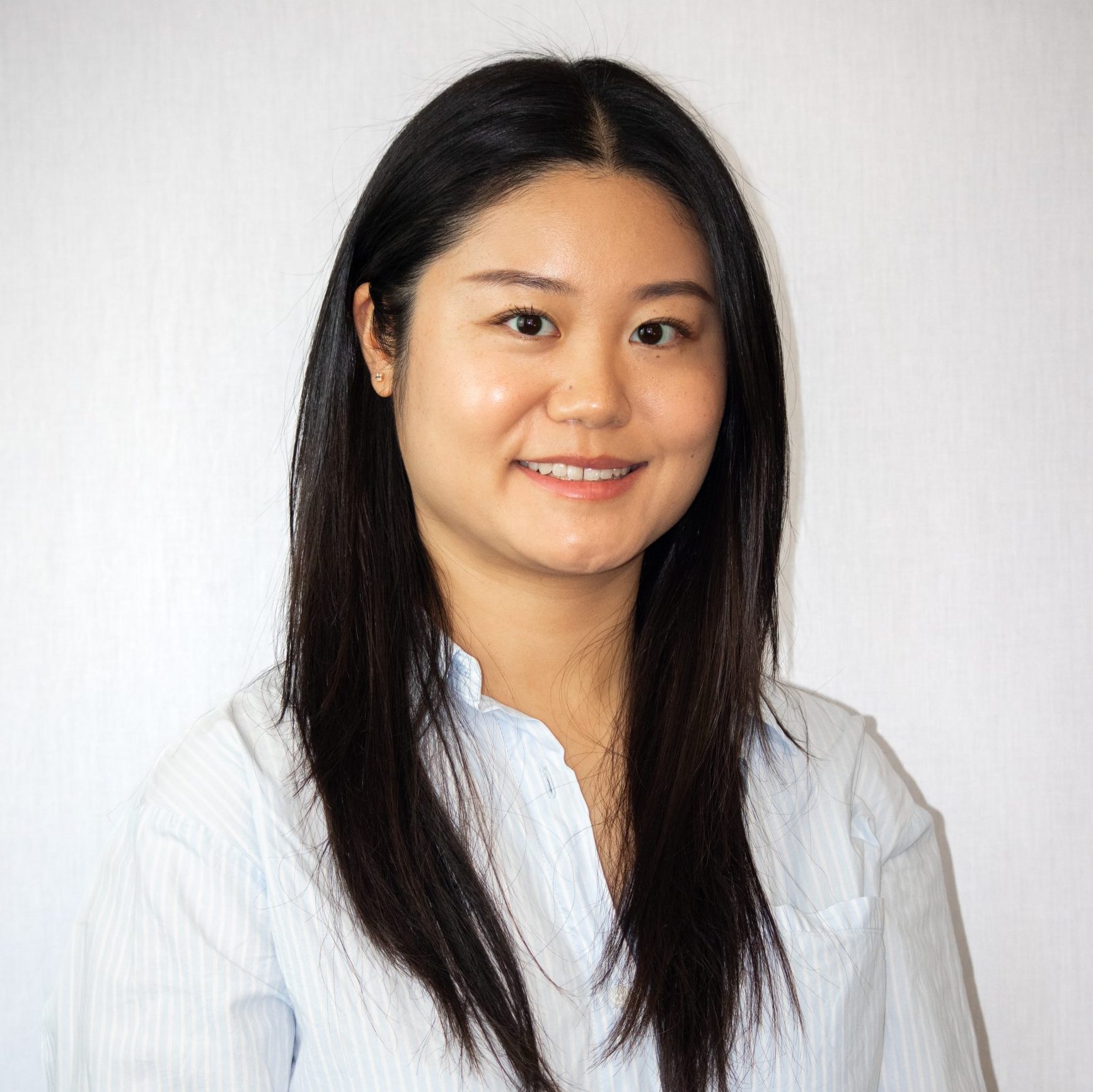

Mission Local is holding intro interviews with incoming and incumbent supervisors, including Shamann Walton, Chyanne Chen, Jackie Fielder, Joel Engardio, Danny Sauter, and Stephen Sherill. You can read those interviews as they are published here.
Mission Local also held exit interviews with elected officials leaving office after the Nov. 5, 2024 election: London Breed, Aaron Peskin, Hillary Ronen, Ahsha Safaí and Dean Preston.
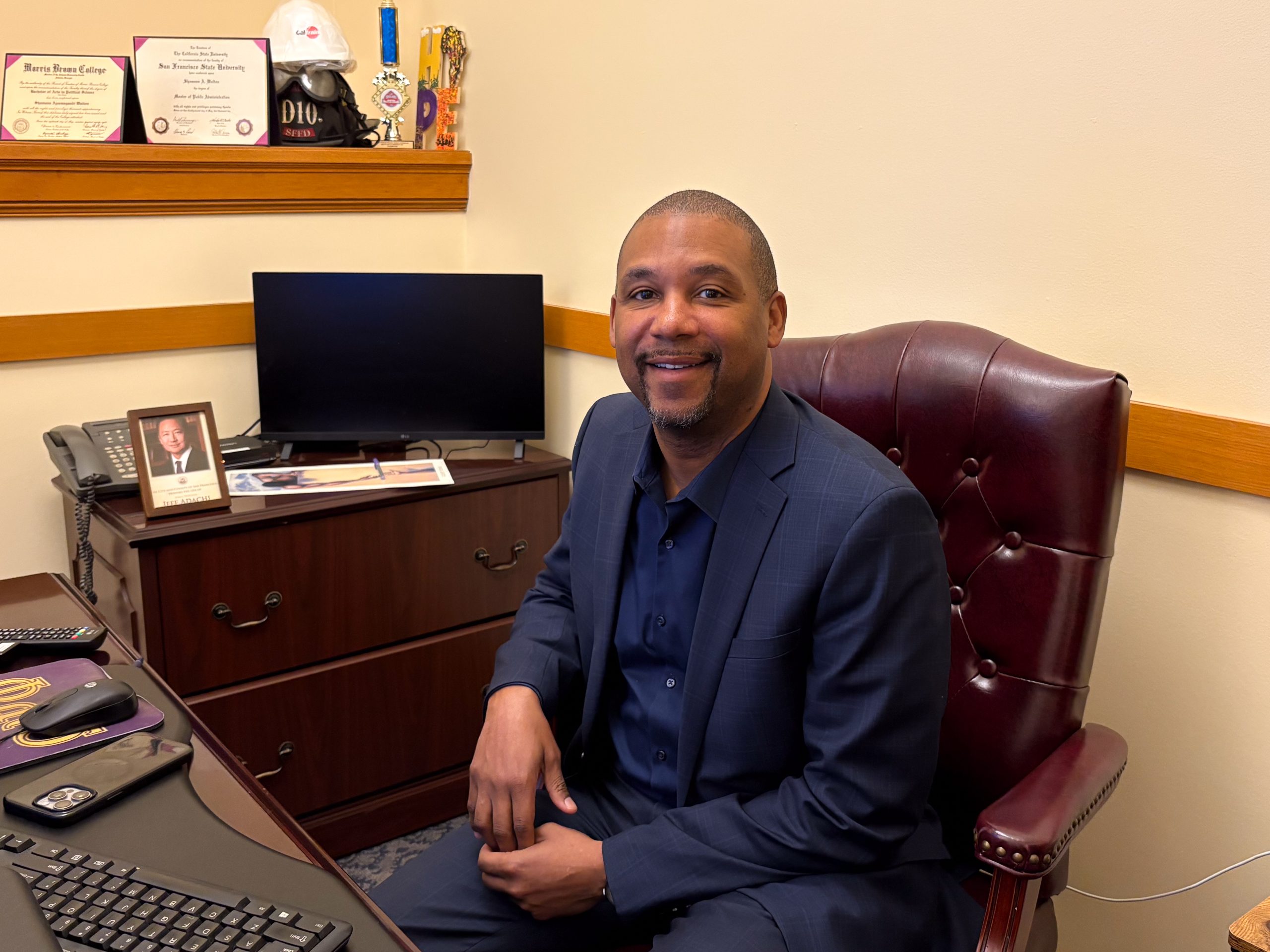
Supervisor Shamann Walton is six years into his time in office at City Hall. He represents District 10, which encompasses neighborhoods such as the Bayview, Potrero Hill and Visitacion Valley.
Sitting at the southeastern edge of San Francisco, District 10 can feel isolated from the rest of San Francisco. Residents often say they are not getting their fair share of attention from City Hall. It has the highest percentage of Black constituents, and the third-highest percentage of Asians.
Mission Local sat down with Walton on Jan. 27 in his office.
Walton, now one of the most senior officials on the board, talked about what he thinks of the new board (less bold), the new mayoral administration (less guarded), and why he no longer supports a participatory budget in District 10.
This interview has been edited and condensed for clarity.
Mission Local: So, what have been your priorities for the last two years, and what are your priorities for the next two years?
Shamann Walton: In general, my priorities have been to make sure that the folks who have been isolated by inequities across the city receive more attention and more support.
So, addressing quality of life issues. Transportation safety is going to be a real big focus of our office, which is why we have a safety plan — really, to deter violence in the community. It’s translated into three languages.
Also, affordable housing. We have a lot of big projects in the district. We want to make sure that the projects that we set out to get completed actually happen: [Potrero] Power Station, Pier 70 and making sure that Candlestick breaks ground.
My priorities haven’t changed from the last two years. Reparations have been a major priority for our office. It still remains a priority to find a funding source for some of the recommendations made by the Reparations Task Force.
The biggest thing for us is affordable housing, language access, quality-of-life issues and public safety. And that will continue to be the focus for us.
ML: The district has become increasingly Asian over the time that you’re a supervisor. Has that impacted your priorities at all?
SW: Language access has always been important for us. One of the first things I did was get City College accredited educators to teach English in Visitacion Valley to many monolingual Chinese-speaking families.
Affordability. Safety. All of my priorities are for everybody, and representative and reflective of everybody who is disenfranchised and isolated.
ML: Is this growing Asian community scattered across the district? Or do they tend to be in one neighborhood?
SW: Pretty scattered across the district, but I would say the majority are probably in Visitacion Valley. But definitely a lot of seniors in particular, living in senior housing in Hunter’s Point.
ML: Other than language access, how do you reach those constituents that are in the senior housing?
SW: Obviously, we send out a newsletter, fliers. We go into the community and do outreach. It depends on what information we’re trying to disseminate.
ML: Compared to your first term as supervisor, what has changed in your second term?
SW: If you look at the makeup of the Board of Supervisors, obviously, the board has gotten, quote unquote, more conservative, depending on who you talk to.
We had a pretty bold board that was not scared to tackle issues of equity and challenge the status quo. Folks questioned decisions that didn’t make sense for the constituency that they served.
I think now there’s a mentality of just wanting to agree with everything everybody says, and not pushing back on things that would negatively affect, particularly, communities of color. That’s been definitely concerning for me. But we continue to focus on the things that we prioritize.
ML: Are there any specific issues that the supervisors on the new board can resolve that may have been more difficult with the old board, or vice versa?
SW: We definitely can all work together to bring more affordable housing to San Francisco. There are some projects in the pipeline. We want to make sure that all of my colleagues support those.
I think that we can do a better job coming together to make sure that safety is addressed, and do it in a manner that’s compassionate and provides resources and opportunities to people who need us the most.
Those things, I think, we’ll all be able to work well together on.
ML: I guess I meant: Is there any specific issue, or a specific legislation that could be easier to tackle or easier to pass?
SW: I think those broader areas are where the focus is going to be, in terms of getting the synergy. I don’t have a specific policy to give you right now.
ML: What about the new mayor’s office? What was the dynamic and relationship between the former board and the former mayor? How might that change for good or ill?
SW: People don’t see all the work that happens behind the scenes or in collaboration. For the majority of the policies the Board of Supervisors push, most folks are all on the same page. That goes for the last mayor. That goes for this mayor.
The media like to highlight differences of opinions. But the majority of policies, we typically support as a whole.
People are asking a lot of questions about, “How do you feel about the new board? How do you feel about the new mayor?” They haven’t even been here long enough [for me] to have an opinion. I think we will have a more cordial relationship with this new mayor, but that remains to be seen.
ML: As a supervisor, you’re perhaps the highest-ranking employee from District 10 to represent the district at City Hall. How are you planning on working with the new mayor to get more attention to the district? Have you had any conversations with the new mayor, in terms of resources for the district?
SW: [I] definitely met with the new mayor when he first got elected, and had conversations about making sure we keep the investment that was promised to the Black community.
With the last mayor, it was the Dream Keeper initiative. With this mayor, [we are] not sure what the focus will be. But the investment is something that I want to make sure is prioritized. The Black community continues to be neglected here in San Francisco. Resources carved out to address Black issues are important.
The mayor and I have talked about that. He says he agrees. Obviously the proof is in the policies. The proof is in the things we support together.
We talked a lot about making sure young people have an opportunity to thrive, and what we can do to support education. Addressing the needs of folks who are unhoused and living on the street, and what opportunities we make for them to be housed and have opportunities.
So those are some of the things we talked about specifically. We haven’t had a lot of one-on-one discussions, but that was something that we talked about and prioritized.
ML: How would you, with this new mayor, specifically advocate for resources?
SW: One-on-one conversations, obviously. And reaching out to him when there are concerns and things that I think we should push and things that are important.
He has staff in place for us to talk to about certain issues and certain concerns. But for me, it’s just directly going to the source as much as possible.
ML: So far, with the new administration, have the dynamics been different compared to when Mayor London Breed first started?
SW: Not for when she first started, for sure. But I would say I was less compelled to talk to her team than I am to the new mayor’s team.
ML: Why is that?
SW: Just a lot of the personalities for the old mayor. Their approach is not the same as what I’m seeing from the new mayor.
ML: Any specific examples of the difference?
SW: I would say that the old mayor’s staff is more guarded and less transparent. And definitely more standoffish when it came to focusing on issues that affect folks who are disproportionately dealing with the most issues.
ML: Is there any example you can think of where you found yourself in a position when they were really guarded and you can’t get anything through?
SW: Not anything that I want to put out there. I’m going to respect the last administration and let them move on and go on about their business.
I got a whole bunch of examples. But the old mayor is gone, and it’s time to focus on getting the work done.
ML: That’s fair. What do you think of the hiring freeze that the new mayor put out? Are there a lot of city workers living in District 10, and how is it going to affect them? Are there any needs in District 10 that could be addressed by hiring more city workers?
SW: We have a good amount of city workers in the district. A lot of folks who work in the service industry and work for MTA and just work for the city as a whole.
We have a major budget deficit that has been projected. And so, as a member of the budget appropriations and as someone who understands that we have to make sure we balance the budget and provide the services that are needed in the community, I would say that the hiring freeze was probably just one step for the new mayor to figure out where we can look for opportunities to maintain critical services and at be able to deliver a balanced budget.
I think it’s something that remains to be seen — the complete negative effect. We can hire folks around emergency services and public safety, which I think is important.
But it’s going to have a negative effect, for sure, particularly on some of our city departments, who were looking to hire so that they can address capacity issues and be able to provide better services for the community. It’s a Catch-22.
ML: Are you concerned about this hiring freeze?
SW: I need more detail in terms of how it negatively affected certain city departments. I’m having those conversations right now.
I’m always concerned when we have a deficit. I’m always concerned when people can’t hire the staff that they need to be able to deliver services to folks in the city. But, at the same time, there’s still more data needed to be collected, in terms of the major negative effects and how long and how temporary the hiring freeze is.
ML: How long do you think that process is going to take for just collecting data and figuring it out?
SW: I don’t want to give a timeline on that. Obviously, the budget process is starting now. So we’ll be looking into everything that will allow us to address the deficit over the next couple of months.
But I don’t have a timeline for how long it’s going to take for the mayor’s team to decide whether or not the hiring freeze is something that should continue in the short or long term.
ML: District 10 residents sometimes feel forgotten. They’re far from City Hall, and they don’t get enough city resources and attention. Do you think that’s the case?
SW: I would say that there’s probably not any district or community that feels like they get enough attention or resources from City Hall.
Most certainly, we’ve been isolated and disenfranchised for years. That’s why I’ve worked hard to improve transportation to make the T [Muni line] more efficient, eliminating switchbacks, bringing in a new bus line — the 15 Express — making sure that, coming out of pandemic, transportation was restored in District 10 first before it was in other areas across the city.
That’s why, during the budget process, I maintained my status as a member of budget appropriations, so that I can be there to fight for resources for the district and make sure that the priorities that my constituents express are reflected.
Yes, the district has been neglected. There’s been a lot of isolation for so many reasons, particularly in our public-housing communities and being a working-class community. We need more resources, more attention, so that all of our families can thrive. That goes for the way our schools are neglected, to how often we clean up when we have areas that have seen illegal dumping, etc..
ML: Is a low election turnout a concern at all for you? And if so, how do you envision yourself increasing it in the next two years?
SW: It’s very concerning to have a low voter turnout from District 10.
We’ve done so many different things to try to get people to register: Tabling at events to get people to vote, sending out emails and information to the entire district, letting people know how easy it is to vote and where they can go.
Getting people to register is one thing. Getting them to vote is another. Voters are going to show up when they’re excited about what’s on the ballot. I think a lot of folks are disheartened with the voting process, disheartened with politics in general, and don’t feel that their voice is being heard. I try to make them understand how vital their voice is; that if they don’t vote, then decisions get made for you, because you’re not a part of the process.
ML: And speaking of getting people engaged in the civil process, District 7 is probably only the one doing a participatory budget. Is that something you envision that District 10 could replicate?
SW: No.
ML: Why is that?
SW: Participatory budget is reliant on who participates. That was in process with my predecessor. But we found that it wasn’t reflective of the entire community and the entire district.
It just wasn’t getting people to get excited about the budget, to participate more. Only certain groups of people were participating; more affluent people.
ML: Looking back at the past six years, what is a project or a program that you’re most proud of? And what is something that you wish you can get done before you leave?
SW: People are always asking that question. I think all the work that we do is important.
I think creating a safety plan, which has actually led to reduction of homicides and shootings in communities, is important.
I think banning e-cigarettes, so that our young people will stop being targeted and getting addicted to tobacco, is big.
I think approving all the affordable housing that we have, including some 100-percent affordable housing projects that we worked on from Day One, is important.
We also worked on closing Juvenile Hall. We didn’t have a whole bunch of people incarcerated in San Francisco, but we also were focused on making sure that people who made mistakes received the opportunity to be successful. We want to continue to work on reforming the juvenile justice system, to make sure it’s beneficial to young people, and not just feeding the prison pipeline.
One of the other big things that we tried to do that hasn’t happened is reparations for Black folks here in San Francisco. We’re going to continue to focus on and push for that.
We have been able to stop people from being deported who have been a part of communities here in San Francisco for decades. Under certain administrations, people have tried to push them out. It’s definitely important to families and keeping communities together. Everything we do in this office is focused on equity and providing opportunities for people who typically get overlooked.
ML: A report says San Franciscans living in Bayview Hunters point are lagging 14 years in life expectancy, compared to those living in Russian Hill. What do you make of that? And what do you think needs to be done to even begin to change that? And how can you, as a supervisor, make a difference?
SW: A lot of that has to do with the air quality in the district. What we have to do is make sure we reduce emissions in the area. We’ve worked to shut down cement plants, and we’ve been successful at that. We have to focus on bringing better quality businesses into our industrial areas, so that we reduce emissions and the number of trucks that keep coming in and out of our community.
I serve in the Bay Area Air Quality Management District. So when there are companies that are violating, I serve on the body that is there to make sure there’s a consequence, and get them to fix their behavior.
I’ve worked with the Navy and the EPA to get the shipyard cleaned up. Try to push the Navy to do it effectively and efficiently. But also to get it done and not take so long, because it’s been too many decades where the nuclear waste from the shipyard is not cleaned up. It’s a hard fight when you’ve got a local government trying to fight the Department of Defense and get them to do what they’re supposed to do.
ML: What has been the biggest challenge when you’re pushing EPA and Navy?
SW: Aside from the personalities and the people, I think it’s just being such a big bureaucracy.
They think that there’s not much we can do, as a city. They take their own time, move at their own pace, because there’s no consequence for inactivity in cleaning up the shipyard. And that’s the biggest barrier.
ML: And so what’s the latest with the naval shipyard?
SW: There’s a schedule and a timeline for cleanup that has never been made.
ML: How do you think redevelopment should be done properly there?
SW: I think that everything needs to be completely cleaned up, all the nuclear waste. Then we talk about what goes next.
The housing that we have there now — I wanted to make sure that there was soil testing and sampling before the buildings went up, since I’ve been in office. So Parcel A, where they are building, those areas have been tested, which is different from other parts of the shipyard.
But I would never say that the shipyard is totally clean.
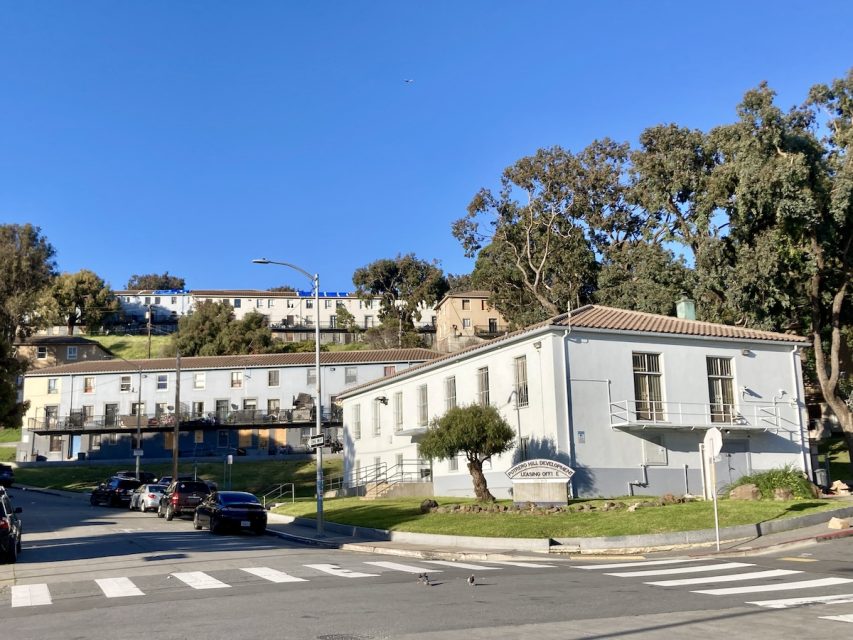
ML: Speaking of housing projects, we know in Potrero Hill, there’s mismanagement. And you’ve called for hearings three times. And it looked like the city was finally going to get rid of Eugene Berger. Did they?
SW: I think the hearings have worked. I think holding Eugene Berger accountable and letting the Housing Authority know how important it is for our residents to receive the services and support that they need to have a quality life.
Eugene Berger is gone. We will have a new provider very soon. I think everyone can look forward to that.
ML: Very soon? Like in February, March, kind of soon?
SW: Probably sooner than that. But I would say contact the Housing Authority.
ML: And there’s also the United Council of Human Services, also known as the Mother Brown’s Kitchen. And they’ve gone through major financial mismanagement. How can you, as a supervisor, (or actually any supervisor in the city, if they have public funded projects in their district) do to bring attention to such problems and prevent things from imploding in the first place?
SW: It’s not my job to destroy nonprofits. So when you say, “bring attention to the mistakes of organizations,” that’s not my job.
My job would be to bring the city department together with the nonprofit and find out what issues exist, so that we can support the nonprofit and help them move forward.
If it’s crimes, or misappropriation of funding and resources and things like that, our job is to make sure we push the city department to hold the organization accountable.
It’s not my job to sell out my nonprofits. It’s my job to support them, because they provide a major service for our city.
ML: Whose job would it be?
SW: The city department that gives them a contract.
ML: Another thing in District 10 is the Candlestick RV Park. HSH [the Department of Homelessness and Supportive Housing] made the decision to close it. How do you think the closure will affect the community in the neighborhood?
SW: If you look at the reason we started the vehicle triage center, we had dozens and dozens of RVs in the Candlestick area, and it was a real sanitary issue. It created a safety issue for the community, as well. So we started the VTC [vehicle triage center], which actually addressed that concern.
But, over the last couple of years, there are less people who are taking advantage of the VTC, and there are things that we need to do to make it accessible. So there are reasons for it to be winding down.
We have another one that will be coming to Jerrold [Avenue]. It will be a vehicle triage center, as well as some tiny homes. So we have an opportunity for folks still living in vehicles to go to that site.
I think there are less than 30 vehicles there now. HSH is working on placements for some of those families, and some of them may end up at the new vehicle triage center.
ML: You’ve been on the job for six years. Two more years before you term out and someone else takes over. Neighborhoods like Bayview Valley and Potrero Hill have a longer to-do list, compared to some of the other neighborhoods in the city. It takes time for change to happen. For District 10, what does the future look like, and what can residents expect?
SW: I think we’ll continue on the path of bringing more small businesses to our corridors. We’ve opened more businesses on Leland Avenue and on the Third Street corridor. Some new businesses on 18th Street in Potrero, and the Dogpatch.
We have built more affordable housing in the last few years than we’ve seen in decades in the district. We have to meet certain housing goals for the state, as well. We’re going to continue to focus on the things that our residents have been asking for, but we are going to see more affordable housing.
We are going to see more access to the waterfront. If you look at the Power Station, if you look at Crane Cove [Park], there’s going to be more access to the waterfront, which means we’re probably going to have more modes of transportation coming to the district, like more water taxis.
I think that District 10 residents should get excited about some of the things that we’ve been able to do. We’re going to continue to see more opportunities grow, which is something that we fought for for a long time.
$120M of taxpayer dollars wasted on black leaders lining their pockets. Breed’s friend Sheryl Davis has misappropriated funds meant to help black community on her gala events, giving money through contracts to her boyfriend and so on. She needs to be in jail!
If Shamann thinks that reparations and claims about nuclear waste are top issues for SF residents, then he really, really needs to go outside of his comfort zone more.
He’s talking about his district there, not the City. He talked about the deficits and MUNI cutbacks, the obstinate indifference of the previous Mayor’s administration, lots of things. He’s also not responsible for Breed’s friends pocket-lining with taxpayer funds, had nothing to do with any of that. He didn’t say reparations are the #1 issue. I see veiled racism in your focus both in the OP linking Walton to Breed’s graft, which he wasn’t at all, and in making things up about reparations being Walton’s priority. The nuclear waste issue is a small but very real issue of corporate greed and coverup that dates back to the Willie Brown admin and before. He’s right to mention it.
LOL, so anyone who criticizes the reparations proposal, including the $5 million per head handout, is engaged in “veiled racism”?
How convenient.
Nope, read harder. I said people LYING to say Walton’s #1 priority was reparations and pushing that veiled hobby-horse of a non-argument to pretend he actually did that, they are probably veiling an obvious racism. What other reason would they have for making that up? Well? What’s your excuse if not?
It’s hard to respect him after his racist self-loathing comments and threatening to fight the black sheriff cadet at City Hall back in 2022
His comments weren’t racist or self-loathing, but regrettable and he apologized. It’s hard to respect racists who would point to that single incident as if it forever tarnishes someone, as you repeat the failure of the lesson in treating other people with respect. He didn’t threaten to fight, that’s not actually what happened at all. If your sole issue with him is your exaggeration of an embarrassing incident, I wouldn’t be surprised to learn that you don’t have any real gripes about him, not even one.
Spoken like a true politician, smoke and mirrors and nothing was said nor done, except when he embarrassed the sheriff cadet.
Ditto previous comment.
Shaman lacks any serious vision and refuses to act as the representative he was elected to be. Going back to his time on the school board, he already showed his limitations as a leader. Since taking office 6 years ago he has achieved little for D10. When he leaves office the community will be exactly where it was when he came in. Maybe that was the plan?
Shamann is not so much the D10 supervisor but rather sees himself as an at-large Supervisor for the city’s black population.
He opposed the proposed district boundary changes a year or two back because he feared that they might lead to there being no black supervisor at all. Now only 4% of SF is black so one might not think we need any supervisor to be black, but Shamann would argue that.
Tom your veil is slipping.
It’s all samo samo talk from this guy. Bayview has not progressed much in the last 15 years. Besides all the handouts that he wants, BV really needs more affluent people moving in and shopping there to help improve the neighborhood. Besides a sweet spot from 2014-2018, that never really happened, and now BV is in the same place it was a decade plus back. Too bad as it’s a nice neighborhood with great potential to be a lot more than what it is today. Tired progressive (regressive) politics at its worse.
“Bayview has not progressed much in the last 15 years” By what metric? Most of them actually say you’re wrong, in fact. Affluent people, lol? Dog whistling?
He is a “out of touch”
Never any discussion about jobs; persons earning their own way .
Just more demands that everyone else owes others and must pay .
To be real , women , Chinese , Japanese , glbt etc have all been discriminated against by this city .
I think to be fair everyone should receive reparations .
The progessives are stuck. They had their chance and allowed the suffering on the streets for way too long.
How about camps like the un refugees live in around the world ?
Six million have shelter food clothing services and learn a trade .
Illegal activity is not tolerated .
All for a fraction of the cost . If there is no work then the city will help relocate you to the place where there are jobs.
Help people dont hurt them
“Never any discussion about jobs; persons earning their own way”
-He’s a supervisor of a district, not a major regional employer.
“Just more demands that everyone else owes others and must pay”
-Welcome to politics, that’s literally part of the job. Literally, the job.
“I think to be fair everyone should receive reparations”
-We can’t see a difference between racism and sanctioned slavery?
“How about camps like the un refugees live in around the world”
-That’s a suggestion for SAN FRANCISCO, #1 US Billionaire city?
I think you have both good ideas and misconceptions of the issues.
FWIW it was CA JUDGES “tolerating” a lot of the things decried.
SF supes, even DA’s have little influence over their decisions.
The decision to only arrest for violent crimes during the pandemic, to keep prison/jail levels at 50%, to offer endless probation for QOL infractions that lead to other crimes and an overall feeling of lawlessness downtown, none of that was actually a political decision. It was all handed down by the Superior courts. The “progressive” impetus towards so-called restorative justice was used as PR fodder by the dishonest Billionaire-backed “moderates” who followed in Breed’s wake of fingerpointing and promises unkept, while deficits spiraled. The fingers never point back at themselves and their talking points were borderline lies upon analysis. In truth the political machinations of dark money are more substantially to blame for the state of SF, after DECADES of pay to play from Brown, Newsom, Lee and Breed. “Care not Cash” didn’t turn out so well, did it. Promises unkept, yet he springboards to the Governorship – that’s not “Progressive,” that’s status quo politicians taking the talking points of one side and the talking points of another and trying to walk the most lucrative middle road, consequences be damned. The result is what you see – but blaming Walton for that individually, when it was actually Breed’s corrupt charade brigade in charge? Nonsensical really. Walton may not have been seen as “doing enough” but that wasn’t the hand he was dealt, either in terms of the political scene or the intangible “state of SF” during the pandemic and downturn. As Trump cuts UN funding, USAID, safety nets and programs to help people like you describe, ask yourself if it’s truly the priorities of Progressivism at work to blame for that. I think most people agree that giving people cash for something that happened 100 years ago is not feasible in this environment, but the issue has not been resolved and the promises made were not kept either. Kicking the can seems to be SF’s most popular political sport, followed by blaming people who don’t carry water for the Billionaires in charge. Mind how we contribute to that ourselves, it’s all we can really do with our vote being so completely watered down by dark money lies for so long. And remember who brought that about – the John Roberts court decision, Citizens United, declaring corporate speech was not only equal to but superior to individual rights.