

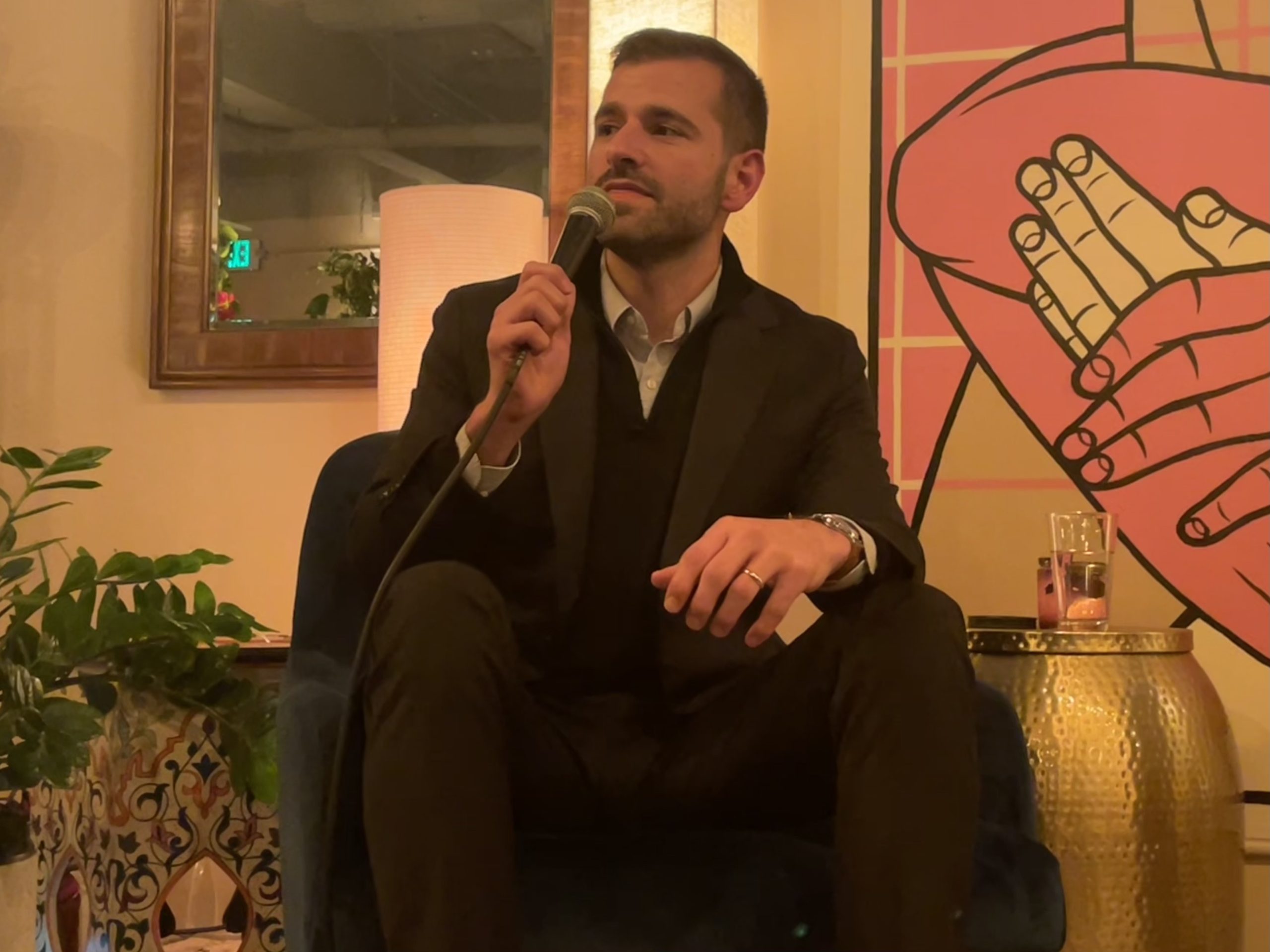

District 3 Supervisor-elect Danny Sauter made it clear on Wednesday at a packed evening at Manny’s that he will be a very different kind of supervisor than incumbent Aaron Peskin, who has overseen the district, on and off, for two decades.
Housing and vacant storefronts are at the top of the 36-year-old Sauter’s list of priorities.
“It’s silly to neglect the fact that we have not been building housing. And I also think it’s silly to say that District 3 is the densest part of San Francisco,” he said, pointing to building opportunities on parking lots in Lower Nob Hill and downtown offices that can be potentially converted to residential space.
The nonprofit executive director and former president of North Beach Neighbors also pointed to the large single-retail vacancies at the Fisherman’s Wharf and elsewhere.
A staunch small-business advocate on the campaign trail, Sauter wants to change the planning code to fill storefront vacancies. It’s “frustrating” that in most of District 3, it’s illegal to operate a flexible retail space, a planning category that allows two business uses under one roof — both a coffee shop and a bookstore, for example. It’s allowed in most of San Francisco. The code is “antiquated” and “has not been responsive and flexible to the current economic reality,” said Sauter.
Additionally, Sauter wants to make it easier to do lot splits for retail so that people can have small spaces instead of massive retail spaces in Union Square and along Fisherman’s Wharf that continue to be vacant. Smaller spaces are more affordable and more accessible to first-time entrepreneurs and small businesses, he said.
Sauter had a clear-cut victory with 55 percent of votes after ranked-choice tabulations and he’s determined to take advantage of that vote.
“After a lot of years of pessimism in San Francisco,” he said. “I feel like there is hope and optimism, and energy and excitement” right now.
To him, that also means pressure to get quick and visible results. “It is seeing things on the streets, seeing things in the neighborhoods tangibly get better,” said Sauter, listing minor but discernible changes including adding trash cans, speeding up a bus line, and supporting beloved community cafes.
In a way, Sauter said he agreed that being a supervisor is “a glorified customer-service job” that requires him to respond quickly, triage, and connect his residents to resources in different city departments.
To be accessible, Sauter plans to set up regular office hours at different neighborhoods around District 3, and create an office-internship program open to people of all backgrounds. He also wants his 80,000 new “residents, constituents, clients” to sign up for newsletters at dannyd3.com. “Please do respond to those emails; they all go directly back to me,” he said.
Facing a district with a good number of diverse neighborhoods, Sauter said he heard loud and clear on the campaign trail that Lower Nob Hill, which has seen an uptick in homelessness in the wake of the pandemic, “has been neglected” and needs to be talked about more. Also on that list are Union Square and communities along Polk Street, which have been hit by vacancies.
Downtown recovery is also on the list of his top three priorities for the first 100 days in office. It was the first thing he mentioned to Mayor-elect Daniel Lurie in their recent one-on-one meeting, “I said to him, ‘Hey, everything related to downtown recovery, let’s work together on.’” In the same meeting, the two also talked about Lurie’s working and communication style, and how they could have a productive relationship.
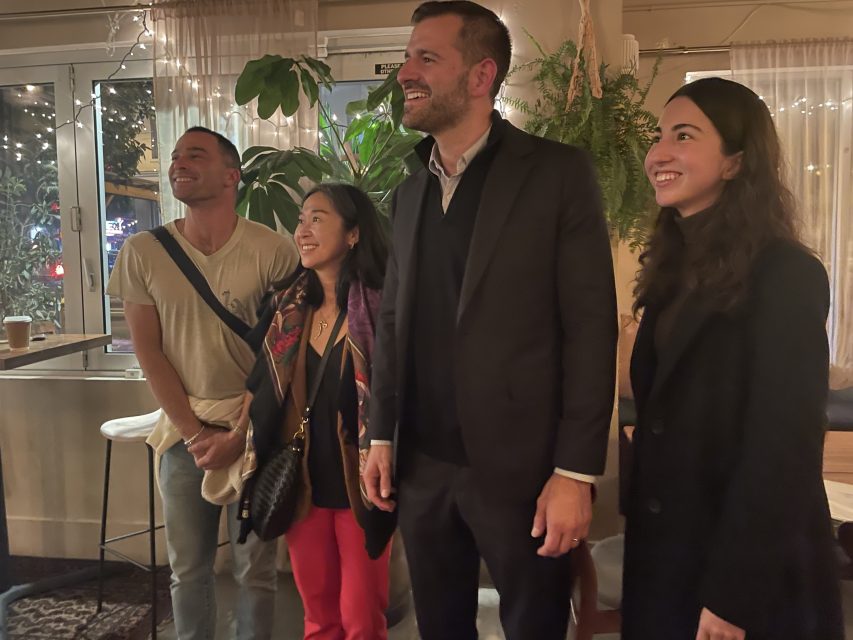
To help him, Sauter has assembled a team drawn exclusively from the moderate and YIMBY wing of San Francisco politics. The District 3 team will include Tita Bell, a seasoned legislative aide for Joel Engardio, who’s expected to be “the experienced hand” to guide the team through the complexities and technicalities of City Hall.
Michelle Andrews will join his staff as well. She has been a district representative in Sen. Scott Wiener’s office since her graduation from University of California, Davis in mid-2023.
Both campaign manager Amy Lee and field director Tomio Nagano will continue on as legislative aides. Nagano also acted as a field director in Marjan Philhour’s failed bid for District 1 Supervisor in 2020.
The team is too newly minted to even determine the scope of each member’s responsibilities. One thing, however, is certain: Lee, who grew up in the North Beach/Chinatown area and speaks Cantonese, will continue working with the Chinese community, just as she did before the election, where she garnered a sizable number of Chinese votes for Sauter from his Chinese American rival, Sharon Lai, who finished second.
He vowed to protect Chinatown SRO residents who often live in anxiety around living conditions and fear of eviction. He wants to protect a District 3 population that’s getting older by helping get funding for healthcare services related to social isolation.
He wants to make sure the boundaries of the police district and supervisorial district are aligned, and plans to look at retention programs for Central Station, which has gone through five captains in the last seven years.
Sauter knows very well that he’s going to take over a district that his predecessor has overseen for 21 years.
“We’re going to get pulled in a million different directions by a lot of well-meaning interest groups and people with time,” he said. “People with power, all those things — but [we’ll] make sure the work that we’re doing is in line with what we campaigned on.”
Sauter’s election should be a massive wake up call to progressives. Blocking housing across the city and promoting a NIMBY Maximus agenda is NOT OKAY! Voters do not want a city run like D9, with scammy nonprofits, TODCO, Jon Jacobo, and false utopian promises of “affordable housing” which never gets built.
Voters are quite fed up with the 2010s progressive school of thought which is about restricting supply while demand skyrockets. And yes, supply is at the root of the problem in the Bay Area.
Ridiculous! SF has plenty of housing. Tens of thousands of units stand empty!
What is needed is truly affordable housing. And small businesses need parking. Lots of it!
Speed up transit?
Does he mean removing bus stops to “speed” up service? Or does he mean boondoggles like that ridiculous Subway to Nowhere?
🚇 Let’s get the Central Subway extended all the way north, which is what we voted for in 1989.
Manny’s?
I guess he couldn’t think of anywhere in District 3…say North Beach, Lower Polk, Nob Hill, Tenderloin. No cafes or gathering places in any of those neighborhoods, apparently.
Manny’s is the pro-gentrification YIMBY HQ, so it is natural that the conservative and real estate industry-purchased Sauter would be appearing there!
A focus on housing is great. I hope Sauter will support increased public investment to build that housing. San Francisco’s 2020 Prop I revenue was supposed to fund municipal social housing, a promise that has so far never been kept.
However necessary it might be to change zoning laws, we can’t do *only* that and wait around for private investments to build all the housing we need – especially at this point in the real estate cycle.
Normally, Yujie Zhou’s penetrating journalism gets to the essence of the subject’s character, and I rush to read her. But this profile is uncharacteristic of her talent:
On housing and development, unlike Peskin, who was a champion of small business and authored the vacancy tax and other measures to encourage small business development, Sauter is a right wing pro-big business conservative. He assembles a team that include proteges of Scott Weiner and Joel Engardio, known corporate Democrats. Sauter’s neoliberal agenda will benefit unbridled development, to the detriment of preservationists and will hit hard on the characters of the North Beach and Chinatown neighborhoods.
Sauter opposed state Prop 33, which would have reinforced rent-control.
And perhaps most shamefully — and most indicative of his character as a human being — he is the only candidate who opposed the BOS Ceasefire Resolution.