


District 7 incumbent Myrna Melgar faced a particularly bruising re-election campaign. She squared off against significant numbers of her own constituents by supporting hot-button issues, like Proposition K, to close the Great Highway to cars, and upzoning parts of her district that have been previously limited to single-family housing. “If I lose this election on this issue, then that’s the right thing to do,” Melgar said in June, after a particularly contentious meeting about zoning changes coming to her district and the rest of the city.
But Melgar didn’t lose the election. No matter the ideological differences, most of her constituents agree: She’s good at the actual work of being a district supervisor.
“When I call, somebody does get back to me,” said Peggy da Silva, a West Portal resident who has reached out to Melgar’s office over concerns like city workers using gas-powered leaf-blowers. “They’re pretty good. They listen,” she added.
That assessment was echoed in interviews with more than a dozen residents and business owners from neighborhoods across District 7. “She’s a big advocate for the community,” said Hanley Chan, a veteran affairs commissioner and West Portal resident. Chan campaigned for Melgar’s re-election, even though he opposed Prop. K.
So, barring unforeseen lunacy, Melgar will be managing the competing interests of her constituents for four more years, including the district’s hot-button issues: Upzoning, housing and transit.

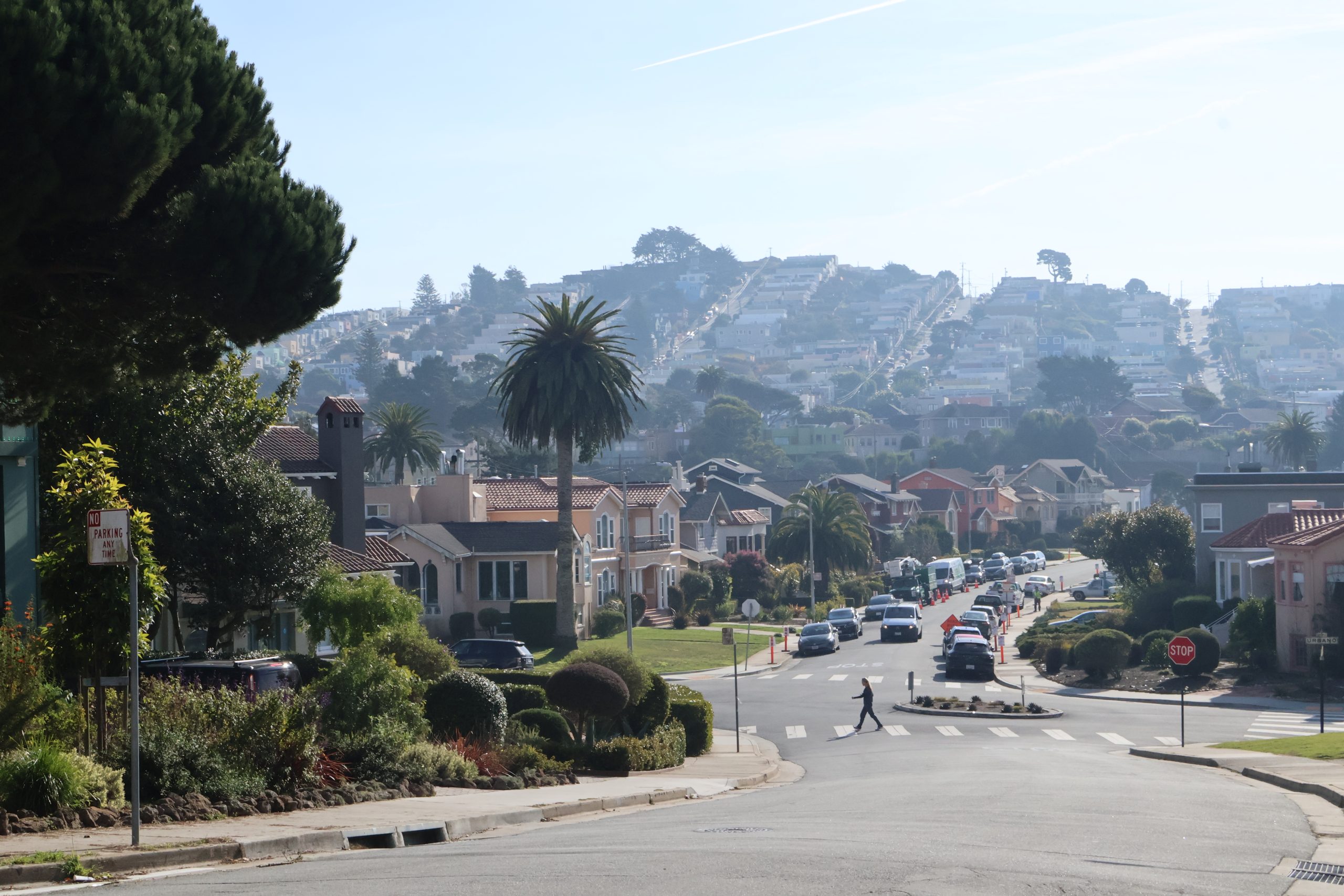
District 7 is the largest district by geography, and encompasses constituents from across the political spectrum. It contains more single-family homes, more homeowners and more drivers than elsewhere in the city, but it’s also home to more dense neighborhoods around San Francisco State University, Parkmerced and City College of San Francisco. Those more urbanized areas played a big role in securing Melgar’s win this November.
Melgar did less well in low-density neighborhoods like West Portal, West of Twin Peaks and St. Francis Wood. Her main competition, Matt Boschetto, won 15 precincts in those areas, or 50 percent of first-choice votes, compared to Melgar’s 35.2 percent.
Still, even if she managed to get significant support, she is well aware that many residents outside of the most urbanized areas appear reluctant to change, and remain reliant on cars.
Housing and transit
More than half of District 7’s homes are occupied by their owners, compared to the citywide average of about a third, according to Political Data, a campaign-data firm. In census tracts within the district’s borders, 86 percent of households have at least one vehicle, compared to 70 percent citywide.
In the coming years, the district will welcome new housing projects explicitly designed for pedestrians, transit users, and cyclists, rather than drivers. This includes 1,100 units at Balboa Reservoir, up to 3,500 units in the parking lots around the Stonestown Galleria shopping mall, and more housing further down the pipeline at the old El Rey Theater and along Laguna Honda Boulevard.

“What I learned is that all of these issues are controversial,” said Melgar, about the process of moving these projects ahead during her first term. “All these issues that involve change.”
Some of the most controversial projects in and around the district have hinged on the challenge of getting around, and parking, in a district where many see driving as a necessity. In West Portal, when Melgar initiated traffic flow changes near the Muni station after a car crashed into a bus shelter and killed a family of four, local merchants strongly opposed the changes, which redirected car traffic around the area.
Today, “any project that we do to improve public transit is going to seem like a major inconvenience,” said Andy Pham, a resident of Ingleside Terraces. Pham takes public transit often, but still drives occasionally.
Karen Tarantola, the vice president of the West Portal Merchants Association, was one of those people opposed to the West Portal traffic changes, and said they did not involve “serious and honest regard for the neighborhood, and how we live here, and how we thrive here.”
In the end, Melgar put together a committee that came up with a compromise plan, resulting in changes that seemingly no one was totally happy with. Some, however, were at least content to be part of the discussion. “It brought people who otherwise wouldn’t even talk to each other to the table,” said Janelle Wong, a West Portal resident and public-transit advocate.
“When you have compromises, nobody is truly 100 percent happy,” said Norman Yee, Melgar’s predecessor. “But hopefully, no one is 100 percent angry.” During his term, Balboa Reservoir was a compromise: Some housing advocates wanted the site to host 5,000 units, others hoped for 200, he said. In the end, 1,100 will be created.
Likewise, Proposition K, to close the Great Highway to cars, while not in District 7, was rejected by 56 percent of District 7’s voters. Nevertheless, Melgar’s position did not derail her campaign. Meanwhile, District 4 Supervisor Joel Engardio may face a recall for supporting the measure.
Evidently, Melgar has not shied away from making bold decisions and letting constituents know where she stands. “In government, people are so paralyzed by the prospect of making change,” she said. “I hope to God I don’t end up like that.”
Bread-and-butter issues
Her confidence, in part, appears to come from her success in knowing many of her constituents, and helping out on services, no matter whether they agree with her on other issues. Asked if they knew their district supervisor, most residents and business owners Mission Local interviewed had directly received help from Melgar’s office.
Take Iqbal Gill, the new owner of Reliable Rexall Sunset Pharmacy at 9th Avenue and Irving Street. He met Melgar when she paid a visit to his store, and her aide, Jen Lowe, has helped him file a legacy-business application with the city.
Likewise, Piedro Galletti, the owner of Mozzarella di Bufala Pizzeria on West Portal Avenue, was in touch with Melgar’s office over a parklet permit last year. He reached out to the district supervisor after waiting months to hear back from the city on his application. “The next day, I got an email from the Planning Department,” he said.
Legacy business applications and permit applications are just one of a long list of tasks Melgar and her staff have dealt with. For all the ideological discourse around the supervisor election, a lot of being a supervisor is dealing with such bread-and-butter issues, and may explain why Melgar was able to win despite differences on bigger issues.
And, even if there are differences on housing and transit. Melgar seems ready to make good on her promises. “I ran the campaign on the promise of a better Westside. My priorities remain the same: Produce more housing on this side of town, and improve all the infrastructure that goes along with that,” said Melgar. “All the quality-of-life things that people expect.”
Just another Breed zombie pretending to have accomplishments but in reality?
Not really at all. Unless you like deficits, potholes, closed schools and PR phot-ops her main “selling point” is exactly that – selling out to developers for $. Oh she really listened about gas leaf blowers, oh wow. Give me a break.
Supes Melgar and Engardio appear to miss the point of why people choose to live their districts. Many do so to avoid the ultra high density character found on the east side – with all its negatives. The west is best because we have a better balance, green spaces, single family homes, quiet nights, less crime, more parking and nicer places to ride your bike. All the while there are multi-unit apartments, Muni coverage and urban commercial corridors. Turning these districts into Mission Bay is not going to fly so easy out here – as it shouldn’t.
They are literally going to destroy the city and rents won’t go down 1 cent as a result, despite that being the purported impetus of developer profit giveaways. The housing crisis is not going to be solved by building yuppie condo towers on the west side for techie transplants and corporate landlord profits. These sellouts have to go. Not only do they ignore their constituency but they lie the entire time about it and point to non-profits backed by the same Billionaires that fill their campaign coffers. It’s disgusting. We deserve actual leadership, not appointed wet nurses for the Billionaire class and their corporate pimps.
I agree that Myrna Melgar’s office is responsive, and I, as a constituent, really appreciate that. My key point to Kelly, in our interview, was that I wanted our supervisor to slow down, listen to constituents, and dig deeper into complex issues. For example: the comment that was attributed to me, about gas-powered leaf blowers. I only mentioned that specific wasteful use of energy to point out the need to look “big picture” at environment and energy. Simply continuing to use leaf/dirt blowers but with a different power source misses the point. In the same way, aggressively building high rise housing (or over-building commercial spaces from the 80’s onward) does not address the complexity of our land use challenges. We are a complex and wonderful city and we need thoughtful and engaged leaders and citizens to move us forward.