


Some of the city’s chartered Democratic clubs have long been recipients of healthy donations from deep-pocketed donors around election time. This year, accelerating a years-long trend, those dollars are flowing to lesser-known entities: Democratic clubs’ slate-mailer organizations.
Major donors can give unlimited amounts to both political action committees and slate mailer organizations, but they may choose to give to slate mailer organizations because these are regulated at the state level, and have less stringent reporting and disclosure requirements.
Slate mailer organizations, which print voter guides with endorsements on candidates and ballot measures, “muddy the waters,” said Eric Jaye, a longtime campaign strategist in San Francisco, and are useful “for well-funded donors to obscure who’s actually funding them.” Top donors to slate mailer organizations are not disclosed on the mailer itself.
Seven of the 27 chartered Democratic clubs with the San Francisco Democratic Party have an active slate mailer organization this year.
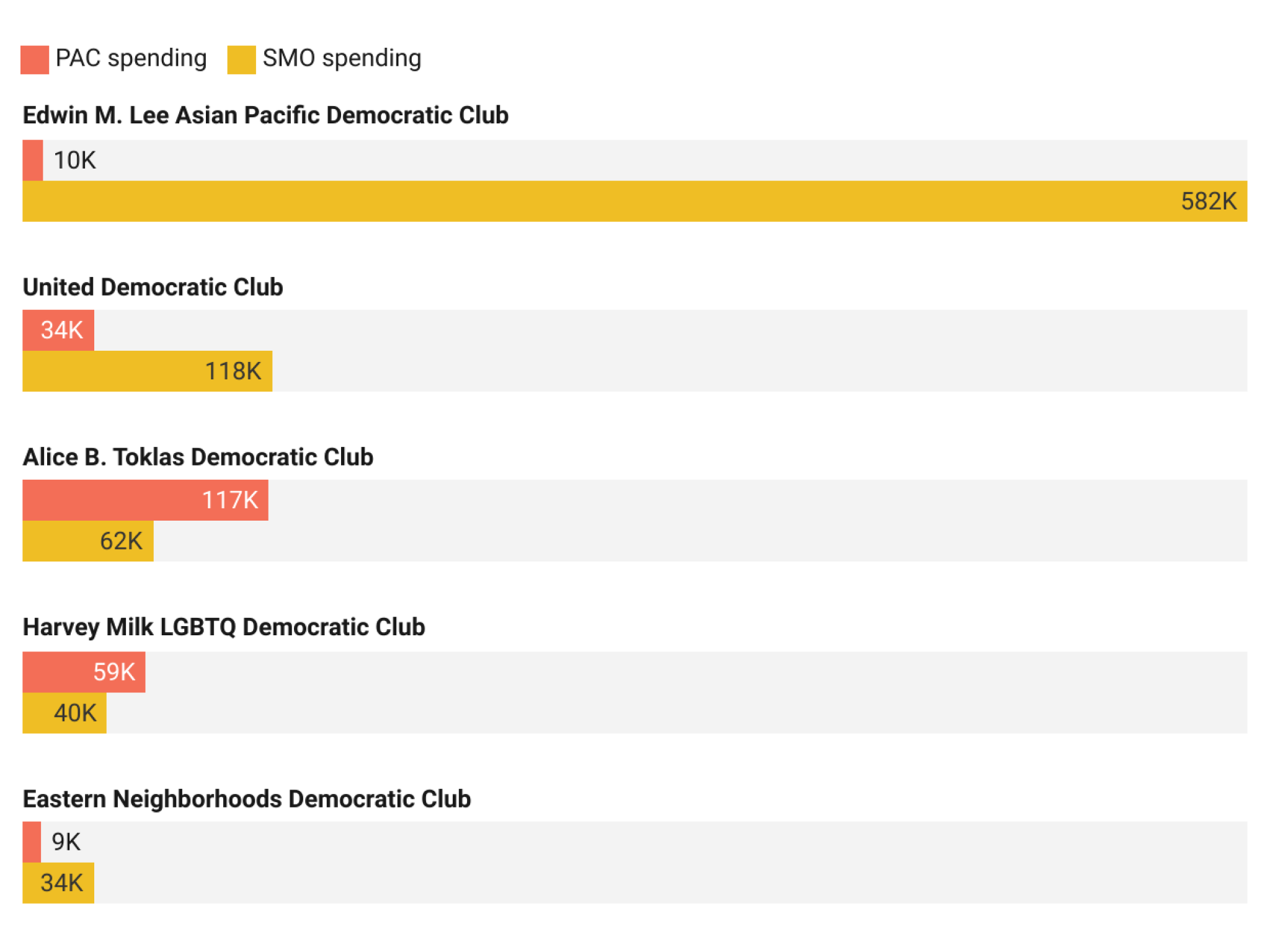
The Edwin M. Lee Asian Pacific Democratic Club, for instance, was created in 1992 and has generally endorsed moderate candidates. Its PAC raised $250 this year and spent only about $10,000, according to campaign finance filings.
But its slate mailer organization received $594,162, as of Oct. 19, largely from Neighbors for a Better San Francisco, and has spent about that much in 2024 — though most of it was for the March election. Its voter guide in November is backing Marjan Philhour in District 1, Danny Sauter in District 3, Bilal Mahmood in District 5, Matt Boschetto in District 7, Trevor Chandler in District 9, and Michael Lai in District 11.
That sum received by the Ed Lee club by far overshadows the rest of the city’s Democratic clubs, exceeding the total spending of all other six democratic clubs’ slate mailer organizations combined.
How much Democratic clubs have spent in 2024
Another example is the United Democratic Club: Its slate mailer organization has spent more than $118,000, while its PAC has spent about $34,000 — less than one-third as much as its slate mailer organization.
Slate mailer organizations file their campaign finance forms to the California Secretary of State, and those payments are not reflected on the San Francisco Ethics Commission’s campaign finance dashboard, making them more difficult to track.
Traditionally, slate mailer organizations took donations directly from candidates and ballot measures: They would receive a few thousand dollars here and there from their endorsed candidates, and would cobble together a voter guide.
Now, however, because of the less stringent reporting requirements, a single group can almost entirely fund a slate mailer organization and its voter guide.
Many of the 27 registered Democratic clubs in San Francisco are still small, run by volunteers, and do not have much in the way of campaign funds. Half of them have not disclosed any spending on this year’s elections.
While a few Democratic clubs' PACs have spent thousands in 2024, many are still small and low on cash
But big-money groups have found their way into the formerly small world of Democratic club politics.
Among the 27 sanctioned Democratic clubs in San Francisco, the Ed Lee Democratic Club, United Democratic Club, District 2 Democratic Club, Alice B. Toklas Democratic Club, Westside Family Democratic Club, and San Francisco Eastern Neighborhoods Democratic Club have received hundreds of thousands from big-money groups in the past two years. Sometimes, that has included money from big Republican donors funding the Democratic ecosystem: William Oberndorf, a hedge-fund investor who has given at least $13 million to Republicans nationally, has poured at least $1 million into Neighbors for a Better San Francisco.
Neighbors for a Better San Francisco, in turn, gave $445,000 to the Ed Lee Democratic Club’s slate mailer organization, which then financed voter guides opposing Prop. B in March, a measure to tie police staffing increases to identified future revenue.
Do these glossy slate mailers work? In low information campaigns like the school board race, for example, “it’s the only way candidates can get their names out,” one consultant said. But in high visibility races, voters may only trust slate cards from well-established “name-brand” clubs.
In March, Neighbors’ investment to oppose Prop. B paid off. More than 70 percent of San Francisco voters rejected the ballot measure. For the November races, the answer will reveal itself in just a few days.
Ed Lee was corrupt. Why wouldn’t his namesake follow suit in plain sight also.