

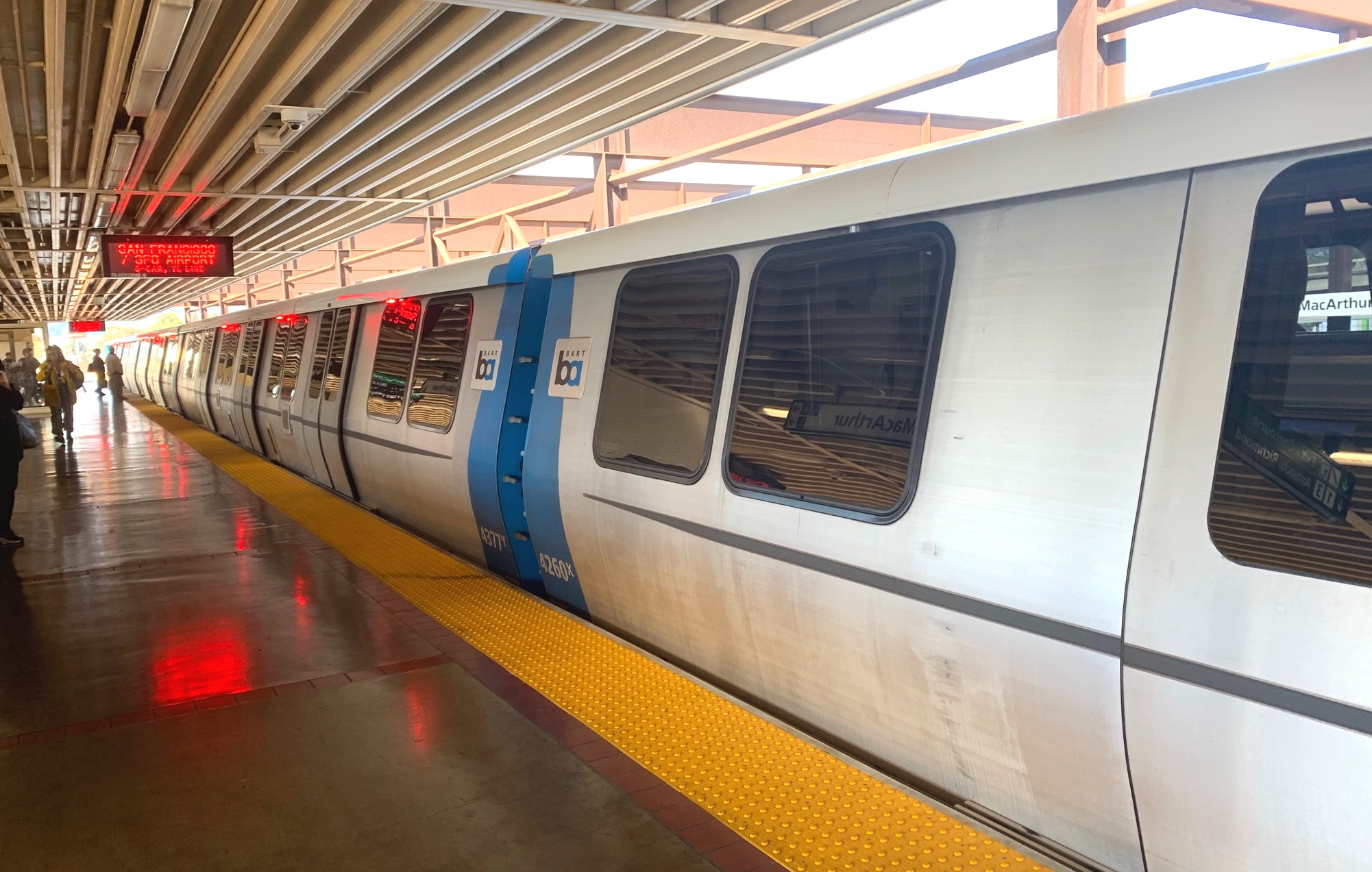

Whoever wins the District 9 BART Board race has a hell of a job ahead. Emergency pandemic funds are running out. Ridership isn’t back. In July of 2025, when the next fiscal year starts, the agency will be facing a deficit of $35 million. The year after that? $385 million. As Janice Li, who has represented District 8 on the BART Board since 2018, puts it, “I can’t tell you that BART will exist in 2027.”
Li’s preferred candidate to join her in this looming fiscal apocalypse is Edward Wright, former chief of staff to Supervisor Gordon Mar, current transit strategy and communications advisor at the San Francisco Municipal Transportation Agency.
The person holding the other San Francisco BART seat — current District 9 BART Board representative (and president) Bevan Dufty — has endorsed the other candidate for BART Board, Joe Sangirardi. Sangirardi is presently director of development for California YIMBY. Though, Dufty says, Wright seems great too. “We are blessed to have two strong candidates.”
The candidates
Wright is an unabashed transit nerd. An entire section of his campaign website is devoted to plans for what he’ll do if elected. Before Wright could afford to live in San Francisco, he commuted on BART to San Francisco State University. At the time, Wright wanted to make trenchant documentaries about social change, but it gradually became clear that the real fun lay in actually trying to change society for the better, instead of filming other people doing it. Studying film is surprisingly good preparation for politics, says Wright. He still uses every skill he learned there, including scripting and editing his own campaign ad.
Sangirardi does not display similar signs of transit nerd — although, admittedly, it would be hard to find a candidate who is more of one than Wright. He does show signs of being deeply interested in local politics, but the closest thing to a transit plan on his campaign website is a paragraph promising to fight unspecified forces “fighting against change, trying to keep us stuck in the past” and for “a clean, safe, and financially sustainable BART.”
Sangirardi’s campaign has been consistently late in filing many campaign-disclosure documents, even after Wright reported this to California’s Fair Political Practices Commission. To Wright, this suggests a fundamental unseriousness about the work of holding political office. To Sangirardi, this suggests that filing procedures in Alameda County aren’t as clear as they could be.
Those campaign filings show that Sangirardi is, indeed, quite good at fundraising. Campaign finance limits don’t apply to BART board races, but Wright’s campaign filings show a lot of small donations, mostly $500 and under. He raised about $55,000, total with recent large donations coming from Li’s BART board campaign fund (a little under $3,000) and Jane Fonda’s Climate PAC ($2,500). Sangirardi raised nearly three times that, including $5,000 that arrived, unbidden, from Garry Tan (Sangiradi says he doesn’t know Tan, and didn’t ask him for a donation) and $1,500 from Families for a Vibrant SF, the tech-backed PAC that helped Sangirardi get elected to the Democratic County Central Committee as part of the San Francisco Democrats for Change slate.
Campaign goals are important. How a person might actually follow through is even more so. Based on interviews with Wright, Sangirardi, Li and Dufty, here’s a look at how that follow-through could play out.
More housing and business on BART-owned land
As you might expect from a person who works for California YIMBY, Sangirardi talks a lot about housing. “There is a massive ability to build a ton of housing around our stations,” says Sangirardi.
Building housing close to BART is important, Li and Dufty confirm. In fact, it is so important that much of the land around BART stations was permitted before the pandemic cratered fare revenues. “Girl, we’ve been doing that,” says Li. “We are past that … BART’s model of building affordable housing and building housing on public lands is one of the best models in California. I say that with a bit of ego and confidence, but I truly believe that.”
Getting new housing near BART used to be a lot harder, says Li. But in 2018, David Chiu (then in the California Assembly) and Nick Josefowitz (who represented District 8 on the BART board before Li) collaborated on a state bill called AB 2923. It gave BART the ability to develop its own zoning for the land that it owns — and to override local laws that conflict with it. Last year, nearly 900 units were finished near the Walnut Creek, Balboa Park, and Millbrae stops. Over 8,000 more are currently under construction at West Oakland, Lake Merritt, Dublin, El Cerrito, North Berkeley, Pleasant Hill, Richmond, and Walnut Creek, with Ashby ready to go next.
AB 2923 also mandates that 20 percent of units built on BART land remain affordable to moderate, low-income and very-low-income residents for 55 years. Even if the BART board inked a deal for some lucrative new development, it wouldn’t be earning money before the BART budget tanks. It should benefit BART in other ways, though, since the people who occupy it are likely to be everyday transit users that the system needs to make up for weekday commuters who now only take BART three days a week instead of five.
Wright also plans to create small vendor programs at the BART stations at 16th Street (in partnership with the American Indian Cultural District) and 24th Street (in partnership with Calle 24). This will not be easy. In the past, street vendor programs have been overwhelmed by vendors selling dubious goods. But, says Wright, his background as a legislative aide means that he already has the experience of working with different communities, and adapting programs when they aren’t working out.
Cutting BART’s budget (in a way that doesn’t lead to a death spiral)
Some of the possible cuts ahead include running trains every hour during non-commute times, closing stations at 9 p.m, closing stations and lines that aren’t generating enough revenue, or closing on the weekends entirely. The trick with budget cuts, both candidates say, is that BART has high fixed costs and low margins. Cut the wrong thing, and BART becomes so unpleasant that riders take it less and less often, erasing any savings through lost fares, and sending it into a transit death spiral.
Wright suggests things like keeping trains running frequently between the busiest stations, even if the frequency of trains going to the end of the line has to be cut. Cuts to service aren’t always a bad thing, says Sangirardi. During the pandemic, BART was able to do a lot of repairs and upgrades using money from Measure RR, which raised money specifically for repairs and improvements.
Sangirardi has been endorsed by three of BART’s largest unions — SEIU Local 1021, AFSCME Local 3993 and ATU Local 1555 — and his campaign disclosures show a $15,000 donation from ATU 1555, (which is going to be renegotiating its contract come June 2025) and $5,000 from the Operating Engineers Statewide PAC. A donation is not a guarantee of support later on, but this does suggest that those particular unions are hoping to have Sangirardi in their corner when budgets are discussed.
Change BART in ways that make more people want to ride it more often
In 2019, BART began to offer its first low-income fare discounts. Both Sangirardi and Wright want to push that further. “There’s a fundamentally inequitable funding structure of an agency that I’d like to fix,” says Sangirardi. The road to that fix, he says, is by prioritizing the safety of stations and trains. If voters see BART as clean and safe, they’re more likely to vote for a ballot measure that would expand BART’s affordable fare programs.
Wright believes expanding affordable fares is how BART makes the case for itself as a public good. Right now, he says, 50,000 students and residents of low-income housing are part of a pilot project called Clipper Bay Pass; they have free access to all bus, rail and ferry services in the nine-county region while the Metropolitan Transit Commission studies how locals use transit when they don’t pay a completely new fare every time they switch from AC Transit to BART to Muni to Caltrain. Another pilot program is selling Bay Passes to companies for employees to use. The future could look like a system where a rider pays a fixed fare, different agencies split the proceeds, and transit poaches people who would otherwise be using ride hailing apps, or driving.
Getting a measure on the ballot in 2026 to stabilize BART’s finances
Sangirardi and Wright represent different strains of San Francisco politics. Sangirardi has worked in political fundraising since college, first for LGBT causes, then for California YIMBY. His main organizing experience in San Francisco is co-founding Neighbors for a Restored Castro Theatre, which supported converting the theater into a concert venue.
Since leaving tech after a bout of soul-searching in the wake of the 2016 presidential election, Wright has mostly worked in politics, first as an aide to gay rights activist and Unite Here 2 organizer Cleve Jones, then on campaigns, then in City Hall. Li first worked with Wright on policy when he was a legislative aide and Li worked at the San Francisco Bicycle Coalition.
Both Dufty and Li agree that making anything happen on the BART board requires great diplomacy. Superficially, the work of the Board is meeting twice a month and voting yea or nay on proposals drawn up by BART staff. That’s just the tip of the iceberg, says Li. The real work comes much earlier: Talking to stakeholders, negotiating with staff, scrutinizing policy or budgets. “If you’re trying to make something happen at the time of the vote,” says Li, “you’re late.”
The BART board, Dufty says, was once seen as the place where dinosaurs go to die. That’s changing. Lateefah Simon is the front-runner to replace Barbara Lee in Congress. It’s a position that has the capacity to launch a political career. The question now is how long BART will be around to do the launching.
Note: After this article was published, Michael Petrelis wrote in to clarify that there is a third candidate in the District 9 BART race: Petrelis is a qualified write-in candidate for District 9 BART board.


Is “BART has high fixed costs” similar to San Francisco government’s high fixed costs for employee pensions and benefits? I learned that some civil servants have multiple pensions–some of which continued to increase in seniority long after employees had left–depending on contract language and how fastidious the emploeyee was with filling out forms. I am not against retirement security, but could audits help reduce the “high” portion of fixed costs? Saving money ought to be better than losing BART altogether along with those pension plans. Thanks for the article.
Anyone remember ‘way back’ when we spent 2.5+ BILLION dollars* on a single subway station with trains different than the rest of the city’s transit system, all in borrowed money speculating on ridership that never materialized and was never realistic? Now what’s this you say about BART needing money? Why don’t they just borrow Billions from the future and name it after a crook like SF did? Complete with janitors who make a quarter million a year, sleeping off their overtime hangovers in the maintenance closets. We get the leadership we deserve, and we get the public transportation system that goes with it. We bought this situation, and we paid a premium. Enjoy your bespoke commute options, techie-futurist transplants. World class here we come.
It’s a low bar, I know, but I’d like to ride BART without getting my throat slit.
Don’t you mean your headline to say “BART passenger on life support” after the knife attack? Make the system safe to ride and funding will not be an issue any longer.
Job 1 is to hire more BART police. Nothing is going to suppress ridership more than people having their throats slashed on the train.