

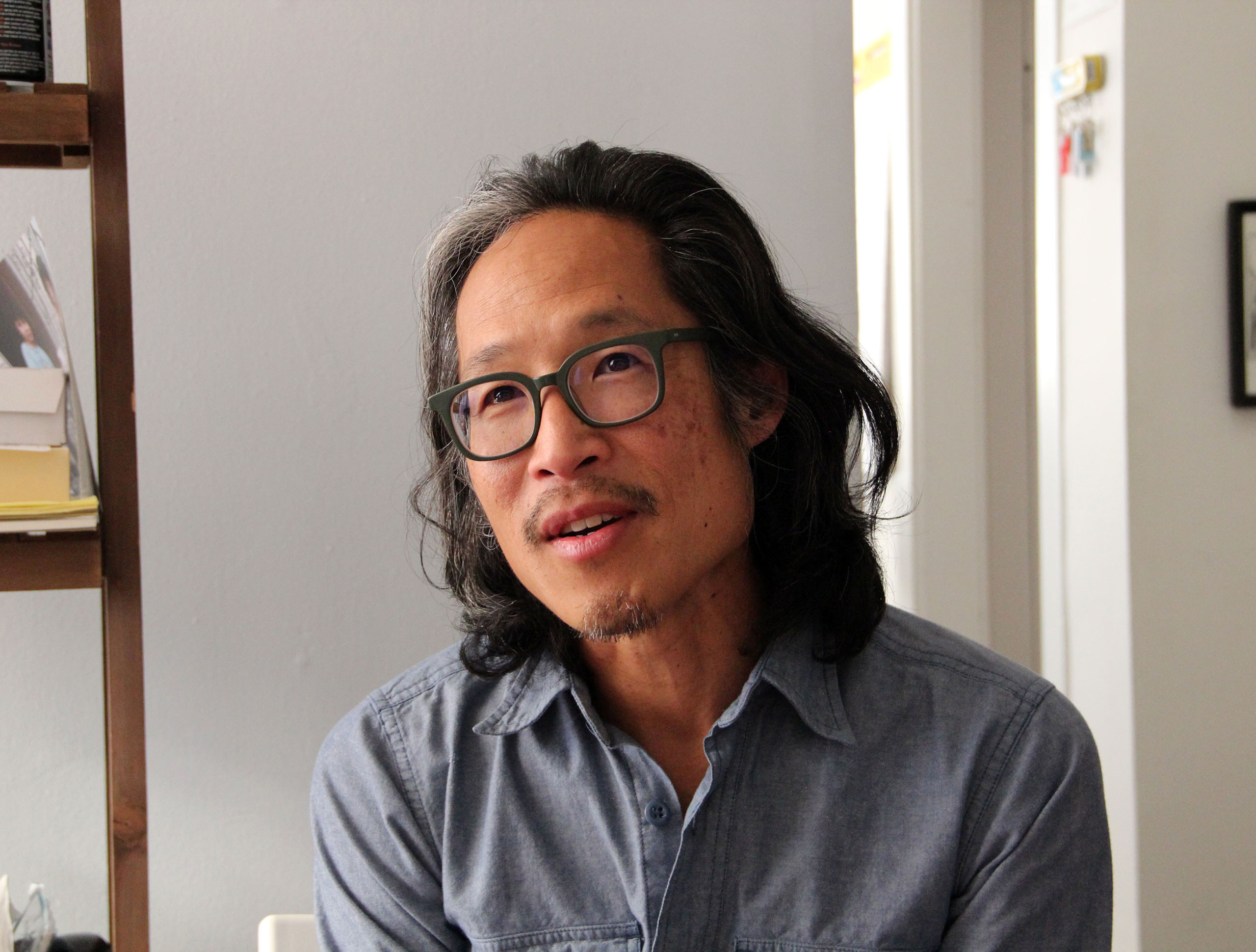

Early in his 24-year tenure as a San Franciscan, Jonathan Koshi learned that homelessness is everywhere. The tents along his regular running route faded into an unremarkable part of the landscape — until they disappeared entirely.
“One day,” Koshi recounted. “They were gone.”
On another run soon after, they were back, but not for long: Koshi watched white Department of Public Works trucks remove the encampments that had been re-erected beneath the highway.
“I was just like, ‘Ah, I get it now. I understand the cycle,’” Koshi said. “This is their life. This is San Francisco.”
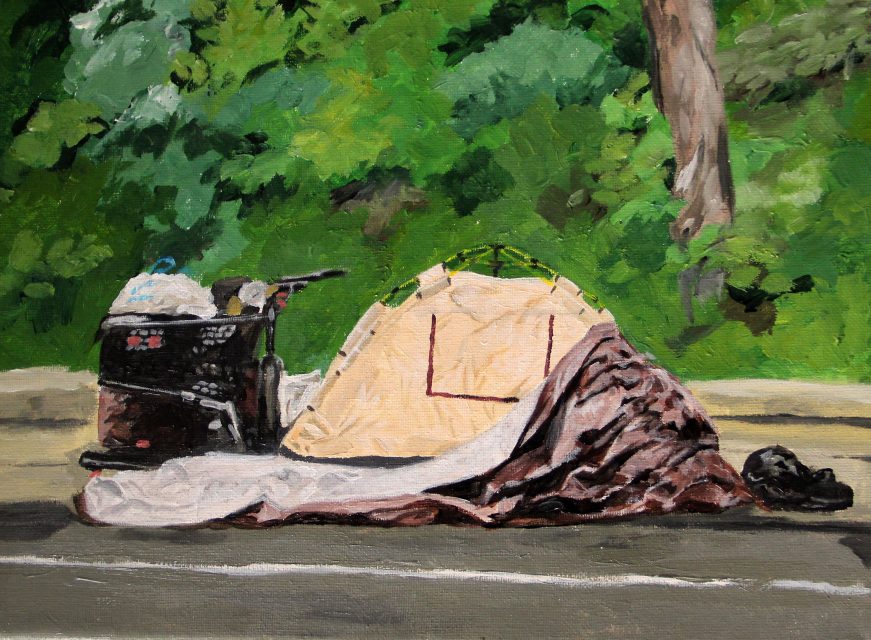
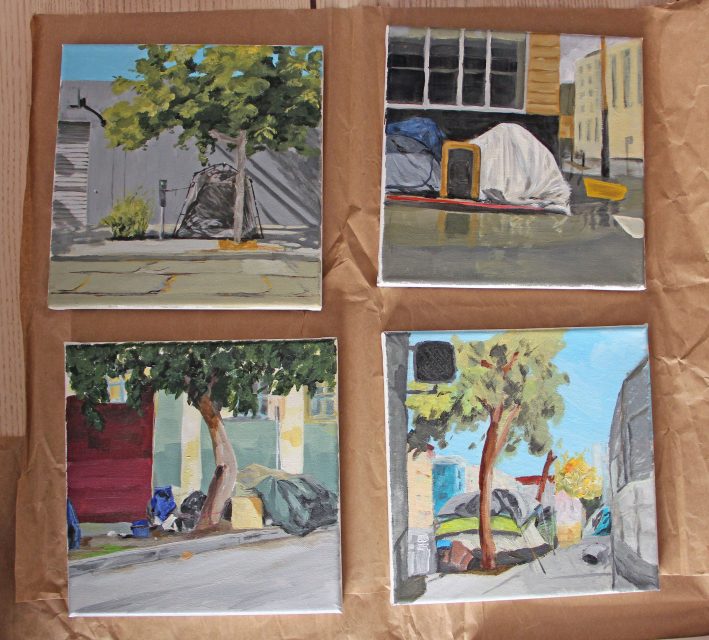
The result of this realization was Koshi’s first art show at Incline Gallery at 766 Valencia St., titled “Life in Transit.” On display through the summer were over 50 paintings of homeless people’s tents, based on photographs Koshi took during his runs.
“I’m trying to capture the light and the beauty and the sense of San Francisco,” Koshi reflected. “It just happens to be this different way of doing it.”
After the birth of his son, Amari, in 2017, Koshi said it became impossible to “filter” homelessness from his perception of San Francisco: This was the reality his son would inherit.
Koshi started painting scenes of public transit for Amari and, last December, started depicting the tents themselves. They soon became “imprinted” in his memory. Forced to “stare dead long” at San Francisco’s homelessness crisis, Koshi said he felt like he was finally grappling with the issue.
“This is what I can do about it,” he thought.
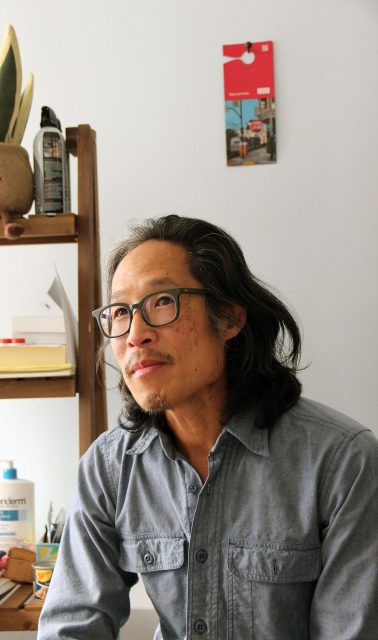
Still, he had concerns: Was his art exploitative?
Koshi has had fairly few encounters with men and women who reside in the encampments he’s painted.
The first time he was confronted, Koshi was crouching down on San Bruno Avenue in full running gear, composing a photo of a homeless encampment with the freeway in the background.
A man emerged from his tent and asked what he was doing.
“Oh shit,” Koshi remembered thinking, embarrassed. He said he was a painter. “And then it was worse.”
“Oh,” the man responded, skeptical.
Only when Koshi began to show photos of his work did the other man relax, Koshi said. “I’m trying to actually portray this in a way that isn’t gross,” the artist explained. “It’s just like I’m painting somebody’s house.”
After this demonstration, the man consented to being part of Koshi’s project. And, for the most part, the reaction to his work has been positive from encampment residents. But he knew he was stepping into a minefield.
“This is so heavily political,” Koshi remembered telling his friend. “I’m going to put myself out there with this shit.” Over a few beers, though, he was convinced to do the gallery show. He agreed, on the condition that 30 percent of the proceeds be donated to Hospitality House, a nonprofit that runs both a free community arts and a shelter program.
Koshi, after all, is no starving artist; he’s a full-time big-data and user-interface designer for LiveRamp. But the Brown University graduate was no less dedicated. After agreeing to do the show in late May, each day he painted from 9 p.m. — when his son fell asleep — to 1 a.m. until the opening in July, taking just one week off to visit family in Hawaii. He sold half the show.
During this time, Koshi said he noticed his craft improving (before, he had done mostly graphite drawings). Inspired by the opulent fabric in Dutch masters’ Renaissance paintings, he learned to paint similar folds in the tents he depicted.
Intensive painting sessions did, however, introduce a new type of “filter.” Koshi found himself flipping between “thinking mode,” when he considered his subjects’ struggles, and “production mode,” when he was focused on creating a visually appealing composition.
At the gallery, passersby often stopped to discuss their feelings about homelessness, the artist said. While he felt these conversations were constructive, he acknowledged how his show stripped away an important perspective on homelessness; viewers did not have to engage with the tents’ inhabitants.
But Koshi has.
As a runner, Koshi says he felt the proximity of people sleeping on the street, and could no longer be “numb” to their experiences.
Commuters who travel through the city by car or bicycle tend to be disconnected from the sidewalks through speed and distance, Koshi said. Traversing San Francisco on foot means “viscerally experiencing [homelessness] in a far more intimate way.”
Making art, it seems, can do the same thing.
Koshi described the time he showed his paintings to a man who often loitered outside his house on Valencia Street. The man, Koshi thought, normally appeared to be “unstable.”
Leaning in to swipe through photos, they connected for the first time.
“He looks me in the eye and says, ‘Your work is the truth,’” the artist recounted. It’s the “highest praise I’ve ever had for anything that I’ve done.”
The photo shows a shopping cart next to a tent.
It must be an old photo because I haven’t seen a shopping cart out there for a couple of years, I assume the cops confiscate them when they see them because they’re a blight and are all stolen.
I commend Koshi on this project. 30 percent of proceeds is better than 10 but 50 percent plus looks real.
I’m sorry I missed this. There is a beauty to the tents, in a way: the resilience of people holding on and surviving in a city that wants to forget them, wishes they’d disappear. I appreciate Jonathan showing that in his art.
What I find it hard to see any beauty in, is the hostile architecture that has multiplied in recent years to displace these folks — whether it’s the fencing along 26th St and South Van Ness, or the vigilante “planters” that city officials protect from removal even when they violate city guidelines and create accessibility issues. I fear it reflects a state of moral decay when public and private investment is to harden public spaces against tents rather than help the people in the tents get the basic things we all want: a warm bed, running water, toilet and shower facilities, and a little personal space with a lock on the door.