



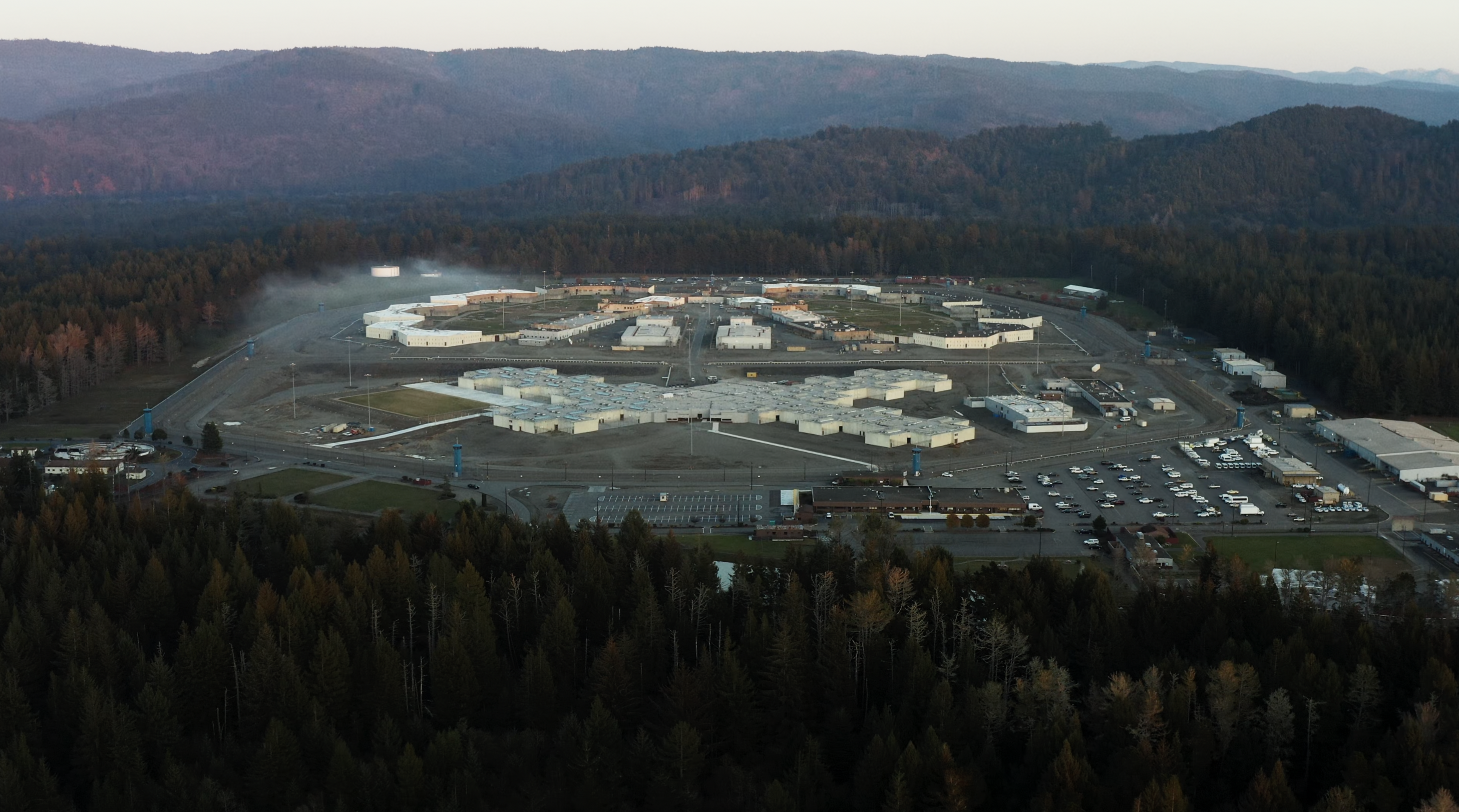
The image is grainy, the fixed camera angle is awkward, and the audio is muffled and scratchy. But the revelatory footage, shot inside California’s supermax Pelican Bay prison, strips bare a moment in 2011 when society’s most forgotten and invisible population seizes the levers of power. Four men sit tensely at a table across from a high-level state official. In a terse and pointed dialogue, they seek to negotiate an end to their government-sanctioned torment.
Captured in never-before-seen footage, this confrontation is at the heart of “The Strike,” a remarkable new documentary that screens Wednesday, Oct. 23, at Oakland’s Grand Lake Theater and Thursday, Oct. 24, at the Roxie. Filmmakers JoeBill Muñoz and Lucas Guilkey, who met in the documentary program at the University of California, Berkeley’s Graduate School of Journalism, reveal how prisoners organized across the state’s vast penitentiary archipelago to end the use of extended solitary confinement in California prisons, particularly Pelican Bay’s Security Housing Units, or SHU.
The scene in question is what the great documentary filmmaker Jon Else, who ran UC Berkeley’s doc program for two decades, called “a piece of the true cross,” as the incarcerated men, some of whom had spent decades in the SHU, present five core demands to end their hunger strike. The footage was initially btained by veteran journalist Michael Montgomery, a consulting producer for “The Strike” who has reported widely on the California penal system. “This was something given to him confidentially by an official, and this is the first time it was put into the world,” Guilkey said on a recent conference call with Muñoz.
The film details how solitary confinement became a blunt tool to manage the racial and ethnic factions that rule California prisons, particularly as surging crime and the war on drugs in the 1980s fueled a prison-building boom. At Pelican Bay, men were often placed in the prison-within-a-prison SHU for alleged gang affiliations, and then left there for decades (the United Nations standard for solitary confinement is 15 days). The interviews with former prisoners describing the SHU’s weird, hushed environment, loneliness and the strategies required to “burn time” are haunting.
History in the making
Inspired by the IRA hunger strikes that led to death of Bobby Sands in 1981 (“There was a lot of study on political consciousness-raising in Pelican Bay,” Guilkey said), a small group of leaders in the SHU negotiated a non-aggression pact amongst the various prison factions. They coordinated the strike by mail — with help from family members outside — and via low-tech prison telephone, which meant emptying water from toilets and using the pipes to communicate across cells. By the time the prison department undersecretary Scott Kernan sits down with the strike leaders in Pelican Bay, more than 6,000 prisoners are refusing to eat.
“Visually, it’s a hard story to bring to light,” Muñoz said. “That footage was a huge opportunity to do that. How better do you illustrate how power works? On one side, there’s the undersecretary of the entire California prison system. On the other side, there’s this other form of collective power, flipping this struggle on its head. How they circle each other is really interesting, and it’s this precious moment where the viewers can eavesdrop on history in the making.”
The compact 85-minute film keeps the focus tightly on the prisoners and their families, while also acknowledging some of the violent acts that led to their incarceration. Their eventual triumph comes after a second hunger strike in 2013 spreads to more than 30,000 prisoners and attracts national attention . Alluded to several times but largely offscreen, a parallel-class action lawsuit forces the prison department and California legislature to reform the system. In footage from hearings, Bay Area politicians like state representative Tom Ammiano and state senator Loni Hancock come across as champions of change.
“A bunch of attorneys in the Bay Area got involved after 2011, and they partnered with jailhouse lawyers,” Guilkey said. “The attitude was, ‘These are not our clients, these are our partners.’ Right before the major hunger strike in 2013 they filed for class certification, and the hunger strike bolstered the class action. It was demanding their humanity to be seen.”
Changing the old mentality
“The Strike” will be broadcast in February 2025 as part of the PBS documentary series Independent Lens. But before then, Muñoz and Guilkey are screening the film at theaters and festivals around the country, including some highly unlikely locales: A few weeks ago, “The Strike” was part of the inaugural San Quentin Film Festival.
In a Q&A session after that screening, an associate warden at San Quentin Rehabilitation Center, who was a young official at California Department of Corrections in 2013, described how she was told that giving into the demands of the hunger strikers would lead to anarchy and violence in the prison. The latest edition of “The Strike” newsletter describes her first-person account, including when she asked her superiors to explain why emptying out the SHU didn’t lead to a breakdown in order.
“They scoffed and dismissed her, she said, and she left the department,” read the newsletter. “She’s only recently returned to the job, as an administrator, ‘to change that old mentality.’ Her comments were met with applause and appreciation.”
“The Strike” screens Wednesday, Oct. 23 at the Grand Lake Theater (3200 Grand Ave., Oakland) and Thursday, Oct. 24 at the Roxie Theater (3117 16th St., San Francisco). For more info, visit www.thestrikefilm.com.
Is there anyways I can see this from Corona Ca. I really want to watch this bad. Im so interested please tell me how. Thank you
The worst of the worst are sent to Pelican Bay.
Plus it is also almost in Oregon, so not sure what the relevance is to the Mission. Yes it is showing at the Roxie so give it a mention. But an entire article that reads like support propaganda for faraway hunger strikes does not obviously seem like something of note to locals in 94110.