
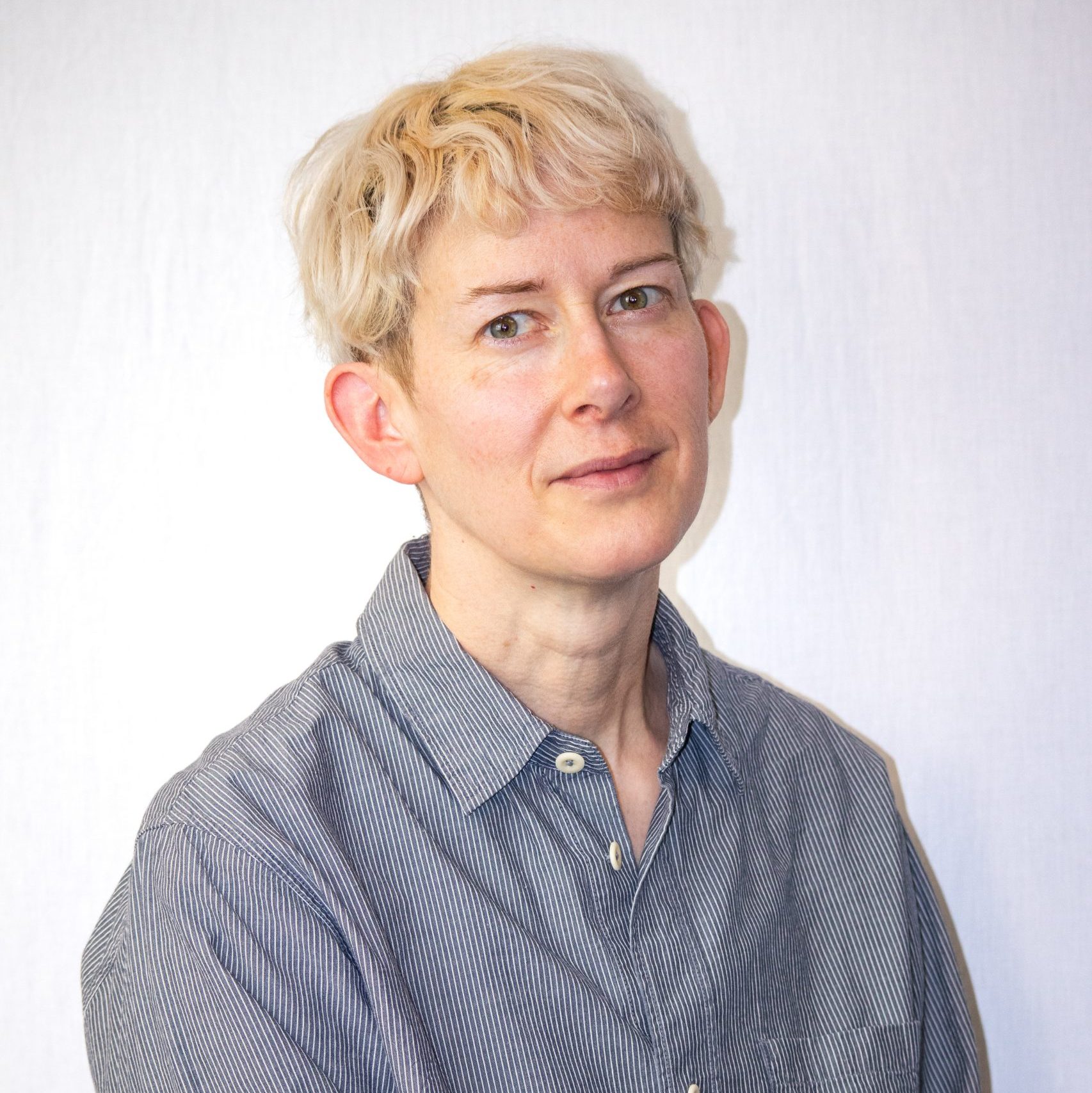
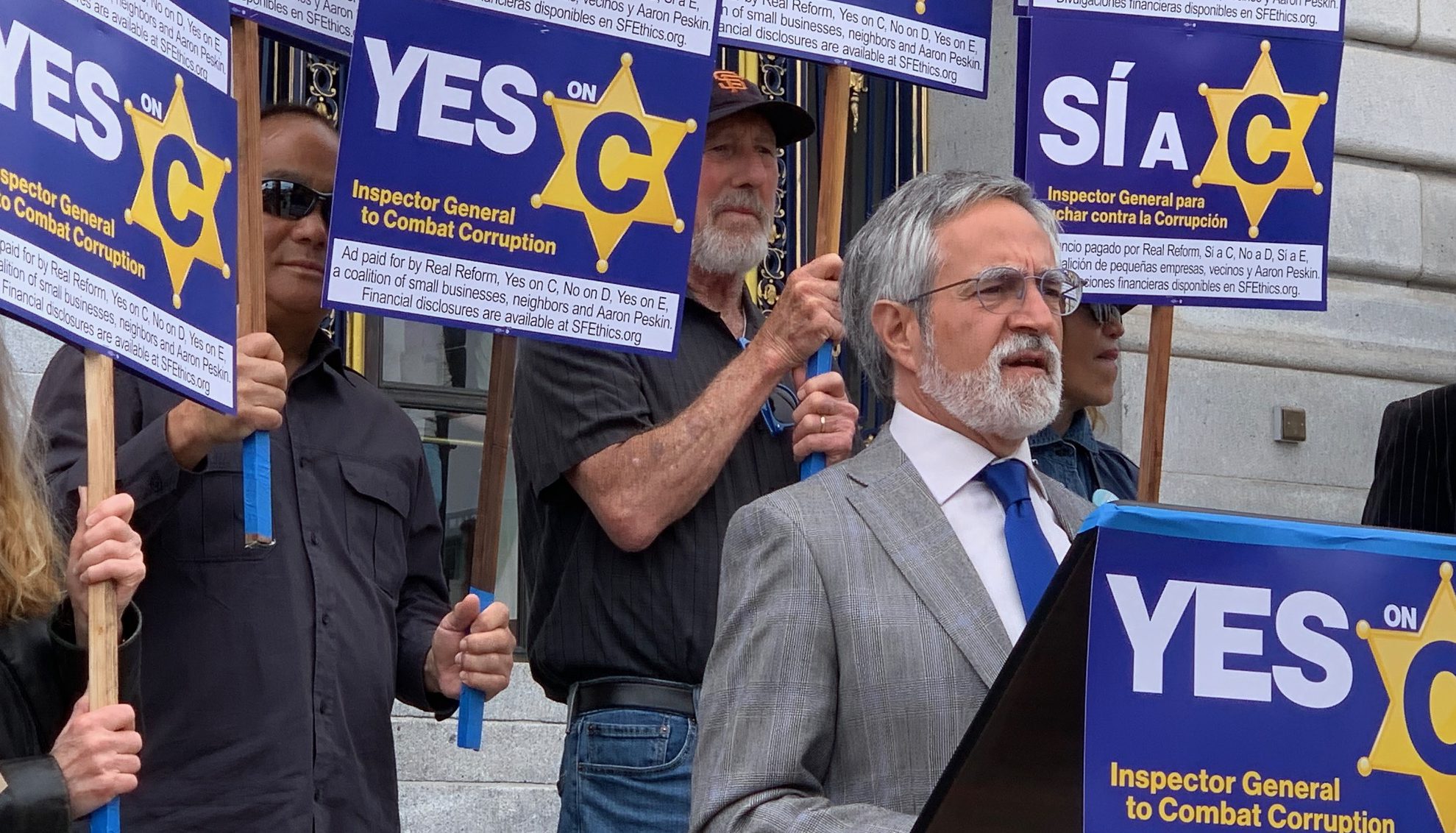

Supervisor Aaron Peskin gathered today for a press conference with several former government officials — former City Controller Ed Harrington, former Ethics Commissioner Paul Melbostad, and retired judge Ellen Chaitin — to discuss why San Francisco voters should vote for Proposition C, even though the San Francisco Democratic Central Committee is telling them not to.
Prop. C, a ballot measure authored by Peskin, would create a new position within the city: An inspector general with the power to investigate government and city contractor fraud, waste, abuse or misconduct.
“It’s time we stop relying on the FBI to uncover systemic corruption, and start cleaning up our own house,” said Peskin, when he first introduced the measure to the Board back in May.
New corruption scandals about officials in and contractors doing business with San Francisco city government have been breaking at a regular clip for years now. Odds were high that a few more would break between May and the election, drumming up support both for the measure, and the guy who authored it.
And lo, it came to pass. Just this month, Sheryl Davis, director of the Human Rights Commission and longtime friend of Mayor London Breed, resigned, after reporting showed she manipulated city spending reports and signed off on $1.5 million in contracts with a man with whom she shares a house. The city controller subsequently took control of the commission (more specifically, its accounting department).
And, as Peskin pointed out today, it can take a long time to get a city audit on suspected bad players.
“It took over a year from the time that I called for an audit of SF Safe in 2023, when the allegations of Kyra Worthy’s crimes were made public,” said Peskin, referring to the police department-adjacent nonprofit that was caught in a scandal short-changing its workers, landlord, and even a local florist, and whose director falsified invoices. “It then took another 196 days after the audit was released before she was actually arrested. This is unacceptable. I believe that the mayor intentionally abdicated her responsibility to root out corruption within her own administration and hold people accountable.”
At the board level, Prop. C was wildly popular; Supervisors Ahsha Safai, Hillary Ronen, Dean Preston, Connie Chan and Matt Dorsey all signed on as co-sponsors, and it was placed on the ballot by unanimous vote. Who would be willing to go on the record as opposed to fighting corruption?
As it turns out, a few people. The interlinked political pressure groups that have poured an unprecedented amount of money into the November election have come out swinging against it, among them GrowSF (“Purportedly designed to enhance efficiency and centralize investigations,” the group’s voter guide reads. “Prop. C instead adds bureaucracy. This role would duplicate existing authority already held by the Ethics Commission, District Attorney, City Attorney, City Services Auditor, and the Sheriff’s Office of Inspector General.”) and TogetherSF Action (“This position consolidates far too much power in a single position.”)
The San Francisco Democratic Party voted to oppose it. As of this March’s election, a majority of the seats on the committee are occupied by members of the Democrats for Change slate, an oppositional bloc that was elected largely with contributions from donors linked to groups like GrowSF and TogetherSF, and also endorsed by those groups.
The consolidation of power into the role of an inspector general is the whole point of Prop. C, says Harrington, who was city controller from 1991 to 2008. The distributed powers held by all these different agencies clearly isn’t getting the job done at the moment. “The Ethics Commission is four years behind,” he says when presented with GrowSF’s list of other groups that could conceivably be doing the work of an inspector general. “They will tell you that Mark Farrell shouldn’t have done something next March.” Indeed, that has historically been the case.
The Ethics Commission is also not equipped to audit anyone’s finances, adds former Ethics Commissioner Paul Melbostad. Its primary role is to protect whistleblowers in city government, not audit entire city departments.
As for the district attorney’s office, says Harrington, “They won’t do something unless you bring it to them. You have to do the inspection work, bring them a package, and then they can decide to charge them. They don’t just assign an inspector to go take a look. In the late 2000s, says Harrington, he began to hear stories about a crew of city electricians that were running “scams upon scams upon scams,” including buying $18,000 worth of “petrified seashore flagstone ” to renovate a house in the suburbs, getting contracts to do electrical work in the Presidio using tools, vehicles and copper wire owned by the city, and turning an empty building on Treasure Island into a clubhouse where they could rendezvous with sex workers. It took three years for the DA to bring charges, said Harrington. By then, the electricians had billed the city for more than $235,000 in personal purchases, and charged thousands more for time they had never actually worked.
As to the idea that the city attorney can fulfill the same role as an inspector general, adds Harrington, “as much as I love them, they’re a political group.”
Harrington has participated for years in discussions on how to create an inspector general position within city government. One of the reasons that it didn’t come to pass were concerns that, if it were an elected position, it wouldn’t actually do much good, since an elected inspector general might be wary of losing political support and endorsements. During his time as controller, says Harrington, he remembers two investigations under the city attorney’s office that just stopped.
In one case, Joanne Hoeper, a chief trial deputy, was fired mid-investigation, and wound up getting a $5 million settlement from the city after she sued for wrongful termination. When the settlement was announced, Hoeper said that she appreciated the money, but what she really wanted was to have the investigation re-started. “I brought this case because I hope that some independent body comes in and looks at what’s going on in the city attorney’s office,” she said. “The people who wasted more than $10 million of the city’s money are still there, and still have unfettered control over millions of dollars of city money.”
What finally persuaded Harrington that the creation of a relatively accountable-yet-independent inspector general was possible, he says, was the realization that it could fit into the city controller’s office, which has a dedicated, independent budget that routinely closes out each year with a surplus of a few million dollars. The money was there. There was no need to try and create an entirely new department from scratch. Research into other inspector-general roles in other cities, carried out by Nate Horrell, one of Peskin’s legislative aides, gave a sense of what best practices might look like.
The amount of money going into the November election makes the creation of an inspector general even more critical, says Jeremy Mack, executive director and treasurer of the Phoenix Project, an influence-tracking group. When people are putting millions of dollars into an election, it’s likely that they will be expecting something in return.
The focus of these big donations towards centralizing power in city government, the goal of TogetherSF’s measure Proposition D, makes the prospect of continued corruption even more likely, said Mack. The TogetherSF measure has fundraised more money than any other item in the November election, at $7.8 million; Peskin’s reform measures, meanwhile, have a meager $18,000 — 0.2 percent as much.
Most important, says Harrington, an inspector general with the powers laid out in Prop. C could stop corruption before it even happens so that a well-meaning project like the Dreamkeeper Initiative (which was also run by Davis) could continue to be recognized for what it was good at, instead of being enveloped in a cloud of scandal.
“At the Department of Human Rights, their budget went from $15 million to $45 million in less than two years. An inspector general could have said, ‘Wait a minute. Do they have the capacity to triple their spending? Do they have controls in place to do that right?’ You don’t just want to catch people doing something wrong. You want to stop them from doing something wrong in the first place.”
Please do a story on Prop 33. There are so many ads against it that are swaying people, and I suspect that it is exactly what we need. But I’d like more info. Please. Thanks!
GrowSF and TogetherSF coming out against Prop C reminds me of Trump’s thwarting of the bipartisan Immigration Bill. Regardless of their ridiculous claims, they are not thwarting it because it is a bad bill, they are thwarting it as part of a self-empowering political strategy.
Are we actually expected to believe that the ethics-challenged GrowSF, an organization that did nothing when their board member Garry Tan posted vile tweets, actually cares about corruption?
Are we to believe that ToegtherSF, whose now-former chief of staff (she’s now Farrell’s campaign manager) used a bullhorn in attempts to disrupt Aaron Peskin’s official announcement that he is running for mayor, cares about ethics?
In summary, thwarting a bill for political gain, using toxic tweets to wish a slow death on progressive politicians and disrupting campaign events of political opponents are tactics that are 100% from Trump’s handbook.
“When someone shows you who they are, believe them the first time.” – Maya Angelou
You’ve been warned.
Weird how actual facts got really twisted by just a few rich people who got stopped from building luxury condos. I’ve got (in sight of my own apartment) blocks of section 8 housing, a gigantic building full of public housing, several SRO hotels that were kept from being converted to luxury condos ONLY because the supervisor supported them.
NIMBY used to be when someone didn’t want something like section 8 housing in their district, but here in district 3, the supervisor SUPPORTED bringing it in. The buildings in chinatown got massive support.
And now, this new version of “YIMBY” isn’t “let’s make affordable housing units”, it’s become “let’s make ANY housing units”, with this idea that even buildings full of million dollar condos will somehow bring rent prices down because “supply and demand”. (seriously, I had 2 people angry that Peskin stopped a 20 story luxury condo building – owned by the Billionaire Chairman of sfstandard.com – because this was going to somehow decrease rents?)
I dunno what happened. But, my district is pretty nice and I wouldn’t leave it. It’s nicer than it was before covid. Obviously, there are problems, but for me, I own a small business here in the city and have kids in public schools and rent an apartment in north beach. The other candidates are simply awful.
Harrington was a big defender of Harlan Kelly and Peskin of Mohamed Nehru so one can only hope the Advocate would have a better nose for corruption than these two
Corruption doesn’t just suddenly happen – it’s allowed to grow through years of no one paying attention. Had Peskin (and other “supervisors”) spent time in City government (getting paid by us) paying attention and “supervising” we wouldn’t have to deal with deep ingrained corruption. Your time has passed Peskin, you’re the one who created the results we’re suffering.
I trust GrowSF and TogetherSF more than I trust local progressives, including Peskin — who has been on the board of supes throughout all of this corruption — and Mission Local, which has never met a criminal it doesn’t like more than the cops.
It seems to me that an inspector general might be a good idea. But I’m going to defer to the groups that are trying to fix San Francisco, rather than the progressives who keep arguing that it isn’t broken. “Crime is down.” Yeah, sure it is.
Campers,
When AIPAC’s D-9 candidate, Trevor Chandler railed against Peskin’s new watchdog at the Portola Neighborhood Association’s Forum at El Rio last night I had this reply …
“Everyone knows you can’t trust the cops to root out corruption and if you combine this new Office and their powers to issue Warrants and Subpoenas with an AI Internet Search Function you’ll be able to find out in seconds if the subject was busted for farting on a Tokyo subway 20 years ago.
h.