

Mission Local is publishing campaign dispatches for each of the major contenders in the mayor’s race, alternating among candidates weekly until November. This week: Mark Farrell. Read earlier dispatches here.
With less than two months to go until Election Day, Mark Farrell is putting the jigsaw-puzzle pieces of his plan for San Francisco together. The mayoral candidate revealed on Wednesday he would not open up Market Street to all cars (just to ride-hailing services like Lyft and Uber), but would upzone downtown, remove members of the police commission, and declare a fentanyl state of emergency.
He said he would fire the Police Chief Bill Scott and San Francisco Municipal Transportation Agency head Jeffrey Tumlin, put together a “stop the spread” tent-removal team, and make use of expanded mayoral powers he is bankrolling in a ballot measure.
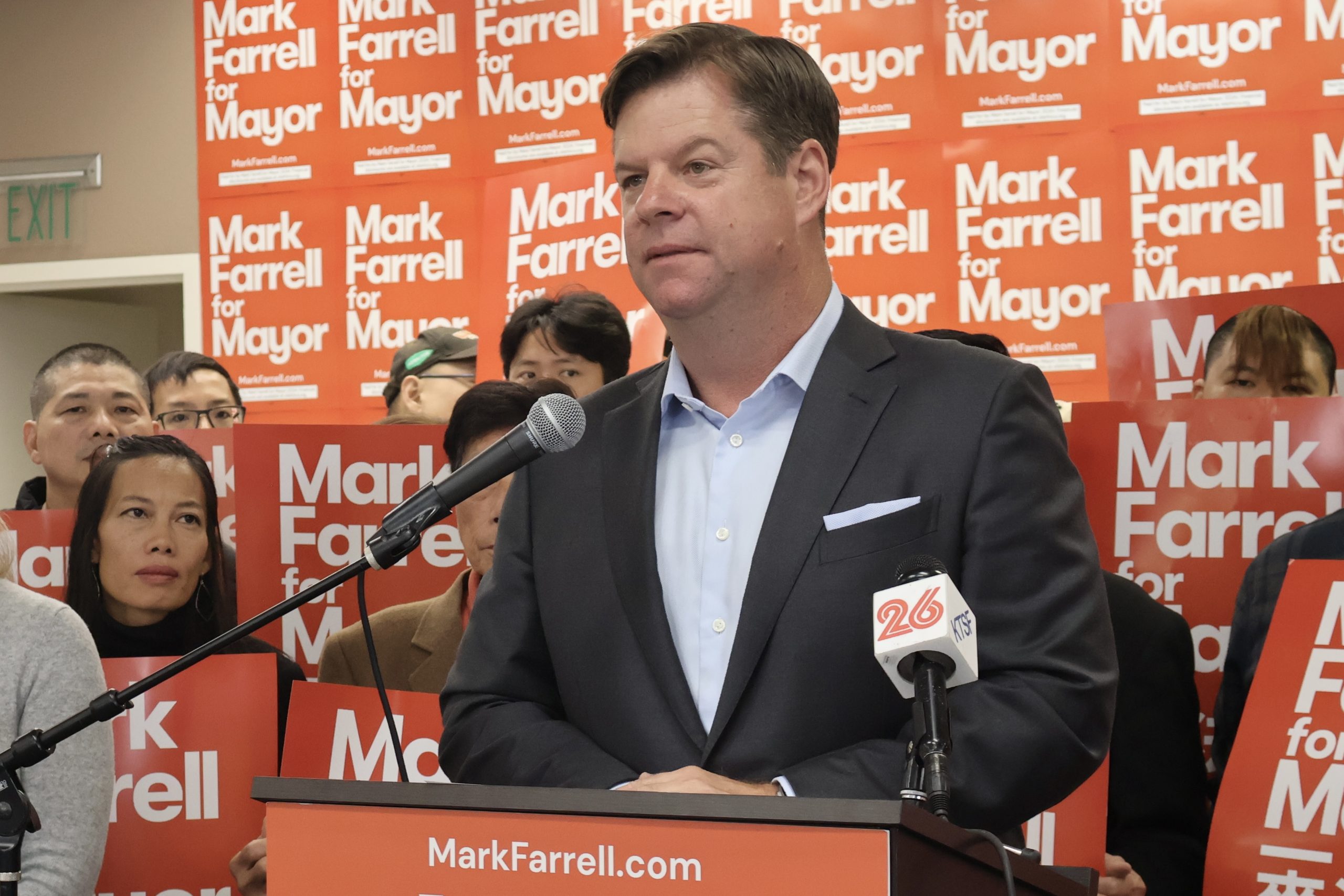
“My 100-day agenda articulates a clear plan: A vision for a safer, cleaner and more vibrant San Francisco,” said Farrell at a Wednesday press conference, reiterating what he and most other candidates have pledged over the last several months.
This time, however, he released a detailed 38-point plan of his first 100 days in office at a press conference with some 30 volunteers, two reporters, and many pork buns, muffins and moon cakes. All were gathered at his campaign headquarters at 299 West Portal Ave.
Here are more details from Farrell’s 100-day agenda:
Government reform, a strong mayor
Farrell sees himself as a stronger mayor than London Breed and, if his efforts to reform the city’s charter come to pass, he would also inherit a much stronger office.
Farrell is banking on voters passing Proposition D in November, a measure sponsored by the political advocacy group TogetherSF that would cut the number of city commissions from 130 to 65 and broaden mayoral powers.
Farrell has put together his own committee to pass the measure, which has fundraised $2.1 million of the $7.8 million total for the proposition. With that price tag, it’s the single most expensive item on the November ballot.
Should Prop. D pass, the mayor would gain appointment authority over five out of seven members of the police commission, the body that sets policy and provides oversight of the police department.
Given these powers, Farrell said he would appoint new members to the police commission, although he did not specify which members he would remove. The commissioners should be focused on recruiting and enabling officers to do their jobs, Farrell said, “as opposed to coming after the police officers on the streets of San Francisco, which they’re doing today.”
The Police Commission, by definition, is the civilian oversight body for the San Francisco Police Department.
In addition, Farrell said he would also fire Scott and Tumlin.
Public safety, housing
For the most part, Farrell’s plan is on track with what he set out to do from the start.
At the onset of his campaign, Farrell promised a hardline approach to the city’s public-safety, homelessness and drug problems.
On Wednesday, Farrell detailed how: He would create a “Stop the Spread” tent-encampment-removal team, although it is not clear how this would be different from the city’s “Healthy Streets Operations Center” and its other teams focused on dismantling encampments.
Farrell also said he would declare a fentanyl state of emergency, which would ostensibly leverage more funding from the state and federal government for treatment programs aimed at abstinence. Farrell has criticized the city’s use of “harm-reduction” programs that try to keep people who are using drugs safer, rather than requiring abstinence for services, though experts say harm reduction is a critical tool of public health.
Likewise, regarding housing, Farrell drove home his plan to focus on upzoning in the Financial District, SoMa and Mission Bay, areas that are already among the most densely built up in the city. He also said he would further reduce the inclusionary requirements (i.e. the percentage of affordable units) for new builds from the current 12 to 16 percent bracket, to 10 percent.
However, on the subject of Market Street, Farrell appears to have fine-tuned his pitch. Upon launching his campaign, Farrell made a splash when he declared that he would bring cars back to Market Street, which is currently only open to buses and taxis; but on Wednesday, he specified he would only bring ride-hailing vehicles back to the corridor.
“Our plan from the beginning was about ride-share vehicles,” he said in conversation with this reporter after his speech. “Let’s be honest, taxis are a dwindling kind of existence here in San Francisco. Ride-share is an activity that I believe we need to promote out of City Hall.”
Farrell has also sided with ride-hailing companies in opposing Proposition L, which would tax them and allocate that income to Muni’s operational budget. Instead, on Wednesday Farrell proposed reevaluating the need for funding for Muni capital projects and focus funds on day-to-day operations.
‘A dogfight until the end’
Farrell’s 100-day plan comes a mere three weeks before voters will begin casting ballots. It’s a tight race, but it is clear Farrell is a top runner, and he knows whom he has to target to get the No. 1 spot.
“No mayor has overseen a steeper decline in our city’s history than Mayor Breed,” Farrell said Wednesday during a nine-minute speech in which he recycled some standard campaign fare targeting his biggest rival.
“Public safety is the number one concern in every single neighborhood. Homelessness is on the rise. Our economy is stuck in cement. Our neighborhoods are struggling, and families are no longer part of the dialogue in City Hall,” he added.
Farrell, for his part, also hit at a brewing scandal that enveloped Breed last week, when Human Rights commission head Sheryl Davis, a longtime ally and friend of the mayor, was caught engaging in questionable (and lavish) spending atop her city department, the Human Rights Commission.
Farrell said he would pause all direct funding for nonprofits and centralize all their contracts under the mayor’s office; Davis is accused of manipulating city spending reports and signing off on $1.5 million in contracts to a man with whom she shared a home.
While Farrell has targeted Breed since the start of the race — and, more recently, Daniel Lurie, on a dedicated page on Farrell’s website saying Lurie is “trying to buy the San Francisco Mayor’s race” — he has also been the target of broadsides from his opponents, largely centered on the use of funds he has raised for his ballot measure committee to subsidize his mayoral campaign, an end-run around donation limits.
Last week, Farrell also faced scrutiny after rival campaigns alleged that one of his campaign ads violated election law, and after the San Francisco Chronicle reported that, as mayor, he had solicited $1.2 million in payments to a nonprofit in which his wife was a board member from parties that had pending business at City Hall.
For his part, Lurie’s campaign has poured resources into media materials opposing Farrell, and a not-so-subtle anti-corruption agenda aimed at his campaign.
And Farrell, seeing the temperatures rise, is getting ready. “This will be a sprint until the end. This will be a dogfight until the end.”

I’d vote for Breed before I’d vote for Farrell and that’s saying a lot.
I’d vote for Farrell before I’d vote for Breed and that’s saying a lot.
He he he…touché!
I just spent a week in Boston, a once blighted but now thriving city. There were no “vendors” sitting in the streets, no drug dealers getting “sanctuary” passes, no RVs containing “families,” and no one injecting or smoking drugs in public. I did not see one tent and noted only one man passed out in the street during my visit. There were some addicts at “Mass & Cass” near the methadone clinic but they were on their feet with a cop driving by frequently. Parklets were clean and without graffiti – in fact, there was very little graffiti anywhere. The public toilets were clean. Trash cans were simple, but they were emptied. There was a notable absence of feces on the street, either canine or human. Small businesses were open with customers.
I talked with several cops, ambulance EMS, and business owners and asked about the absence of blight. They all said versions of the same thing: “We won’t put up with it.”
Compare this attitude to our once thriving city. The attitude and political will make the difference. The Mission’s supervisor is AWOL and quite vocal that she hates her job. Most of the other supervisors excel at posturing but do little for their districts. The current mayor reacts rather than acts and has no consistent vision other than to appoint her cronies to wasteful commissions. San Francisco’s condition is pitiful under the current government.
Mark Farrell has my vote with Mark Lurie a second. For #3, I’m thinking that one of my cats would do a better job than the current administration.
Do not vote for anyone who is currently a supervisor. They vote for issues they do not understand. The Supervisors all voted for the demolition of The United Irish Cultural Center. The new non profit building is to be called The Cultural Center on 45/ Wawoma.ThisisA a slate and glass 6 story building with a rooftop restaurant with a veiw of low income housing,underground swimming pools and a garage for about 50 cars.This is to be built in sand on the same block as 4 small apartment buildings, a cafe,pizza place and motel.There are no known inspections of nearby buildings or the single family homes nearby to see if this is feasible. There is an underground stream/ aquifier under the zoo.The Pandas are coming and 1 million visitors are expected.This project is directly across from the zoo.All the Supervisors voted for this A big question is’ How did planning department allow this to happen?’