



When the San Francisco Unified School District wants to get parents’ attention, it can. We receive multiple emails in multiple languages. Text messages buzz on our phones. Landlines ring and robocalls drone on about an important pending announcement. Public-school parent Ed Parillon compares it to the episode of “The Office” in which Ryan creates a startup called WUPHF that links everyone’s means of communication, resulting in all the fax machines and phones and printers going off at once.
He has a point.
Last weekend, when the district abruptly delayed its scheduled school closures announcement, none of this happened. Superintendent Matt Wayne put a statement on the district’s website, which is a bit different than simultaneously sending out a text, email, robocall and WUPHF. Well into last week, teachers complained that nobody had sent them an official district communique announcing the abrupt delay of the closure announcement — and, needless to say, parents didn’t get an email, either.
“When the SFUSD wants to send a message, it’s generally irritating and over the top,” says Parillon. “But the one time there’s a message about something parents really want to know, they did nothing of the sort.”
He has a point here, too.
A piddling percentage of San Franciscans have kids, and no city in California has a higher percentage of its children in private schools — so, strange and terrible things are allowed to fester in the school district for years.
And fester they do, until the excrement hits the air conditioning. The district’s yearslong inability to escape near-fiscal insolvency, a disastrous, $40 million-plus poured into a payroll system that made teachers’ lives hell and, finally, the inability to formulate a coherent plan to close schools on the agreed-upon timeline led to frustrations bubbling over among current and former members of the school board.
It’s the delay in the closures plan that seems to have really torn it. It’s not just that a deadline was missed and families and school staff were put on pins and needles for weeks, though that ain’t great. Rather, it’s that school-board members described the long-in-the-making school closure plan’s methodology and the strategy to implement it as so lacking that a delay was deemed necessary.
Perhaps more than a mere delay: Last week, Board President Matt Alexander and Vice President Lisa Weissman-Ward quietly reached out to the mayor’s office for help, and a municipal Seal Team Six was assembled to aid the troubled district. Wayne, for now, kept his job, but gained a group of city execs to look over his shoulder while he does it. This was deemed preferable by the school board to sacking Wayne on the spot at a Sunday emergency meeting, as there is no SFUSD Brock Purdy to leap off the bench and take over.
So, both the timing and the extent of the pending school closures are to be determined. That’s a hard conversation for the next couple of days. But there is a list out there. We’re told it’s between 10 and 14 schools. There have been all kinds of cloak-and-dagger insinuations about how the list will be disseminated piecemeal, as the district readies staff and parents and kids for the bad news.
Thus far, the district has done anything it can to avoid having forthright and straightforward discussions with the families and staff at the schools it deems are struggling, and figuring out how to move forward. The district has also done anything it can to avoid simply showing its hand and letting concerned parties know what’s what — and having arguments on the merits.
We do mean anything. If you’re a public school parent, and you check your email diligently and have the time and inclination to respond to district missives, you may have filled out a survey regarding school closures.
Straightforward it was not: Parents were instructed to imagine they had 12 coins, and made to disseminate them in baskets marked “equity,” “access” and “excellence.” Separate and apart from pitting things everyone should want against each other, it is markedly unclear how such data about anodyne concepts could be satisfactorily distilled into a formula to close brick-and-mortar schools.
But we are informed that district representatives were seriously planning to tell aggrieved parents that their kids’ school was closing because of tabulations based on imaginary baskets of hearts, moons, stars and clovers. Perhaps a wizard could make sense of this, but we were unable to locate any wizards who doubled as public-school parents.
We did, however, find lawyers and Ph.D data scientists — but they said the survey confused the hell out of them, too.
“I am an attorney who works in software copyright issues. I spend a lot of time thinking through ‘how do we slice and dice intellectual property rights? … structuring and dicing them is pretty complex and deliberate. That is what I do all day,” said public elementary school parent Luis Villa.
But Villa was no match for the baskets of equity, excellence and access.
“It was just very confusing. This felt like a logic puzzle. It was completely opaque,” he said. “I have some sympathy, in that they are trying to build a thing that will not be gamed by parents whose sole concern is ‘I gotta save my kid’s school.’ They want something more general. But it’s not useful to just confuse everyone.”
Villa, a Cuban American, is a native English speaker. He graduated from Duke University and earned his J.D. from Columbia University. As a lawyer, he specializes in parsing arcane texts. And the SFUSD survey flummoxed him. As he was struggling to fill it out, he wondered how the monolingual Spanish-speaking parents of his child’s school classmates were faring.
The answer: Not great.
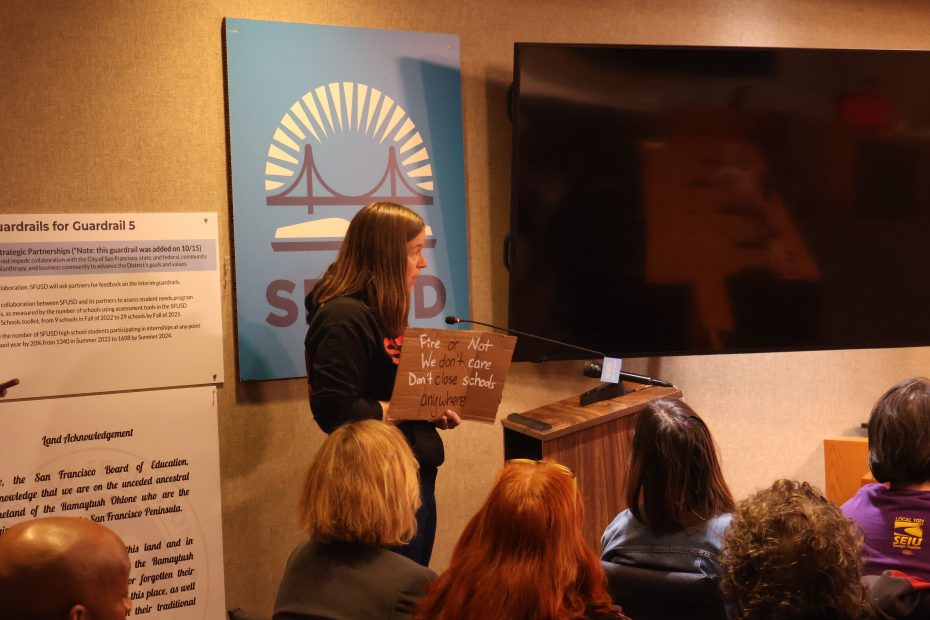
Laura Padilla is on her kids’ school’s English Learning Advisory Committee, and volunteered to help monolingual Spanish-speaking parents with the surveys. When she told them to choose between “access” and “equity” and “excellence,” they were confused. “They kept telling me that all of these are important.” She was then asked to define “excellence,” which is harder than you might think. Who doesn’t want “excellence”?
This turned out to be a tortuous process. Padilla says she could only walk two parents through a survey in a half-hour.
The “excellence” situation is a problem Ed Parillon warned the district about all the way back in May. Defining “excellence” isn’t only difficult, it’s inseparably tied in to other factors.
Parillon, who serves on the SFUSD District Advisory Committee, wrote to the district that “the measures are of dubious value, and largely a reflection of family incomes, like test scores, but they also have nothing to say about why a school should or should not stay open. … Test scores surely travel with students and families.”
His advice, and much of the input from the District Advisory Committee, went unheeded. The survey, Parillon concludes, was “essentially manufacturing consent for closing schools.”

So the criteria here were opaque, confusing and questionably suitable. That’s a problem. But another problem was that, as you’d expect, the parents who’d take the time to fill out an online-only, voluntary survey skewed disproportionately white, educated, and financially stable.
The district weighted for that, giving more emphasis to responses from Latinx parents like Villa and Padilla, or Black parents like Parillon. But this doesn’t really work because, while the results were corrected for race, they were not corrected for income or educational attainment. This created a homogenizing effect for Black and Latinx participants.
“Look, I’m a Black parent,” says Parillon, who used to develop credit-risk models and now works in affordable development. “But there is a certain type of parent who has the access and time to fill out your stupid survey. You are not getting a real cross-section.”
You don’t need a Ph.D data scientist to tell you that. But we found one, who’s also an SFUSD parent of two young children. And he told us that.
“The self-selection of the survey cannot be representative,” said Philippe Marchand, who earned his Ph.D from the University of California, Berkeley, in environmental science, and has spent years as a statistician and data scientist and teacher.
“Correcting the factor of race cannot correct the self-selection of the sample and the overrepresented higher level of education and also income. It’s just whoever shows up. They shouldn’t make it look more scientific than it really is.”
Marchand says he hopes the district doesn’t try to use this survey to rationalize its actions. “The process,” he says, “was really unfortunately designed.”
Well, you don’t need a Ph.D data scientist to tell you that, either. But he did.
And he, and all the rest of us, are on pins and needles, waiting for the next email in multiple languages, text messages buzzing on our phones or landlines ringing with robocalls. WUPHF.
The survey seems nonsensical. They should instead survey parents who have taken their kids out of SF schools and better define those parents who are most likely to leave the district and prioritize those responses. In the health insurance business the adage is “the healthy hunt while the sick stay”. SF schools have actively chased out the students that cost the least to educate and have kept the students that require the most and most expensive services. Closing schools will only exacerbate this problem. The solution is to attract more students who cost less. The message that SF is now “centering middle class and mass affluent kids who do their homework” will be a hard sell politically.
I’m really thankful for the work of the District Advisory Committee members, and Ed Parillon in particular who clearly identified the major issues with the district’s metrics. Too bad the DAC didn’t have more role in defining the process.
Imagine being the district, assembling a solid team like that, providing them hours of informative meetings about the district and all the relevant data… just to ask them to fill that “coins-in-buckets” survey… even as a bystander it feels a bit insulting.
I have 4 kids in SFUSD and I didn’t get any kind of survey about closing schools. I get endless emails and texts, but no survey.
Same! Enrolled for the first time this spring, absolutely did not get any communication about this apparently terrible survey!
Since the district hasn’t sent anything meaningful to SFUSD families, the only thing we have to go on is some news coverage and the mayor’s press release. It’s not much, especially since it is English only.
Between SFUSD and the Mayor’s Office there should be more than ample capable translators and interpreters to make the information that does get released accessible non-English speakers.
“…they are trying to build a thing that will not be gamed by parents whose sole concern is ‘I gotta save my kid’s school.’”
A city where parents have to compete in a zero-sum game to save THEIR kids’ school, has some serious problems wrong that go way beyond whatever boogeyman is being trotted out to justify the school closures in the first place.
In one of the richest cities in the world, we can do better. The fact is, the powers that be want to privatize public education, and profit off insanely valuable land that has been owned by the public for years, and “under-monetized.”
The fact that Breed, et al are being so secretive about everything is SKETCHY AS HELL.
Whatever the motivation for this closure plan, it will eventually come out. Let’s just hope it does while there’s still time to expose the corruption and folly, so it can be fought. When you give these public resources away, they are VERY difficult to get back.
I’m old enough to remember, not that long ago, the problem was classes were “too large,” but now they’re “too small?” I think not….
The problem we have is not politics, it’s money. And yes, they completely screwed the pooch with this payroll thing, but moving forward, the problem is strictly money. You want a decent muni system, you pay for it and your city benefits. You want a decent school district, you pay for it and your city benefits, not just because you have students who aren’t idiots, but because of the people who will stay/come to SF.
Go ask ANYONE from the suburbs. ANYONE buying a house when they have kids. They will ALL be looking at the ratings of the school district. ALL of them. Even with no kids, you STILL look at the school district to make sure you’re not investing in a terrible area.
You want SF to succeed, you want people to come here? you want people to think this is a good place to live when they’re considering coming here with their family? You want businesses to think about having employees who aren’t coming in from Vallejo or Walnut Creek? You fund the damn schools and stop closing them and playing politics with them.
Schools are infrastructure and they’re a major deciding factor on where people live. You can invest in this city, or you can keep your money and watch the city devolve into a wasteland of homelessness and uneducated children adding to the masses while people in multi-million dollar condos complain endlessly.
PPS called this out early on and mentioned this in Press Releases. They have a huge network and have been advocating for us. You need to talk to them.
Those are the people who are supposed to be teaching your kids…critical thinking?
I’d like to recommend a substack by Paul Gardiner from SFEDup that asks, “which schools would you close?” It has great charts.
https://sfeducation.substack.com/
Also a book from 2020 that looks back: “Class Action, Desegregation & Diversity in SF Public Schools”, by Rand Quinn. SFPL has one copy.
In order to see what’s in store for SFUSD, all 1 needs to do is look at the management catastrophe that is in Wayne’s rear view, HUSD.
True! But sad, our children are at Risk. With all this “Chaos” I am glad I left the State. Letting this new generation who has “No Common Sense” run California is a Disaster. “Seasoned Comitted Loyal Citizens” with Good Work Ethics is vital in a success of any Business. Too many “Mental Burn Out Days” did NOT exist. yet we thrived with a wealth of motivated loyal hard working staff who were there daily and on time!
As a former SFUSD employee,
I ALWAYS took my job serious and believed we needed to do a Good/Great job because these parents are relying and trusting us with the most valuable possession they possess – Their Children.
You don’t need a survey to take action.
Strong action is needed to address this critical situation. If school closures and layoffs are necessary- then act. Paralysis analysis does no good.
I, as a former employee could tell you alot but we are not allowed to disclosed. We were required to sign a disclaimer.
How to run a public school system? There’s hundreds in the land! Which begs the question: Is anyone ever looking at public school systems which – low bar – aren’t steering the plane towards the mountain all the time?
they look, but the $$ is the problem. Look at Zillow and you’ll see that a leading indicator is the school district. I’ve bought and sold a few houses over the year and you know what I look for: Good Schools. Even before I had kids. It’s an indicator of the area’s overall value and the resale value. The property itself gains in value because of the schools, and then because of the homeowners income and the lack of vacant housing, they have more money for schools, and it’s a cycle.
SF lost a TON of money with covid, but the majority of kids’ are still here. So we need to decide: Fund the schools with extra money, so people can see that we have a good schools system, OR close schools and allow SFUSD to devolve into chaos, and ensure people won’t invest in SF and the schools system will continue in this self propagating downward spiral.
SFUSD receives more money per student than any other large school district in California
SFUSD has one of the lowest student-teacher ratios in the state
SFUSD has been able to afford a student-teacher ratio nearly as good as Palo Alto’s because it has paid its teachers far less than many other districts in the Bay Area