



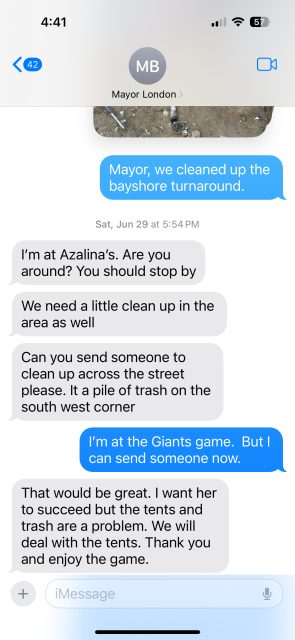
On June 29, Mayor London Breed texted Carla Short, the director of San Francisco Public Works, asking her to send out a crew to pick up trash in the Tenderloin.
“I’m at Azalina’s. Are you around? You should stop by,” read the text from Breed, sent at 5:54 p.m. while the mayor was at a Malaysian restaurant near Ellis and Leavenworth streets. “Can you send someone to clean up across the street please. It [sic] a pile of trash on the south west corner.”
Short said she was at a Giants game but promised to “send someone now.”
“That would be great,” Breed wrote in response. “I want her to succeed but the tents and trash are a problem,” she added. “We will deal with the tents. Thank you and enjoy the game.”
That simple text exchange, which was deleted by Breed from her personal phone but recovered from Short’s device, has revealed a practice within the mayor’s office of routinely deleting text messages and other day-to-day communiques, a practice public-records experts say violates California law.
“If Mayor Breed’s texts were about government business and less than two years old, it would be illegal for her to delete them,” said Susan Seager, a First Amendment expert and law professor at the University of California, Irvine, who runs the university’s Press Freedom and Transparency initiative. “State law says that public records must be retained for two years. San Francisco is not allowed to nullify state law with its own policies and rules.”
Nevertheless, it has been the policy of San Francisco since 2014 to allow the mayor to delete texts. Half a dozen public-records experts said that is a problem, and that the mayor is opening the city up to litigation by deleting texts dealing with official business.
But the mayor’s office sees things differently. Without a lawsuit forcing the matter, it is unclear the practice will change.
Mayor’s texts are ‘non-records’
The mayor’s practice of deleting text messages came to light last month during an Aug. 20 hearing of the Sunshine Ordinance Task Force, the local body responsible for overseeing San Francisco’s public records law.
The task force was considering a complaint filed against the mayor’s office, accusing it of failing to respond to a public records request in a timely manner, and then failing to turn over any records at all.
On June 29, a frequent filer of public-records requests named Hazel Williams asked for the latest message from Breed on a variety of platforms, like SMS, Signal, and WhatsApp. The mayor, like other city officials, uses her personal phone to conduct city business and speak to staff.
The mayor’s office, after a lengthy delay, wrote on Aug. 8 that it had nothing responsive to the request from Williams. In other words, the mayor had no text messages whatsoever dealing with official city business.
Williams’ requests to other city departments, however, revealed communication between Breed and Public Works, when Public Works responded with the text exchange between its director and Breed.
“I really want to drive this point home: I have text messages sent from the mayor on the day that I asked the mayor’s office for her latest text message,” said Williams. “And yet the mayor’s office says they have no records.”
Hank Heckel, the mayor’s legal compliance officer, wrote in a statement that “Unless such texts have independent legal significance, the individual officials and staff in the Mayor’s Office generally determine whether or not to continue to store individual texts on their phones.”
At the Aug. 20 hearing, Heckel said the mayor does not use other platforms, like WhatsApp or Signal. Breed’s texts, he said at the hearing, are “typically treated as non-records … in the parlance of record retention policies.”
2014 policy may have always violated California law
Those policies date back to 2014 and Mayor Ed Lee. Since then, San Francisco mayors have abided by local public records retention guidelines that allow for the routine destruction of day-to-day communications that are not defined as “records” under the city’s administrative code.
San Francisco Administrative Code §8 defines records as “paper, book, photograph, film, sound recording, map, drawing or other document … made or received by the department in connection with the transaction of public business.”
Although the code does not specifically include text messages, emails, voicemails, or other routine communications, the mayor’s office has, since 2014, interpreted “records” to exclude such communiques, meaning they “may be destroyed when no longer needed,” according to the retention policy.
Five of the six experts who spoke to Mission Local, however, disagreed with this interpretation, saying a practice of deleting texts before two years violates California state law, and that the 2014 policy has likely always violated state law. San Francisco Administrative Code §8.3 notes that “Nothing in this Section shall be deemed to apply to or authorize the destruction of any records that are required to be retained by local, State or federal law.”
“The mayor’s compliance officer is wrong,” said Karl Olson, a 35-year public-records attorney. Olson successfully argued a 2017 case in front of the California Supreme Court called City of San Jose v. Superior Court, in which the court ruled that public officials’ messages on personal devices are still public records.
Olson pointed to that City of San Jose decision, in which he represented a resident seeking to obtain texts from a city council member’s private phone. He also noted that California Government Code §34090 separately requires that public records be maintained for a period of at least two years.
“The definition of a public record is anything except the shopping list from home,” he said, pointing to the two-year retention requirement for records. “When you’re texting about public business, then that’s gonna be a public record.”
The San Francisco city attorney’s office declined to comment on the matter. In a statement sent after publication, the mayor’s office reiterated its position that texts are not “records” for retention purposes, and cited a 1995 memo from the city attorney’s office.
That memo, created well before the wide use of text messages, notes that records like “phone message slips, appointment calendars, and notes of meetings and conversations” need not be retained. “Accordingly,” the statement from the mayor’s office read, “the Mayor’s Office does not require the retention of such items, which include day-to-day routine emails and texts.”
“San Francisco seems to claim that texts/emails are simply not public records (unless extra, significant circumstances apply), and thus not disclosable,” wrote Brian Hofer, the founder of the Oakland nonprofit Secure Justice and the inaugural chair of Oakland’s privacy commission. “That’s a silly position to take.”
For his part, Heckel also noted that the mayor’s retention policy is similar to that of the Board of Supervisors and other city departments. It is unclear whether other elected officials, like supervisors, also have a practice of routinely deleting messages.
It’s also unclear to what extent Mayor Lee and other mayors deleted their text messages. Williams said she believes Breed’s practice of deleting texts goes back to 2020, when a trove of text messages publicized by Williams showed Breed personally directed staff, including the police chief, to “clear,” “clean,” and “fix” homeless encampments around the city. “After that,” Williams said, “I was unable to get anything from the mayor’s office.”
David Loy, an attorney and the legal director of the First Amendment Coalition, sees more wiggle room for the mayor and San Francisco. He said that while the deletion is a problem and opens the city up to litigation, the definition of “records” under California law is nebulous and has never been adequately defined by state courts.
There is a “hodgepodge of different laws and local rules” that govern retention of records in California, Loy said. “To my knowledge, no court has held that the law requires cities to retain every kind of record under the [California Public Records Act],” he said. “There is some play at the joints here about what the record retention laws are and the obligations of an agency.”
Still, the experts were unanimous that the practice of deleting messages hampers government transparency and keeps the public in the dark about official conduct.
“When you’re a public official — someone dedicated to working and performing your duties in the name of the people — that comes with an obligation to have a light shined upon your activities,” said Gunita Singh, a staff attorney at the Reporters Committee for Freedom of the Press. “There’s no excuse for shielding [records] from the public by way of loose compliance with records retention schedules. The mayor’s office should do better.”
This piece has been updated with an additional statement from the mayor’s office and the mayor’s legal compliance officer.
Breed, like Farrell, is too ethically challenged and can’t be trusted. She’s got to go.
The “she” is the proprieter of Azalina’s – the mayor wants the restaurant to succeed.
Right? I feel like the journos are trying to create a story out of a conversation with a business owner that turned into a tiny bit of action.
The Mayor deletes texts and SFPD uses drones in violation of state law.
So, why are we supposed to vote for Breed and why did Breed overfund the police?
Oh, because lawbreakers like the mayor and the cops need to be arrested. Wait, what? I mean ….
The level of BS corruption in San Francisco makes me ashamed of the city. I mean, we take a beating on Twitter, You Tube, Reddit etc etc over poop on sidewalks, needles, open drug flea markets, the fact that Republicans are a non-starter here (for which I am grateful). The amount of ignorance hate thrown at us is considerable, but I always defend the city. Not blindly and stupidly like a MAGA defends their leader. But when faced with facts, I’ll admit that we could do better or what ever is appropriate. But then I read stories like this and it makes me sick. What elected official can, with a straight face, seriously state that texts aren’t documents? I mean really? I would think that it goes without saying that if you’re on the government teet then the public has a guaranteed right to see your texts as related to your job. How could they say otherwise and as the story says, SF’s little “policy” doesn’t trump state law. Thinking it does just shows the level of entitlement and elitist corruption means the mayor should at minimum explain herself and should probably be replaced. I expect to read this kind of garbage from a republican administration, not a democrat. There really aren’t any good reasons to delete texts that I can think of. However, there are numerous bad reasons to delete texts and most have to do with corruption. Do better, Mayor Breed. Act like a democrat that takes their job seriously and wants to leave the city better than when they were elected.
BREED HAS ALWAYS BEEN A CRIMINAL. How is this even a revelation?
The revelation should be that NOTHING IS BEING DONE ABOUT IT.
Chiu the ‘annointed’ City Attorney has skin in this scam.
Clean house, FIRE BREED.
Azalina’s is in the Tenderloin, selling inexpensive Malaysian Street food at an $89.00 per person “prix fixe” menu price. I want them to succeed too, but not at astronomical and unrealistic prices for a neighborhood of poverty!
“I want them to succeed too, but not at astronomical and unrealistic prices”
Welcome to Neo-SF, the pay to playground for the neo-riche.
like many her ‘zonor sniffs the political winds and follows the stink.
after the murder of George Floyd, she like so many other corporations, joined the bandwagon to (dis)honor the awful event by speaking to the public about de-funding the police.
while the Dreamkeeper Initiative did receive funding that was taken from the police budget, her ‘(dis)honor has quietly replaced that funding (and it appears surpassed that which was removed).
we see sfpd now given carte blanche to operate as they see fit and surveillance technology being deployed much like the chinese communist party all for the sake of the political survival of someone who regurgitates the same rhetoric as the recently alleged target for assassination. she just couches the words better and the sheep just nod in approval because it’s ‘liberal’ san francisco.
George Orwell warned us.
Mayor Breed used to (and probably still does) request the police clear out homeless encampments around the gym she regularly worked out at. There’s probably a nice trove of deleted texts around that activity.
Notice how things got cleaned up in 1 week before Dreamforce Conf?
Just like 4 years ago, Breed sweeps for photo ops and PR, that’s it.
Gavin Newsom’s roadmap, Scott Wiener’s tactics, Ed Jew’s morality.
I just can’t listen to Breed’s speeches anymore, I get the fist of death.