

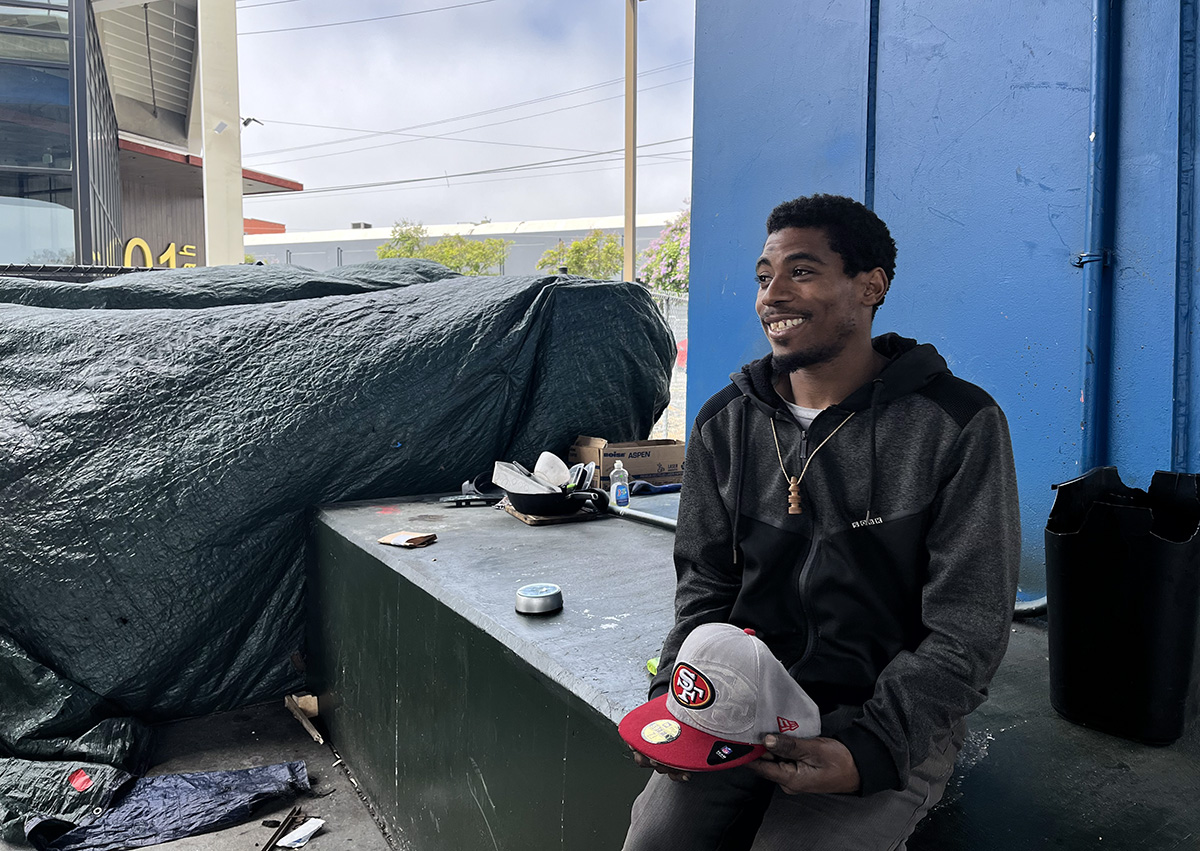

It’s 8:02 a.m. Wednesday morning, before an expected sweep.
Under Highway 101 and a cool, gray sky, Chez stirs in his sleep.
Nestled between a metal gate and a freeway pillar, a large tarp is draped over his tent at night. Neatly stacked outside his structure, he has a stovetop, a pile of clean pots and pans, blankets, a foam mattress, a spray bottle of bleach, and a few wool blankets. Beside his tent stands a cabinet on wheels with drawers packed with miscellaneous items.
In 24 hours, everything will have to be moved.
The night before, after spotting an encampment-clearing notice at the end of the block, Chez packed up most of his belongings into a cart. He is prepared. He knows the drill.
The “very aggressive” sweeps promised by Mayor London Breed have already begun. In the past week, police and Public Works have routinely cleared encampments scattered across the city. They load tents, clothes, bicycles, and other belongings into their trucks, power-wash the sidewalks, and occasionally make arrests.
The city’s schedule of planned encampment enforcement lists this section of Division next and Chez’s community, located under Highway 101 near Division Street, is bracing for the dawn of August 1.
Still bundled up in layers, Chez sprays down the concrete slab under the pillar with bleach. A self-described “neat freak,” the 32-year-old has dreams of one day starting a janitorial service. He hopes for a life with more stability, with more permanent housing. But for now, he’s happy with his own space on Division Street over the cramped and hostile nature of navigation centers and shelters.
“I’d rather be out here. I’ll risk it out here,” he said. “Being out here and being in there is really not too different.”
Further along Division, a breeze rattles Jeffry’s tent as cars zip by overhead.
“Define ‘more aggressive.’ They’re taking our things. They’re taking our people,” the 28-year-old says. “What’s left?”
Jeffrey has been waiting for housing placement for two years. In that time, he has been arrested once. His property has been discarded during sweeps too many times to count.
No clearing notice has been placed on the block his tent is located, and he is entirely unaware of the impending sweep. Jeffry says he has no plans to pack up.
“I’m just waiting to get to the other side,” His voice catches and he continues. “It’s not living, being out here on the street. We’re just trying to live, and we’re being punished.”
His voice is airy, soft, and lethargic. He speaks in short sentences that escape through a hole in the tarp over his tent.
Across the street on a highway pillar, someone has scrawled: “Not Abanded, This is all we have please have some decency.” Beneath it is an arrow pointing into a private lot with a few semi-permanent structures.

9 a.m. on Alameda St. and Potrero Ave.
Just around the block, Cory wakes up on Wednesday morning and begins disassembling his small green tent and folding his tarp. His honey-colored Belgian Shepherd, Blueberry, mulls around him.
So as not to disturb others, he repacks his tent each morning. He wheels his cart filled with all his belongings to a U-Haul storage container across the street, and then goes about his day. He typically grabs some food, sees friends, and brushes up on his tech skills at Code Academy. Around 7 or 8 p.m., he pitches his tent in the same spot and prepares for bed.
He hasn’t heard about the notice and he has not seen the slip of paper taped two blocks away. But he is always ready.
After the U.S. Supreme Court Grants Pass decision and Gov. Gavin Newsom’s recent executive order, Cory is unfazed by this upcoming sweep. It’s all predictable — all just politics, he says. Commenting on the $24 billion Newsom spent on homeless programs, Cory wonders: Where did all that money go?
“The navigation centers are just about filled to capacity. Where is everyone going to go?” he asks. “There’s not enough affordable housing.”
For Cory, living on the street without permanent shelter is a temporary answer. Just last August, Cory was living in the Tenderloin, paying rent in an single-room occupancy hotel with broken pipes and mold.
He wondered why he was paying rent for such poor conditions, and moved to the street.
“They have to fix the housing market. They have to fix the affordable rental situation. They have to fix the job market before any of this other stuff is going to get fixed,” he says gesturing towards the tents, trash piles, and tarps scattered along the underpass. “That should be obvious, but it doesn’t seem to be to a lot of people.”
At 13, he ran away from his Minnesota home with a friend in a Chevvy Corvair, San Francisco-bound. At 14, he lived homeless on Polk Street, spending nights picked up by men, a Bible in hand that was supposed to protect him. In his 20s, he says, he worked in video editing and at a few businesses along Pier 39 before he entered the tech world and got a job at Google. At 30, shortly after Sept. 11, 2001, he enlisted and was flown out to northern Africa and the Middle East with the United Nations.
He returned in 2012 and found housing for veterans, but violence was pervasive and he needed to get out. Since then, he’s bounced around.
Cory says he’s experienced sweeps before, and once had four officers threaten to arrest him. When he responded saying he understood they were just doing their job, they backed off.
The aggression and force used in sweeps is what disturbs him most.
“These are people that can’t really fight back and don’t have any legal standing,” he said.
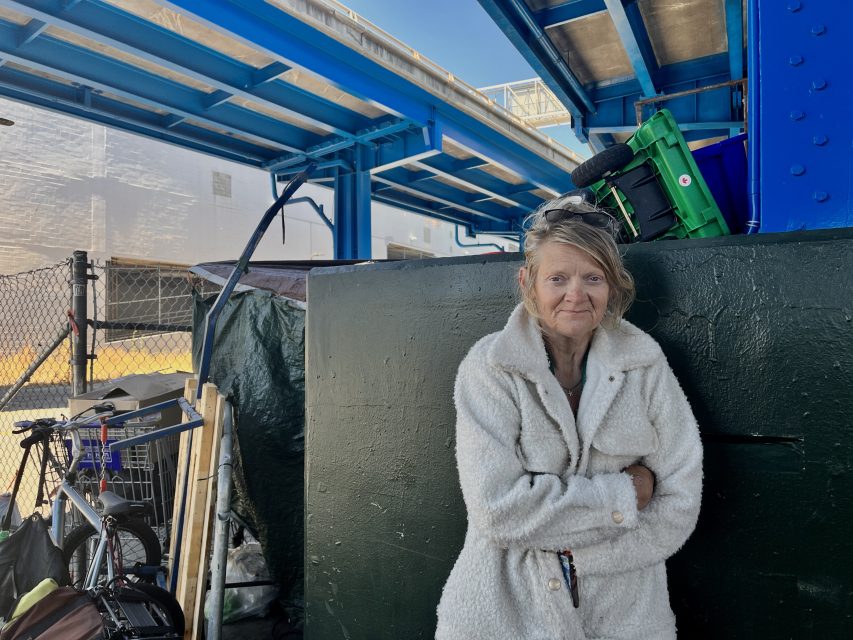
11:30 a.m. under Highway 101
Chez has changed into a red flannel and has a few friends over in his tent. Cory has dropped his cart off at UPS and left to grab breakfast.
Down the block, Joy Carmack, 53, is bent over her bike, fiddling with the lock. She is wearing a white faux fur coat and tinted glasses.
She’s experienced several encampment sweeps, one in the last few weeks. About a month ago, her partner, Juan, was arrested and they lost nearly everything, including her phone. She had left it in a jacket pocket during the time of the sweep, and didn’t have time to retrieve it.
“I got a call back on a job in that time,” she said, shaking her head. “Of course, just when I get my act together.”
In the past, they have had to watch as Publics Works employees collect their possessions and load them into massive garbage trucks. They have had their bikes destroyed and their recycling disposed of.
“We’re just supposed stand aside and watch them crush it all,” Carmack said. “It’s just so wasteful.”
The two of them have received no notice of the upcoming sweep, but that is typical, they said. In the past four years Carmack has been in the area under 101, sufficient warnings have only been given a handful of times.
Though they are housed in navigation centers in opposite parts of the city, the bulk of their belongings remain on the street. So does their recycling.
The navigations centers have strict restrictions on how much residents can bring in the space. Carmack said the limited storage requires many to leave a portion of their belongings outside.
Since the couple makes their living off of recycling, Carmack the additional storage is essential for their survival.
“If you don’t want to be a thief or a criminal, you either have to sell stuff or recycle,” she said, emphasizing that neither of them would ever consider stealing. The assumption that they are criminals or dangerous because they are poor is “dead wrong,” she continues.
“We buy stuff at the store just like everybody else does,” she said. “We’re still part of this. We’re not the big-wigs, but we’re still making the city go around.”
She read on her phone this morning that sweeps would be ramping up, and tried to show Juan. He shrugged it off. The sweeps are like mechanics to them now.
In June, Juan was arrested in a sweep for illegal lodging. He keeps his papers folded up neatly in his wallet, but admittedly hasn’t looked at them until now. The slips are creased and almost illegible.
“They gave you three misdemeanors,” Carmack says in shock, squinting at his discharge slip. At the top of the paper, police had misspelled his name on the form, and wrote the wrong address. On the bottom of the slip, the scheduled court date is hard to make out. July 18? July 13?
Either way, it doesn’t matter. He never went.
“That’s not my name,” Juan protests. “How can I go to court if that’s not my name?”
“Oh, lord,” Carmack sighs, and puts her hand on her head. “Then you definitely shouldn’t be out here, honey.”
They bicker back and forth. Carmack is visibly exasperated, but Juan can’t stop laughing.
Done with Juan’s antics, Carmack says it’s time for her to head out and bike the seven mile loop to drop off her recycling before the center closes. On a good day, one bag can bring in 54 bucks.
I feel like this series you are doing on homelessness is intended to make us feel sympathetic, but you are picking the worst people to achieve that. Most of them seem to have options available to be indoors and are choosing not to (doesn’t feel like paying for an SRO, sleeps in a navigation center but still stores their stuff on the street…)
There seem to be way more voluntary homeless people than I thought. Party’s over, they all need to be indoors.
Ana: We aren’t selecting people to make you feel one way or another. We’re talking to the people who are at the places where sweeps are planned. Everyone is likely to have different reactions. Best, Lydia
Thank you for the reporting.
Still I see no reporting on the homeless people that come around our block, and turn over trash cans and spread trash at night… nor the ones defecating in plain view during the day on the sidewalks… nor the entitled ones who insist on smoking meth and fentanyl in front of Marshall Elementary. There are many types of homeless- true, It does seem that this news site mainly focuses on the type described in the article. These people draw the ire of SF because the cops are not empowered to enforce the laws regarding vagrancy (remember those?) and many of the homeless want to take their slice out of the middle (of the sidewalk).
It’s been obvious to anyone paying attention that the vast majority of folks on the street in SF are either seriously mentally ill or voluntarily homeless. The former should be forcibly placed into treatment. The latter want to live for free in tents on public thoroughfares and do drugs in relative peace, which they have somehow been able to get away with for five years now. Enough is enough.
Closing time. You don’t have to go home, but you
Can’t
Stay
Here
“They have to fix the housing market. They have to fix the affordable rental situation. They have to fix the job market before any of this other stuff is going to get fixed,”
Unnhhh Hnnnhhh
Homelessness is the symptom, not the disease. It’s far easier to sweep people away and blame victims than engage in a meaningful conversation to address underlying causes. The decision made by the Supreme Court effect very real people existing under horrendous circumstances. I welcome any supreme Court Justice to stay in a homeless encampment and shelter for at least one week prior to passing judgment, for their sweeps fix nothing. Until we address housing shortages, employment, healthcare and other social maladies, homelessness will continually blossom. Sadly, there’s no political will to do so, which is why this problem has persists. Regardless, treating humans less than human coupled with a stubborn unwillingness understand causative variables, only engenders symptom we deride.
Thank you Zenobia Lloyd for your humanity and for writing this excellent piece. There but for the grace of the Universe go I…….go you. I bet Mission Local wins a Pulitzer for this series. Thank you.