

Seven candidates for San Francisco elected office in November are benefiting from an unusual, though seemingly legal, arrangement: They are all receiving multiple $500 donations from different branches of the same statewide group, a practice campaign rivals say skirts city donation limits.
In San Francisco, supervisor races have strict $500 contribution limits per donor. But a nonprofit called Govern for California, which has historically financed state races, has employed eight of its different chapters to give $500 each to six supervisor candidates and to District Attorney Brooke Jenkins. Each of the candidates has received $4,000 from the group’s chapters.
Govern for California was founded in 2012 to fight “special interest” in politics. It is currently being investigated by the California Fair Political Practices Commission after CalMatters published an investigation in 2022 into the organization’s use of local chapters as “force multipliers” to influence politics. The FPPC confirmed on Friday that the investigation was still open, but declined to comment further.
The seven San Francisco candidates receiving Govern for California money are Marjan Philhour in District 1, Danny Sauter in District 3, Bilal Mahmood in District 5, Matt Boschetto in District 7, Trevor Chandler in District 9, Michael Lai in District 11, and District Attorney Jenkins.
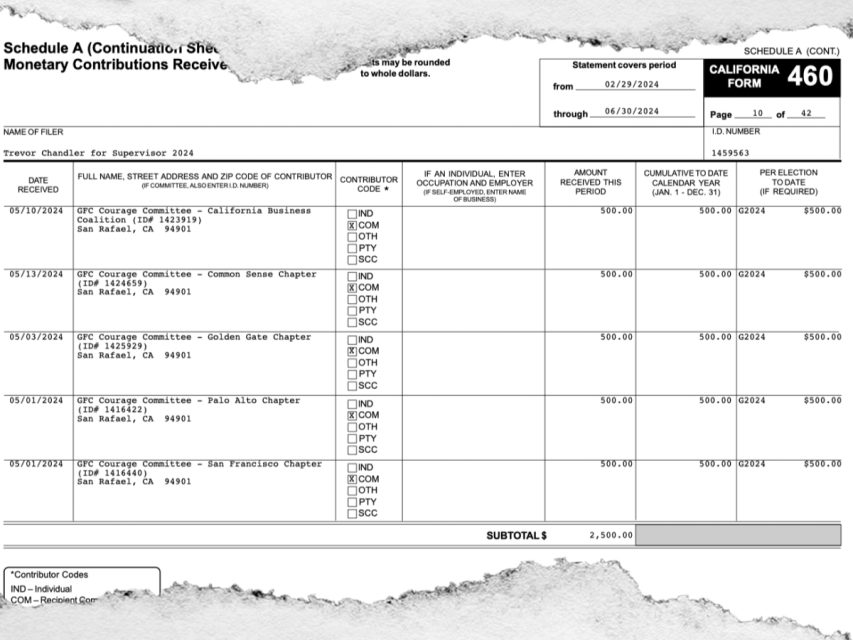
Several campaign-finance experts said the arrangement is likely not illegal: Donors can coordinate with one another to support the same candidates and thereby increase their collective giving power.
But the giving effectively masks the source of the money, experts said, hindering transparency and violating the spirit of campaign-finance law.
“The question is: Who is giving this much money to a particular candidate? Because that’s the whole purpose of campaign finance law, to understand the disclosure of individuals,” said Ann Ravel, former chairperson of the Federal Elections Commission during the Obama administration.
Ravel herself accepted money from Govern for California in an unsuccessful 2020 State Senate run, and said that, while the practice is legal, the concern is that voters will not know who is funding candidates.
“There’s lots of very wealthy people who are part of [Govern for California], so you don’t really know who’s trying to influence the election that way,” she said. “It’s important to know who the actual donors are.”
Added Bob Dockendorff, who sat on the San Francisco Ethics Commission from 1996 to 2000: “It’s a problem, a big problem … It was never our intent to see that happen. That’s what we’re trying to avoid: Hiding dark money.”
Approach is typical for group statewide and locally
Govern for California was founded in 2012 by David Crane, a Stanford public policy lecturer who has rallied against public-sector unions and served as an advisor to Gov. Arnold Schwarzenegger in the 2000s; he devised Govern for California to oppose “special interests.” Its donors include wealthy real-estate and tech interests in the Bay Area, like billionaire investor Mark Heising, venture capitalist Mark Perry, and McKinsey partner Gary Pinkus.
Crane has said that he was influenced by labor unions when devising the chapter model, CalMatters reported, pointing to unions like SEIU, where locals spend on candidates.
Govern for California typically focuses on governance issues and has fought public sector unions: It opposed an ultimately successful 2023 state bill allowing legislative workers to unionize, and recently lobbied against a proposal to expand unemployment insurance to striking workers.
The group did not respond to requests for comment.
The CalMatters investigation detailed how candidates for the state legislature. like Assemblymember Matt Haney. took multiple donations from different Govern for California chapters, just like San Francisco’s supervisor candidates, making up a substantial portion of their total haul.
The group’s practices and CalMatters’ reporting led to the open investigation by the California Fair Political Practices Commission.
Govern for California had $2.21 million in revenue as of 2022, according to its latest tax filing. As a 501(c)(4), the source and spending of that money is largely kept hidden, unless it goes to candidates or ballot measures.
The group also spun up an associated 501(c)(3) nonprofit, which cannot spend on candidates directly, in April 2023. Filings have not yet been released for that nonprofit.
While the group seems to be a modest spender in San Francisco so far, it has dipped its toes in: It gave $10,000 to the public pressure group GrowSF in January, $15,000 to the moderate-leaning United Democratic Club in 2016, $5,000 to the pro-school board recall PAC San Francisco Parent Action in January, and $1,000 to the Republican-funded powerhouse Neighbors for a Better San Francisco in February.
The group has 17 active chapters that often fund the same candidates. In 2022, the group spent more than $3 million in statewide races, according to CalMatters.
Govern for California chapters’ cash on hand

California
Business
Coalition
Santa
Clara
Govern for California
Action Committee
Marin
$158,689
$114,960
$409,878
$107,692
Southern
California
Bay Area
Sierra
$106,413
$105,863
$103,475
Govern for California
Courage Committee
Future
Generations
Excellence
in Education
Palo Alto
$297,796
$102,603
$86,227
$95,681
Govern for
California
Network
Committee
East Bay
Santa Cruz
$57,327
$83,373
San Francisco
Golden
Gate
$22,238
$246,126
Santa
Barbara
$102,133
Common
Sense
$44,979
$59,916
Hollywood
$13,071

Govern for
California
Courage
Committee
Govern for
California
Action Committee
$409,878
$297,796
San Francisco
Marin
$158,689
$246,126
Santa
Clara
California
Business
Coalition
Sierra
$106,413
$114,960
Excellence
in Education
$107,692
$95,681
Golden
Gate
Bay
Area
Common
Sense
$102,133
$105,863
$59,916
East Bay
Southern
California
$57,327
Future
Genera-
tions
Govern for
California
Network
Committee
$103,475
$86,227
Palo
Alto
Santa
Cruz
$22,238
Santa
Bar-
bara
Hollywood
$102,603
$83,373
$13,071
$44,979
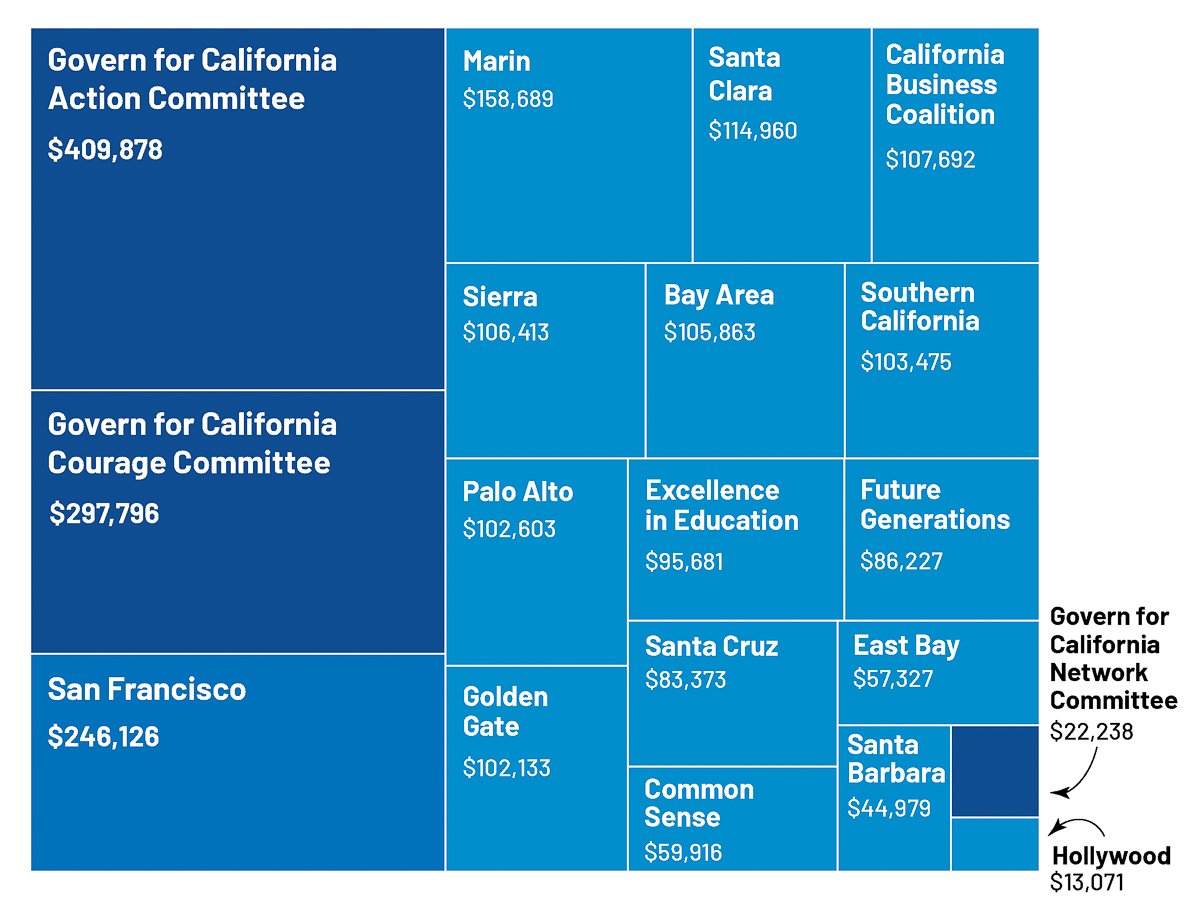
Chart by Xueer Lu. Data current as of June 30. Data source: California Secretary of State.
Its chapters, collectively, had $1.59 million in the bank as of June 30, according to state filings. The San Francisco chapter is the richest, with $246,125 in cash on hand. The group also has four separate state-level political action committees, with about $730,000 on hand, that bankroll state and local candidates.
The eight Govern for California chapters involved in San Francisco elections are, cumulatively, spending $28,500 in the 2024 races so far, including a $500 donation to Mark Farrell’s mayoral campaign. Since 2016, Govern for California has spent about $94,000 in San Francisco elections, according to city filings.
Ahead of the March primary, Govern for California’s chapters also donated about $10,000 each to Philhour and Mahmood for their successful Democratic Central County Committee races. San Francisco’s $500 donation ceiling does not apply to the race for the DCCC, which is a state body. Govern for California’s chapters also gave $5,500 to Lanier Coles, who also won a seat on the San Francisco DCCC.
Donations are small source of total funds
The donations to the San Francisco supervisor candidates are a small part of their overall fundraising: 3.4 percent for Chandler in District 9, for instance, and 1.9 percent for Philhour in District 1.
But the amounts can be significant in races where winners and losers are separated by hundreds, and sometimes just dozens, of votes.
“It may not seem like a lot, but to have $4,000 under your control, that could be a full staff person’s salary for the month in a race where 100 votes could mean the difference between someone getting elected or not,” said District 9 candidate Jackie Fielder, the public bank advocate and democratic socialist.
Fielder, who is running to replace termed-out Supervisor Hillary Ronen, first called out her chief opponent for benefitting from the arrangement. She said Chandler “should be investigated for skirting campaign finance laws” and that a third-party is planning on filing a complaint with the San Francisco Ethics Commission.
District 5 Supervisor Dean Preston’s campaign, through a spokesperson, denounced the arrangement and called Govern for California a “multi-headed conservative corporate PAC.” Supervisor Myrna Melgar in District 7 called them an “anti-union group” and said, “I trust that the regulators will look at [the group’s spending] and determine whether or not it goes around the law.”
Most of the Govern for California donations came over a two-week stretch in late April and early May. Some of the chapters, which are legally separate entities, are outside San Francisco, like the Santa Cruz and Palo Alto chapters.
Most of the candidates who received Govern for California funding did not respond to requests for comment. Sauter said his campaign follows all relevant laws.
Philhour, for her part, hit back at those who were raising concerns about the arrangement, saying they should focus on bread-and-butter issues affecting voters instead.
“Imagine being just 95 days from Election Day — and instead of centering the voices and concerns of voters who are demanding real change, you create a distraction based on a flawed and confusing campaign finance system set up to keep political newcomers out,” she said. “It’s the same old rhetoric that got us here in the first place, and San Franciscans are tired of it.”
Disclosure: This reporter briefly worked with Jackie Fielder in 2018 at The Worker Agency, a communications firm.


It tells us a lot about how and for whom Marjan Philhour will govern when she calls an attempt to determine who is trying to install their puppets on the Board of Supervisors a distraction.
Antiques and valuable artworks are often accompanied by a pedigree so that interested parties know the historical chain of ownership. It is a way of proving that something is genuine. Philhour should be proud of being owned by so many rich “moderates” and should want everyone to know who they are.
If she does not want us to know who is trying to buy her a seat on the board, how can she expect anyone will think she is being transparent on any other issue? I mean, she will lie and obfuscate if she gets elected, but how are we supposed to believe her lies and obfuscation?
Arntz is helping hide the ID’s of the donors behind Charter Amendments.
He came before the BOS and requested they take an option to opt out of obeying a State law that says these donors must be listed after the Proposal because it would take too much paper ?
Voter ‘Pamphlet’ presently is clocked at 361 pages going to around a half million voters so, if it were a Novel it would easily have enough readers to be on the New York Times best seller list.
it all reminds me more and more of the Redistricting Task Force and their late night moving of District Lines to Favor these billionaire forces.
The Reverand, Townsend wept when he did it but he moved the lines anyway and it gave us Arch Conservative Dorsey as a replacement for Daly/Kim regimes.
And, a flip to Conservative representation over Mar family in D-4 was it ?
Big Brother controls almost every bit of Local Media and I’m hearing perfectly sane and compassionate people parroting Republican Talking Points.
“I got a bad feeling about this one, Vern.”
Go Niners !!
h.
Save us all and San Francisco from Breed’s former lackey and YIMBY darling marjan Philhour. Last time she ran, she invented a fake “tenants rights group” and sent campaign mailers to trick folks into thinking she is supportive of tenant rights and protections. She is not!!!
just what i expect from that group of candidates.
Yes, thank you ML for holding the magnifying glass to the big dollars backing these unqualified candidates. Their donations have afforded them good teams who made up these narratives that “an outsider” needs to lead our communities. The evidence is piling up that they have been bought and paid for to pursue the interests of business and NOT of the people of San Francisco. They will see how wrong they are for undermining the competence of voters come November.
I have been voting for years and I always make up my own mind.
I don’t care how much money is donated to which candidate.
And I’m tired of progressives implying that my vote has anything do with donations. This is San Francisco. If you think we’re all stooges who will vote however some right-wing billionaire tells us to vote, why are you living here?
Mission Local is missing the point on donations. BALLOT MEASURES can be influenced by money because most of us don’t have any idea what they really mean. But candidates? Give us a little credit for making up our own minds.
Once upon a time, district supervisor races were pretty cheap and kinda boring. Tech and real estate billionaires are spending millions of dollars to try install their “free market” candidates on the Board of Supervisors; many of these billionaires do not live in San Francisco but are spending massive amounts of money to control the outcomes of our local elections. In 1977 when San Francisco voters decided to re-organize supervisor elections to choose their supervisors from their own local neighborhoods instead of for voting citywide generalists, a supervisor’s campaign cost about $15,000.
Ignore the dark money and recently formed Astroturf Super PACs at your peril. Inform yourself. Vote.