

“Number of children?”
“Sixteen,” reports Margarita Mena. Seniors? Twenty-eight.
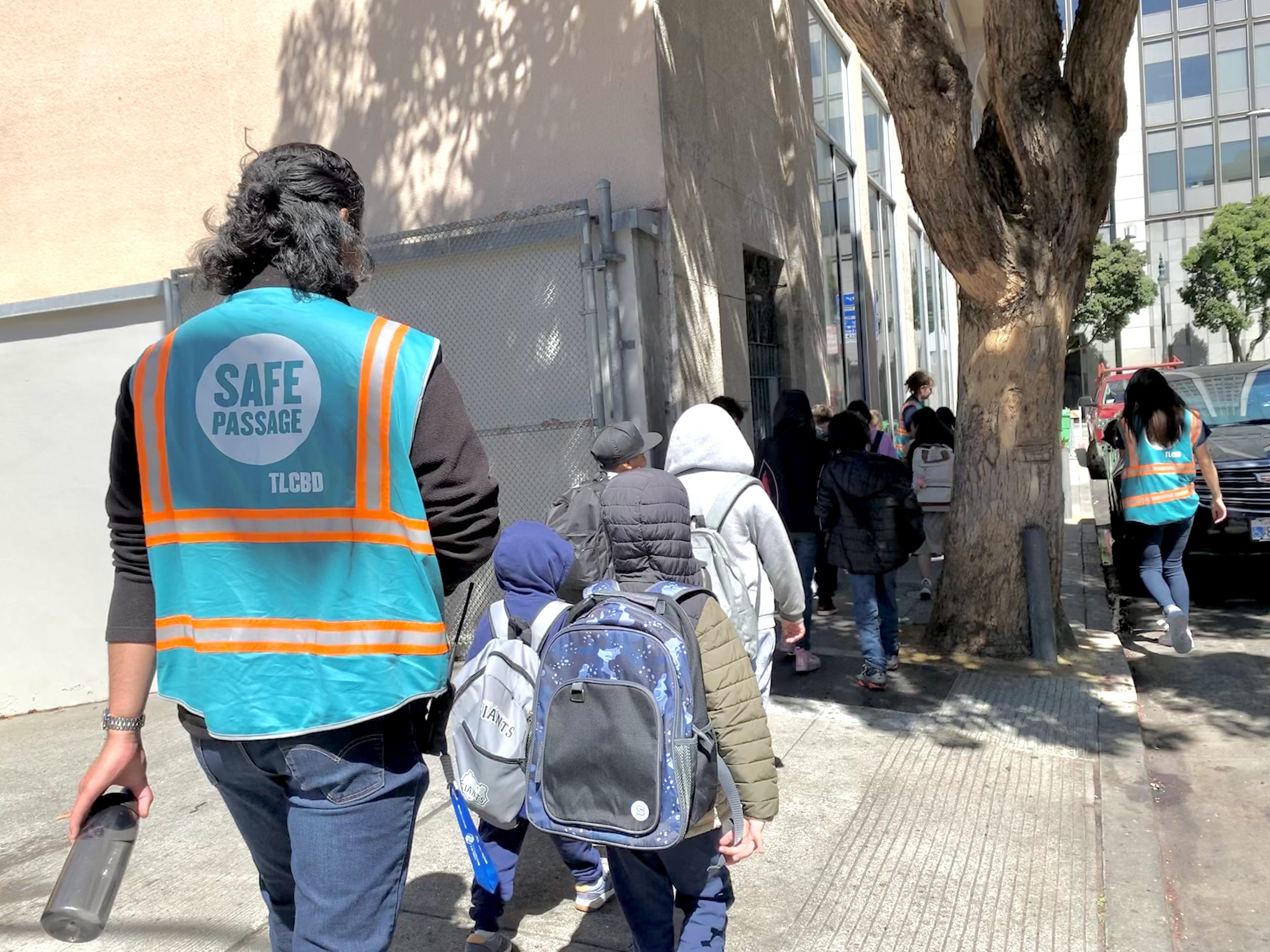
Mena is wiping down a tray of radio receivers for Safe Passage, a program now in its 16th year that helps children and elderly people walking through the Tenderloin, one of the city’s poorest neighborhoods where every street is on the city’s High Injury Network, and severe and fatal crashes were at levels ten times higher than the rest of the city from 2014 to 2019.
Between 2017 and 2022, three of the four most common intersections where pedestrians were hit by cars and injured were in the Tenderloin, so safe passage for the children and seniors who live in the neighborhood, helps.
Mena is one of 22 paid staffers posted at different intersections helping residents navigate the neighborhood safely, or “roaming” ahead to scan heavily trafficked blocks for any issues: Obstacles in the sidewalk, drug use, feces.
As she answers her team lead on a recent Monday afternoon, Mena glances at her clicker to check her numbers.
“Drug activity?” — “Drogas?” Margarita pauses to think. “No.”
“Erratic Behavior?” — “Medium.”
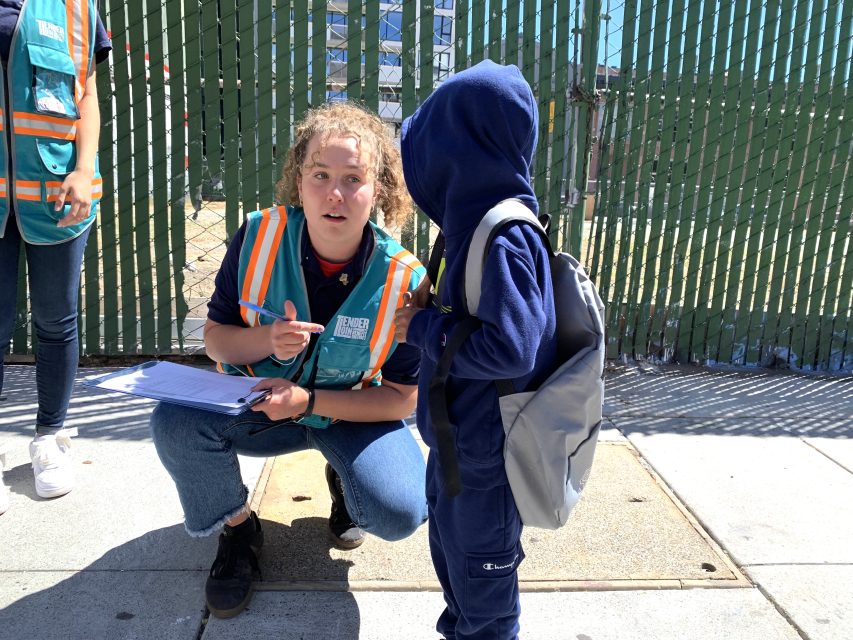
Issues are infrequent, but do happen: Between April and June, children and after-school programs were rerouted eight times by Safe Passage after incidents ranging from intoxication and drug use to medical responses. Mena, for her part, said she has seen it all: Fights, car wrecks, fires, overdoses.
Eight “negative incidents” occurred in the same period, including indecent exposure and a driver running a red light and nearly hitting a staff member.
The San Francisco Municipal Transportation Agency has already banned turns on red lights at more than 50 intersections in the neighborhood, and limited speeds across the neighborhood, and an $8 million federal grant announced in December will go toward further traffic safety improvements in the Tenderloin.
Fentanyl has changed the game
Kate Robinson, the head of the Tenderloin Community Benefit District, which runs the program, said that reception for Safe Passage has cooled with the arrival of new drugs and dealers without ties to the neighborhood.
“There was a strong ‘kid code,’ which has really diminished over the last few years since fentanyl took hold and the level of dealing changed,” Robinson said. “And it just changed the nature of all of it.”
On Monday afternoon, the first day of school, before workers began their trek out to their positions, Safe Passage leaders reminded staff to “have patience” with those in the streets and with each other.
“With a lot of the displacement that’s going on, we’re finding more people are a little irritated out on the street because they’re being pushed around a lot,” Eric Rozell, director of Safe Programs at the Tenderloin Community Benefit District. Mayor London Breed in July announced “very aggressive” sweeps across the city, and police officers and Public Works staff began clearing encampments in recent weeks.
Rozell is addressing nearly 20 people who have gathered for a 2 p.m. shift. “Code orange,” as workers are reminded, is for an emergency, and can mean blood, weapons, fire, or an overdose.
Rozell set out with the rest of the team, all donning blue and orange vests. In recent months, he said, he has seen fewer tents, but more people on the streets, which reflects city data showing that, while homelessness has increased since 2022, encampments have decreased.
The frequency of incidents can vary, but they often tend to coincide with the beginning of the month, when people get assistance or employment checks and can afford to buy drugs.
“Hey, folks,” Rozell calls out to a group of people sitting on the sidewalk, leaned up against a building on the shaded side of Jones Street. “School’s going to be letting out in about 30 minutes, so we might have some kids coming through.”
Nearly everyone nods, and some say hello. Along the route, most promise to clear out soon.
From kids’ program to all-around neighborhood guides
Robinson said Safe Passage launched in 2008, in part because a child accidentally ended up in the wrong summer program, setting off alarm bells among concerned parents. There are some 3,500 children living in the Tenderloin, according to the 2022 census.
Last year, the program assisted more than 1,000 children and 655 seniors each day, on average. Today, the program’s annual budget is around $600,000.
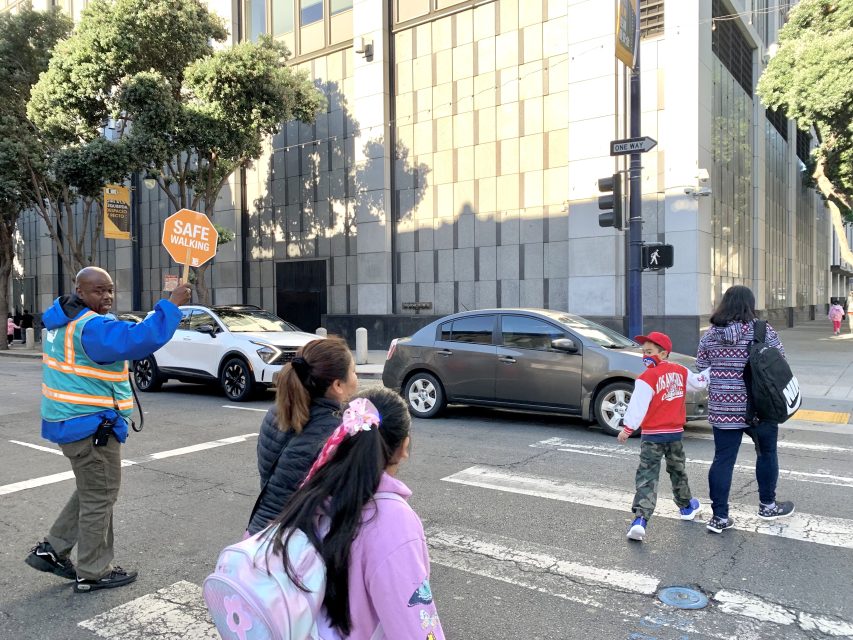
On Tuesday, before the second day of school, a Safe Passage worker named Jerry Franklin grinned and greeted each child as they passed by Turk and Larkin streets — a whining child hurried along by his mother, another messily eating an ice cream treat.
“Good morning! You got cookies on your face!” Franklin exclaimed, holding up an orange octagon labeled “BE SAFE” in the middle of the crosswalk as they hurried past.
What began as “mothers’ concerns” and “concern for all the dangers,” Mena said in Spanish, has now become much more. The workers are all equipped with overdose-reversing Narcan, and radios to stay in touch throughout each shift. They assist elderly residents with getting around, and they serve as friendly faces in a tight-knit but often tough neighborhood.
At Tenderloin Community School, children are dressed their best for their first day back from summer. Carrying Fortnite backpacks and wearing Mario hoodies and Michael Jordan T-shirts, they run to hug their after-school program mentors — all trained by Safe Passage and wearing the same blue-and-orange vests.
Francisco Craig, an employee with Salvation Army Kroc Center, has noticed big changes in the seven or eight years he has been working alongside Safe Passage.
“It’s actually like a really nice safe space for the kids,” Craig said, as kids gathered around him and his colleagues before setting off. “Just a couple years back, there were needles on the ground, druggies passed out, and stuff like that.”
Cops, community ambassadors all involved
Especially with the arrival of other community groups like Urban Alchemy community ambassadors, Craig said, things have improved. The collaboration between different city and community entities seems woven into Safe Passage; in fact, multiple employees interviewed said they also have separate jobs at Urban Alchemy.
The Tenderloin police station has two officers dedicated to Safe Passage, and in the program’s early days, Robinson said the captain even paid to paint the “yellow brick road” which once marked the Safe Passage route through the neighborhood.
Despite one minor discovery early in the pre-walk — a “Code brown!” was called after one worker spotted feces on the sidewalk, and fell back to report it to 311 — overall, the first day of school goes smoothly. There’s very little trash on the street, and few people are loitering or blocking the sidewalks.
“This is actually as good as it gets,” Rozell said, looking around, impressed.
“I cannot believe my eyes,” said Kate Robinson, the head of the Tenderloin Community Benefit District when she reached Turk and Leavenworth streets, noting how clear the typically packed sidewalk was. Turning onto another block: “I’m just shocked at how few code browns!”
There was likely a reason for that, though. Hugh Robinson, who worked the morning shift, said he had noticed a big cleanup ahead of a visit from Mayor London Breed to the neighborhood for the first day of school.
Of course, things continue to change in the Tenderloin. As public officials carry out police blitzes and homeless sweeps through the city and people living on the street find themselves in different states of desperation, Safe Passage does what it can, where it can.
Finishing up her report, Mena’s supervisor asks: “Positive impact?”
“High,” she says.
This story has been updated to reflect that the Safe Passage reroutes and incidents occurred within the past quarter, not the past year, based on new information from the organization.
Why doesn’t tlcbd talk about her clean team the ones who actually clean those safe passages ?? You know the ones out cleaning the code browns trash etc etc
The resources and costs that the public invest to accommodate and sustain these negative behaviors (drug use, public camping, etc.) on the streets reveal whose lives are valued more than others. We can do better than shield our kids. We can choose to not tolerate these antisocial behaviors in shared public spaces.