

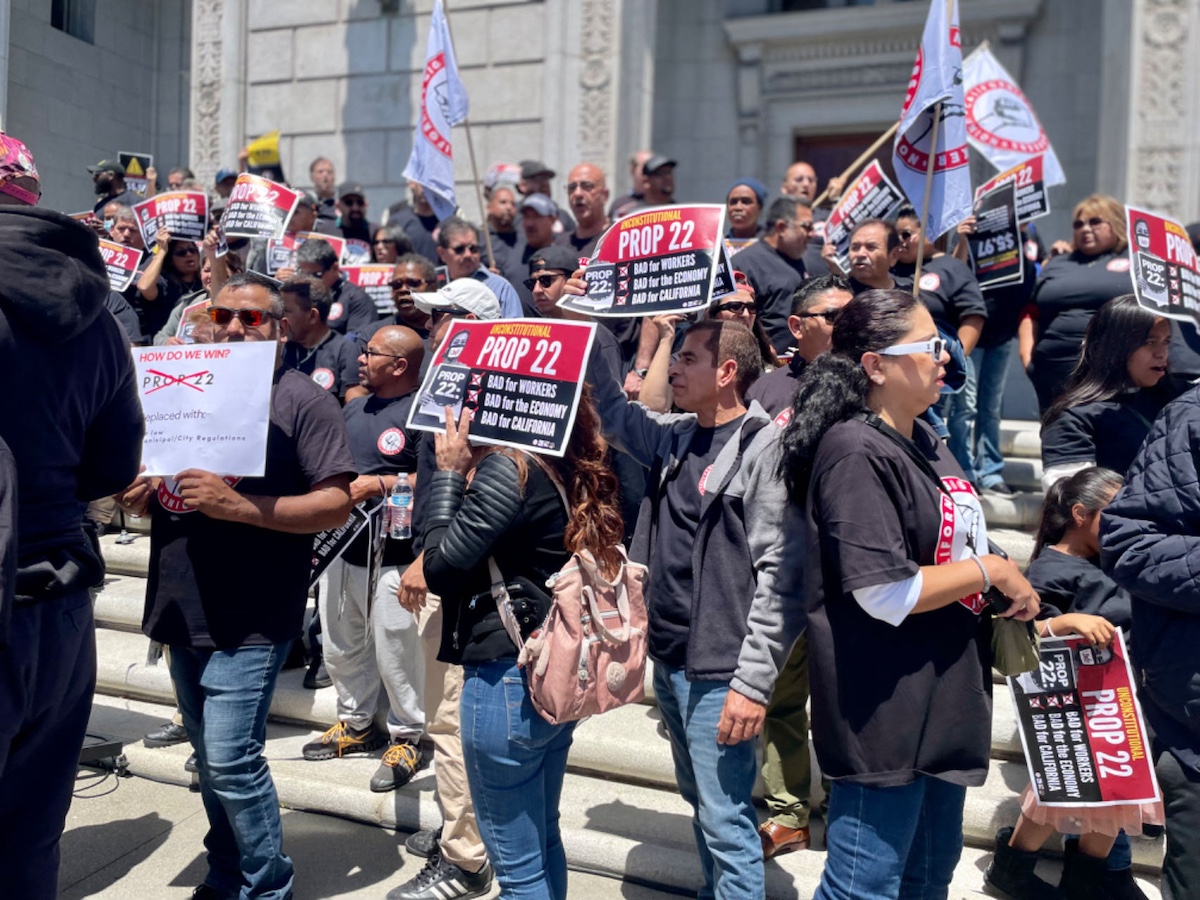

California app-based gig workers — Uber, Lyft drivers and DoorDash food-delivery workers — can be legally classified as independent contractors, per today’s ruling on Proposition 22 from California Supreme Court.
Much of the lawsuit turned on the question of whether Proposition 22 usurped the legislature’s authority to establish and enforce a workers’-compensation system, which is a violation of the California Constitution.
In its ruling today, the court found that was not the case, that it “does not itself restrict the Legislature’s authority to enact workers’ compensation legislation … ” wrote Justice Goodwin Liu.
“We’re disappointed in today’s ruling,” said Tia Orr, California executive director of SEIU, which sought to overturn Proposition 22, representing four gig workers. “Gig workers are determined to ensure fairness in the gig economy, and won’t stop fighting to win greater workplace rights and protections on the job.”
The rideshare companies felt otherwise. The ruling put “an end to misguided attempts to force them into an employment model that they overwhelmingly do not want,” said an Uber spokesperson. “Whether drivers or couriers choose to earn just a few hours a week or more, their freedom to work when and how they want is now firmly etched into California law.”
Similarly, Lyft said in a statement that “We are thrilled that the California Supreme Court unanimously upheld the democratic will of the voters and did what’s right for California’s communities and economy.”
Proposition 22 classifies app-based workers as independent contractors, instead of employees with mandated employee benefits. A California ballot measure in 2020, Proposition 22 was approved by 59 percent of the votes after more than $200 million in donations from gig companies such as Uber, Lyft, Doordash and Instacart.
In the years following, Proposition 22 has triggered a statewide discussion on labor rights.
Gig companies called for upholding Proposition 22, arguing that voters had spoken.
Labor advocates criticized Proposition 22 as a false promise laid to voters by its proponents. A May study by the University of California, Berkeley Labor Center found out that, despite claims that drivers would earn at least 120 percent of local minimum wages, a majority of drivers earned less than the minimum wage.
The study was co-authored by the Center on Wage and Employment Dynamics and compared the trips from California drivers to their counterparts in Seattle, Chicago and Boston.

So we end up AB 5 accomplishing the exact opposite of what it was design for.
Prop 22 was the obvious reaction AB5 which reclassified most independent contractors as employees in the state of CA and many consider to be a huge overreach by state legislators. What I’ve seen is that many businesses have moved large pools of contract work to other states (for things like QA testing and data labeling)